- Which personal injury attorneys truly serve all of California?
- What cases do statewide California personal injury attorneys handle?
- How do contingency fees and case costs work for California injury clients?
- What deadlines apply to California personal injury and wrongful death claims?
- How does fault work in California and why does it matter statewide?
- When do California injury cases move to federal court?
- How are commercial truck crashes and out of state defendants handled?
- What do current safety statistics say about risk across California?
- Which evidence should you preserve right away in a California claim?
- How are wrongful death and minor settlements approved in California?
- How do California rules compare with Texas and Illinois?
- How does a statewide firm coordinate treatment, liens, and insurance?
- Why consider GoSuits for statewide California injury representation?
- References and resources
Which personal injury attorneys truly serve all of California?
When you ask which personal injury attorneys serve all of California, you are looking for a team admitted in California that regularly appears in courts from San Diego to Siskiyou and handles matters in every venue where an injury can occur. A statewide practice handles claims in superior courts across all fifty eight counties and, when appropriate, in the United States District Courts seated in the state. That reach matters because venue rules, local standing orders, and court technology differ by county and district. Statewide counsel knows how to file, serve, and litigate efficiently wherever your case belongs, and can coordinate rapidly if a case begins in one county and must be moved.
Beyond geography, attorneys serving all of California build their work around California civil law. That includes the state’s time limits for filing, government claim presentment for public entities, California’s system of comparative fault, and California’s approach to products liability and premises liability. For example, California has adopted pure comparative negligence, so a plaintiff’s damages are reduced by their own percentage of fault rather than barred entirely, a rule established in Li v. Yellow Cab Co. [1]. The state also recognizes strict products liability for defective products, another California Supreme Court doctrine established in Greenman v. Yuba Power Products [3]. Counsel who litigate statewide integrate these doctrines in strategy from day one.
Practical capability also matters. A statewide team is equipped for in person appearances and remote proceedings and uses electronic filing and service where available. Statewide California courts and the federal courts sitting in California support remote appearances in many situations, so attorneys with a statewide practice structure schedules to reach every region without delay. When your case requires specialized medical or engineering testimony, statewide counsel build networks that reach the providers and experts your case needs, while keeping the focus on your goals and on responsive communication.
What cases do statewide California personal injury attorneys handle?
The heart of a statewide practice is civil injury litigation. While every case is unique, the following categories come up most often across California’s roads, properties, and workplaces. We discuss each topic in everyday language so you can match your experience to the legal framework that applies, and we include authority where it helps.
How are car crashes handled across California courts?
Automobile collisions are the most common injury claims in the state. A key legal question is liability, often informed by traffic statutes, witness accounts, and objective data like event data recorders. Because California uses pure comparative negligence, even if you are partially at fault, you may recover reduced damages proportionate to your responsibility [1]. For serious cases, reconstruction and human factors analysis are common. Statewide counsel know the differences in local traffic conditions, from rural two lane roads to dense urban corridors, and build venue specific strategies accordingly. Many clients ask who can help them start. Car accident lawyers can investigate promptly, preserve evidence, and communicate with insurers while you focus on care. In more complex claims, car accident lawyers in California coordinate multiple policies and jurisdictions, especially when commercial or rental vehicles are involved.
How are commercial truck crash claims different?
Heavy truck cases add federal safety rules, company policies, and electronic logging devices to the liability picture. Federal sources such as the Large Truck and Bus Crash Facts series shed light on crash mechanisms and common causation patterns [10]. Discovery often includes driver qualification files, hours of service data, and telematics. Punitive exposure can arise from systemic safety failures. Many people start by searching for truck accident lawyers who can lock down motor carrier evidence under preservation letters and temporary restraining orders where necessary. In a large state that hosts interstate freight corridors, truck accident lawyers in California must be comfortable filing in state court or removing or remanding to federal court when out of state motor carriers are parties.
What should motorcyclists know about California injury claims?
Motorcycle cases often revolve around visibility, right of way, and roadway design. California’s pure comparative fault system applies to riders and drivers alike [1]. Some defenses invoke assumption of risk in sports or recreational settings, but that doctrine is limited and context dependent, as the Supreme Court clarified in Knight v. Jewett [2]. Riders frequently ask who will handle their case statewide. Many seek motorcycle accident lawyers to investigate vehicle dynamics, lane usage, and signage. With traffic differing from inland counties to the coast, motorcycle accident lawyers in California frequently work with local investigators to capture scene data quickly.

What about falls and unsafe property conditions?
Premises claims require proof that a property owner created, knew, or should have known about a dangerous condition and failed to correct it or warn in time. Evidence often includes maintenance logs, video, and incident history. The law balances reasonable safety measures against not turning owners into absolute insurers of safety. If you are dealing with a serious fall, fall accident lawyers can help gather notice evidence and handle insurer communications while medical issues stabilize. Because weather and building standards vary regionally, fall accident lawyers in California tailor proof of notice and remedy to local conditions.
How do wrongful death claims proceed in California?
Wrongful death in California is governed by statute and allows certain family members to bring claims for the loss of a loved one. The statute identifies who may sue and which damages are permitted [6]. The two year statute of limitations for personal injury generally applies to wrongful death, subject to specific tolling or discovery rules in limited situations [4]. Compassionate and firm advocacy is needed to navigate liability disputes, economic damages, and allocation among heirs. Families often start with fatal accident lawyers who can coordinate probate steps and claims in parallel across multiple counties if needed.
How are brain trauma claims approached?
Head trauma can range from concussion to catastrophic injury with long term cognitive or physical effects. Proof can include imaging, neuropsychological testing, and lay witness accounts of change. Because symptoms can be subtle at first, early documentation is important. For many families, brain injury lawyers manage the legal process while medical teams address care plans. In statewide practice, lawyers coordinate local specialists and handle venue issues quickly to keep cases moving.
What happens in a defective product injury case?
California recognizes strict products liability for injuries caused by defective design, manufacture, or inadequate warnings. That means a plaintiff can recover without proving negligence if the product is defective and causes harm [3]. Litigation can involve complex testing and distribution chain discovery. If a product harms multiple people, cases sometimes relate to coordinated proceedings or multidistrict litigation. Dangerous product injury lawyers often file in a California forum where venue is proper, and may coordinate with federal courts if removal occurs or if the case is part of a national proceeding.
How do contingency fees and case costs work for California injury clients?
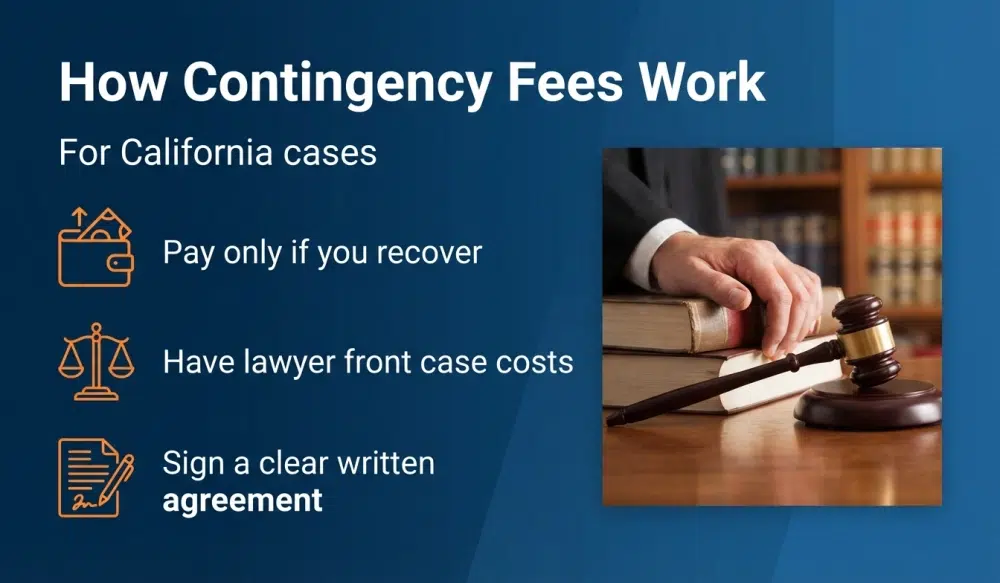
Most California injury cases are handled on a contingency fee. The attorney advances case costs and is paid a fee only if there is a recovery. California regulates fee agreements through the Rules of Professional Conduct, which require that fees be fair and that contingency agreements be in writing with required disclosures. The State Bar publishes the current rules and guidance for the public and attorneys [9]. A clear written agreement will explain the percentage, how costs are deducted, and how any liens will be satisfied from a settlement or judgment. Reputable statewide firms provide fee terms in plain language, review them with you, and welcome questions before you sign. If your case needs filing in another county or federal district in California, fee terms do not change because of courtroom location.
What deadlines apply to California personal injury and wrongful death claims?
California has strict time limits to file a lawsuit. For most personal injury claims, the deadline is two years from the date of injury. The California Courts Self Help Center explains these deadlines in a public facing guide [4]. When a claim involves a California public entity, a government claim must be presented within six months in many cases before any suit can be filed, and failing to present on time can bar the case entirely [5]. Wrongful death claims are statutory and commonly follow the two year period, but specific rules may affect accrual, so counsel reviews facts immediately [6]. Because California is large and clients move, a statewide team tracks deadlines regardless of where the care or accident took place. If there is a chance the case must be filed in federal court due to parties from different states, counsel will still calendar the same primary limitation periods to protect your rights.
How does fault work in California and why does it matter statewide?
California uses pure comparative negligence. If a jury finds a plaintiff 20 percent at fault, the award is reduced by 20 percent but is not barred [1]. This rule applies in every county. By contrast, a distinct doctrine applies to some sports or recreational settings called primary assumption of risk. It limits duty in certain active sports to avoid chilling vigorous participation, but it does not expand beyond its proper contexts. California’s high court clarified in Knight v. Jewett that the key question is the duty owed given the nature of the activity and the parties’ roles [2]. Attorneys serving all of California understand when a defendant may try to recast an ordinary negligence case as a sports case and how to respond. The same is true for product liability, where California’s strict liability doctrine established in Greenman remains foundational for design, manufacturing, and warning defect theories statewide [3].
When do California injury cases move to federal court?
Some California injury cases end up in federal court. That can happen if the parties are from different states and the amount in controversy exceeds the federal threshold or if a federal question is involved. The Administrative Office of the United States Courts explains the federal courts’ role and structure and how they intersect with state courts [9]. A statewide team is comfortable filing in federal court in the proper district or removing or remanding when a case belongs in one system or the other. This is especially common with out of state commercial defendants, multi vehicle chain collisions, or when coordinated national litigation is underway.
How are commercial truck crashes and out of state defendants handled?
Commercial trucking claims require fast action to preserve evidence and a working knowledge of motor carrier regulations. The Federal Motor Carrier Safety Administration publishes national statistics and regulatory information that often inform liability and safety practices [10]. When defendants are from outside California, counsel analyze personal jurisdiction and venue options. If diversity jurisdiction exists, defendants may remove to federal court and seek to transfer between districts. With cross border issues, statewide counsel will also assess choice of law and damages caps, and keep the focus on California law when it applies. Early discovery requests target electronic logging devices, engine control modules, driver schedules, and safety audits. Many clients begin by contacting truck accident lawyers to send litigation hold notices before evidence is altered. Truck accident lawyers in California can then choose the optimal forum and strategy for full compensation.
What do current safety statistics say about risk across California?
California records thousands of serious crashes every year. The California Office of Traffic Safety publishes statewide statistics showing trends in fatalities and serious injuries that vary by county and roadway type [7]. Nationally, the National Highway Traffic Safety Administration reported that in 2022 there were tens of thousands of traffic fatalities, with detailed state level data available for trends by crash type and roadway user [8]. These numbers are not just abstract. They help explain why experienced statewide counsel invest in scene investigation and expert analysis across California’s wide variety of driving environments and why timing matters when evidence can be lost. If your crash involved a rental car, rideshare, or scooter, counsel familiar with statewide insurer networks and municipal permit rules can navigate overlapping coverage and local regulations.
Outside traffic incidents, serious injuries also arise from defective products and unsafe properties. California’s doctrine of strict products liability provides a clear framework for proving a defect and causation without proving negligence, as the state’s high court recognized in Greenman [3]. In the premises context, duty analyses often rely on notice and reasonable measures under the circumstances of each county or city. A statewide practice builds case strategies around these California doctrines and the specific facts of each setting.
Which evidence should you preserve right away in a California claim?
Protecting your claim starts with preserving evidence. In California vehicle crashes, file the required accident report with the Department of Motor Vehicles when thresholds are met. The DMV explains the SR 1 reporting requirement and when it applies [15]. Keep photos and video from the scene, contact information for witnesses, and any communications from insurers. Save medical records and receipts. For commercial vehicles or premises cases, counsel often sends preservation letters to secure logs, surveillance footage, maintenance records, and incident reports. In product cases, do not discard the product or packaging. A statewide firm can coordinate prompt inspection regardless of where the product is located in California. If a government entity may be responsible, contact counsel immediately because of the short presentment period for government claims [5].
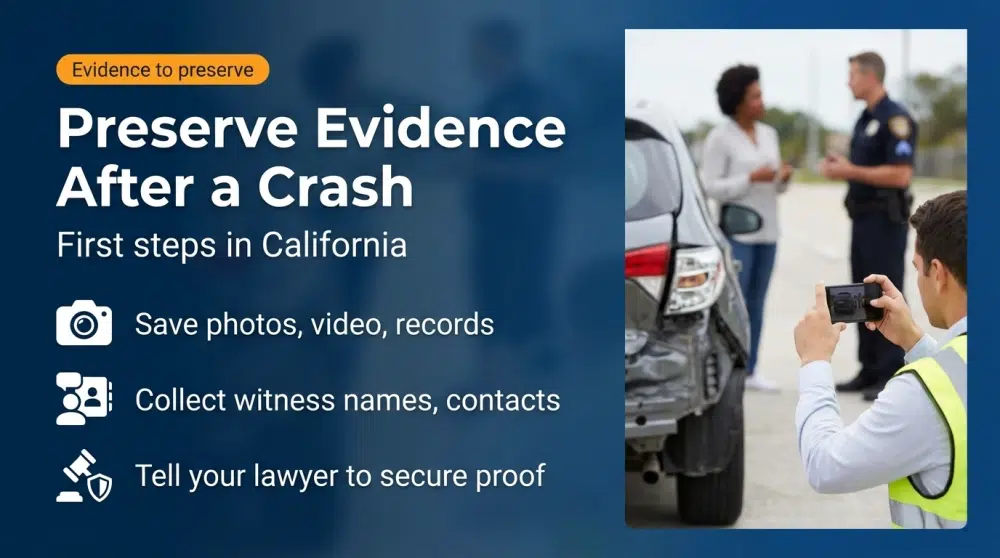
Two more practical steps: write down a timeline while details are fresh, and avoid posting about the incident on social media. Insurers and defendants may monitor public accounts. Share updates directly with your lawyer so your legal strategy remains protected by privilege.
How are wrongful death and minor settlements approved in California?
California law provides a structure for wrongful death and for settlements for minors. For wrongful death, authorized heirs recover for their losses and the estate may have a separate survival claim under California Code of Civil Procedure section 377.60 and related sections [6]. For minors’ claims, settlements typically require court approval to protect the child’s interests, and funds are often placed in restricted accounts. A statewide practice handles approvals in the county where the minor resides or where the case is pending, prepares the required judicial council forms, and appears as needed for hearing. Families appreciate when the same team that knows the liability facts can also guide them through the approval process in a convenient venue.
How do California rules compare with Texas and Illinois?
If your incident involved parties from more than one state or happened while you were traveling, it helps to understand some high level differences.
- Comparative fault. California uses pure comparative negligence so your recovery is reduced by your fault percentage, not barred entirely [1]. Texas uses modified comparative responsibility with a bar at more than fifty percent fault; a plaintiff who is more than fifty percent responsible cannot recover [11]. Illinois uses a similar fifty one percent bar rule [14].
- Time to sue. California’s general personal injury deadline is two years [4]. Texas generally has a two year period for personal injury [12]. Illinois generally provides two years for personal injury as well [13]. Public entity claims may have shorter deadlines in each state, and special rules can apply to medical or professional claims, so counsel must review specifics quickly.
- Products and premises. California’s strict products liability rule is well developed and applies statewide [3]. Other states generally recognize strict products liability but details differ. Premises liability duties also vary in application. A California case with Texas or Illinois connections may still be best filed in a California forum, but counsel will analyze venue and choice of law at the outset.
These differences can influence settlement leverage and trial strategy. A statewide California team is prepared to address opposing counsel’s attempts to invoke other state rules where they do not apply and to litigate efficiently in the correct court.
How does a statewide firm coordinate treatment, liens, and insurance?
After an injury, you may be dealing with health insurance, medical payments coverage, worker compensation, or hospital liens. A firm that serves the entire state maintains relationships with hospital systems, physical therapy providers, and lien administrators across California. They request balances and itemized statements, verify lien notices, and negotiate reductions at the close of a case so more of the net proceeds reach you. The same team manages multiple insurance coverages, including uninsured or underinsured motorist claims, and keeps you updated in plain language. When cases involve multiple defendants in different counties or out of state insurers, statewide counsel takes a lead role in coordinating timelines and policy demands without delay.
Why consider GoSuits for statewide California injury representation?
We focus on civil personal injury and handle claims throughout California. A free consultation helps you understand time limits, evidence priorities, and next steps. We will meet by phone, video, or in person anywhere in the state so you can move forward with clarity.
- Where we practice. We represent clients across California in superior courts statewide and in the United States District Courts located in California. See our practice areas.
- Technology driven approach. Our team uses secure cloud systems, electronic filing, and remote proceedings to move your case efficiently. We built exclusive proprietary software that automates essential litigation workflows for faster, better results while preserving attorney judgment at every step.
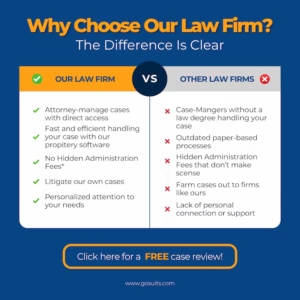
- Attorney access. Although we use technology to expedite your case, every client has a designated attorney. We do not use case managers. You have unfettered access to your lawyer for questions, strategy, and updates.
- Leadership in innovation. We continually improve how discovery, medical records, and damages models are prepared so insurers see the full picture sooner.
- Past results. Our team has secured meaningful recoveries for clients across the state. Review representative outcomes in our prior cases.
- Team and experience. We bring more than 30 years of combined experience to personal injury litigation that includes motor vehicle collisions, trucking, motorcycle, premises liability, product defect, and catastrophic injury. Get to know our attorneys and learn more about us.
- Trial ready. We prepare each case as if it will be tried. That preparation improves settlement discussions and positions your case for court when necessary.
We are here to guide you with clear communication and practical next steps. Explore our full list of practice areas, and reach out when you are ready to talk about your situation.
References and resources
- Li v. Yellow Cab Co. 13 Cal.3d 804 1975 – CourtListener
- Knight v. Jewett 3 Cal.4th 296 1992 – CourtListener
- Greenman v. Yuba Power Products 59 Cal.2d 57 1963 – CourtListener
- Starting a case and time limits to sue in California – California Courts Self Help
- Government Code section 911.2 presentment deadlines – California Legislative Information
- Code of Civil Procedure section 377.60 wrongful death – California Legislative Information
- Traffic safety quick stats for California – Office of Traffic Safety
- Traffic Safety Facts 2022 data summary – National Highway Traffic Safety Administration
- Court role and structure overview – United States Courts
- Large Truck and Bus Crash Facts – Federal Motor Carrier Safety Administration
- Comparative responsibility 33.001 – Texas Civil Practice and Remedies Code
- Limitations period for personal injury 16.003 – Texas Civil Practice and Remedies Code
- Personal actions two year limitation 735 ILCS 5 13 202 – Illinois General Assembly
- Modified comparative negligence 735 ILCS 5 2 1116 – Illinois General Assembly
- SR 1 report of traffic accident occurring in California – California DMV