
- What is a pain journal, and why does it matter in Carrollton TX injury claims?
- What should you record in a Carrollton pain journal template?
- How do you track pain and symptoms day to day?
- What sample template can you use for a car accident injury journal?
- How can a pain journal influence negotiations with insurers in Texas?
- What mistakes should you avoid when you document pain for an insurance claim?
- How do plaintiffs and defendants use pain journals differently?
- How do discovery, authentication, and admissibility work for a pain journal?
- What deadlines in Texas could affect your ability to use a pain journal?
- Who in Carrollton TX benefits most from a car accident injury journal?
- How can you start your Dallas personal injury lawyer pain journal template today?
- Why choose GoSuits in Texas and how technology supports your case?
- References and resources
What is a pain journal, and why does it matter in Carrollton TX injury claims?
A pain journal, also called a pain and suffering journal or injury claim diary template, is a structured daily record of your physical symptoms, emotional challenges, activity limits, medications, treatment, and how injuries affect your work and family life. In a Carrollton, TX, personal injury claim, this record helps you and your attorney show the full impact of injuries beyond medical bills. Texas law permits recovery of noneconomic damages for physical pain, mental anguish, and other harms in appropriate civil cases. A clear, contemporaneous record can help show the severity, frequency, and duration of your symptoms, and how they tie to the crash or incident. Jurors and insurance adjusters often find detailed, timely notes more persuasive than vague generalities.
Civil claims rely on evidence that is credible, consistent, and tied to recognized legal standards. Rules of evidence often allow a diary to be used to refresh your memory and may permit certain entries to be considered for their truth under limited exceptions. The Federal Rules of Evidence recognize exceptions for present sense impressions, then existing physical condition, and statements for medical diagnosis or treatment, and Texas has parallel rules that courts apply in state cases [2] [1]. If you start early and write regularly, your Carrollton, TX, pain journal can support settlement talks and help your testimony remain clear and steady if your case goes to trial [7].
Local context matters. Carrollton sits within Dallas, Denton, and Collin Counties, and collisions are common in the Dallas Fort Worth area. NHTSA data show that Texas consistently has large numbers of traffic injuries each year, which explains why thorough documentation often influences outcomes in motor vehicle cases [6]. Whether you work with Carrollton car acciDallas-Fortdent lawyers or other counsel, they will want timely, concrete records to present your story effectively.
How does a pain and suffering journal help prove noneconomic damages?
A well-kept journal anchors your descriptions of pain with dates, times, and activities. That level of detail helps your care providers understand your symptoms, and helps your legal team relate your lived experience to recognized damages categories. When you note that you could not lift your child on Monday, missed a physical therapy session on Wednesday due to migraine intensity, and slept in a recliner on Friday to reduce back pain, those entries paint a day-by-day picture of loss and limitation. Your treating provider may rely on your notes when forming opinions, and entries made for diagnosis or treatment can align with recognized hearsay exceptions in many courts [2].
Which Texas and federal rules affect how journals are used in court?
Texas judges look to the Texas Rules of Evidence and Texas Rules of Civil Procedure for admissibility and discovery. Key concepts often include the scope of discovery, the use of writings to refresh memory, authentication, and potential hearsay exceptions. Comparable federal rules provide similar guidance and are frequently consulted for structure and analysis [1] [2] [3] [4]. In short, the journal may be discoverable and, with proper foundation, entries can support testimony or be used to refresh your recollection.
What should you record in a Carrollton pain journal template?
Use consistent headings and short entries. Write clearly, like you are explaining to a trusted doctor. Include the following fields and keep your tone factual.

- Date and time Record when pain starts, peaks, and subsides.
- Location and type of pain Neck, lower back, knee, shoulder, headache, burning, throbbing, stabbing, aching.
- Intensity Use a 0 to 10 numeric rating scale, where 0 is no pain and 10 is the worst pain imaginable, which is widely used in clinical practice [9].
- Duration and frequency Minutes, hours, all day, intermittent, constant.
- Triggers and relievers Lifting, standing, stairs, sitting, driving, applying heat, ice, medications, rest, stretching, therapy.
- Functional limits Could not drive more than 20 minutes, needed help with groceries, missed a workout, woke up at night, could not focus during a meeting.
- Work and school impacts Time missed, modified duties, productivity loss, meetings rescheduled, tasks offloaded to coworkers.
- Activities of daily living Bathing, dressing, chores, yard work, cooking, childcare, pet care, hobbies, social events.
- Emotional effects Anxiety, irritability, sleep issues, fear of driving, sadness, loss of enjoyment. Keep statements brief and tied to events.
- Treatment and medication Names, dosages, side effects, therapy sessions, home exercises, assistive devices, referrals.
- Doctor visits Date, provider, key recommendations, upcoming tests, imaging, referrals.
- Photos or attachments If appropriate, note where photos of bruising, swelling, or braces are saved.
Each entry should be practical, specific, and honest. Avoid exaggeration. Write soon after events, so entries are more likely to be accurate, which aligns with how courts evaluate reliability [2].
How do you track pain and symptoms day to day?
Pick a method you will actually use. Your consistency matters more than the format.
- Paper notebook A dated notebook is simple and dependable. Number the pages, and do not tear out pages. If you make a mistake, draw a single line through it, and initial the correction.
- Digital document Use a private document with automatic time stamps. Save versions, and back up to secure cloud storage.
- Calendar based log Make short daily entries, and link to longer notes, if needed.
- Symptom tracker app Some people benefit from reminders. If you use an app, take periodic screenshots, so you can preserve the data if the app changes or stops working.
No matter the method, aim for short entries twice daily during the first weeks, then at least three to five times weekly as you stabilize. Bring your journal to medical visits, so your provider can address patterns and document them in medical records that may fit within recognized exceptions for statements made for diagnosis or treatment [2].
What sample template can you use for a car accident injury journal?
Below is a practical injury claim diary template you can copy. Tailor the fields to your situation, and the guidance of your legal counsel. This layout also works for slip and fall incidents, product injuries, and construction site injuries in Carrollton, TX.

What does a daily entry look like?
- Date Monday, April 8
- Time of entry 8:00 pm
- Main symptom Lower back pain, aching with sharp spikes when standing
- Intensity 7 morning, 5 afternoon, 6 evening (0 to 10 scale) [9]
- Duration Constant all day, flares every hour for several minutes
- Triggers Sitting more than 15 minutes, carrying laptop bag
- Relief Heat pack, stretching 10 minutes, ibuprofen 400 mg at 2:00 pm
- Function Needed help lifting toddler, skipped grocery store, could not finish laundry
- Work impact Missed 2 hours due to a doctor visit, worked from home
- Emotional Frustrated, felt anxious about freeway driving
- Treatment Physical therapy at 10:30 am, therapist added hamstring stretch
- Next steps MRI scheduled Thursday, bring journal to appointment
What weekly summary should you add?
- Best and worst days Note the causes
- Average intensity Record rough average for the week
- Activity limits Driving, sitting, lifting, sleep
- Medication changes New side effects, dosage changes
- Goals for next week Walk 10 minutes daily, complete home exercises, attend therapy
What sections help your lawyer and doctors quickly find key facts?
- Accident overview One page summary of the incident, date, location, and immediate symptoms
- Provider list Names, specialties, addresses, and visit dates
- Work history Employer, job title, regular duties, and any restrictions
- Activity checklist Driving, sitting, standing, walking, stairs, lifting, sleep, household chores, sports, social activities
- Medication chart Name, dosage, frequency, side effects, start and stop dates
How can a pain journal influence negotiations with insurers in Texas?
Insurance adjusters analyze objective records, medical notes, imaging, bills, and wage data. A detailed journal adds context and helps connect the dots. When an adjuster argues that treatment gaps suggest recovery, your entries may show that you could not attend therapy due to a documented spike in symptoms, or a doctor planned a rest period. The journal can also demonstrate how flare ups limit your work schedule, household tasks, and recreation, which supports noneconomic damages. Consumer facing materials from Texas regulators emphasize documentation and careful record keeping during claims and disputes [14].
Negotiations still depend on medical evidence, witness testimony, liability proof, and Texas law on damages. A journal does not replace medical records, but it can complement them and strengthen your narrative during settlement talks and mediation.
What do Texas insurers typically request and how should you prepare?
- Medical records and bills Your providers will supply these with your consent. Keep your journal consistent with what you tell your doctors, since providers may rely on your reports for diagnosis or treatment [2].
- Proof of wage loss Keep pay stubs, time sheets, and employer correspondence. Note in your journal when pain caused missed time or reduced duties.
- Photographs and repair receipts Maintain a simple index in your journal, so you can locate items quickly.
- Prior injuries or conditions Be candid and distinguish old symptoms from new ones. Use your journal to explain differences in location, intensity, and activity limits.
What mistakes should you avoid when you document pain for an insurance claim?
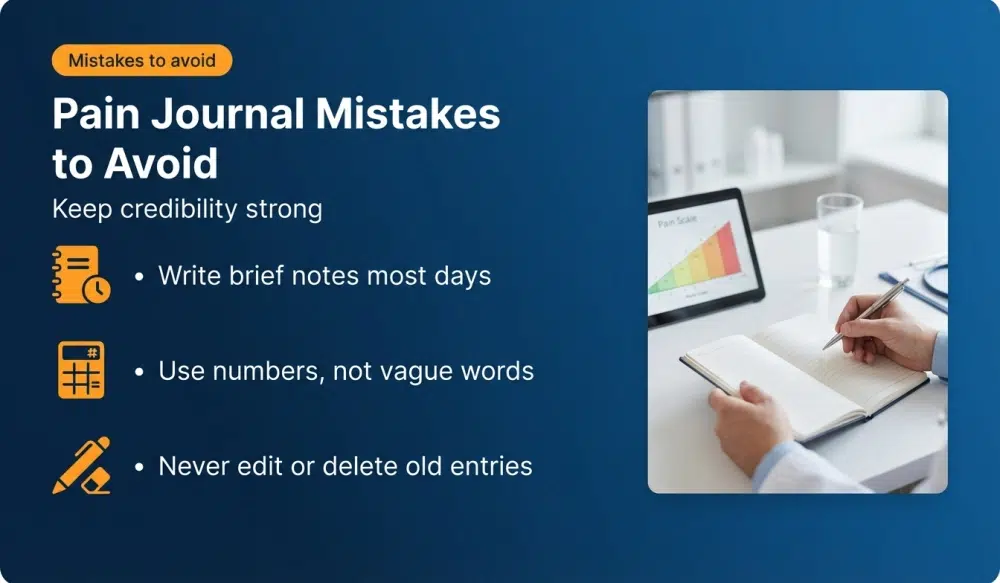
- Writing only on good or bad days Inconsistent entries undercut credibility. Aim for brief notes most days.
- Using vague terms Words like “hurts a lot” help less than clear descriptions and numbers. Use a 0 to 10 scale and concrete examples [9].
- Exaggerating or speculating Stick to facts about your body and activities. Avoid assigning blame or legal conclusions in the journal.
- Editing old entries Do not delete or rewrite. If needed, add a dated clarification.
- Posting on social media instead of private journaling Public posts can be taken out of context during litigation.
- Ignoring privacy Discuss with your attorney how to protect sensitive information. HIPAA protects your health information in the hands of covered entities, but it does not make litigation records automatically private [10].

How do plaintiffs and defendants use pain journals differently?
Plaintiffs use journals to track symptoms for treatment, to refresh memory, and to show daily effects of injuries. They highlight consistent entries recorded close in time to the events and corroborated by medical notes. Plaintiffs may point to entries made for diagnosis or treatment, and argue they match recognized exceptions and are therefore reliable [2].
Defendants evaluate journals for internal inconsistencies, gaps, or statements that contradict medical records, surveillance, or employment data. They may argue certain entries are hearsay outside any exception, or challenge authentication if the entries lack reliable time stamps or appear altered [13]. Defendants may also use discovery to obtain the journal and related materials [4].
How do discovery, authentication, and admissibility work for a pain journal?
Can the other side get your journal in discovery in Texas?
Discovery rules in Texas provide broad access to relevant, nonprivileged information, including documents and tangible things, that are relevant to the subject matter of the case. A pain journal about accident-related symptoms is usually discoverable if requested. Consult the Texas Rules of Civil Procedure for the scope of discovery and obligations to preserve and produce responsive materials [4]. Separate federal guidance reflects similar principles for cases in federal court [15].
How do you authenticate a pain journal if you need to use it in court?
Authentication generally requires evidence sufficient to support a finding that the item is what the proponent claims it is. For a journal, this can come from your testimony about when, why, and how you wrote entries, along with identifiers like initials, page numbering, time stamps, and metadata for digital files. The Federal Rules of Evidence provide a useful template for authentication, and Texas follows comparable concepts [13] [1].
Can a journal be used to refresh your memory at deposition or trial?
Yes. Courts permit writings to refresh a witness’s memory. If your recollection is incomplete, the lawyer may ask if reviewing your own notes would help. After you review the writing, you testify from refreshed memory, not by reading the entry aloud. Depending on jurisdiction, the opposing party may be entitled to see the writing used to refresh memory, and to use it in cross-examination [3] [1].
What hearsay exceptions might apply to entries in a pain journal?
- Present sense impression and then existing physical condition Statements describing your condition or pain, made close in time, may fall within exceptions recognized in the evidence rules [2].
- Statements for medical diagnosis or treatment Entries made to obtain medical care, and reasonably pertinent to diagnosis or treatment, may qualify under recognized exceptions [2].
- Recorded recollection If you made an accurate record when the event was fresh, and cannot fully recall it later, a court may allow the record to be read into evidence under specific conditions [2].
Admissibility is fact specific. Even if an entry itself is not admitted, a journal can still help structure reliable testimony and support medical opinions.
Could spoliation issues arise if a journal is lost or altered?
Spoliation disputes can be significant. Texas courts have addressed when and how juries may hear about destroyed or missing evidence, and what remedies are appropriate. Proper preservation of evidence helps avoid litigation about sanctions or instructions [12]. Keep back ups of digital journals and retain originals of paper notebooks.
What deadlines in Texas could affect your ability to use a pain journal?
Texas has a general two-year statute of limitations for many personal injury claims, measured from the date the cause of action accrues. Failing to file in time can bar the claim. Timely journaling helps your attorney evaluate damages and build the case well before the deadline. Confirm the specific deadline for your situation in the Texas Civil Practice and Remedies Code, and speak with a lawyer promptly after an injury [5].
Who in Carrollton TX benefits most from a car accident injury journal?
A pain and suffering journal is helpful in many types of civil injury claims in Dallas, TX, and surrounding areas of Dallas County, Denton County, and Collin County. Examples include the following.
- Motor vehicle collisions People working with Dallas car accident lawyers often rely on journals to demonstrate how neck and back injuries affect driving, work, and family routines.
- Commercial vehicle crashes Those working with Dallas truck accident lawyers can show how long haul commutes, medical appointments, and therapy sessions reduce time at work and home.
- Motorcycle incidents Riders represented by Dallas motorcycle accident lawyers often document weather sensitivity, road vibration, and helmet related headache patterns.
- Falls on unsafe property Clients who connect with Dallas slip and fall lawyers frequently track swelling, bruising, balance issues, and fear of stairs or uneven surfaces.
- Construction site injuries People guided by Dallas construction accident lawyers may chart restrictions on lifting, climbing, and tool use, and how those limits affect overtime and job assignments.
- Head injuries Families working with Dallas brain injury lawyers can capture headaches, light sensitivity, memory problems, mood changes, and how school or work accommodations evolve over time.
- Defective product injuries Consumers supported by Dallas product liability lawyers can record symptom onset timing, consistent with product use, and any recall or repair history.
In all of these situations, Dallas personal injury lawyers encourage prompt, accurate journaling, because consistency supports both treatment and case evaluation [7].

How can you start your Dallas personal injury lawyer pain journal template today?
Use this quick start plan to begin a Dallas personal injury lawyer pain journal template that fits your case.
- Choose your format Paper or digital. If digital, set auto save and cloud back up. If paper, number each page.
- Set reminders Morning and evening for the first month, then three to five times weekly.
- Use consistent headings Date, time, location, intensity, duration, triggers, relief, function, work, emotional, treatment.
- Link to medical care Bring the journal to every appointment. Ask your provider to note key patterns in your chart, when relevant [2].
- Preserve versions Save read only copies weekly, and store them securely.
- Keep privacy in mind Limit access, and avoid sharing entries publicly.
- Coordinate with your lawyer Ask how to produce needed pages for discovery while keeping unrelated, private entries confidential, within the rules [4].
Why choose GoSuits in Texas and how technology supports your case?
Injury victims in Carrollton, TX, face immediate medical and financial pressures. A clear pain journal can help your legal team tell your full story. A free consultation with a personal injury attorney gives you space to ask questions, review timelines, and learn how documentation like a journal fits into your case plan. GoSuits represents clients across Texas, including Carrollton, Dallas County, Denton County, and Collin County. We use a technology driven approach, supported by exclusive proprietary software, built to move cases faster while maintaining quality and accuracy. Our leadership in innovation means you get clear communication, secure document sharing, and data backed case preparation from day one.
Even with advanced tools, every client has a designated attorney. We do not use case managers, and every client has direct access to their lawyer for strategy updates and questions. Our team brings more than 30 years of combined experience, including substantial trial work that helps us value cases realistically and prepare for the courtroom when necessary. You can review a selection of past results and case summaries here prior cases. Learn about the lawyers who will stand with you here our attorneys. Explore how we work and what drives us here about us. For a full list of the matters we handle, including motor vehicle collisions, unsafe property injuries, product injuries, and more, visit practice areas.
References and resources
- Texas Rules of Evidence – Texas State Law Library
- Rule 803 Hearsay Exceptions – Cornell Law School Legal Information Institute
- Rule 612 Writing Used to Refresh a Witness – Cornell Law School Legal Information Institute
- Texas Rules of Civil Procedure – Texas State Law Library
- Section 16.003 Limitations – Texas Statutes
- State Traffic Safety Information Texas – National Highway Traffic Safety Administration
- Civil Cases – United States Courts
- Prevalence of Chronic Pain and High Impact Chronic Pain – Centers for Disease Control and Prevention
- Pain Assessment – NCBI Bookshelf National Center for Biotechnology Information
- HIPAA for Individuals – U.S. Department of Health and Human Services
- Publication 4345 Settlements Taxability – Internal Revenue Service
- Brookshire Brothers Ltd v Aldridge – CourtListener
- Rule 901 Authenticating or Identifying Evidence – Cornell Law School Legal Information Institute
- Auto Insurance Help – Texas Department of Insurance
- Rule 26 Duty to Disclose General Provisions Governing Discovery – Cornell Law School Legal Information Institute