- What changed in Texas law for 2026?
- How do Texas immigration measures interact with federal law in 2026?
- What tax changes should Texas households and businesses watch in 2026?
- How might AI related laws and standards affect Texans in 2026?
- What new public safety and consumer privacy rules matter in 2026?
- How do 2026 laws affect personal injury cases in Texas?
- What steps can you take now to prepare for 2026 compliance and claims?
- How should plaintiffs and defendants approach evidence and liability under new rules?
- What are common real world scenarios Texans ask about for 2026?
- Who is GoSuits and how can we help?
- References and Resources
What changed in Texas law for 2026?
As of January 1, 2026, Texas has implemented a significant package of legislation that reshapes how the state handles everything from border enforcement to emerging technology. Passed during the last legislative session, these measures prioritize public safety protocols, economic incentives for small business owners, and the regulation of artificial intelligence in government.
Here is a breakdown of the key statutes now effective in the Lone Star State and how they impact residents, landlords, and state agencies.

How does Senate Bill 8 change the relationship between county jails and ICE?
One of the most notable public safety measures for 2026 is Senate Bill 8 (SB 8), which mandates stricter cooperation between local law enforcement and federal immigration officials.
Under this new requirement, Texas sheriffs operating county jails must participate in the 287(g) program, a formal partnership with U.S. Immigration and Customs Enforcement (ICE). This agreement authorizes trained sheriff’s deputies to perform specific federal immigration enforcement tasks within the jail system, such as verifying the immigration status of detainees.
Proponents of SB 8 argue that it closes gaps between state and federal jurisdiction, ensuring a unified approach to enforcement. However, critics have raised concerns that the mandate imposes new financial and administrative burdens on local departments while potentially straining community relations. The law applies to almost every county in Texas that maintains a jail facility.
What tax relief is available for small businesses under House Bill 9?
To support the local economy, lawmakers passed House Bill 9 (HB 9), which specifically targets the tax burden on business inventory.
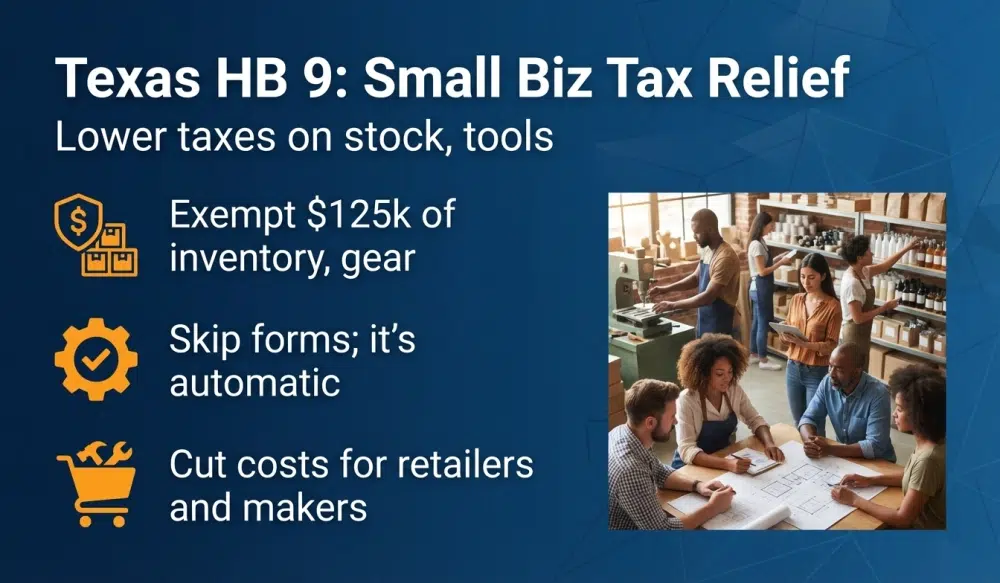
Effective immediately, this law expands the property tax exemption for “business personal property.” Business owners can now exempt up to $125,000 of the value of their inventory and equipment from local property taxation.
This measure is designed to lower operating overhead for retailers, manufacturers, and other small enterprises that rely heavily on physical stock. A key benefit of HB 9 is its ease of access: the exemption is automatic, meaning qualifying business owners do not need to file additional paperwork to trigger the savings.

How will Senate Bill 38 speed up evictions for squatters?
Property rights and housing disputes are the focus of Senate Bill 38 (SB 38), which aims to expedite the legal removal of squatters, or individuals occupying a home or rental unit without the owner’s consent.
Previously, landlords often faced lengthy court delays even when dealing with unauthorized occupants. SB 38 shortens the statutory timeline for courts to process eviction cases specifically related to unlawful occupancy. While property owners must still provide proper notice before filing suit, the law reduces the waiting period between filing and a court’s final ruling.
Legislators positioned this bill as a necessary protection for homeowners losing control of their property, though tenant advocacy groups have expressed concern that expedited timelines could compromise due process in complex housing disputes.
What new regulations does House Bill 149 apply to Artificial Intelligence?
Recognizing the rapid integration of technology in the public sector, Texas has enacted House Bill 149 (HB 149) to place guardrails around the use of Artificial Intelligence (AI).
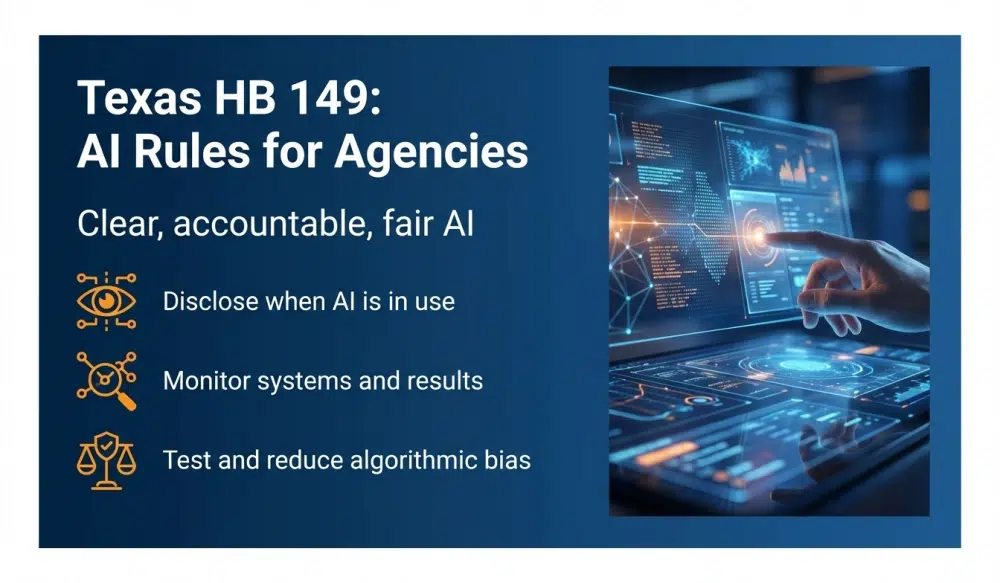
This law introduces a regulatory framework for state agencies and government contractors that utilize AI systems for decision-making, data analysis, or administrative tasks. The statute focuses on three core pillars:
-
Transparency: Agencies must be open about when and how AI is being utilized.
-
Accountability: There must be oversight mechanisms to monitor AI performance.
-
Bias Reduction: Standards are set to prevent algorithmic bias in government services.
By codifying these standards, supporters believe Texas can foster technological innovation while preventing the unchecked use of automated systems in sensitive public matters.
Who is GoSuits and how can we help?
We focus on helping injured Texans and families navigate civil claims with clarity and care. If you have questions about how 2026 laws might intersect with your potential claim or defense, a free consultation can help you understand your options and the steps that protect your rights. We practice across Texas and handle cases statewide.
- Technology driven approach GoSuits uses exclusive proprietary software to gather evidence faster, organize records, and model damages timelines. This helps you move from confusion to a clear plan without delay.
- Designated attorneys for every client Even though we use advanced technology to expedite your case, you will work directly with a designated attorney. We do not assign case managers to run your case. You will have open access to your lawyer for questions and strategy updates.
- Proven results Our track record includes recoveries for clients across Texas in cases involving serious roadway injuries, unsafe premises, and defective products. See a sample of our work on our page for prior cases.
- Leadership in innovation We continually refine our litigation toolkit with secure evidence capture, timeline engines, and analytics that help present complex facts to juries in ways they can trust.
- Experience that matters Our team brings 30 years of combined experience and trial readiness. That courtroom background benefits settlement talks and trial presentation alike.
- Practice areas We represent clients in motor vehicle collisions, including truck accident and motorcycle cases, severe injury claims, product defect matters, premises liability, and wrongful death. Learn more about our practice areas and meet our attorneys. For firm values and history, see about us.
If you or a loved one was hurt, or if you face a claim as a Texas business, we welcome the chance to talk through what comes next and how to prepare for 2026 developments with confidence.

References and Resources
- Texas Constitution Article 3 Section 39 Effective Dates – Texas Constitution and Statutes
- Property Tax in Texas Overview – Texas Comptroller of Public Accounts
- Franchise Tax Overview and Rates – Texas Comptroller of Public Accounts
- IRS Form 1099 K Threshold Updates – Internal Revenue Service
- Arizona v. United States Summary – Legal Information Institute
- Form I 9 Central – U.S. Citizenship and Immigration Services
- Immigrant and Employee Rights Section – U.S. Department of Justice
- AI Risk Management Framework – National Institute of Standards and Technology
- AI Marketing Claims Guidance – Federal Trade Commission
- Texas Data Privacy and Security Act – Office of the Texas Attorney General
- Crash Facts 2022 Texas – Texas Department of Transportation
- Rule 901 Authenticating Evidence – Legal Information Institute
- Rule 26 Duty to Disclose General Provisions Governing Discovery – Legal Information Institute