- What new California laws take effect on January 1, 2026?
- How do the 2026 workplace and wage updates affect California workers and employers?
- What consumer protection measures begin in 2026?
- Which health and wellness laws take effect in January 2026?
- What artificial intelligence regulations start in 2026?
- How do 2026 housing and rental laws protect tenants?
- What criminal justice and public safety changes occur in 2026?
- Which environmental and animal protection laws begin in 2026?
- What election process reforms take effect for 2026?
- How do education laws change in 2026?
- What cultural recognition and accessibility updates occur in 2026?
- Which laws take effect later in 2026?
- How should individuals and businesses prepare for these 2026 legal changes?
- References and resources
What new California laws take effect on January 1, 2026?
California approved nearly 800 new laws during the 2025 legislative session, with the majority scheduled to activate on January 1, 2026 [1]. These measures touch nearly every aspect of daily life, from the wages you earn to the insulin you purchase, from the safety of your personal data to the protection of marine wildlife along the coast. Understanding these changes now helps you comply, plan, and protect your rights as the new year begins.
The scope of these 2026 laws is broad. Workers will see higher minimum wages and expanded leave protections [2]. Consumers gain stronger privacy rights and refund guarantees for undelivered purchases. Renters receive new appliance guarantees from landlords [4]. Healthcare patients benefit from capped insulin costs and expanded privacy protections [3]. Businesses face new disclosure requirements for artificial intelligence use and climate impacts. Election officials must accelerate vote counting and ballot processing. Schools gain resources to combat discrimination. Animal welfare advances through protections for whales and cats. Even California’s official symbols expand with a new state snake and shrub.
For residents, employers, landlords, healthcare providers, technology companies, and government agencies, these laws reshape obligations and opportunities. This guide walks through each major category, explaining what changes, when it happens, and what you need to do.
What is the new minimum wage in California for 2026?
Under Senate Bill 3, California’s statewide minimum wage increases to $16.90 per hour on January 1, 2026, adjusted for inflation [2]. The salary threshold for exempt workers rises to $70,304 annually. Local minimum wages in cities like San Francisco and Los Angeles may be higher, and specialized industries such as fast food and healthcare maintain their own elevated wage schedules [6]. Workers and employers should verify the applicable rate for their location and industry to ensure compliance with payroll obligations [15].
How do new tip theft enforcement rules protect workers in 2026?
Senate Bill 648 empowers the California Labor Commissioner to investigate, cite, and pursue civil action against employers who unlawfully take tips from employees [1]. Previously, enforcement relied heavily on individual worker complaints and private lawsuits. This change gives the state direct authority to pursue violations, providing an additional layer of protection for restaurant servers, bartenders, delivery drivers, and other tipped workers. Employers should audit tip pooling and distribution practices before January to avoid penalties.
What expanded leave rights do crime victims gain in 2026?
Assembly Bill 406 allows workers to use paid sick leave and certain types of unpaid leave if they or a family member become victims of crime and need to attend judicial proceedings [5]. This expands the circumstances under which protected leave applies, covering court appearances related to criminal cases. Workers no longer face the choice between participating in justice proceedings and losing income or risking termination. Employers must update leave policies and train managers on these new grounds for absence.
Are training repayment agreements still allowed in California after 2026?
Assembly Bill 692 bans new employment contracts that require workers to repay training costs or pay penalty fees if they quit before a specified time, commonly called stay or pay agreements [1]. The prohibition takes effect January 1, with limited exceptions. Employers that previously used these contracts to recoup training investments must redesign retention strategies. Workers hired after the effective date cannot be bound by such terms, though contracts signed before January 1 may remain enforceable under their original terms.
What pay transparency requirements apply to hiring in 2026?
Senate Bill 642 requires employers to provide a good faith pay scale or range when offering a position to a new hire [1]. This builds on California’s existing pay transparency framework, ensuring that applicants and employees have clear information to evaluate compensation fairness and negotiate effectively. Employers should prepare standardized pay ranges for each role and train hiring managers to communicate ranges during recruitment and offer discussions.
What notice obligations apply to mass layoffs starting in 2026?
Senate Bill 617 adds requirements for employers ordering mass layoffs [1]. In addition to existing notice duties, employers must now provide written information about services available through local workforce development boards and details on CalFresh food assistance eligibility. These additions help displaced workers access public resources quickly. Employers planning significant workforce reductions should coordinate with HR and legal counsel to satisfy all notice elements and avoid penalties.
How does bias training change under new 2026 protections?
Senate Bill 303 protects employees who acknowledge their own personal biases in good faith during employer sponsored bias mitigation training [1]. The law clarifies that such admissions do not constitute unlawful discrimination. This encourages honest participation in training programs without fear of retaliation or liability. Employers should update training materials and facilitator guidance to reflect this protection and create a safer environment for open dialogue about bias and inclusion.
What streamlined processes help small restaurants expand in 2026?
Assembly Bill 671 creates a faster approval process for small restaurants retrofitting existing commercial spaces [1]. Local planning departments must offer streamlined reviews for qualifying projects, reducing delays and costs for entrepreneurs. Restaurants that need to adapt older buildings for food service can move through permitting more efficiently, supporting economic growth in the hospitality sector.
Can restaurants continue outdoor dining setups from the pandemic era?
Assembly Bill 592 allows restaurants to maintain outdoor dining areas that originated during COVID-19 restrictions [1]. The law also permits open windows and folding doors for restaurants with open kitchens, expanding design flexibility. This makes permanent the temporary measures that helped restaurants survive the pandemic and that many communities now value as enhancements to street life and outdoor activity.
Do used car buyers gain return rights in 2026?
Senate Bill 766 allows purchasers or lessees of used cars to return the vehicle within three days of the transaction [1]. Dealers must also provide specific disclosures about the vehicle’s condition, history, and terms. This law takes effect on October 1, 2026, giving consumers a cooling off period and more information to make informed decisions. Buyers should review all disclosures carefully and act within the three day window if they identify problems or reconsider the purchase.
What refund rights do food delivery app users gain in 2026?
Assembly Bill 578 requires food delivery platforms to refund customers for undelivered items [9]. Customers can also adjust tips if service falls short of expectations. Platforms must clearly disclose the cost of food, all fees, and tip amounts before the order is completed. These rules address common frustrations with third party delivery and make pricing more transparent. Consumers should review itemized charges and request refunds promptly if deliveries fail to arrive.
What limits apply to credit union overdraft fees in 2026?
Senate Bill 1075, approved in 2024, takes effect on January 1, 2026 [1]. It caps overdraft fees charged by credit unions at $14 per transaction. This reduces the financial burden on account holders who occasionally overdraw and brings credit union practices more in line with evolving consumer protection standards. Credit union members should verify their account agreements reflect the new cap.
What disclosures must self storage facilities provide starting in 2026?
Senate Bill 709 requires self storage rental agreements to disclose whether the advertised rental fee is a promotional or discounted rate and to state the maximum fee the facility can charge during the first year [5]. This prevents surprise rate increases that some customers experienced after signing contracts with introductory pricing. Renters should compare total first year costs, not just initial monthly rates, when choosing a storage provider.
How quickly must companies notify consumers of data breaches in 2026?
Senate Bill 446 requires businesses to notify affected individuals of data breaches within 30 calendar days of discovering or being notified of the breach [1]. Limited exceptions exist for law enforcement investigations. The tighter timeline pushes companies to detect breaches faster, investigate promptly, and communicate with consumers quickly so they can protect themselves from identity theft and fraud. Consumers should monitor accounts closely after receiving breach notices and consider credit freezes or monitoring services when warranted.

Which health and wellness laws take effect in January 2026?
What insulin cost protections begin in 2026?
Senate Bill 40 caps insulin co-payments at $35 for a 30 day supply for individuals covered by large group health plans [3]. Additionally, California launches CalRx, a state branded insulin line sold at pharmacies for $11 per pen or a maximum of $55 for a five pack [7]. These measures make insulin affordable for Californians with diabetes, reducing financial barriers to essential medication. Patients should ask their pharmacists about CalRx products and verify their insurance plan’s co-pay structure for covered insulin.
What privacy protections expand for gender affirming care in 2026?
Assembly Bill 82 strengthens privacy protections for individuals receiving gender affirming healthcare [1]. The law limits disclosures and unauthorized sharing of medical information related to these services, safeguarding patients from discrimination and harassment. Healthcare providers must update data handling practices, and patients can feel more secure that their treatment information remains confidential.
How do hemp product regulations change in 2026?
Assembly Bill 8 bans industrial hemp extracts from being added to food, food additives, beverages, or dietary supplements unless the extract achieves purity greater than 99 percent and contains no tetrahydrocannabinols or synthetic cannabinoids [1]. This crackdown targets intoxicating hemp products that bypass cannabis regulations. Manufacturers must reformulate products, and consumers should verify labels and sources to avoid non compliant items.
What nutrition change applies to corn tortillas in 2026?
Assembly Bill 1830, passed in 2024, requires most commercially sold corn tortillas and corn masa products to be fortified with folic acid starting in 2026 [9]. The mandate aims to reduce neural tube defects such as spina bifida in newborns. Small businesses that produce these items are exempt. Consumers buying tortillas at grocery stores will benefit from added nutrition without changing their shopping habits.
What artificial intelligence regulations start in 2026?

What safety reporting must large AI companies provide in 2026?
Senate Bill 53 requires the largest artificial intelligence companies to publicly disclose their safety and security protocols, report critical safety incidents to the California Office of Emergency Services, and strengthen protections for employees who speak out about safety concerns as whistleblowers [1]. This law brings transparency to an industry developing powerful technologies with significant societal impacts. Companies must document procedures, train staff on incident reporting, and prepare public disclosures.
What penalties apply to providers of deepfake pornography in 2026?
Assembly Bill 621 imposes fines on individuals and platforms that provide or distribute deepfake pornography, which uses artificial intelligence to create fake explicit images or videos of real people without consent [1]. This addresses a growing harm enabled by accessible AI tools. Victims gain a legal mechanism to seek accountability, and platforms must monitor content and remove violations promptly.
When must law enforcement disclose AI use in police reports?
Senate Bill 524 requires law enforcement agencies to disclose when artificial intelligence tools are used to generate or assist in creating police reports [1]. This transparency requirement helps courts, defense attorneys, and the public understand how technology influences policing and evidence. Departments must update reporting templates and train officers on documentation requirements.
What restrictions apply to AI medical advice in 2026?
Assembly Bill 489 prohibits generative artificial intelligence products from falsely implying that advice or care recommendations come from a person holding a healthcare license or certificate [1]. The law prevents consumer confusion and ensures people understand when they are interacting with automated systems rather than licensed professionals. Developers must add clear disclaimers, and consumers should verify the source of medical guidance before relying on it.
How do 2026 housing and rental laws protect tenants?
Must landlords provide stoves and refrigerators starting in 2026?
Assembly Bill 628 requires landlords to provide working stoves and refrigerators as part of lease agreements beginning January 1, 2026 [4]. Landlords must also repair or replace these appliances if they are subject to safety recalls. Tenants and landlords can mutually agree to allow the tenant to provide and maintain their own refrigerator. This ensures basic habitability standards in rental units and prevents disputes over essential appliances. Landlords should inspect appliances before leases begin and respond promptly to repair requests. Tenants can withhold rent or pursue remedies if landlords fail to comply.
What criminal justice and public safety changes occur in 2026?
What penalties now apply for purchasing sex from minors?
Assembly Bill 379 makes it a felony for adults to purchase sex from 16 and 17 year olds [5]. The law also reinstates loitering with intent to purchase sex as a misdemeanor crime in California. These changes strengthen protections for minors vulnerable to exploitation and provide law enforcement with additional tools to prosecute offenders and deter illegal conduct.
Do adult sexual assault survivors gain more time to file lawsuits in 2026?
Assembly Bill 250 temporarily waives statutes of limitations for adult victims of sexual assault to file civil lawsuits if they allege a cover up [5]. The waiver applies from January 1, 2026, through December 31, 2027, and exempts public entities. This provides survivors with an opportunity to seek accountability and compensation when institutions concealed abuse. Survivors should consult attorneys to evaluate claims and meet the two year window.

What identification must law enforcement officers display in 2026?
Senate Bill 805 requires law enforcement officers operating in California to visibly display their agency name and either their name or badge number when interacting with the public [5]. Exceptions apply for undercover operations and specific circumstances. This promotes transparency and accountability, helping the public identify officers and file complaints or commendations when appropriate.
How do new laws protect blue whales in 2026?
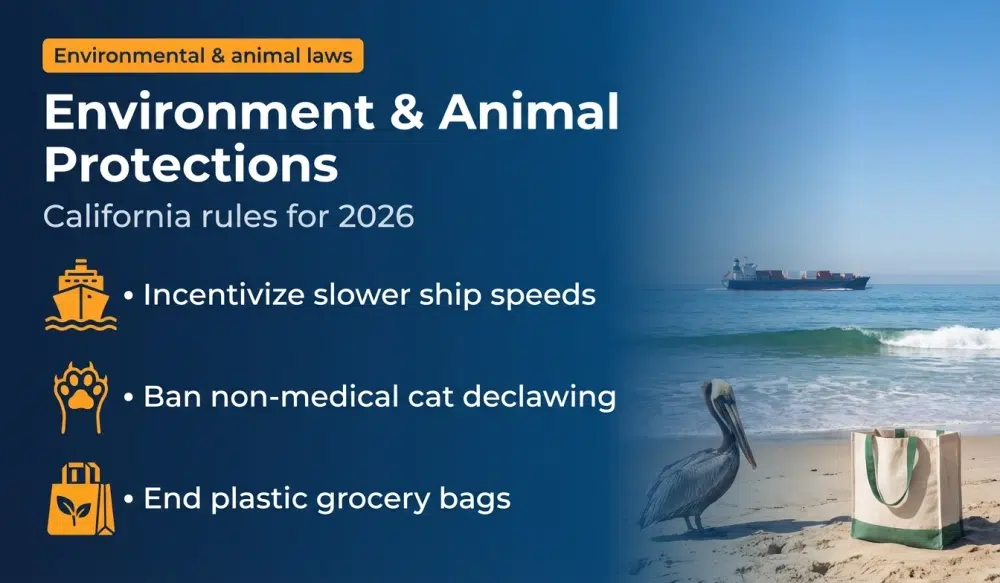
Assembly Bill 14 creates incentives for shipping companies to voluntarily reduce vessel speeds along the California coast [1]. Slower speeds reduce the risk of fatal ship strikes on blue whales and other marine mammals while also decreasing air pollution and noise. Companies that participate may receive recognition or other benefits, encouraging industry cooperation with conservation goals.
Is cat declawing banned in California starting 2026?
Assembly Bill 867 prohibits cat owners and veterinarians from declawing cats except for medical necessity [4]. Declawing is considered inhumane by many animal welfare advocates because it involves amputating the last bone of each toe. The law protects cats from unnecessary pain and encourages owners to use alternative methods such as scratching posts and nail caps to manage scratching behavior.
What plastic bag rules change in 2026?
Senate Bill 1053 bans grocery stores from providing any plastic shopping bags to customers, closing a loophole in a previous law that allowed thicker reusable plastic bags [1]. Shoppers must bring their own reusable bags or purchase paper or other compliant alternatives at the store. This reduces plastic pollution and waste. Consumers should keep reusable bags in their vehicles or near entryways to avoid inconvenience.
What are California’s new official state symbols for 2026?
Senate Bill 765 designates the giant garter snake (Thamnophis gigas) as California’s official state snake [1]. Assembly Bill 581 establishes the bigberry manzanita (Arctostaphylos glauca) as the official state shrub. These additions celebrate California’s biodiversity and raise awareness of native species.
What election process reforms take effect for 2026?
How quickly must election results be finalized under 2026 rules?
Assembly Bill 5 requires county election officials to finish counting most ballots and release results by the 13th day after an election [1]. Counties may request extensions under limited circumstances. Previously, counties had up to 31 days to certify results to the Secretary of State. The shortened timeline accelerates the democratic process and reduces uncertainty for candidates, voters, and the media.
When can officials begin processing mail in ballots in 2026?
Assembly Bill 16 allows election officials to start processing mail in ballots at any time after they are mailed to voters [1]. Until now, processing could not begin until 29 days before the election even though some counties mailed ballots earlier. This change spreads out the workload and helps officials meet the faster result deadlines established by other reforms.
What are the new deadlines for signature verification issues in 2026?
Assembly Bill 827 reduces the timeframes for notifying voters about signature verification problems and for voters to cure those issues [1]. In statewide elections, officials must notify voters within 14 days after the election, down from 22 days previously. Voters have 22 calendar days after the election to verify their signature, down from 28 days. These compressed timelines align with faster counting requirements and reduce the window for resolving ballot challenges.
Must counties provide digital precinct maps in 2026?
Assembly Bill 17 requires each county’s registrar of voters to make available a free digital map showing the boundaries of every precinct [1]. This improves transparency and helps voters understand their polling locations, redistricting, and electoral geography. Counties should ensure maps are accessible online and updated regularly.
How do education laws change in 2026?
What office addresses antisemitism and discrimination in California schools starting in 2026?
Assembly Bill 715 creates an Office of Civil Rights within the state education system to prevent and address discrimination, with a coordinator specifically appointed by the governor to handle antisemitism [1]. This centralized office provides resources, guidance, and oversight to ensure that schools respond effectively to bias incidents and create inclusive environments for all students.
Which students are guaranteed admission to California State University in 2026?
Senate Bill 640 expands a direct admission program that guarantees qualified high school students admission to California State University campuses [1]. This removes uncertainty for eligible students, simplifies the application process, and increases access to higher education. Students and families should review CSU eligibility requirements and timelines to take advantage of guaranteed admission pathways.
What cultural recognition and accessibility updates occur in 2026?
Is Diwali recognized as a California state holiday in 2026?
Assembly Bill 268 designates Diwali as an official state holiday [9]. Public schools and community colleges may close in observance, and state employees can take the day off. In 2026, Diwali falls on Sunday, November 8, with the observed holiday on Monday, November 9. This recognition honors California’s diverse South Asian communities and their cultural traditions.
What relief is available for parking penalties due to financial hardship in 2026?
Assembly Bill 1299 allows local agencies to reduce or waive parking penalties when individuals provide evidence of financial hardship or homelessness that prevents them from paying the full fine [1]. Individuals may also request payment plans to satisfy the obligation over time. This ensures that traffic enforcement does not trap low income residents in cycles of debt and penalties.
Which laws take effect later in 2026?
What food allergen rules begin in July 2026?
Senate Bill 68 makes California the first state to require restaurants to list major food allergens on their menus, taking effect in July 2026 [1]. This critical safety measure helps diners with allergies make informed choices and reduces the risk of dangerous allergic reactions. Restaurants should begin reviewing menus and training staff well before the July deadline.
Does a face covering ban for law enforcement start in mid 2026?
Senate Bill 627 prohibits most law enforcement officers from covering their faces while on duty [5]. The law takes effect in July 2026 and is currently subject to litigation in court. The intent is to promote transparency and accountability by ensuring officers are identifiable during interactions with the public.
What chatbot safety rules begin in July 2026?
Senate Bill 243 requires companies operating AI powered chatbots to clearly notify users that they are communicating with a computer, not a person [1]. Companies must also report safety concerns, such as when a user expresses thoughts of self harm. These protections take effect in July 2026 and aim to prevent misunderstandings and provide mental health intervention opportunities when appropriate.
Can housing be built near transit stops under 2026 rules?
Senate Bill 79, effective in July 2026, allows residential development near major transportation stops [5]. This promotes higher density housing close to public transit, reducing sprawl and car dependence while increasing housing supply in areas well served by infrastructure.
Are loud ads on streaming platforms limited starting mid 2026?
Senate Bill 576 prohibits video streaming services from increasing the volume of advertisements above the volume of the content being viewed [1]. This consumer protection takes effect in July 2026 and addresses a common annoyance, ensuring that ads do not startle or disturb viewers.
How should individuals and businesses prepare for these 2026 legal changes?
Workers should verify that their employer’s wage rates, tip practices, and leave policies comply with the new requirements [2]. Ask human resources for updated employee handbooks and confirm that pay stubs reflect the correct minimum wage [15]. If you anticipate needing leave related to crime victim proceedings, notify your employer early and keep documentation of court dates.
Consumers should review subscriptions and contracts for self storage, credit union accounts, and food delivery services to understand new protections and pricing disclosures. Prepare reusable shopping bags for grocery trips. If you take insulin, contact your health plan and pharmacy to confirm coverage details and ask about CalRx options [7].
What steps should employers take to comply with 2026 workplace laws?
Employers must adjust payroll systems to reflect the new minimum wage and updated exempt salary thresholds [6]. Revise written policies to include expanded leave for crime victims, eliminate stay or pay contract terms for new hires, prepare good faith pay ranges for every role, and incorporate additional mass layoff notice content. Train managers on bias training protections and tip theft enforcement. Audit current practices with employment counsel to identify gaps before the January 1 effective date.

How should landlords prepare for appliance requirements in 2026?
Landlords should inspect all rental units to ensure that working stoves and refrigerators are in place before existing leases renew or new tenants move in [4]. Document the condition and functionality of appliances with photos and checklists. If appliances are subject to recalls, arrange for repairs or replacements immediately. Update lease templates to clarify appliance provision responsibilities and communicate with tenants about mutual agreements if tenants prefer to supply their own refrigerators.
What should technology companies do to comply with AI regulations in 2026?
Companies developing or deploying artificial intelligence must prepare safety and security protocols for public disclosure, establish whistleblower protection mechanisms, create incident reporting procedures for the California Office of Emergency Services, implement content moderation systems to detect and remove deepfake pornography, add disclaimers when AI generates content that might be confused with licensed professional advice, and train employees on these requirements. Start compliance work well before the January deadline to avoid penalties.
How should restaurants adapt to outdoor dining and retrofit changes in 2026?
Restaurants benefiting from outdoor dining should verify compliance with local codes and ADA accessibility rules for permanent installations. Restaurants planning retrofits should engage with local planning departments early to take advantage of streamlined approval processes [8]. Those anticipating menu updates for the July allergen disclosure requirement should begin ingredient audits and menu design work now.
What should healthcare providers and facilities know about 2026 health laws?
Providers prescribing insulin should educate patients about CalRx options and verify that insurance plans honor the $35 co-pay cap [3] [7]. Facilities handling gender affirming care must strengthen privacy safeguards and train staff on expanded protections. Pharmacies stocking hemp products should verify that formulations meet the new purity standards and remove non compliant items from shelves before enforcement begins.
How can election officials prepare for faster counting in 2026?
Registrars of voters should assess current processing capacity and timelines, identify bottlenecks, invest in additional equipment or staffing if needed to meet the 13 day result release deadline, update procedures for notifying voters of signature problems within the new 14 day window, publish digital precinct maps online in accessible formats, and coordinate with the Secretary of State on reporting protocols.
What should shipping companies and animal care providers know about new protections?
Shipping companies operating along the California coast should evaluate voluntary speed reduction programs to protect blue whales and explore available incentives. Veterinarians must update client education materials and consent forms to reflect the cat declawing ban [4], offering alternative solutions for scratching behavior. Animal shelters and rescue organizations should also communicate the prohibition to adopters.
References and resources
- KCRA News – New California laws in 2026: These laws will take effect on January 1
- California Department of Industrial Relations – California’s minimum wage set to increase to $16.90 per hour on January 1, 2026
- California Legislature – Bill Text SB-40 Health care coverage: insulin
- KTLA – New laws going into effect in California in 2026
- KTVU FOX 2 – List: New California laws taking effect in 2026
- CalMatters – California’s minimum wage is increasing in 2026 as Los Angeles debates $30 an hour
- CBS8 San Diego – 2026 New California Laws: Insulin out-of-pocket costs capped, step therapy requirements prohibited
- California Legislature – Official bill tracking system
- SF Gate – New Calif. laws in 2026 include additional holiday, changes to tortillas
- ABC10 – California raises minimum wage to $16.90 an hour in 2026
- California Attorney General – Attorney General Bonta Releases Informational Bulletin on New Ghost Gun Laws Coming into Effect January 1, 2026
- FOX 11 Los Angeles – From e-bikes to self-driving cars: California’s new traffic laws for 2026
- KCRA – Interactive: California’s minimum wage is rising in 2026. See how the boost compares to other states
- BillTrack50 – CA SB40 Health care coverage: insulin
- California Department of Industrial Relations – Minimum Wage Information