- What do California laws say about lane splitting?
- How do CHP lane splitting guidelines affect fault in Irvine crashes?
- Who may be at fault in an Irvine lane splitting accident?
- How does comparative negligence work in California motorcycle lane splitting crashes?
- What evidence helps prove a lane splitting injury claim in Orange County?
- What insurance steps should you take after a motorcycle crash in Irvine?
- What damages are available in a California motorcycle injury case?
- How long do you have to file a lawsuit in California?
- What if a loved one died in a lane splitting crash in Irvine?
- Do you need an Irvine lane splitting accident lawyer and how can legal help make a difference?
- What defenses will insurers raise and how do you respond?
- How do juries view lane splitting in California?
- How do helmet and equipment laws affect your claim?
- What local roads and patterns in Irvine can influence lane splitting risk?
- FAQs about lane splitting, fault, and claims in Irvine
- Why choose GoSuits for an Irvine lane splitting crash case?
- References and Resources
What do California laws say about lane splitting?
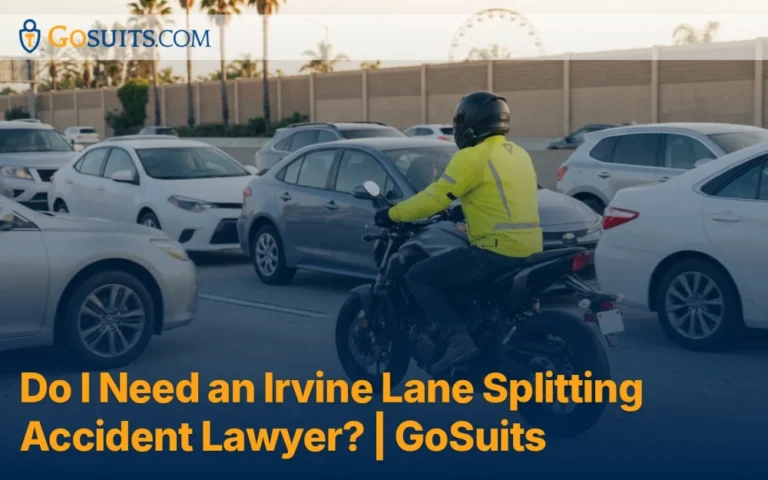
California is the first state to define lane splitting in statute. California Vehicle Code section 21658.1 defines lane splitting as driving a motorcycle between rows of stopped or moving vehicles in the same lane, including on divided and undivided streets, roads, or highways [1]. The law does not prohibit lane splitting. Instead, it authorizes the California Highway Patrol to develop educational guidelines for safe practices. CHP has published lane splitting safety guidance that emphasizes rider judgment, speed management, and attentiveness by all road users [2].
Helmet use is mandatory for motorcyclists and passengers in California under Vehicle Code section 27803. Noncompliance can lead to citations and may be raised by insurers when disputing injuries [9].
To put lane splitting risk into perspective, national agencies and universities have analyzed motorcycle injuries and fatalities. Nationally, motorcyclists face a higher fatality rate per mile traveled compared with passenger vehicles [3]. Research from the University of California has associated lane splitting at lower speeds and lower speed differentials with reduced likelihood of severe injuries compared to typical rear-end crashes in stop-and-go traffic, reflecting potential safety benefits when practiced prudently [4].
How do CHP lane splitting guidelines affect fault in Irvine crashes?
CHP’s guidelines are educational and not a separate law, but they can provide context for evaluating driver and rider conduct. The guidelines emphasize factors such as traffic flow, speed differential, and the need for vigilance by both riders and drivers before changing lanes or opening doors [2]. In practice, claims adjusters, attorneys, and sometimes jurors look at whether conduct was reasonable under the circumstances. If a rider adheres to practices CHP highlights as safer, such as maintaining a small speed differential and not passing at high speeds, it may help demonstrate reasonable care. If a driver failed to signal, made an unsafe lane change, or drifted while distracted, that may support a negligence finding against the driver even when the rider was lane splitting.
In other words, guidelines can inform the duty of care analysis without replacing the statutes and case law that actually govern negligence. Negligence in California focuses on whether each person acted with reasonable care in the situation, a core principle set out in the Civil Code and case law [6] [7].
Who may be at fault in an Irvine lane splitting accident?
Fault in lane splitting crashes is highly fact specific. Multiple parties may share liability, and California applies pure comparative negligence, meaning each person’s share of fault reduces their own recovery but does not bar it [6] [7].
Common fault scenarios include:
- Unsafe lane change by a driver. A driver makes a sudden lane change without signaling or adequately checking mirrors and blind spots and strikes a motorcyclist who is splitting lanes. California law requires reasonable care, and unsafe lane changes can support driver fault.
- Following too closely or abrupt braking. In congested parts of I-5, I-405, or SR-55 passing near Irvine, a driver tailgates or slams brakes abruptly, contributing to a squeeze or sideswipe involving a lane splitting rider.
- Open-door events. A passenger opens a door into traffic or an adjacent lane, interfering with a rider filtering forward; this can be negligent depending on the circumstances.
- Excessive speed differential by a rider. If a rider passes significantly faster than surrounding traffic, especially in tight spaces, a factfinder may assign a share of fault to the rider based on reasonableness and the CHP guidance context [2].
- Distracted driving. Phone use, infotainment interaction, or other distractions that cause lane drift or delayed reactions can put fault on the driver.
- Commercial vehicle constraints. Large trucks have wider blind spots and longer stopping distances. If a truck merges without proper clearance and hits a motorcyclist splitting lanes, the trucking company and driver may share fault. If you were hurt in such a crash, Orange County truck accident lawyers understand federal and state safety rules that can matter in litigation.
Because fault allocation drives outcomes and settlement value, a thorough investigation matters. California car accident lawyers and Irvine motorcycle accident lawyers often examine vehicle location, crush damage, scrape patterns on road surfaces, dashcam video, and witness statements to reconstruct what happened in the seconds before contact.
How does comparative negligence work in California motorcycle lane splitting crashes?
California follows pure comparative negligence by statute and Supreme Court precedent, which means an injured person’s damages are reduced by their percentage of fault, but they are not barred from recovery even if they were mostly at fault [6] [7]. In the lane splitting context, that can look like this:
- Example: A jury finds a driver 70 percent at fault for an unsafe lane change and a rider 30 percent at fault for excessive speed differential. If the rider’s proven damages are 100,000 dollars, the net recovery would be 70,000 dollars.
- Practical impact: Insurers often argue rider fault to reduce payouts. Evidence that the rider matched traffic conditions, maintained visibility, and wore a compliant helmet can counter those arguments [2] [9].
California jury instructions and negligence principles focus on reasonableness and proximate cause. Courts and juries allocate responsibility according to who failed to use reasonable care and how that failure contributed to the crash [6] [7].
What evidence helps prove a lane-splitting injury claim in Orange County?
You can strengthen your case by gathering and preserving evidence as early as possible:
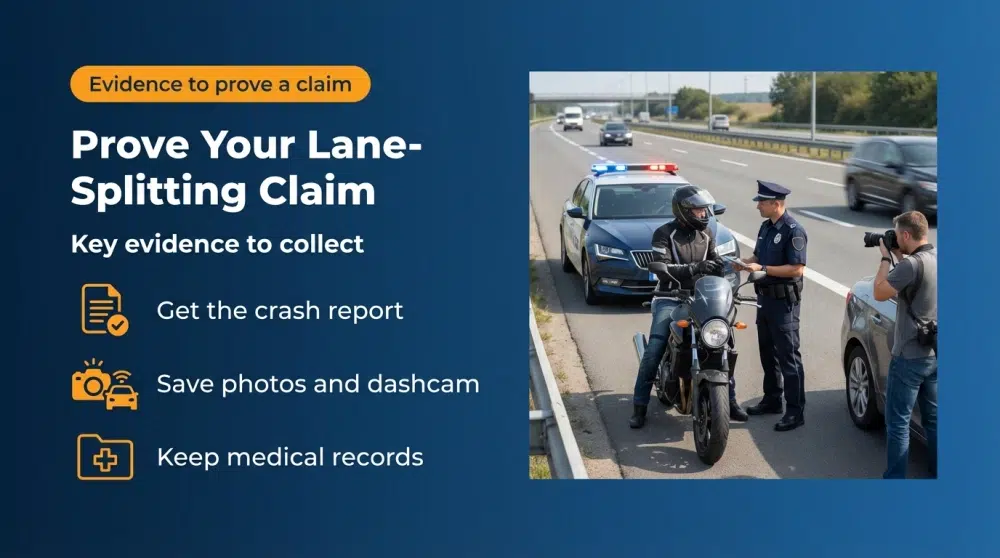
- Official reports. Request the police or CHP collision report number and later obtain the full report when available. The report typically records parties, diagrams, and initial fault observations that insurers weigh.
- SR-1 filing. California requires an SR-1 Traffic Accident Report filed with DMV within 10 days if anyone is injured or there is property damage of 1,000 dollars or more [8].
- Scene photos and video. Capture lane positions, skid marks, debris, traffic density, and lighting. Irvine often has good visibility and multiple-lane interchanges; photos can show how traffic was flowing.
- Dashcam and surveillance. Preserve dashcam footage from any involved vehicle. Nearby businesses and Caltrans cameras may capture the event window.
- Vehicle and gear inspection. Document scrape and impact points on your motorcycle, mirrors, fairings, engine guards, and rider gear. These help determine contact angles and speed.
- Medical records. Prompt evaluation ties injuries to the crash and documents symptoms, imaging, and referrals.
- Witnesses. Get names and contact information from motorists or construction workers who had an unobstructed view.
- Telematics and EDR. Some passenger vehicles and bikes record limited data. If a commercial vehicle is involved, telematics and driver logs may matter.
Independent reconstruction and time-distance analysis can be valuable in disputes about visibility, speed differential, or lane positioning. Where trucks or commercial fleets are involved, interstate truck accident lawyers may also evaluate compliance with safety rules and company policies that affect driver actions.
What insurance steps should you take after a motorcycle crash in Irvine?
The first calls are for medical care and law enforcement. When it is safe:
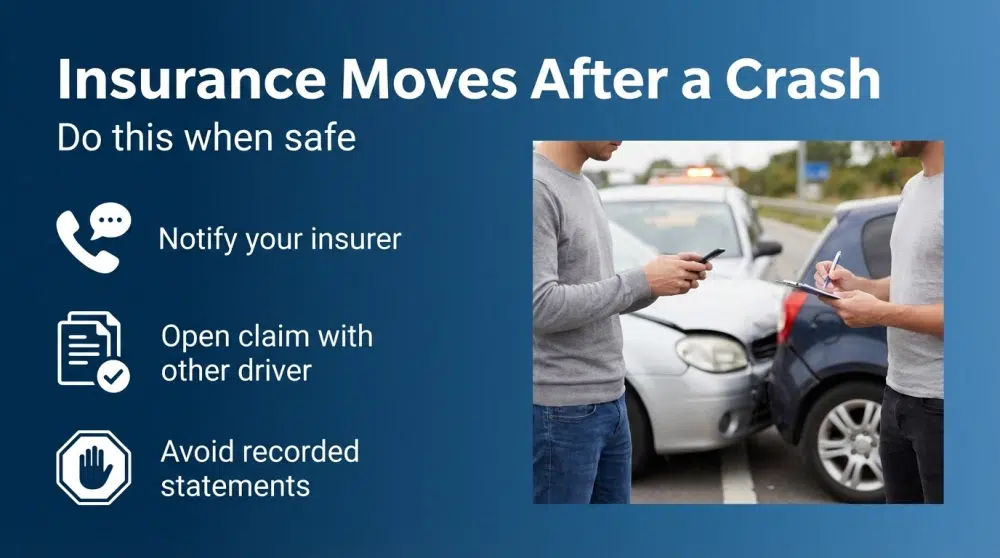
- Notify your insurer. Most policies require prompt notice. Provide the basics but avoid recorded statements until you understand your rights.
- Open a claim with the at-fault insurer. Exchange information at the scene. Be factual. Insurers may try to frame lane splitting as reckless. California law does not prohibit lane splitting, so stay focused on what the other driver did or did not do [1].
- Use medical payments coverage if available. It can cover initial bills while fault is being evaluated.
- Uninsured or underinsured motorist coverage. If the at-fault driver lacks adequate insurance, UM or UIM can be critical in California. Review your policy carefully.
- Follow consumer guidance. The California Department of Insurance publishes consumer guides that explain first party and third party claim processes and common pitfalls [12].
Documentation, consistent treatment, and careful communication with insurers are essential. If your injuries are significant or liability is contested, Orange County motorcycle accident lawyer teams are often involved early to manage evidence, expert analysis, and communications.

What damages are available in a California motorcycle injury case?
If you prove liability, you can demand compensatory damages, which are intended to make you whole:
- Medical expenses. Hospitalization, surgery, imaging, therapy, medication, and future care.
- Lost earnings and earning capacity. Time off work and long-term vocational impact.
- Property damage. Motorcycle repair or total loss, gear replacement.
- Pain, suffering, and loss of enjoyment. Human losses proven through testimony, records, and corroborating evidence.
- Out-of-pocket expenses. Travel for treatment, home modifications, and other reasonable costs.
California generally does not cap compensatory damages in ordinary negligence cases. Documentation and credible expert support help translate injuries into a thoroughly supported demand package. Where traumatic brain injury, spinal harm, or complex fractures are present, injured motorcyclist attorneys often coordinate multiple specialists to model future needs.
How long do you have to file a lawsuit in California?
For most personal injury claims arising from negligence, California’s statute of limitations is two years from the date of injury, with specific exceptions and tolling rules for certain scenarios [5]. Claims against public entities may require a government claim within six months before a lawsuit, which is a separate administrative step. Do not miss these deadlines. Timing issues can be decisive, so it is important to evaluate all applicable timelines as soon as practicable.
What if a loved one died in a lane splitting crash in Irvine?
California wrongful death and survival actions are governed by statutes that identify who can sue and what categories of damages are available. Families can recover for losses such as financial support and companionship, and the estate may pursue survivorship claims related to the decedent’s losses before death. These cases often involve meticulous evidence work and expert analysis on causation and damages. Families in Orange County sometimes work with wrongful death lawyers to handle these complexities while they focus on healing.
Do you need an Irvine lane splitting accident lawyer and how can legal help make a difference?
Lane splitting claims require careful attention to facts, physics, and California law. A seasoned Irvine lane splitting crash lawyer will focus on:
- Liability framing. Building a narrative that shows reasonable riding and highlights the driver’s unsafe acts or omissions.
- Speed differential and visibility analysis. Using scene measurements, video, and human factors to show what was foreseeable.
- Medical causation. Linking injuries to the crash rather than prior conditions through records and treating providers.
- Insurance leverage. Navigating first party and third party claims, policy limits, and lien issues [12].
- Trial readiness. Preparing from day one as if the matter will be tried, which often improves outcomes.
Because insurers frequently argue that lane splitting is inherently unsafe, it helps to ground your case in California’s statutory definition, CHP guidance context, and comparative negligence principles [1] [2] [6] [7]. Motorcycle crash attorneys with trial experience can translate these frameworks for adjusters and juries in a way that resonates.
When the crash involves mixed vehicle types, such as semis or delivery trucks in the MacArthur Boulevard or Jamboree Road corridors, experienced commercial truck accident attorneys and motorcycle crash attorneys often collaborate on blind-spot dynamics, stopping distances, and fleet policies. If your case spans multiple modes, Irvine personal injury lawyers can coordinate that expertise under one strategy.
What defenses will insurers raise and how do you respond?
Common insurer tactics in lane splitting cases include:
- Alleged excessive speed differential. Response: Frame speed relative to traffic and sight lines, support with video and measurements, and reference CHP’s safety context rather than arbitrary rules [2].
- Sudden emergency claims. Response: Analyze whether the driver’s inattention or unsafe lane change created the emergency.
- Helmet or equipment disputes. Response: Confirm compliance with California’s helmet law and show injury mechanisms that are not helmet-related when relevant [9]. Reference public health data about the protective effect of helmets to counter speculative arguments [3].
- Bias against lane splitting. Response: Educate that California defines lane splitting and that liability still turns on reasonableness and proximate cause [1] [6] [7].
- Comparative negligence inflation. Response: Use structured proofs to isolate each contributing act and quantify realistic shares of responsibility.
How do juries view lane splitting in California?
Perceptions vary. Some jurors ride and understand why filtering reduces rear-end exposure in stop-and-go traffic. Others may be unfamiliar or assume it is prohibited. The law’s recognition of lane splitting and CHP’s safety education can help level-set. Counsel often use demonstratives that show lane geometry, sight lines, and time-distance windows to explain why a careful rider and a careful driver can coexist safely. When a driver violates basic rules of care, such as failing to signal or check mirrors, jurors often respond to clear, visual proof of that lapse. Negligence remains the core question, not whether lane splitting exists [1] [2] [6] [7].
How do helmet and equipment laws affect your claim?
California requires a compliant helmet for riders and passengers [9]. If an insurer argues nonuse contributed to the injury, they may try to reduce damages by comparative fault. However, the real-world effect depends on the injury type and medical proof. For example, a lower-extremity fracture has little connection to helmet use. Public health data show helmets reduce the risk of head injury and death, which is important safety information and can become a point of focus at trial if disputed [3]. Proper apparel and conspicuity can also be relevant to reasonableness and avoidability arguments.

What local roads and patterns in Irvine can influence lane splitting risk?
Irvine sits at the convergence of multiple high-volume corridors, including I-405, I-5, SR-55, SR-73, and arterial roads connecting business districts and campuses. Traffic density peaks during commute windows and near major interchanges. State crash surveillance shows that Orange County has a significant number of motorcyclists killed or injured each year, with trends tracked in statewide rankings and dashboards [11]. In these environments, lane splitting can reduce certain risks, such as rear-end collisions in heavy congestion, while creating other exposure points around lane changes and merges. It is especially important to manage your speed differential, anticipate lane change indicators, and position yourself for visibility.
FAQs about lane splitting, fault, and claims in Irvine
Is lane splitting legal in Irvine?
Yes. California law defines lane splitting and does not prohibit it. Irvine riders must still use reasonable care and comply with all applicable traffic laws [1].
Are there set speed limits for lane splitting?
No. There is no statute that sets a specific speed cap for lane splitting. CHP’s guidance discusses risk and safe practices rather than hard limits. A small speed differential compared to traffic, adequate gaps, and rider judgment are emphasized [2].
Will lane splitting automatically make me at fault?
No. Fault is based on negligence. Juries and insurers look at all conduct: lane changes, signaling, attention, speed, visibility, and right-of-way. Comparative negligence may apportion shared fault rather than all-or-nothing results [6] [7].
What should I do immediately after a crash?
Call 911 if needed, move to safety, exchange information, photograph the scene, and seek prompt medical care. File an SR-1 with DMV if required by law [8]. Notify your insurer and consider consulting an Irvine motorcycle accident lawyer before providing recorded statements [12].
What if the other driver left the scene?
Report a hit and run immediately. Uninsured motorist coverage can help in many cases. Preserve any video and witness information.
How long will my claim take?
Timelines vary based on injury recovery, fault disputes, and policy limits. Many cases resolve after medical stability, but contested liability or complex injuries may take longer. Early investigation often improves results.
Do I need Orange County motorcycle accident lawyer help if the insurer accepts fault?
Even admitted-fault cases can involve disputes about medical causation, future care, or wage loss. Experienced motorcycle crash attorneys can structure a comprehensive demand and address liens and policy issues to maximize net recovery.
Can I still recover if I was partly at fault?
Yes. California’s pure comparative negligence system allows recovery reduced by your percentage of fault [6] [7].
What if a commercial truck was involved?
Truck cases add layers like fleet policies and federal safety rules. Coordination with commercial truck accident attorneys can help gather telematics, logs, and compliance data promptly.

What about property damage and diminished value to my bike?
You can claim reasonable repair costs or fair market value if totaled, along with rental or loss-of-use. Diminished value can be pursued with support from qualified appraisers in appropriate cases.
Why choose GoSuits for an Irvine lane splitting crash case?
When you are dealing with a lane splitting crash in Irvine or greater Orange County, you deserve a team that blends human advocacy with cutting-edge tools. GoSuits is a California personal injury firm serving clients across Irvine, Orange County, and surrounding communities. We handle motorcycle, car, and truck crash litigation, along with premises liability and wrongful death matters. We invite you to learn more about prior cases, meet our attorneys, and review our about us and practice areas.
How we support you:
- Technology-driven case building. We use exclusive proprietary software to accelerate evidence collection, organize medical and billing data, and model damages with clarity. This approach shortens timelines and improves presentation quality without sacrificing personal attention.
- Designated attorney access. Although we leverage technology to move your case forward faster, every client works directly with a designated attorney. We do not route cases through case managers. You have unfettered access to the lawyer leading your matter.
- Real courtroom experience. Our trial experience benefits your case from day one. Insurers take trial-ready files seriously.
- Proven outcomes. Our track record includes significant results for injured riders and drivers, as reflected in our publicly available summaries of prior cases. Results vary with facts and law, but preparation and persistence matter.
- 30 years of combined experience. Our team brings decades of combined litigation experience to negotiation tables and courtrooms.
Where we practice:
- Core service areas. Irvine, Orange County, Los Angeles County, Riverside County, San Bernardino County, and San Diego County.
If you are weighing whether to contact an Irvine motorcycle accident lawyer after a lane splitting crash, a free consultation can clarify next steps, timelines, and evidence priorities. We can assess liability theories, navigate insurance, and map out a plan to protect your health and claim. We also handle related matters for riders and their families, including claims that involve commercial vehicles where Orange County truck accident lawyers and motorcycle crash attorneys collaborate, and cases that implicate family harms where Orange County wrongful death lawyers become involved. If you are recovering from a crash and need help with the civil claims process, our Irvine personal injury lawyers are ready to listen, explain your options, and get to work.
Other practice areas we handle include car collisions, where California car accident lawyers on our team address multi-vehicle chain reactions and intersection cases; and broader injury cases that our California personal injury lawyers manage across the region. We also coordinate on complex transportation collisions that may call on the skills of serious motorcycle injuries lawyers and truck collision lawyers when facts overlap across practice areas. Explore our practice areas to see how we can help in your situation.
References and Resources
- California Vehicle Code section 21658.1 Lane Splitting – California Legislature
- Lane Splitting Safety Guidelines – California Highway Patrol
- Motorcycle Safety and Helmets – Centers for Disease Control and Prevention
- Motorcycle Lane-splitting and Safety in California – UC Berkeley SafeTREC
- Code of Civil Procedure section 335.1 Statute of Limitations – California Legislature
- Civil Code section 1714 Duty of Care and Comparative Fault – California Legislature
- Li v. Yellow Cab Co. of California, 13 Cal.3d 804 – CourtListener
- SR-1 Traffic Accident Report Requirements – California DMV
- California Vehicle Code section 27803 Motorcycle Helmet Law – California Legislature
- Negligence Overview – Cornell Law School Legal Information Institute
- Crash Rankings and County Trends – California Office of Traffic Safety
- Automobile Insurance 101 Consumer Guide – California Department of Insurance
- Motorcycle Road Safety – National Highway Traffic Safety Administration
- Types of Cases and the Courts – United States Courts
- United States Code Collection – GovInfo