
- What should you do before your first medical visit after an injury in Irvine, CA?
- What should you bring to the doctor after a car accident in Irvine?
- What should you tell your doctor after an accident so your records are complete?
- What delayed injury symptoms should you watch for after a crash or fall?
- What exams or imaging might be ordered, and why do they matter for a claim?
- How do you document injuries for insurance claims without missing details?
- How do California rules and deadlines affect your medical visit and follow up?
- Where should you go in Orange County for care, ER, urgent care, or primary care?
- How should you handle follow up care, referrals, and discharge instructions?
- How do you prepare for an independent medical exam requested by an insurer?
- How should you manage prescriptions, pain control, and therapy plans safely?
- How do you document work restrictions and time off for wage loss claims?
- How do you track medical bills, mileage, and out of pocket costs accurately?
- How do you obtain, organize, and review medical records for a personal injury claim?
- What common medical visit mistakes should you avoid after an accident?
- What are common checklists for car, motorcycle, and slip and fall injuries?
- How long should you keep records, and what privacy rights do you have?
- When should you consider speaking with a lawyer about your medical visit and claim?
- Why choose GoSuits for injury cases in Irvine and throughout California?
- References and Resources
What should you do before your first medical visit after an injury in Irvine, CA?
If you were hurt in a traffic crash, bike collision, pedestrian incident, or a fall, a focused plan for your first medical visit can protect your health and your future claim. Here is a checklist for your doctor’s visit to complete before you go.
- Write a short timeline: Start with the date, time, and location in Irvine, or elsewhere in Orange County. Note the weather, traffic, exact movements, and any immediate symptoms. Specifics help your doctor and create a clear record you can rely on later.
- List every symptom: Include pain levels, stiffness, headaches, dizziness, numbness, tingling, sleep problems, ringing in the ears, memory lapses, vision changes, and mood changes. Many symptoms start mild, then worsen hours or days later, especially after a concussion, so your list should include even small changes [9] [10].
- Gather prior medical info: Bring a list of past injuries, surgeries, ongoing conditions, and medications. This helps your doctor separate new harm from older issues. It also supports a clear discussion of causation during your post accident medical evaluation.
- Collect crash or incident documents: Bring any police exchange forms, traffic collision reports, if available, photos of the scene and vehicles, names of witnesses, and insurance information. If your crash involved injuries or property damage meeting California’s reporting thresholds, you may need to file DMV Form SR 1 within 10 days [1] [2].
- Prepare questions: Write questions about diagnosis, testing, activity limits, work notes, and red flag symptoms that require urgent care. This prevents gaps in your post accident medical checklist.
Taking these steps improves care and creates the foundation for documenting injuries for insurance claims. National data shows traffic deaths remain high, which underscores the importance of prompt, thorough care after crashes [8].
What should you bring to the doctor after a car accident in Irvine?
Use this medical visit checklist after an injury to make your appointment productive.
- Government identification and insurance cards: Bring health insurance and auto insurance cards. If you received an insurance claim number, include that as well.
- Accident paperwork: Police report or exchange form, claim numbers, and any letters from insurers. This helps your physician document mechanism of injury and provides claim context.
- Photo and video evidence: Photos of vehicle damage, deployed airbags, skid marks, road hazards, or unsafe property conditions. These details help correlate forces with common injuries, such as whiplash and soft tissue trauma [11].
- Medication list: Include prescriptions, over the counter drugs, supplements, and allergies. Note any blood thinners, which may change imaging or treatment decisions.
- Symptom log or pain journal: Bring your notes that show onset, duration, and triggers. Simple charts with daily entries create a trusted pattern over time.
- Work information: Employer name, job duties, and schedule, so your doctor can write accurate work restrictions or time off notes, when medically necessary.
- Emergency contact: Provide someone who can assist with follow up and transportation if you receive medication that affects driving.
What should you tell your doctor after an accident so your records are complete?
Clear communication helps your doctor diagnose and creates accurate medical records for a personal injury claim.
- Describe the mechanism of injury: Explain impact direction, seat position, restraint use, speed, and whether you braced or rotated. Mention if you struck your head, lost consciousness, or experienced immediate neck or back pain. This detail helps connect forces to injury patterns [11].
- Report all symptoms without minimizing: Avoid phrases like “it is not a big deal.” If you have headaches, light sensitivity, mental fog, sleep disturbance, or nausea, report them even if mild. Concussion symptoms can appear later and fluctuate [10].
- Explain how daily life is affected: Note difficulty lifting children, sitting for work, driving, sleeping, or exercising. The functional impact supports treatment planning and helps validate disability notes.
- Share mental health symptoms: Anxiety, flashbacks, sadness, or irritability can follow trauma. Reporting these early can lead to timely referrals and better outcomes.
- Be consistent with prior records when truthful: If you had pre existing issues, be open about them. Physicians can distinguish an aggravation of an existing condition from a new injury when they have the full picture.
Complete records matter because medical records are often admissible as business records in California courts when foundational requirements are met [6].
What delayed injury symptoms should you watch for after a crash or fall?
Not all injuries show up immediately. Some symptoms may develop over hours or days.
- Head injury and concussion: Watch for worsening headache, confusion, concentration problems, sleep changes, light or noise sensitivity, nausea, balance problems, and mood changes. Seek prompt medical attention if symptoms worsen, or new neurologic symptoms appear [10].
- Neck pain and whiplash: Stiffness and reduced range of motion can intensify after 24 to 48 hours. Report any radiating pain, numbness, or tingling in arms or hands that may suggest nerve involvement [11].
- Back pain and radicular symptoms: Low back pain with shooting leg pain, weakness, or numbness requires urgent evaluation.
- Internal injury signs: Dizziness, fainting, abdominal pain, or shortness of breath can signal internal bleeding and require emergency care.
If you develop severe or rapidly worsening symptoms, call emergency services, or go to an emergency department. Hospitals have a duty to provide an appropriate medical screening examination to determine if an emergency condition exists [14].
What exams or imaging might be ordered, and why do they matter for a claim?
Your doctor may recommend specific tests based on symptoms and exam findings. Understanding their purpose helps you follow through and maintain complete documentation.
- X rays: Best for evaluating fractures or alignment issues. Often first line for suspected bone injury.
- CT scans: Useful for head injury screening in the emergency setting, or for complex fractures when detail matters.
- MRI: Helpful for soft tissue and nerve issues, such as ligament sprains, disc injuries, and brain imaging when indicated.
- Ultrasound: Sometimes used for soft tissue injuries or suspected internal bleeding.
- Neurocognitive testing: Used to assess concussion impact on attention, memory, and processing speed [10].
When test results are recorded and preserved in the chart, they become part of the medical record that can support causation and damages. In litigation, medical records can qualify as business records if foundational elements are met in California courts [6].

How do you document injuries for insurance claims without missing details?
Insurers and courts rely heavily on medical documentation. Use the steps below to strengthen your records for a personal injury claim.
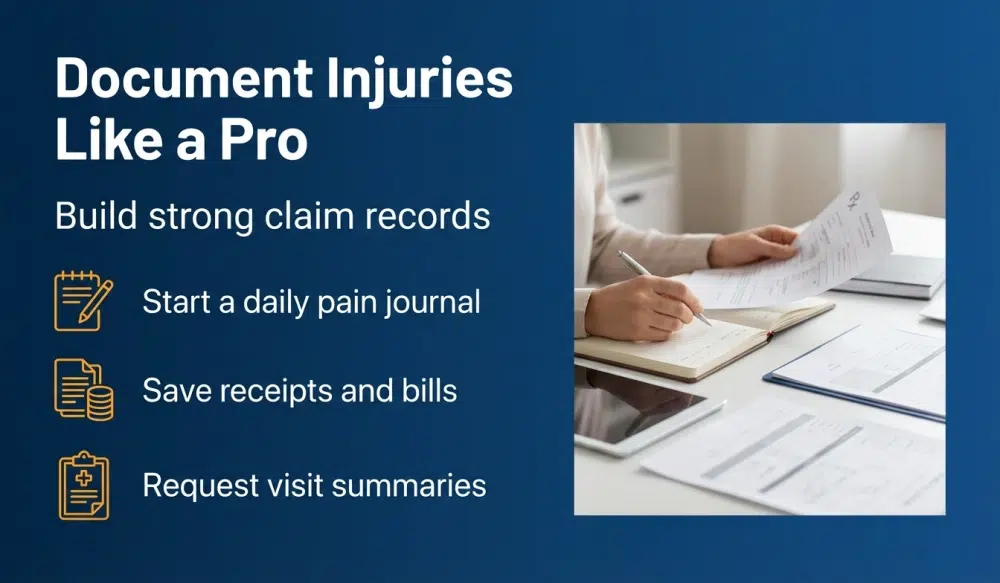
- Start a pain journal: Daily entries with pain levels, triggers, and limitations create a consistent story. Include work, chores, family activities, and hobbies affected.
- Save all receipts: Medications, braces, parking, and co pays are part of your damages. Keep originals or clear photos.
- Track missed work: Keep timesheets, pay stubs, and employer notes that match doctor restrictions.
- Request visit summaries: After each appointment, ask for the visit summary so you can confirm accuracy and follow care plans. You have a right to access your medical records under federal and California law [4] [5].
- Organize digitally: Use a folder system by date and provider. Save PDFs of imaging reports and test results. Clear organization reduces stress and speeds claim review.
If an insurer contacts you, be polite and avoid speculation about your diagnosis or recovery timeline. Direct medical questions to your treating providers. The California Department of Insurance offers guidance for consumers about auto insurance claims processes [12].
How do California rules and deadlines affect your medical visit and follow up?
State laws and deadlines affect your health decisions and the strength of any civil claim.
- Statute of limitations: Many California personal injury claims must be filed within two years from the date of injury. Missing this deadline can bar a claim, with limited exceptions [3].
- DMV accident reporting: California requires reporting crashes that result in injury, death, or property damage above a threshold within 10 days, typically using DMV Form SR 1 [1] [2].
- Medical record access rights: Federal and California law provide rights to access and obtain copies of your records within specified timeframes, often within 15 business days in California for inspection or copies, in many situations [4] [5].
- Evidence rules for records: Medical records can be used as evidence when proper foundations are met under California Evidence Code provisions on business records [6].
These rules are not just technical. They influence how your records are created, preserved, and used to prove your claim.
Where should you go in Orange County for care, ER, urgent care, or primary care?
Choose the right level of care based on your symptoms.
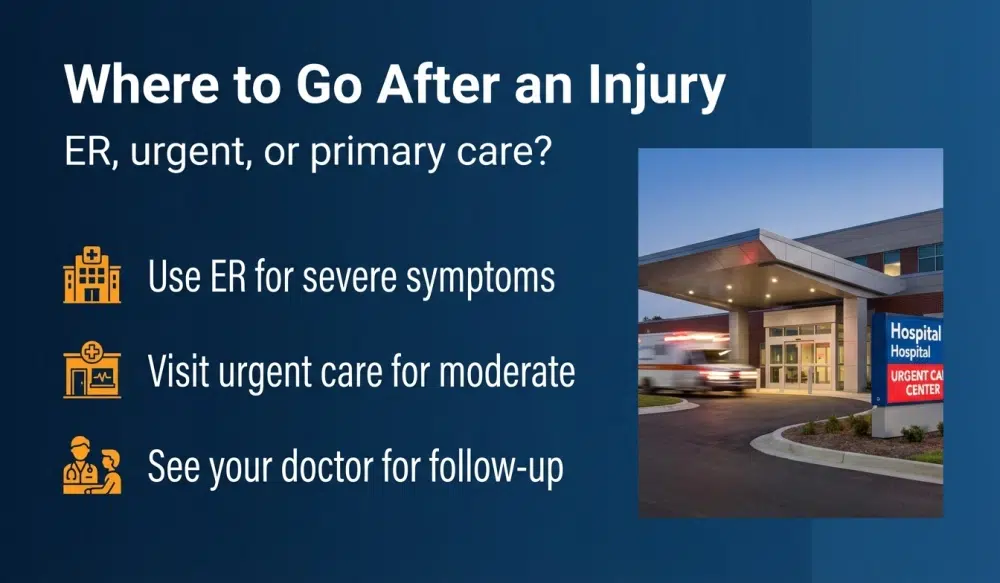
- Emergency department: Choose the emergency room if you have severe pain, trouble breathing, weakness or numbness, confusion, heavy bleeding, worsening headache after a head strike, or any sign of stroke or spinal injury. Hospitals must provide an appropriate medical screening examination for emergency conditions [14].
- Urgent care: Appropriate for moderate pain, lacerations that need closure, mild head injury without red flags, or suspected sprains. Urgent care can order basic imaging and provide initial care with referrals.
- Primary care or specialist: Use your primary care physician for follow up. You may be referred to orthopedics, neurology, physical therapy, or pain management, depending on findings.
Orange County crash trends remind us that collisions are a persistent risk. The California Office of Traffic Safety publishes city and county collision data and rankings to help communities focus on prevention [13].
How should you handle follow up care, referrals, and discharge instructions?
Follow up care is part of your recovery and an essential element in documenting injuries for insurance claims.
- Schedule follow up before leaving: If you are in the emergency department or urgent care, try to set your next appointment before discharge. This reduces delays and gaps in care.
- Review discharge instructions: Confirm activity limits, wound care, and warning signs that require urgent care. Ask for written instructions if you did not receive them.
- Complete referrals: Timely specialist evaluations can identify injuries that basic imaging might miss, such as ligament tears or nerve injury. Keep referral slips and appointment confirmations.
- Communicate barriers: If you cannot attend therapy due to transportation, work, or childcare challenges, tell your provider. They may adjust frequency, or provide home exercises. Record these communications in your pain journal.
How do you prepare for an independent medical exam requested by an insurer?
In some claims, a liability insurer or defense counsel may request a physical examination. California law regulates defense physical examinations of personal injury plaintiffs in civil cases [7].
- Know the scope: The examination must be within the scope allowed by law and any court order. Clarify the specialty of the physician and the body parts to be examined.
- Bring records and a timeline: Have a concise summary of your injuries, treatments, imaging, and current symptoms. Avoid exaggeration. Consistency with your treating records is critical.
- Be truthful and concise: Answer questions politely. Do not guess. If you do not know, say so. If asked about legal theories, defer to your legal team.
- Note the duration and procedures: Afterward, write down start and end times, what tests were done, and who was present. This helps your legal team evaluate the report.
How should you manage prescriptions, pain control, and therapy plans safely?
Safe medication and therapy management improves recovery and supports accurate records.
- Follow the prescription plan: Take medications as directed. Do not combine sedating medications with driving. Report side effects promptly.
- Use non medication strategies when appropriate: Ice, heat, gentle movement, and guided physical therapy can reduce pain and stiffness. Ask for a home exercise plan, and record your progress.
- Avoid gaps in therapy: Consistency is persuasive evidence of ongoing symptoms. If you must pause therapy due to cost or scheduling, document why and inform your provider.
- Store and dispose safely: Use a lockbox for opioids, and return unused medications through take back programs.
How do you document work restrictions and time off for wage loss claims?
Work documentation can be just as important as imaging when losses are evaluated.
- Obtain detailed work notes: Ask your doctor for specific limits, such as no lifting over a certain weight, no driving beyond a set time, seated work only, or complete rest for a defined period. Clear restrictions help employers accommodate and support wage loss claims when time off is necessary.
- Keep employer communications: Save emails and letters about light duty or missed shifts. Match these with your pain journal and medical notes.
- Use accurate pay records: Keep pay stubs, tips documentation, and statements from your employer to show baseline earnings and losses.
How do you track medical bills, mileage, and out of pocket costs accurately?
Accurate expense tracking supports fair reimbursement in settlement or verdict.
- Create a simple ledger: List date, provider, service, amount billed, amount paid, and balance. Include pharmacy receipts and over the counter items recommended by your provider.
- Track mileage to appointments: Keep a log with dates, destinations, and miles driven for medical visits. The Internal Revenue Service publishes mileage allowances for medical travel that may be relevant for tax treatment. Confirm current rates each year [15].
- Keep EOBs: Explanations of Benefits from your health insurer document amounts paid and any deductibles or co pays. These show what you owe and what might be subject to subrogation.
How do you obtain, organize, and review medical records for a personal injury claim?
Complete records strengthen your claim and help your team evaluate liability and damages.
- Request records early: You have a federal right to access your health information, and California provides additional rights and timelines for inspection and copies of records [4] [5].
- Ask for both records and itemized bills: Medical records show diagnosis and care, while itemized bills prove cost. Request imaging on disc and the radiology report.
- Check for accuracy: Review mechanism of injury, symptom lists, and work notes for completeness. If an error appears, politely ask your provider about the process to add an addendum.
- Organize by date and provider: Use a binder or digital folders. Create a quick index so you or your legal team can find key items fast.
- Preserve all originals: Keep originals safe. Provide copies to insurers or other parties. Courts may rely on business record foundations when determining admissibility [6].
What common medical visit mistakes should you avoid after an accident?
- Waiting too long to seek care: Delays can worsen injuries and create gaps in records that insurers may challenge.
- Downplaying symptoms: Minimizing can lead to under treatment and incomplete charting. Be honest and thorough.
- Skipping follow up: Missed appointments weaken claims and can slow recovery.
- Stopping therapy abruptly: If therapy is not working, discuss alternatives rather than stopping without a plan.
- Not reporting head injury signs: Timely evaluation of concussion symptoms is vital for safety and documentation [10].
- Failing to report the incident: If legally required, submit the DMV accident report to comply with California law [1] [2].
What are common checklists for car, motorcycle, and slip and fall injuries?
What is the car crash medical visit checklist for Irvine drivers?
- Bring crash documentation: Police exchange, insurer contact, photos, and witness names.
- Report head and neck symptoms: Mention any head strike, seat belt marks, and neck stiffness. Track headaches and concentration changes [10] [11].
- Ask about imaging criteria: Discuss when X ray, CT, or MRI is appropriate based on guidelines and exam findings.
- Request work notes: Get specific restrictions for driving, lifting, or prolonged sitting.
- Begin a pain journal: Daily entries help you and your providers track progress.
If you have questions about navigating claims and treatment plans after a vehicle collision, a conversation with Irvine car accident lawyers can help you understand options and next steps grounded in your records.
What is the motorcycle or bicycle crash visit checklist?
- Helmet and gear inspection: Bring photos of any helmet impact points or damaged gear, which may correlate with head or shoulder injuries.
- Road rash and wound care: Ask about infection prevention, tetanus status, and scar management referrals.
- Joint stability evaluation: Shoulder, wrist, knee, and ankle injuries are common; ask about targeted exam maneuvers and therapy.
- Vision and vestibular screening: Consider screening if you have dizziness, balance issues, or blurred vision after a head strike [10].
What is the slip, trip, and fall visit checklist?
- Describe the hazard: Wet floor, uneven surface, poor lighting, or lack of handrails. Photos help connect the mechanism to injuries.
- Document bruise patterns: Photograph bruising at consistent intervals to show evolution.
- Assess head injury risk: Falls can cause concussions and serious head injuries. Report any head strike and delayed symptoms promptly [10].
- Ask about therapy and balance training: Prevent re injury with strength and balance programs, when appropriate.
How long should you keep records, and what privacy rights do you have?
Store records securely for the duration of your claim, and beyond, in case issues arise later.
- Keep records until your claim resolves: Maintain records through settlement or final judgment. Save digital backups in secure storage.
- Understand your access rights: You have a right to timely access to your medical information under federal law. California law provides additional rights and timelines for copies and inspection of records [4] [5].
- Confirm releases before signing: Read any medical authorization carefully. Limit scope to reasonable dates and providers related to your injuries.

When should you consider speaking with a lawyer about your medical visit and claim?
If you have significant injuries, time off work, or complex symptoms, legal help can coordinate with your medical documentation and protect important deadlines. Speaking with Irvine car accident lawyers can be useful where liability is disputed or where multiple insurers are involved. A legal team can obtain certified records, track bills, and work with experts when necessary to present a full picture of your harms and losses.
Whether your injury involves a vehicle crash, a bicycle or pedestrian incident, or a fall on unsafe property, careful medical documentation and timely follow up are essential steps. When you are ready, a local attorney in Irvine can help you understand how your medical records, bills, and daily journals fit into a potential civil claim timeline in California.
Why choose GoSuits for injury cases in Irvine and throughout California?
If you were injured in Irvine, or anywhere in California, we offer a supportive path forward. A free consultation with an Irvine personal injury attorney can help you review your medical visit checklist, identify missing documentation, and plan next steps that align with your care. We practice across California and handle a wide range of civil injury cases.
- Technology driven approach: GoSuits uses exclusive proprietary software to move cases faster and with better organization. From medical record intake to timeline building, our tools help reduce delays and surface key facts early.
- Designated attorneys for every client: Although we harness technology to expedite work, every client has a designated attorney and direct access. We do not use case managers to run your case. You can reach your attorney to discuss your care and claim progress.
- Leadership in innovation: Our systems streamline medical record retrieval, expense tracking, and evidence management, while keeping you informed at every step.
- Proven results: We are proud of outcomes we have achieved for clients. Explore selected matters on our page for prior cases.
- Experienced trial lawyers: With 30 years of combined experience and substantial trial work, we prepare every case as if it will be tried. That preparation benefits settlement and courtroom presentation.
- Wide range of practice areas: We handle motor vehicle collisions, premises liability, product cases, catastrophic injury, wrongful death, and related civil claims. See our full list of practice areas.
- Transparent team: Learn about the lawyers who will work with you on our attorneys, and see our firm story on about us.
We meet you where you are, align with your medical care, and keep your case moving. If you are ready to talk, we are here to help you navigate care, documentation, and the civil claim process.
References and Resources
- Accident Reporting Requirements and SR 1 Information – California DMV
- Vehicle Code section 16000 Accident Reporting – California Legislative Information
- Code of Civil Procedure section 335.1 Two Year Limitations – California Legislative Information
- Individuals Right under HIPAA to Access their Health Information – HHS
- Health and Safety Code section 123110 Patient Access to Records – California Legislative Information
- Evidence Code section 1271 Business Records – California Legislative Information
- Code of Civil Procedure section 2032.220 Physical Examination of Plaintiff – California Legislative Information
- Traffic Fatalities 2022 Final FARS Data – NHTSA
- Motor Vehicle Safety Data and Prevention – CDC
- Concussion Signs and Symptoms – CDC HEADS UP
- Whiplash Overview – MedlinePlus NIH
- Auto Insurance Claims Consumer Guide – California Department of Insurance
- City and County Collision Ranking Results – California Office of Traffic Safety
- EMTALA Guidance and Resources – Centers for Medicare and Medicaid Services
- Publication 502 Medical and Dental Expenses – IRS