
- What does this Los Angeles medical visit checklist cover?
- Why does seeing a doctor quickly matter after an injury in Los Angeles?
- What should you bring to your first post accident medical appointment?
- How should you explain the incident and your symptoms to the doctor?
- What evaluations and tests might your doctor order, and why do they matter in a civil claim?
- How do you track symptoms, pain, and daily limitations after an injury?
- How do medical records, bills, and notes support a California personal injury claim?
- Which California and federal rules affect medical documentation in injury cases?
- What questions should you ask your Los Angeles accident doctor during the visit?
- How should you handle referrals, imaging, therapy, and follow up care?
- How do you obtain, review, and correct your medical records?
- How are insurance, billing, and medical liens handled in injury cases?
- What if a government vehicle or public property was involved in Los Angeles?
- How can a lawyer use your medical documentation in a California civil case?
- How does GoSuits help injured people in Los Angeles, CA?
- References and resources
What does this Los Angeles medical visit checklist cover?
This Los Angeles personal injury lawyer medical visit checklist after injury is a practical, step by step guide to help you prepare for your doctor visit, document your symptoms, and protect your civil claim. It is written for people hurt in car crashes, bike and motorcycle collisions, pedestrian incidents, falls, and other negligence cases in Los Angeles, CA. It also highlights California specific rules that affect deadlines, medical records, and evidence, with citations you can verify in the references section.
We focus on three goals. First, protecting your health with prompt and thorough medical care. Second, creating clear medical documentation of injuries, pain, limits on work and daily activities, and the cost of care. Third, understanding how California laws and court rules treat medical records and deadlines so your civil claim is preserved and supported by admissible evidence [1] [4] [5] [7] [12].
Why does seeing a doctor quickly matter after an injury in Los Angeles?
Getting evaluated promptly can protect your health and creates a clear link between the incident and your injuries in the medical record. Many symptoms appear hours or days later. Headache, neck stiffness, dizziness, confusion, abdominal pain, new numbness or weakness, and increasing pain are examples you should not ignore. Injury is a leading cause of death for people ages one to forty four in the United States, underscoring the importance of timely care and follow up [8].
Traffic crashes remain a significant source of injury. National data shows tens of thousands of people die in motor vehicle crashes annually, with NHTSA estimating more than forty thousand fatalities in 2022. The scale of harm highlights why immediate evaluation and consistent treatment matter after a collision, even when you feel okay at the scene [9].
Within California, some events also trigger administrative reporting. If a crash resulted in injury, death, or property damage that meets state thresholds, you must file a report with the California DMV, typically within ten days, even when a law enforcement report exists. Keep a copy of any DMV report you file for your records and share it with your legal counsel [3].
What should you bring to your first post accident medical appointment?
Preparation helps your doctor treat you and helps your future claim by creating precise records. Use this checklist.
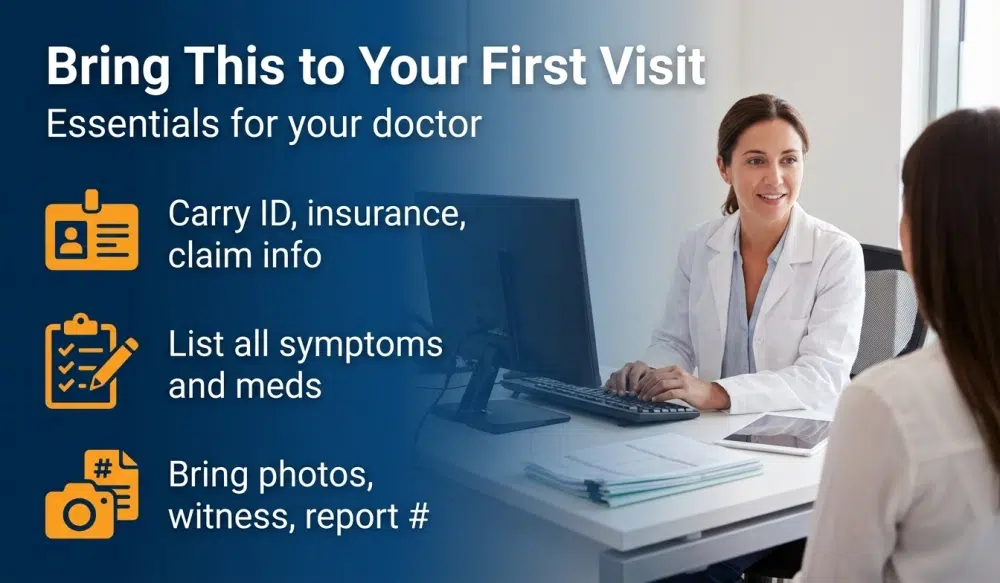
- Photo ID and insurance cards Bring government issued ID, health insurance, Medicare or Medi Cal, and any auto policy information that includes med pay coverage.
- Accident details Date, time, location, how the incident happened, damage to vehicles or property, whether airbags deployed, and whether you lost consciousness. If available, bring the police report number and the agency name, such as LAPD or CHP. If you will later request the CHP traffic collision report, note that form CHP 190 is typically used [13].
- Symptom list Write every symptom, even mild or intermittent. Include headache, neck or back pain, tingling, dizziness, nausea, sleep changes, light or noise sensitivity, memory issues, mood changes, joint pain, bruising, cuts, and pain with movement.
- Pain journal entries If you have started a pain and activity journal, bring it. If not, begin one today. Date the entries and note what hurts, the intensity on a zero to ten scale, what activities aggravate symptoms, and what helps.
- Medication list Include over the counter and prescription drugs, dosage, frequency, and any allergies.
- Prior conditions and care Be honest about prior injuries or conditions in the same body areas, prior imaging or surgeries, and baseline limitations. Accuracy builds credibility and helps your doctor differentiate new from old problems.
- Work and daily activity impact Note missed work days, tasks you can no longer do, childcare or family responsibilities affected, and how pain interferes with sleep or concentration.
- Photos and videos If you safely captured images of the scene, vehicle damage, skid marks, or visible injuries, bring them on your phone. Dates and times are helpful.
- Contact details for witnesses and insurers Names and phone numbers for witnesses, and claim numbers with insurance companies if any were opened.
- Questions for the doctor Prepare a short list about diagnosis, needed imaging, activity restrictions, return to work guidance, and warning signs that should prompt urgent care.
How should you explain the incident and your symptoms to the doctor?
Be clear, factual, and complete. Your doctor will use your history to guide the exam and testing, and your medical chart will be a central piece of evidence later.
- Describe the mechanism of injury For car crashes, note speed, direction of impact, seat position, seat belt use, headrest position, and whether you braced before impact. For falls, describe the surface, shoes, lighting, wet or uneven areas, and whether warning signs were present.
- Do not minimize or exaggerate If pain is intermittent, say so. If you have bad days and better days, record both. Consistency across visits builds credibility.
- Map your symptoms Point to where it hurts and where pain radiates. Note numbness, tingling, weakness, headaches, vision issues, jaw pain, chest pain, shortness of breath, abdominal pain, and any new bladder or bowel issues.
- Explain daily impact Tell the doctor what you cannot do that you could do before, such as lifting children, driving, working a full shift, sleeping through the night, cooking, or hobbies like running or yoga.
- Ask for written work and activity notes If you need modified duty or time off, ask the doctor to write specific limits with dates. Keep copies for your records.

What evaluations and tests might your doctor order, and why do they matter in a civil claim?
Medical testing is ordered to diagnose and guide treatment. In an injury claim, test results also support causation and the nature and extent of harm.
- Physical exam and neurologic screening Range of motion, strength, reflexes, sensation, balance, and gait tests help identify sprains, strains, radiculopathy, concussion, and more.
- Imaging X rays rule out fractures and obvious bone alignment issues. CT scans can evaluate fractures and internal bleeding. MRI can show soft tissue injury to discs, ligaments, tendons, and brain structures. Ultrasound may assess muscles or joints.
- Concussion assessment If you had head impact or whiplash, your doctor may perform cognitive tests and balance exams. Report headaches, memory issues, and light or noise sensitivity promptly. Early identification and follow up can reduce complications [8].
- Referrals You may be referred to orthopedics, neurology, pain management, physical therapy, or mental health care. Attend all visits and keep referral paperwork together.
- Documentation value The combination of physician notes, imaging reports, diagnostic codes, and billed charges can be used to show the injury is real, the treatment was medically necessary, and the costs are reasonable. In both federal and California courts, medical records are commonly introduced through the business records exception to the hearsay rule if the legal requirements are met [4] [7].
How do you track symptoms, pain, and daily limitations after an injury?
A simple system helps you and your care team, and it helps your attorney tell your story clearly. Consider the following routine.
- Daily pain and function journal Date your entries. Record pain level on a zero to ten scale, where pain is located, what activities made it worse or better, and what you could not do that day because of pain or dizziness.
- Sleep and mental health Write down difficulty falling or staying asleep, nightmares, anxiety, sadness, or irritability. These symptoms can be related to pain or trauma and deserve care.
- Work and school impact Track missed days, reduced hours, task modifications, and performance impacts.
- Home and caregiving impact Note childcare tasks you needed help with, household chores you could not complete, and social activities missed.
- Treatment log Keep dates of doctor visits, therapy sessions, imaging, and medications refilled. Keep receipts for co pays, out of pocket items like braces or ice packs, and travel mileage to appointments if you track it for your records.
How do medical records, bills, and notes support a California personal injury claim?
Medical documentation connects the incident to your injuries and supports damages. In California civil cases, your medical records and bills are often used to prove past medical expenses, future care needs, and non economic losses like pain, suffering, and inconvenience. Civil jury instructions address the types of damages a jury may consider, which often align with the categories you document in your medical records and daily journals [11].
From a legal perspective, two practical points matter. First, authenticate and admit the records properly. Lawyers often rely on the business records exception to the hearsay rule at both the federal level and under the California Evidence Code, which requires showing the records were made in the regular course of business, at or near the time of the events, by a person with knowledge, and that making such records is the regular practice of that business [4] [7]. Second, organize a complete set. Obtain initial emergency room records, clinic notes, imaging reports, referrals, therapy notes, operative reports, prescriptions, and billing ledgers with CPT and ICD codes where available. Gaps in care or missing records invite disputes about causation and necessity.
Which California and federal rules affect medical documentation in injury cases?
Several laws and rules are important in Los Angeles and across California. Knowing the basics helps you and your lawyer plan the timeline of your case and your evidence strategy.
- Statute of limitations Most California personal injury lawsuits must be filed within two years of the injury. If the defendant is a public entity, you must file a government claim within a much shorter period in most cases. Missing these deadlines can end your claim [1] [2].
- Government claims When a claim is against a public entity, California law generally requires a written claim within six months of the injury for personal injury cases. If you think a city, county, or state agency might be involved, talk with counsel right away about this step [2].
- DMV reporting If a collision involved injury or certain property damage, California requires you to submit a DMV report, separate from any police report. Retain a copy for your records and timeline [3].
- HIPAA access rights At the federal level, you have the right to access and receive copies of your medical records and, in many cases, to request amendments if something is incomplete or inaccurate. These rights help you assemble a complete file and correct errors that could confuse insurers or a jury [4] [6].
- Evidence rules Medical records can be admitted under the business records exception if the foundational requirements are met. The same general concept exists in the Federal Rules of Evidence and the California Evidence Code [4] [7].
- Discovery In California civil cases, the scope of discovery is broad. Medical records that are relevant to claims and defenses may be discoverable subject to valid objections and applicable privileges. Your attorney will manage what must be produced and when [12].
What questions should you ask your Los Angeles accident doctor during the visit?
Asking focused questions can improve your care and create helpful records. Consider these.
- Diagnosis What is the working diagnosis today, and what other diagnoses are you considering?
- Testing Do I need X rays, CT, MRI, or nerve studies, and why?
- Referrals Should I see orthopedics, neurology, pain management, physical therapy, or behavioral health?
- Activity limits What activities should I avoid, and for how long? Can you write a note for my employer with specific restrictions and dates?
- Return to work Can I return to light duty? What tasks should I avoid to prevent aggravation?
- Red flags What warning signs should lead me to urgent care or the emergency room?
- Follow up When should I return, and what should I monitor or track until then?
- Documentation Can I get copies of today’s visit notes, imaging orders, and referrals for my records?
How should you handle referrals, imaging, therapy, and follow up care?
Completing the treatment plan helps your recovery and strengthens your case. Skipped appointments and long gaps in care may be used by insurers to argue that you recovered quickly or that symptoms were minor.

- Schedule promptly Book referred specialists and imaging as soon as you receive orders. Keep confirmation emails or text messages.
- Attend consistently Go to every appointment and therapy session. If you must cancel, reschedule immediately and keep a record of the reason.
- Follow instructions Use prescribed medications as directed if safe for you, do home exercises, and follow activity restrictions. If side effects occur, call your doctor and document the issue.
- Update your journal Note changes after therapy or medication adjustments, both positive and negative.
- Request copies After imaging or specialty visits, ask for reports and any updated restrictions. Keep everything in one folder, digital or physical, organized by date.
How do you obtain, review, and correct your medical records?
Under federal law, you have a right to access your medical records and obtain copies. You also have a right to request an amendment if your record is incomplete or inaccurate. Each provider has a process for requests and response times, usually explained in their patient rights or privacy notice. Bring a photo ID when picking up, and ask for secure electronic delivery if available [4] [6].
In Los Angeles County, hospitals and clinics typically publish patient rights and language access policies. If you need an interpreter, request one in advance and ask that your chart reflect that an interpreter was present when you describe symptoms and history. Accurate communication leads to accurate records and appropriate care [10].
- How to request Use each provider’s release of information form, often available online. You can request visit notes, imaging, lab results, therapy notes, billing ledgers, and itemized statements.
- What to review Confirm that dates, the mechanism of injury, body parts affected, and your reported symptoms are captured. Ask your doctor to add an addendum if key details were omitted.
- How to correct If a material error exists, make a written request to amend. The provider will respond, and if they deny the request, you may be able to add a written statement of disagreement that becomes part of the record [6].
How are insurance, billing, and medical liens handled in injury cases?
Financial arrangements vary. Your care may be billed to your health insurance, to auto medical payments coverage, or held on a lien that is satisfied from a settlement. Ask providers what they accept and how billing will be handled. Keep copies of all bills, explanation of benefits, and payment receipts. Organization reduces stress and supports accurate damage calculations later.
Be careful with forms. Do not sign blanket releases that give insurers access to your entire lifetime medical history without discussing with your attorney. Targeted releases can provide relevant records without unnecessarily broad disclosure. Your attorney can also object if a request is overbroad during discovery in a civil case, consistent with the scope of discovery under California law [12].
What if a government vehicle or public property was involved in Los Angeles?
Special rules apply when a public entity may be responsible for an injury, such as a collision with a city vehicle or a dangerous condition on public property. California’s Government Claims Act generally requires a written claim within a short time frame for personal injury, often six months from the date of injury. If you think a public agency is involved, act quickly to preserve the right to bring a lawsuit later [2].
In addition, you may need to obtain records from law enforcement or transportation agencies. For collisions investigated by the California Highway Patrol, you can request the traffic collision report using CHP 190. Keep correspondence and proof of submission with your claim file [13].
How can a lawyer use your medical documentation in a California civil case?
A well documented injury story helps your attorney present causation and damages clearly. Organized medical records, imaging reports, physician opinions, therapy notes, and bills let your legal team work efficiently and build the strongest record possible. Your records also guide expert selection, deposition questions, settlement negotiations, and trial presentation under California procedure and evidence rules [4] [7] [12].
Working with accident lawyers early can help you avoid missed deadlines, preserve evidence, and manage communications with insurers while you focus on recovery. If your case proceeds in Los Angeles Superior Court, your lawyer will also follow local civil procedures and scheduling practices that affect discovery and trial preparation [14].
When you are ready to speak with a professional, many firms offer free consultations. This can be a good moment to ask how your records will be gathered, how medical liens will be addressed, and what milestones to expect during the claim.
In many cases, Los Angeles accident lawyers coordinate with your care providers to obtain certified records and billing, request necessary addenda, and secure declarations that satisfy business records exceptions where appropriate. These steps can streamline admissibility and reduce disputes over foundation at deposition or trial [4] [7].
How does GoSuits help injured people in Los Angeles, CA?
If you were hurt in Los Angeles, CA, a focused plan for medical visits and documentation can make a real difference. GoSuits represents people in civil personal injury cases, including car, truck, motorcycle, pedestrian, and slip and fall matters. We handle cases throughout California. Our team uses a technology driven approach to move cases forward while keeping personal attention at the center.
- Free consultation for injury cases A brief call can help you understand immediate next steps for medical care and documentation, what records to request, and what timelines apply to your situation.
- Exclusive proprietary software We use our own case acceleration platform to collect medical records faster, monitor treatment status, and flag missing items for follow up. This helps reduce delays that often slow injury claims.
- Attorney access without case managers Although we use technology to expedite your case, every client works directly with a designated attorney. We do not use case managers. You have unfettered access to your lawyer for updates and strategy.
- Leadership in innovation Our systems integrate secure document intake, medical provider outreach, and timeline mapping so your treatment and evidence are aligned from day one.
- Trial experience and results We prepare every case as if it will be tried to a verdict. That preparation often strengthens settlement outcomes and ensures we are ready if a jury is the right path. You can review some of our past results here prior cases.
- Practice areas and scope We handle a range of personal injury matters. Learn more about who will represent you here our attorneys, and read about the firm here about us. For a full list, visit practice areas.
- Combined experience Our lawyers bring more than 30 years of combined experience in civil personal injury litigation in California courts.
If you have questions about preparing for your doctor visit today or about organizing records for a claim, you can reach out to talk through your options. Many clients appreciate step by step guidance on what to bring to the first visit, how to describe symptoms, and how to build a complete medical file. We are here to help you move forward.

What is the quick version of the medical visit checklist?
- Get prompt care Do not wait on new or worsening symptoms. Seek emergency care when appropriate and schedule clinic follow up promptly [8].
- Bring essentials ID, insurance, accident details, symptom list, medications, photos, witness and insurer info.
- Tell the full story Mechanism of injury, all symptoms, and how your life is affected at home and work.
- Ask for specifics Diagnosis, tests, referrals, restrictions, return to work notes, red flags.
- Follow through Complete imaging and therapy, attend all visits, and document everything.
- Request records Obtain visit notes, imaging, and bills regularly. Use your right to access and to request corrections if needed [4] [6].
- Know deadlines Track filing limits, government claims, and DMV obligations in California [1] [2] [3].
People often start by searching for accident lawyers to understand how to coordinate medical visits, records, and insurance communications while they heal. In Los Angeles, accident lawyers can also help you request the police or CHP report, preserve video, and organize your medical file for settlement talks or litigation [13] [14].
References and resources
- California Code of Civil Procedure section 335.1 Statute of Limitations for Personal Injury – California Legislative Information
- Government Code section 911.2 Government Claims Act Time for Presentation – California Legislative Information
- Accident Reporting Requirements SR 1 – California DMV
- Right to Access Your Medical Records – U.S. Department of Health and Human Services
- Right to Amend Your Medical Record – U.S. Department of Health and Human Services
- Federal Rules of Evidence Rule 803 Hearsay Exceptions – Cornell Law School Legal Information Institute
- Evidence Code section 1271 Business Records – California Legislative Information
- Injury and Violence Key Data – Centers for Disease Control and Prevention
- Early Estimate of Motor Vehicle Traffic Fatalities in 2022 – National Highway Traffic Safety Administration
- Injury and Violence Prevention Program – Los Angeles County Department of Public Health
- California Civil Jury Instructions CACI – Judicial Council of California
- California Code of Civil Procedure section 2017.010 Scope of Discovery – California Legislative Information
- Traffic Collision Report CHP 190 – California Highway Patrol
- Civil Division Information – Superior Court of California County of Los Angeles