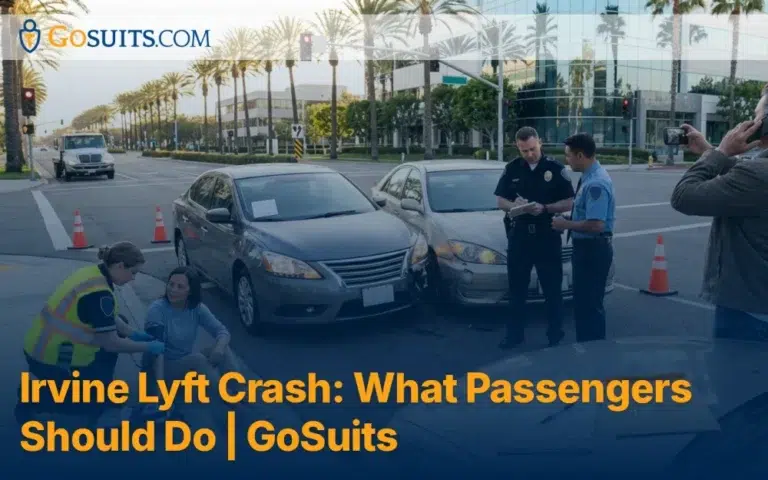
- What should you do immediately after a Lyft crash in Irvine?
- How do you report a Lyft accident in Irvine and to California authorities?
- What insurance covers Lyft passengers in California?
- What if the other driver was uninsured or underinsured?
- What evidence should you collect and preserve from a rideshare crash?
- How do liability and comparative fault work for Lyft passenger claims in California?
- What injuries are common for rideshare passengers and why does early care matter?
- How long do you have to file an injury claim or lawsuit in California?
- Who do you notify and what should you say to insurers after a Lyft crash?
- How are damages calculated in California civil cases?
- How do Irvine police reports and records requests work?
- What steps should parents take if a minor was injured as a Lyft passenger?
- What if a government vehicle or roadway defect contributed to the crash?
- What if you were in an Uber or a different rideshare in Irvine?
- Do you need legal help for an Irvine Lyft passenger claim and how can it help?
- How does GoSuits support Irvine Lyft passengers with a technology driven approach?
- Where can you learn more from reliable sources?
What should you do immediately after a Lyft crash in Irvine?
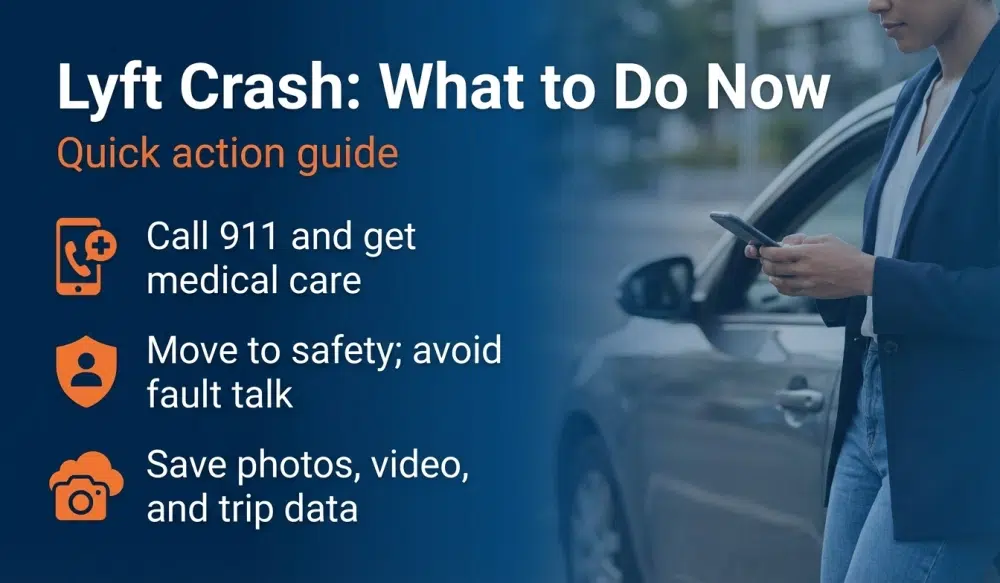
If you are a Lyft passenger involved in a crash in Irvine, your first focus is safety and medical care. Call 911 if anyone is hurt. Even if you feel okay, seek a medical evaluation as soon as possible, because symptoms from concussions, soft tissue injuries or internal injuries can appear hours or days later. Prompt care also creates a clear medical record linking your injuries to the collision, which insurers rely on when evaluating claims.
When it is safe, take photos and videos of the scene, vehicle positions, visible injuries, skid marks, traffic controls, weather, road conditions and any debris. Exchange information with the drivers, including names, license plates, driver license numbers, and insurance. Request contact information for witnesses who saw what happened. Use your smartphone to capture the Lyft trip screen with the driver name, vehicle, time and route.
- Check for injuries and call 911: Report any pain, dizziness, confusion or bleeding.
- Move to a safe area: If vehicles are creating a hazard and it is safe to move, step to a sidewalk or shoulder.
- Document the scene: Photos, videos and notes help preserve facts while memories are fresh.
- Save your Lyft trip data: Take screenshots of the ride receipt, route map and messages in the app.
- Do not argue about fault: Limit statements to the facts and let the evidence speak for itself.
Federal and state traffic safety agencies consistently find that prompt emergency response and early treatment improve outcomes for crash victims. National data show thousands of roadway deaths annually, underscoring the seriousness of even seemingly minor collisions [9].
How do you report a Lyft accident in Irvine and to California authorities?
Report the crash within the Lyft app and follow the prompts to document what occurred. If there are injuries or significant property damage, California law requires reporting to law enforcement. Any driver involved in a crash resulting in injury or death must report the collision to the local police department or the California Highway Patrol without delay, and the driver of a vehicle involved must make a written report to the police within 24 hours [2].
Separate from police reporting, California law requires a report to the Department of Motor Vehicles when a crash involves injury, death or property damage that meets statutory thresholds. The Vehicle Code sets these reporting duties so that the state can track collisions and financial responsibility [13]. Keep copies of any report numbers you receive. These documents often become key evidence in civil claims.
- Report in the Lyft app: Use in app tools to report the collision and request support.
- Call Irvine Police or CHP: If anyone is hurt, notify law enforcement and request an officer at the scene [2].
- DMV reporting: Ensure state reporting requirements are met under the Vehicle Code [13].
- Request the report number: Save the incident or report numbers for follow up.
What insurance covers Lyft passengers in California?
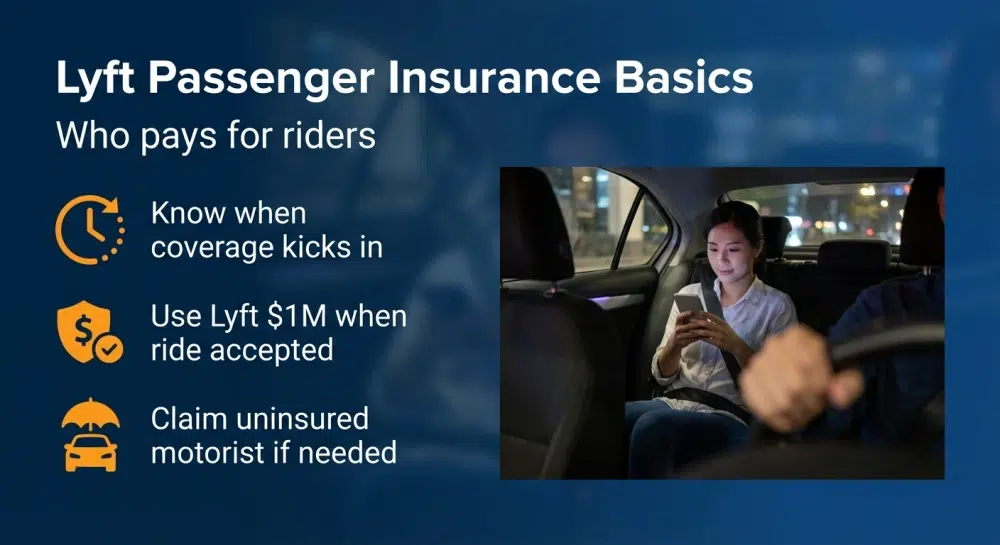
California has specific insurance rules for transportation network companies. When a rideshare app is on and the driver is waiting for a match, law requires primary liability insurance at specified minimum levels. When a ride is accepted or a passenger is in the vehicle, the law requires at least 1,000,000 in coverage for death, personal injury and property damage, and also requires uninsured and underinsured motorist coverage during that engaged time [1] [4]. These rules operate in addition to any personal auto policies that may apply, and they are overseen by state regulators [3] [14].
As a passenger, you typically did not cause the crash. Depending on who is at fault, your claim may be presented to the at fault driver’s insurer, the Lyft policy, or both. Coverage can include medical costs, lost income, and non economic harms when supported by evidence and California law. The structure of coverage changes depending on whether the driver had accepted a ride or had a passenger at the time of the crash, so saving your trip details is important for confirming the engaged period [1] [4].
- App on, no match: Primary liability coverage at statutory minimums applies during the waiting period [1].
- Ride accepted or passenger onboard: At least 1,000,000 in liability plus uninsured or underinsured motorist coverage applies during engaged time [4].
- Personal policies: Some personal auto policies exclude ridesharing, which is why state law sets TNC specific requirements [3].
What if the other driver was uninsured or underinsured?
California requires rideshare companies to carry uninsured and underinsured motorist coverage during an engaged trip, which can apply if a hit and run driver or a driver with insufficient coverage caused the crash [4]. This coverage can help address medical expenses and other losses when the at fault driver’s policy does not fully cover the harm. You still need to document your injuries and economic losses, and you should notify all potentially responsible insurers promptly so that deadlines are met.
Passengers can also have their own medical payments coverage or health insurance that pays initial bills while liability is being determined. Proper coordination of benefits prevents gaps and helps you avoid unpaid balances. California Department of Insurance consumer materials explain how layered coverages can interact in rideshare collisions [3].
What evidence should you collect and preserve from a rideshare crash?
Evidence drives civil cases. The more you collect early, the better your ability to show what happened and how you were affected. In a rideshare crash, some critical evidence is digital and can be lost if not preserved quickly.
- Trip data: Save screenshots of the Lyft ride receipt, time stamps, route map and any driver messages.
- Vehicle and scene photos: Capture all vehicle damage, airbag deployment, seat positions and any roadway hazards.
- Witness information: Gather names, phone numbers and short notes of what each witness observed.
- Medical records: Request visit summaries, imaging and diagnoses that connect injuries to the collision.
- Expense records: Track bills, co pays, medication costs, rides to medical appointments and lost work days.
- Police and DMV reports: Keep copies of police report numbers and any DMV filings that apply [2] [13].
Sending a written preservation request early can help secure telematics, dash camera footage and electronic trip logs. State regulators also require TNCs to maintain certain records, which can be requested in discovery if a lawsuit becomes necessary [14].
How do liability and comparative fault work for Lyft passenger claims in California?
California uses comparative negligence, which means responsibility for damages is divided based on each party’s share of fault. Even if more than one driver was negligent, a non negligent passenger can still claim compensation. Comparative negligence principles are well established in California law and allow recovery to be reduced by any share of fault, if applicable [8]. The foundational California authority adopting comparative negligence confirms that the trier of fact can apportion responsibility among those who contributed to the crash [15].
As a passenger, you rarely bear fault unless you interfered with the driver or engaged in conduct that contributed to the collision. Claims may be presented to one or more insurers depending on how fault is allocated between the Lyft driver and another motorist. Photographs, statements, vehicle data and the police report typically guide insurers on fault allocation. If the evidence is inconclusive, independent reconstruction may be warranted in larger loss cases.
What injuries are common for rideshare passengers and why does early care matter?
Passengers can sustain a range of injuries, including whiplash, concussions, facial injuries from seat belts or airbags, fractures, shoulder or knee injuries from bracing, and psychological harm such as anxiety. Many soft tissue and head injuries may not show immediate symptoms. Seeking prompt medical care helps identify hidden injuries and supports causation opinions that insurers rely on. National public health data estimate high medical and work loss costs from motor vehicle crashes, illustrating why timely treatment and documentation matter for both health and financial recovery [11].
Follow your doctor’s instructions, attend follow up appointments, and keep a recovery journal tracking pain levels, mobility, sleep and daily limitations. This contemporaneous record helps quantify non economic harm like pain and loss of enjoyment of life.

How long do you have to file an injury claim or lawsuit in California?
California’s statute of limitations for most personal injury suits is two years from the date of injury. Filing after the deadline can bar your claim, with limited exceptions for minors and certain delayed discovery scenarios [5]. If a public entity or employee may be responsible, shorter notice deadlines apply under the Government Claims Act, generally requiring a written claim to the public entity within six months of the incident before any court filing [6] [7].
- Standard deadline: Two years for most injury claims in California [5].
- Government claims: Usually six months to submit a claim to the public entity, with strict procedural requirements [6] [7].
- Minors: Different rules can toll or extend time while the injured person is under 18, but other shorter deadlines can still apply in special contexts.
Talking with Irvine car accident lawyers early can help you identify all applicable deadlines and avoid missed notice requirements that could harm your claim.
Who do you notify and what should you say to insurers after a Lyft crash?
Notify Lyft through the app, and promptly inform your own auto and health insurers. If you receive calls from insurance adjusters for any driver, keep your statements brief and factual. Do not guess about speed, distances or injuries. Politely decline recorded statements until you have had a chance to review the police report and your medical records. Written communications allow you to be precise and minimize misunderstandings.
- Notify all insurers: Lyft’s claims portal, your auto insurer and your health insurer should be notified once you know there are injuries.
- Be factual: Share what you observed without speculation.
- Avoid premature settlements: Do not sign releases or accept payments until the full scope of injury and treatment is clear.
- Keep records: Save every letter, email and voicemail related to the claim.
How are damages calculated in California civil cases?
In California civil injury cases, allowable damages include economic harm such as medical expenses, rehabilitation, lost wages or earning capacity, and property losses. Non economic damages compensate for pain, physical impairment, inconvenience, grief, anxiety and loss of enjoyment of life. Documentation is critical. Medical bills, pay stubs, employer letters, tax records, and testimony from treating providers and family members can all support the value of your claim.
Insurers often use multipliers or comparative data to evaluate non economic harm, but California juries receive instructions that emphasize human experience and credibility over formulas. Evidence ledgers and consistent medical follow up are often persuasive. State traffic safety and public health sources also highlight the significant costs of crash injuries to individuals and communities [11] [9].
How do Irvine police reports and records requests work?
If an officer responded, the Irvine Police Department prepares a traffic collision report that can be requested once available. The report contains driver and witness information, diagrams, citations, and preliminary fault assessments. You can request a copy through the Irvine Police Department’s records unit using the department’s published process [12]. The report number and date of incident will help locate the file more quickly.
- Obtain the report number: Ask the officer at the scene or call the non emergency line later.
- Request the report: Follow the City of Irvine’s procedures and include your relationship to the incident [12].
- Review accuracy: Check names, insurance, and vehicle identification numbers for accuracy and request corrections if needed.
Local crash data can provide context for insurers and courts. State agencies maintain collision databases that help identify common risks and locations, and public summaries are available to the community [10].
What steps should parents take if a minor was injured as a Lyft passenger?
When a child is hurt, get medical care promptly and notify all relevant insurers. Keep detailed records of caregiving time, school absences and developmental or behavioral changes. California law treats minors differently for court deadlines in many cases, often tolling time until the minor turns 18, but there can be important exceptions and special procedures for resolving claims involving minors. If a public entity is involved, the earlier government claim deadlines may still apply [6] [7].
- Medical follow up: Pediatric evaluations and monitoring are important for concussions and growth plate injuries.
- Documentation: Save school notes, therapy reports and activity restrictions.
- Settlement approval: California courts often require approval of any settlement involving a minor to protect the child’s interests.
What if a government vehicle or roadway defect contributed to the crash?
If a city, county or state vehicle played a role, or if roadway design, maintenance, traffic signals or construction zones contributed, special rules apply. California’s Government Claims Act generally requires written notice to the public entity within six months before filing any lawsuit, and there are strict content and service rules [6] [7]. Potential public entities could include the City of Irvine, County of Orange or Caltrans, depending on where and how the incident occurred. Early investigation helps identify the right agency and any contractors involved.
What if you were in an Uber or a different rideshare in Irvine?
California’s rideshare insurance statutes apply to all transportation network companies operating in the state. The legal framework for waiting period coverage and engaged period coverage, including the minimums and the requirement for uninsured or underinsured motorist protection, is set by statute and oversight from state regulators, not by brand names [1] [4] [14]. The practical steps remain the same: obtain care, document the scene, report in the app, contact law enforcement when required, and preserve your trip data.

Do you need legal help for an Irvine Lyft passenger claim and how can it help?
Even when liability seems clear, rideshare claims can involve multiple insurers and coverage layers. An attorney can coordinate benefits, negotiate with insurers, evaluate the need for independent experts, and file suit if necessary. If a government entity is potentially responsible or if the at fault driver lacks sufficient coverage, time sensitive notice and documentation issues become critical. Many Irvine car accident lawyers understand how transportation network company coverage interacts with personal and commercial policies and can help you navigate the process.
Timelines are important. California highway safety and public health data show the scope of traffic injury burdens statewide, but your case turns on specific facts, medical documentation and legal deadlines [10] [11] [5]. Reaching out for guidance early helps protect your claim while you focus on recovery.
Which insurer pays first if both the Lyft driver and another driver share fault?
It depends on fault allocation and coverage periods. If both contributed, claims may be presented to both insurers. During an engaged trip, the Lyft policy must provide at least 1,000,000 in liability coverage and often addresses passenger claims even when another driver is partially at fault, with subrogation to follow for equitable contribution between insurers [4].
Do you need to file anything with the DMV after a serious crash?
California Vehicle Code provisions require reporting to state authorities when a crash involves injury, death or property damage that meets statutory criteria. Ask the involved drivers to complete required forms and retain proof of submission as part of your records [13].
Can a passenger be blamed for a Lyft crash?
It is uncommon. Passengers might bear a small share of fault only if their actions interfered with safe driving. Under California comparative negligence, any such share would reduce, not eliminate, recovery [8] [15].
Are Irvine roads particularly dangerous for rideshare users?
The risk varies by corridor, time of day and traffic volume. Statewide data from transportation safety agencies show significant crash burdens that affect all road users, and local rankings provide context for trends by city and county [10] [9]. Beyond statistics, your focus should be on preserving evidence and meeting deadlines for your individual claim.
What are the top steps to protect your rights after a Lyft crash?
- Get medical care: Prioritize health and create a clear record.
- Call police if anyone is hurt: Cooperate with officers and request the report number [2].
- Save digital evidence: Preserve trip data and communications.
- Notify insurers: Report the claim and keep communications organized.
- Track losses: Document wage loss, out of pocket costs and daily impacts.
- Monitor deadlines: Calendar the two year statute and any shorter government claim deadlines [5] [6].
Where can Irvine passengers find local help and information?
For crash reporting and records, the Irvine Police Department publishes guidance on how to request a traffic collision report [12]. State transportation and insurance regulators maintain resources on rideshare coverage and safety trends that apply in Orange County and throughout California [3] [14] [10]. When you plan next steps, consider both medical needs and legal timelines, including the standard two year civil filing deadline and the shorter timelines for any claims that involve public entities [5] [6].
For context, many Irvine passengers benefit from early conversations with advocates who routinely handle transportation network company claims. This is especially true in multi vehicle crashes or cases with serious injuries, where experts and detailed economic analyses may be necessary.
What practical checklist can you follow after a Lyft crash in Irvine?
- Safety and care: Check for injuries, call 911, visit urgent care or your doctor.
- Scene documentation: Photos, videos, witness contacts and the Lyft trip screen.
- Official reports: Request police at the scene when there are injuries and obtain the report number [2].
- State requirements: Confirm any required reporting under the Vehicle Code [13].
- Insurance notifications: Report to Lyft, your auto insurer and health insurer.
- Medical records: Keep all visit summaries, imaging and treatment plans.
- Expense tracking: Keep receipts and a ledger of all out of pocket costs.
- Calendar deadlines: Two year civil filing period, six month government claims when applicable [5] [6].
How do you build a strong Lyft passenger case strategy in California?
A strong strategy starts with accurate facts and clear medical proof. Obtain and review the police report, verify insurance coverage periods under California’s rideshare statutes, and assemble a complete damage package with medical bills, wage loss evidence and a day to day impact journal. Be ready to explain why medical care was reasonable and necessary, and to connect each claimed cost to the crash. Comparative negligence analysis should address any arguments that another driver or factor caused or contributed to the collision [8] [15].
Insurers look for consistency. Missed medical appointments, gaps in care or unclear documentation can reduce offers. If disputes arise about mechanics or speeds, consider whether vehicle data, photographs and a qualified reconstruction can clarify the sequence of events. State regulators require TNCs to keep certain records, which can support these analyses if obtained through lawful requests [14].
Many claims resolve without a trial. Others need filing to secure evidence, meet deadlines or compel fair evaluation. Clear communication, organized records and well supported damages often improve outcomes over time.
Why do statistics and community safety data matter for your claim?
Public safety data give context about how and where crashes happen. National estimates show tens of thousands of fatalities annually and many more injuries, illustrating the scale of roadway harm and the importance of effective prevention and response [9]. California publishes collision rankings and local data tools that help communities understand risk patterns and allocate resources for safer roads [10]. While your case depends on individual facts, insurers and courts often find it helpful to understand the broader environment in which the collision occurred.
What can you do to prepare for settlement talks in an Irvine rideshare case?
- Complete treatment: Reach maximum medical improvement or obtain a physician opinion on future care needs.
- Compile a demand package: Include police report, medical records and bills, wage loss proof, photos, witness statements and a liability summary.
- Address comparative fault: Explain evidence on each party’s share of responsibility with citations to statutes and the report [2] [8].
- Explain coverage: Reference California TNC statutes that set minimums during engaged rides and how they apply to your claim [4] [1].
- Value non economic harm: Use your recovery journal, provider notes and daily life impacts to support pain and suffering.
What common pitfalls should Lyft passengers avoid after a crash?
- Delaying care: Waiting to see a doctor can harm health and weaken causation.
- Deleting app data: Do not delete the Lyft app or messages without saving screenshots first.
- Recorded statements: Avoid recorded statements before you review records and understand coverage.
- Ignoring deadlines: Calendar the two year civil filing period and the six month government claim requirement when applicable [5] [6].
- Missing the police report: Obtain and review the crash report from the Irvine Police Department [12].
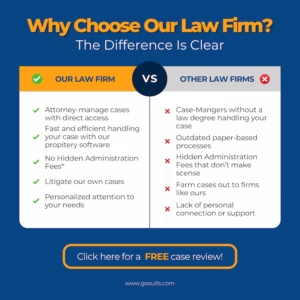
How should you think about choosing local legal help for an Irvine rideshare claim?
Experience with TNC coverage periods, California statutes and local practices can help streamline a claim. Look for clear communication, trial readiness when needed and a plan to investigate liability with photos, vehicle data and witness statements. Many firms offer initial conversations, which can help you understand next steps and timelines. The complexity of rideshare insurance structures, government claim issues and comparative negligence makes early guidance valuable. car accident lawyers who routinely manage these issues can coordinate benefits, address liens and organize evidence so you can focus on care and recovery.
Many Irvine car accident lawyers are familiar with local crash reporting, court procedures and negotiation practices. Choose a team that prioritizes direct attorney access, prompt updates and transparent strategy discussions.
How does GoSuits support Irvine Lyft passengers with a technology driven approach?
If you were a passenger in a Lyft crash in Irvine, CA, a free consultation can help you understand the insurance layers, your medical documentation needs, and the timelines that apply to your claim. GoSuits represents people in civil injury matters across California, including Orange County and the City of Irvine. We use an exclusive proprietary software platform to intake, investigate and advance cases with greater speed and clarity, while maintaining hands on attorney guidance every step of the way.
- Designated attorneys: Every client has unfettered access to their attorney. We do not assign case managers in place of lawyers.
- Technology with a human touch: Our internal tools automate routine tasks so attorneys can focus on strategy, evidence and negotiation.
- Proven results: See examples of outcomes in our prior cases. Results depend on facts and law, and past outcomes do not predict future results.
- Trial readiness: We prepare each matter as if it may go to trial, which often strengthens negotiation leverage.
- Broad practice coverage: Our practice areas include rideshare and auto collisions, pedestrian and bicycle injuries, premises liability and wrongful death.
- Seasoned team: With 30 years of combined experience, our attorneys have led complex investigations, coordinated experts and presented cases in court when necessary.
- Transparent access: Learn about our attorneys and our mission on the about us page.
From preserving Lyft trip data to coordinating medical records and preparing comprehensive demand packages, our process is built to move your case forward efficiently while you focus on recovery.
Where can you learn more from reliable sources?
- Cal. Pub. Util. Code § 5433 – California Legislative Information
- Cal. Veh. Code § 20008 – California Legislative Information
- Transportation Network Companies and Ridesharing – California Department of Insurance
- Cal. Pub. Util. Code § 5434 – California Legislative Information
- Cal. Code Civ. Proc. § 335.1 – California Legislative Information
- Cal. Gov. Code § 911.2 – California Legislative Information
- Cal. Gov. Code § 945.4 – California Legislative Information
- Comparative negligence – Legal Information Institute
- Early Estimate of Motor Vehicle Traffic Fatalities in 2022 – NHTSA
- Crash Rankings – California Office of Traffic Safety
- Costs of Motor Vehicle Crash Injuries – CDC
- Request a Traffic Collision Report – City of Irvine
- Cal. Veh. Code § 16000 – California Legislative Information
- Transportation Network Companies – California Public Utilities Commission
- Li v. Yellow Cab Co. of California – CourtListener