
- What should you do immediately after a Lyft crash in Los Angeles?
- How do you protect your health and document injuries after a rideshare collision?
- Do you need to call 911 and file a police report in Los Angeles?
- How do you report the crash to Lyft and to insurance companies?
- What insurance covers you as a Lyft passenger in California?
- What damages can a Lyft passenger claim in a California civil case?
- Who could be liable for a Lyft passenger’s injuries?
- What if more than one driver shares fault in California?
- What are the claim deadlines and statute of limitations in California and Los Angeles?
- How do you get the police report and key evidence in Los Angeles?
- Should you give a recorded statement to an insurance adjuster?
- How do medical bills and liens work after a rideshare crash?
- What changes if the Lyft driver was on the app or off the app?
- How do you start a claim or lawsuit in Los Angeles, and what is the timeline?
- Frequently asked questions about Lyft passenger crashes in Los Angeles
- Why choose GoSuits if you were injured as a Lyft passenger?
- References and resources
What should you do immediately after a Lyft crash in Los Angeles?
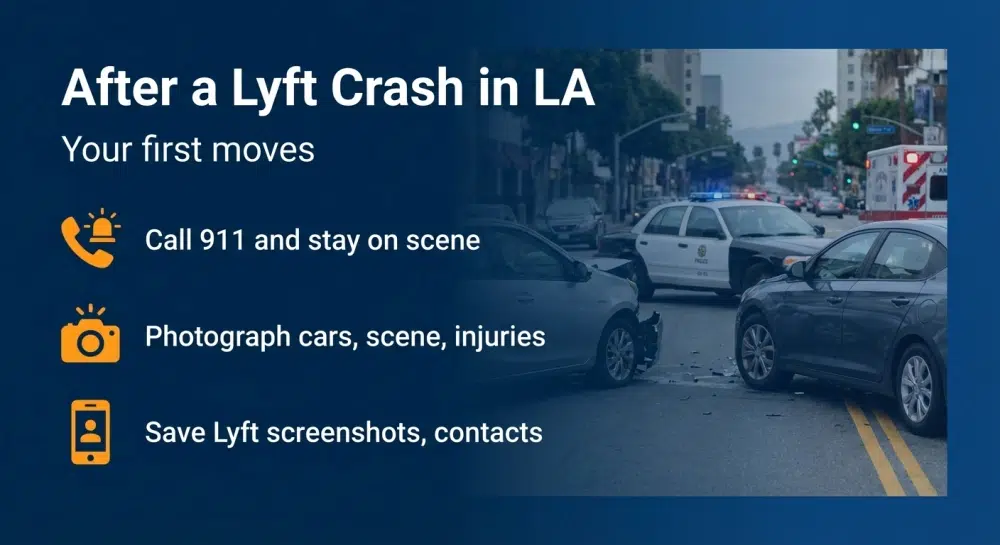
Safety comes first. If you are a Lyft passenger in a crash within Los Angeles, move to a safer location if you can do so without further injury, and call 911. Even if injuries appear minor, a prompt assessment can uncover issues that are not obvious at the scene. Take a calm breath, and use your phone to record what you can.
- Check for injuries: Ask the driver and others if they are hurt, and tell the dispatcher what you see. Follow the instructions of emergency personnel.
- Call 911: Report the crash location with clear landmarks in Los Angeles, for example a freeway exit, cross street, or mile marker.
- Stay at the scene: Unless emergency personnel direct you otherwise, remain present so your statement can be taken by law enforcement for the collision report [4].
- Photograph everything: Capture the Lyft vehicle, other vehicles, license plates, street signs, traffic signals, skid marks, debris, visible injuries, and the interior of the rideshare vehicle, including airbag deployment and seat belt usage indicators.
- Collect contact information: Ask drivers for names, phone numbers, driver license numbers, plates, and insurance details. Get witness names and phone numbers if possible.
- Note Lyft details: Screenshot the trip screen, driver name, vehicle description, and the exact time stamp. Email yourself the Lyft receipt when it arrives, so it is preserved.
- Do not admit fault: As a passenger, you typically are not at fault, but avoid speculation about cause. Provide factual information to police and medical providers.
- Record conditions: Note weather, lighting, traffic, construction, and any hazards. If you overhear admissions by any driver, write them down promptly.
- Secure personal items: If your phone, glasses, or laptop were damaged, photograph them and keep the items for later evaluation.
What personal notes should you create within twenty four hours?
Write a brief, time stamped summary while memories are fresh. Include the route you were on, where you sat in the Lyft, whether you wore a seat belt, the sequence of impacts, and immediate symptoms like headache, dizziness, or neck pain. Email the summary to yourself to create a digital trail.
How do you protect your health and document injuries after a rideshare collision?
Seek prompt medical care the same day if possible. Some injuries are delayed in onset or masked by adrenaline. Timely care protects your health and creates records that insurers use to evaluate your claim.
- Use the emergency department or urgent care: If emergency personnel recommend transport, accept it. If you leave the scene, consider urgent care or your primary care clinic the same day.
- Tell doctors everything: Describe all body areas that hurt, even if pain seems minor. Ask for a written discharge plan, and keep copies of imaging, lab results, and prescriptions.
- Watch for concussion signs: Headache, nausea, light sensitivity, confusion, and memory issues can appear later. Report new symptoms promptly.
- Follow through with care: Attend follow up visits, physical therapy, and referrals. Gaps in care can be used by insurers to argue your injuries resolved.
- Track symptoms: Keep a journal of pain levels, sleep issues, headaches, dizziness, anxiety, and how injuries affect work and daily activities. This helps quantify non economic harm.
- Keep a medication list: Note dosages, timing, and side effects. Update this list at each appointment.
Speaking with car accident lawyers early can help you coordinate documentation and avoid common mistakes that weaken claims.
Do you need to call 911 and file a police report in Los Angeles?
When anyone is injured or killed, California law requires the driver to report the crash to law enforcement without delay, and if a report is not taken at the scene it must be submitted within twenty four hours [4]. As a passenger, you can and should call 911 to request police response. If officers do not respond, go to a station to make a counter report, and keep the receipt.
Separate from law enforcement, many crashes must also be reported to the California Department of Motor Vehicles within ten days if there is injury, death, or property damage that meets the statutory monetary threshold [5]. The driver typically files this DMV report, but if you own a damaged vehicle or are asked to complete any part, consult counsel before submitting forms.
What information goes into a collision report, and can you fix errors?
California collision reports generally include involved parties, insurance, statements, diagram, and contributing factors. If you believe there is an inaccuracy, contact the agency to ask about a supplement request. Provide supporting documents like photos or medical notes. While officers decide whether to amend, a clear written correction can still help during insurance negotiations.
How do you report the crash to Lyft and to insurance companies?
Use the Lyft app Safety Center or the ride receipt to report an incident. Provide basic facts, and avoid commentary about fault or injuries beyond a straightforward description. If you receive outreach from insurance carriers, ask for the claim number and adjuster contact, and explain that you will follow up after you have received medical care and legal guidance.
- Report inside the app: Submit the in app crash report, attach photos if available, and save screenshots of everything you send.
- Record claim numbers: You may hear from Lyft’s insurer, the Lyft driver’s personal insurer, and the other driver’s insurer. Keep a single list of claim numbers and contacts.
- Avoid recorded statements: You are not required to give a recorded statement to another driver’s insurer. It is common to wait until you have counsel before any interview.
- Send preservation letters: Consider asking that telematics, app logs, and dashcam footage be preserved. Digital data can clarify speed, braking, and timing.
- Consider a CPUC complaint for unsafe conduct: If you believe safety rules were violated, you can file a complaint with the California Public Utilities Commission which regulates rideshare companies [14].
What should you avoid saying in early claim calls?
Do not guess about speed, distance, visibility, or the medical prognosis. Avoid phrases like I am fine or I am not injured when you have not completed evaluation. Instead, say you are still being assessed and will share records when available.

What insurance covers you as a Lyft passenger in California?

California requires transportation network companies to maintain specific insurance coverage that varies based on the period of the trip. Coverage applies even if a driver’s personal insurer denies a claim because the vehicle was used for rideshare activity [1] [2].
- Period one, driver logged in, waiting for a ride request: Minimum liability limits apply by statute. The company must maintain primary coverage of at least fifty thousand dollars for bodily injury per person, one hundred thousand dollars per accident, and thirty thousand dollars for property damage, with additional excess coverage, as required by California Insurance Code sections in the rideshare insurance chapter [2].
- Periods two and three, ride accepted and passenger on board: The company must provide at least one million dollars in liability coverage and also one million dollars in uninsured and underinsured motorist coverage for injuries to riders and others, as set by California law for rideshare operations [1].
- Why these rules exist: The California Public Utilities Commission created the transportation network company category and established foundational safety and insurance requirements, later reinforced by statute [3] [1].
As a passenger, you are generally covered by the company policy during the ride and from the moment the driver accepts your trip until the ride ends. The precise coverage that applies in a given crash depends on the app status, which is why saving screenshots of the trip acceptance and timeline matters.
For additional consumer facing guidance on rideshare insurance in California, the Department of Insurance publishes materials for riders and drivers [15].
How do uninsured and underinsured motorist benefits work for passengers?
If another driver causes the crash and has no insurance or too little, uninsured or underinsured motorist coverage during the covered ride period can pay for bodily injury. Your recovery can be limited by policy terms and offsets. Documentation of liability and all categories of harm remains essential to access these benefits within the policy framework.
What damages can a Lyft passenger claim in a California civil case?
Under California law, people have a general right to compensation when they are harmed by the lack of ordinary care of another person or entity [9]. In a Lyft passenger crash, the categories of civil damages often include the following.
- Medical expenses: Emergency care, hospital visits, imaging, specialist visits, therapy, medication, medical devices, and future care if needed.
- Lost income: Past wage loss, and future loss of earning capacity if injuries affect long term work ability.
- Out of pocket costs: Transportation to medical appointments, replacement services for household tasks, and other accident related expenses.
- Pain and suffering: Physical pain, discomfort, inconvenience, emotional distress, and loss of enjoyment of life.
- Property damage: Personal items damaged during the crash, such as phones, glasses, or laptops.
Insurers typically require documentation of each category. Keep medical bills and records, pay stubs or employer letters for wage loss, receipts for other expenses, and photographs and journal entries showing how the injuries affect daily life. For significant injuries, future medical needs may be summarized by your providers or through a life care plan based on clinical recommendations.
Who could be liable for a Lyft passenger’s injuries?
Liability in a rideshare collision often turns on standard negligence principles and the particular facts of the crash.
- Other highway users: Another driver who violated the rules of the road or was inattentive can be held responsible for injuries that follow from that negligence [9].
- Rideshare driver: A Lyft driver who failed to use reasonable care may be liable. When the driver is on the app and in a covered period, the company policy typically responds as primary coverage [1] [2].
- Government entity: If a dangerous roadway condition or negligent maintenance contributed to the crash, a city, county, or state agency might be involved, subject to special notice requirements and immunities [7] [8].
- Product manufacturer: If a vehicle or component defect contributed, a product claim may be explored. This is fact intensive and requires technical investigation.
How is fault proven in a busy Los Angeles corridor?
In urban Los Angeles corridors, investigators often combine photographs, video from businesses or traffic cameras, event data recorder downloads, and witness testimony. Prompt notice to preserve digital evidence can make a difference. Detailed diagrams tied to measurements at the scene help reconstruct vehicle paths and impacts.
What if more than one driver shares fault in California?
California follows pure comparative negligence in civil cases. This means that if multiple drivers share responsibility, the finder of fact assigns percentages of fault, and each party is liable to pay their percentage of the damages. For example, if two drivers each bear half the fault, each pays half of the recoverable loss. This system is grounded in California’s general duty of care codified in the Civil Code and the California Supreme Court’s decision that replaced contributory negligence with comparative fault in civil negligence actions [9] [10].
As a passenger, you are rarely assigned fault, but comparative principles can still affect how different insurers divide payment responsibilities.
What if both drivers deny fault?
When drivers dispute responsibility, your claim can still proceed against multiple carriers. Evidence development becomes central. Independent witnesses, video, and physical damage patterns often resolve standoffs. If settlement is not possible, litigation and discovery can obtain sworn testimony and records that clarify fault allocation.
What are the claim deadlines and statute of limitations in California and Los Angeles?
- Personal injury statute of limitations: Most injury claims in California must be filed within two years from the date of injury [6].
- Claims against public entities: If any California public entity is a potential defendant for a roadway condition or a vehicle operated by a government employee, you usually must file a government claim within six months, and you cannot sue unless and until you comply with that claim presentation rule [7] [8].
- Police and DMV reporting windows: Report to law enforcement without delay when there is injury or death, and complete any required DMV reporting within ten days when statutory thresholds are met [4] [5].
There are exceptions and tolling rules in certain circumstances. Because deadlines are strict, and missing one can end your claim, consider prompt legal guidance even while you focus on medical recovery.
What if the at fault party is not immediately identified?
You can open claims with any potentially responsible insurer while investigation proceeds. Identifying information can emerge later from police reports, video, or vehicle records. Early notice preserves rights while evidence is gathered.
How do you get the police report and key evidence in Los Angeles?
Police reports, photographs, and witness statements often guide insurance decisions. In Los Angeles, traffic collision reports can be requested through the Los Angeles Police Department online portal or in person. The LAPD provides instructions for how to obtain a collision report, including identification and eligibility requirements for involved parties [11].
- Get the report number at the scene: Ask the officer for the report number or a business card. If officers did not respond, ask dispatch how to make a counter report.
- Follow the LAPD process: Submit the request through the city system, and keep copies of your request and any correspondence [11].
- Preserve digital evidence: Save ride screenshots, rideshare receipts, dashcam files, and photos. Back them up in cloud storage, and email them to yourself.
- Identify cameras: Note nearby businesses, traffic cameras, and residences that may have captured the crash. Request that footage be preserved quickly, as many systems overwrite within days.
- Document vehicle damage: Obtain written estimates and detailed photographs. Consistent damage patterns can help prove impact angles and speed.
How can you preserve data from the Lyft app?
Save the trip timeline, driver profile, route map, and receipts. Export any in app communications to your email. If available, request that Lyft preserve relevant data for the ride through your claim or through counsel’s preservation request.
Should you give a recorded statement to an insurance adjuster?
You can provide basic facts like your name, contact information, and the claim number. A recorded statement to the other driver’s insurer is optional, and it is common to wait until medical issues are clearer or to let counsel coordinate. Even your own insurer statement can be scheduled after you are ready.
- Be brief and factual: Do not guess about speeds, distances, or medical diagnoses. Say you will provide medical documentation once available.
- Do not sign broad authorizations: Ask for specific requests rather than open ended medical authorizations.
- Keep a log: Record every call with date, person, and summary, to help avoid confusion later.
How should you respond to early settlement offers?
Early offers often precede full medical evaluation. Consider whether you have completed treatment and understand future needs. If not, ask for time to complete care and gather records. Counter offers typically include a documented summary of injuries and damages with supporting bills and reports.
How do medical bills and liens work after a rideshare crash?
Medical billing after a collision can be complex. As a passenger, your treatment may be billed to your health insurer. If you have medical payments coverage on your own auto policy, it may help pay early bills. Any balances and liens are typically reconciled at settlement or judgment.
- Use health insurance: Present your health plan card to providers. Health coverage can reduce bills, and your plan may later seek reimbursement from settlement funds.
- Understand liens: Hospitals, public plans, and some providers may assert liens. Accurate lien resolution protects your net recovery.
- Track all bills: Keep statements and explanation of benefits, so that final accounting includes every charge and adjustment.
- Ask providers about billing preferences: Some clinics will bill health insurance, while others may offer to defer payment. Request itemized statements and keep copies.
How do out of network charges and balance bills get addressed?
Out of network rates can be higher than negotiated in network rates. At case resolution, providers and plans may agree to reductions based on policy terms, statutory rights, or hardship. Detailed records of coverage, denials, and payments help support fair reductions.
What changes if the Lyft driver was on the app or off the app?
Coverage depends on app status. If the driver had not opened the app or was not available for rides, only personal auto coverage typically applies. If the driver was logged on and awaiting a request, rideshare statutory minimums apply. Once a ride is accepted, or an official Lyft passenger is in the vehicle, larger company policy limits usually apply, including the one million dollars minimum liability and one million dollars uninsured and underinsured motorist coverage for covered injuries [1] [2] [3].
Because these thresholds matter, gather and save screenshots that show when the ride was accepted, the pickup time, and when it ended.
What if multiple policies apply at the same time?
Primary and excess coverage can layer depending on the period and fault allocation. Insurers may dispute priority of payment. Coordinated claims and clear evidence of app status, fault, and damages help resolve which policy responds and in what order.
How do you start a claim or lawsuit in Los Angeles, and what is the timeline?
Many claims resolve with evidence and negotiation. If settlement is not possible, or deadlines are near, a lawsuit may be filed in Los Angeles County Superior Court.
- Open claims with all potential insurers: Company policy, rideshare driver personal policy, and the other driver’s policy may be involved. Request coverage confirmation letters and policy limits when appropriate.
- Build liability proof: Police report, photos, vehicle property damage estimates, witness accounts, and if necessary crash reconstruction.
- Build medical proof: Records and bills from all treating providers, documented diagnoses, and opinions on future care when appropriate.
- Calculate damages: Past medical bills, anticipated future medical needs, wage loss, and non economic harm with supporting documentation.
- Negotiate: Provide a comprehensive settlement presentation when you are medically stable, or when further delay would jeopardize deadlines.
- File suit before deadlines: If suit is required, the complaint, service, and case management deadlines follow local court rules and statewide statutes [6].
Los Angeles car accident lawyers understand local police and court procedures, and can help you avoid missed deadlines while you focus on treatment.
What happens after filing a lawsuit?
After filing and service, the case generally moves through discovery, depositions, potential motions, and settlement conferences. Courts encourage early exchange of information that supports fair resolution. Trial dates depend on court calendars and case complexity.
Why choose GoSuits if you were injured as a Lyft passenger?
If you were hurt as a Lyft passenger in Los Angeles, the path forward involves medical care, layered rideshare insurance, and strict statewide deadlines. A free consultation with a personal injury attorney helps you understand coverage during different ride periods, how to document damages, and when to open claims with each insurer. GoSuits represents clients throughout California and focuses on injury litigation from traffic collisions, including rideshare crashes.
- Technology first approach: GoSuits uses exclusive proprietary software to move cases faster and surface key data points that improve strategy, from pinpointing coverage to modeling damages. Our system helps reduce delays and supports timely decisions.
- Dedicated attorney access: Although we leverage technology to expedite every case, you will work directly with a designated attorney. We do not hand cases to case managers. Every client has open access to their lawyer for updates and strategy.
- Trial tested: Our team brings thirty years of combined experience and a record of trying cases when needed. That courtroom background supports better outcomes in negotiation and at trial.
- Results: We have secured meaningful results for clients across a range of injury cases. See our prior cases for examples of past recoveries.
- Full scope personal injury practice: We handle traffic collisions including rideshare, commercial vehicle, and motorcycle matters, as well as premises liability, product injury, and wrongful death. Explore our practice areas and meet our attorneys. Learn more about us.
If you want to talk through next steps after a Lyft passenger crash, we are ready to listen, explain your options, and take on the work so you can focus on recovery.
References and resources
- California Insurance Code section 5430 rideshare insurance requirements periods and coverage – California Legislature
- California Insurance Code section 5433 minimum liability limits and additional coverage during app on periods – California Legislature
- Decision 13 09 045 creating the transportation network company category – California Public Utilities Commission
- California Vehicle Code section 20008 accident reporting to law enforcement within twenty four hours – California Legislature
- California Vehicle Code section 16000 requirement to report traffic accidents to DMV – California Legislature
- California Code of Civil Procedure section 335.1 two year statute of limitations for personal injury – California Legislature
- California Government Code section 911.2 claim presentation within six months – California Legislature
- California Government Code section 945.4 requirement to present claim before suit against public entity – California Legislature
- California Civil Code section 1714 general duty of ordinary care – California Legislature
- Li v. Yellow Cab Company 13 Cal 3d 804 adoption of comparative negligence – CourtListener
- Traffic collision reports request process for involved parties – Los Angeles Police Department
- California crash statistics and traffic safety quick stats – California Office of Traffic Safety
- Traffic Injury Mapping System statewide crash data and maps – UC Berkeley SafeTREC
- Transportation network company complaint information – California Public Utilities Commission
- Transportation network company insurance guide for consumers – California Department of Insurance