- What should you do first after a UPS delivery truck crash in Los Angeles?
- Which scene evidence matters most in Los Angeles?
- How do you preserve electronic data like EDR, telematics, and dashcams?
- Which federal FMCSA records can support your claim?
- How can police and 911 records help in Los Angeles?
- What medical and employment records should you collect?
- How do you document vehicle and property damage effectively?
- What California deadlines and notice rules apply?
- Who might be liable in a Los Angeles UPS truck collision?
- How does comparative negligence affect recovery in California?
- What defense tactics appear often and how can evidence respond?
- How is the evidence used in negotiation, mediation, and trial?
- Why choose GoSuits for a Los Angeles UPS delivery crash case?
- References and Resources
What should you do first after a UPS delivery truck crash in Los Angeles?
Your safety comes first. Call 911, accept medical care, and follow the instructions of first responders. If you can do so safely, begin preserving evidence right away. Delivery truck scenes in Los Angeles change quickly because traffic moves fast, vehicles are towed, and surveillance systems overwrite video on short cycles. Early steps you take may make a meaningful difference later.
It is understandable to feel overwhelmed. Consider contacting Los Angeles truck accident lawyers as soon as you are able. Early legal help can send preservation letters and coordinate retrieval of crucial electronic data from the UPS vehicle before it is lost.
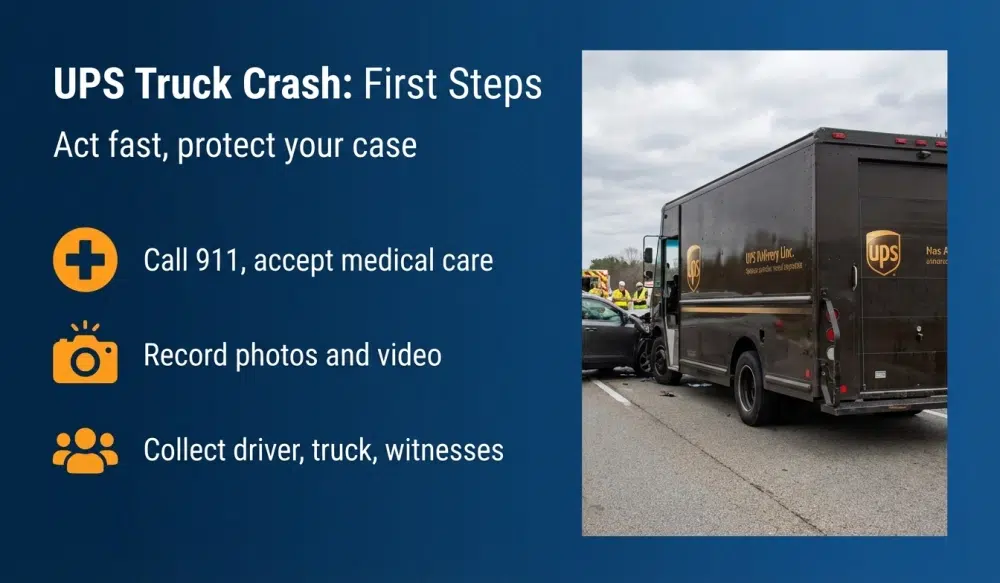
- Call 911 and request police response. Officers can secure the scene and generate a collision report used by insurers and courts. That report number will help you request records later [12].
- Seek prompt medical evaluation. Even if you feel fine, some injuries emerge hours or days later. Your medical records will anchor any claim for injuries and treatment [11].
- Collect basic information. Note the UPS truck number, license plate, the driver’s name, DOT number on the door, and any employer contact details. Many UPS units display a USDOT number that allows you to look up the carrier’s profile [13].
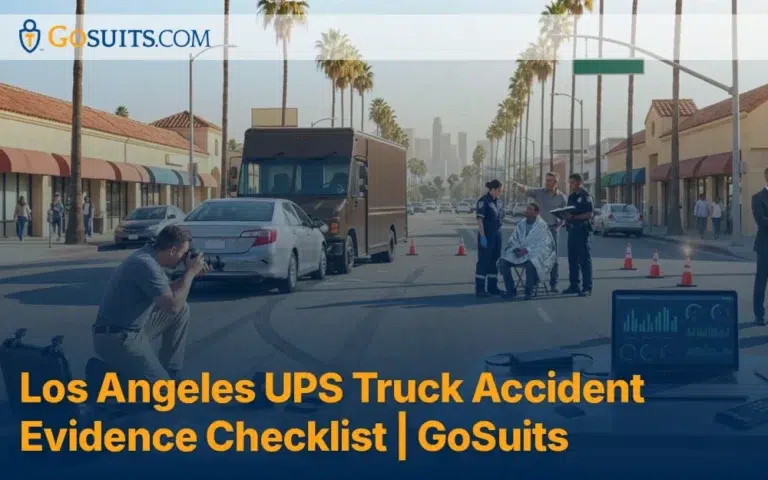
- Preserve photos and video. Photograph vehicles, cargo, skid marks, traffic controls, lane markings, weather, lighting, and any visible injuries.
- Identify witnesses. Get names, contact details, and quick voice memos about what they saw.
- Avoid detailed statements to insurers. Provide basic facts only until you have had a chance to review the police report and your medical status.
Which scene evidence matters most in Los Angeles?
Los Angeles streets present unique conditions, from peak traffic on the 405 and 101 to narrow neighborhood delivery routes. Your checklist should reflect local realities while capturing universal proof of fault and damages.
- Scene photographs. Take wide shots to show intersection geometry and sight lines, mid-range shots to show vehicle positions, and close-ups of impact points, tire marks, debris, fluid trails, and airbag deployment. Include reference objects like lane stripes and crosswalks for scale. Add time and location stamps if possible.
- Traffic control evidence. Photograph traffic signals, stop signs, speed limit signs, and delivery restrictions. If a signal was malfunctioning, capture that too.
- Roadway condition documentation. Note potholes, construction zones, faded paint, or blocked signage. Document temporary traffic control devices around construction if present.
- Delivery activity proof. Capture parcels on dollies, open cargo doors, hazard triangles, or the absence of warning devices. Delivery context can bear on stopping, parking, or loading practices.
- Witness contact list. Los Angeles collisions often have multiple observers including pedestrians, cyclists, rideshare drivers, and nearby businesses. Gather a robust witness list with phone and email.
- Immediate notes. Create a short memo on your phone describing events while fresh in your mind, including time, speed estimate, lane location, signal phase you observed, and any statements you heard at the scene.
How do you preserve electronic data like EDR, telematics, and dashcams?
Electronic data can provide timing, speed, braking, and location information that is difficult to dispute. Many delivery fleets use several systems at once.
- Event Data Recorder insights. Many vehicles record pre and post crash data such as speed, brake application, throttle position, and seatbelt status. Federal rules define core data for many passenger vehicles under 49 CFR Part 563 [6], and the National Highway Traffic Safety Administration provides guidance about these devices [5]. Heavy commercial vehicles may rely on engine control modules and telematics outside Part 563, yet they still often capture valuable crash data.
- Telematics and GPS logs. UPS and similar carriers frequently use fleet telematics that capture route history, harsh braking, idling, and speeds at specific locations. These records can tie a truck to a lane of travel at a specific time.
- Onboard and outward facing dashcams. Many fleets record forward road view and sometimes driver facing video. These systems often overwrite within days or weeks, so prompt preservation is critical.
- Electronic Logging Device and hours of service data. Federal rules require motor carriers to keep hours of service records for at least six months, and to maintain related supporting documents for compliance checks [1].
- Preservation step. Send a written spoliation and preservation notice quickly that instructs the carrier to retain EDR imaging, telematics, dashcam files, ELD records, and any incident reports. Preserve cell phone data for all drivers if distracted driving is suspected. Courts may allow adverse inferences for willful suppression of evidence under California law [9], and federal rules address sanctions for loss of electronically stored information when litigation is reasonably anticipated [10].
Which federal FMCSA records can support your claim?
Mosaic evidence from federal motor carrier safety records can show whether a driver and company met baseline safety duties before and after the crash.
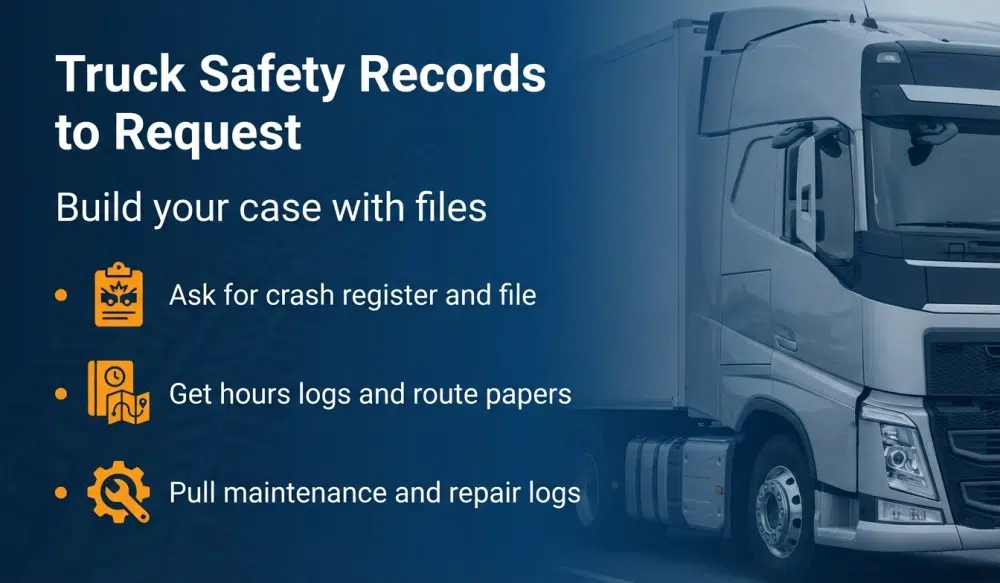
- Accident register. Carriers must maintain an accident register and accident files with specific details for three years following each crash [3]. Ask for the register entry, investigative file, and any photos or internal reports.
- Hours of Service logs. Request ELD data, edits and annotations, unassigned driving logs, and supporting documents such as fuel receipts and bills of lading, which help verify routes and hours [1].
- Inspection, repair, and maintenance. Maintenance records can reveal chronic brake, lighting, or tire issues. Federal rules require systematic inspection and repair programs, with retention of records for vehicles under the carrier’s control [2].
- Post accident testing. For certain crashes, DOT rules require alcohol and controlled substances testing of CDL drivers. Obtain testing documentation and timing to determine compliance [4].
- Carrier profile. Use the USDOT number on the truck to locate the motor carrier in federal systems like the SAFER Company Snapshot, which provides basic identification, operation classification, and inspection history [13].

How can police and 911 records help in Los Angeles?
Official records often define the narrative that insurers and juries see first.
- Traffic collision report. In California, collisions are typically recorded on the CHP 555 form. You can request a copy through the California Highway Patrol if it is a CHP investigation, or through the investigating city department when applicable [12].
- 911 audio and CAD logs. Dispatch recordings and computer aided dispatch logs can verify timing, location, reported hazards, and observed driving. Ask for preservation within days because many systems recycle recordings.
- Body worn camera and in car video. Where available, request responding agency video under applicable public records rules. These often capture positions of vehicles, driver statements, and the scene layout.
- Collision scene diagrams. Obtain scale diagrams and measurements, which help reconstruction experts analyze speed and angles.
What medical and employment records should you collect?
Your health records and financial documentation quantify the impact of a UPS delivery truck accident on your life.
- Treatment records and imaging. Gather emergency care records, physician notes, diagnostic imaging, physical therapy notes, and pharmacy records. Federal privacy rules recognize a patient right of access to medical records, which helps you obtain copies quickly [11].
- Symptom diary and pain journal. Keep a daily record of pain levels, limitations, and missed activities. Note sleep disruption, transportation challenges, and caregiving needs.
- Work and income proof. Collect pay stubs, W2s, 1099s, offers of employment, and employer letters confirming missed time and reduced duties. Self employed individuals should compile invoices and profit and loss summaries.
- Out of pocket costs. Track co pays, medical equipment, transportation to appointments, and help with household tasks.
How do you document vehicle and property damage effectively?
Clear visuals and organized estimates help insurers and juries see the physical impact of the crash.
- Multi angle photos. Photograph all sides of your vehicle and the UPS truck, under hood components if visible, wheel alignment, and any intrusion into the cabin. Include close ups of broken glass, crumple zones, and deployed airbags.
- Repair estimates and appraisals. Obtain written estimates from reputable shops and retain all parts invoices. Keep versions if the estimate changes after teardown.
- Salvage and total loss documents. If your vehicle is a total loss, collect valuation reports and title transfer paperwork.
- Personal property inventory. List damaged items inside the vehicle such as phones, child seats, or work tools. Keep purchase receipts where possible.
What California deadlines and notice rules apply?
California law sets clear timelines. Missing a deadline can limit your options.
- Personal injury and wrongful death. In most cases, you have two years from the date of injury or death to file a civil lawsuit in California court [7].
- Claims against public entities. If a government vehicle or roadway condition is involved, you must present a written claim within six months in most cases, before filing suit, under the Government Claims Act [8].
- Preservation requests. Send spoliation and preservation notices as soon as possible, sometimes within days of the crash, to protect electronic and physical evidence under state and federal discovery rules [9] [10].
- Medical records retrieval. Use your federal right of access to request complete records quickly to avoid gaps in proof [11].
If your case could be filed in federal court, be aware that federal rules for discovery and preservation apply once litigation is reasonably anticipated, and courts expect early cooperation on evidence issues [15].
Who might be liable in a Los Angeles UPS truck collision?
Liability in a UPS delivery crash can involve more than one party. The facts dictate who is responsible and in what proportion.
- UPS driver. Allegations might include speeding, unsafe lane change, failure to yield, following too closely, or distracted driving. Hours of service compliance and route planning can matter.
- Employer or motor carrier. Carriers can be responsible for negligent hiring, retention, training, supervision, and for systemic violations of safety regulations, as well as vicarious liability for on duty driving.
- Vehicle owner or maintenance contractor. If a third party handled maintenance, poor inspections or repairs may be at issue, especially for brakes, tires, steering, and lighting. Federal maintenance requirements provide measurable benchmarks [2].
- Shippers and loaders. Improper loading or overweight cargo can affect braking and stability, which may contribute to the crash dynamics.
- Public entities. Dangerous roadway conditions and signal malfunctions can play a role. Different procedures apply to claims against public entities [8].
How does comparative negligence affect recovery in California?
California uses comparative fault principles that allow courts and juries to allocate responsibility among all involved actors. The Judicial Council’s Civil Jury Instructions describe how fault may be assigned to each party and how damages are reduced accordingly. For example, instruction 405 addresses comparative fault concepts in negligence cases [14].
Evidence that clarifies timing, speeds, signal phases, and driver behaviors can reduce arguments about shared responsibility. Video footage, EDR data, and reliable witness statements often carry significant weight when fault is contested.
What defense tactics appear often and how can evidence respond?
Defendants and insurers frequently raise recurring themes. A methodical checklist helps you respond with facts.
- Sudden emergency or unavoidable crash. Respond with telematics and EDR timelines, scene measurements, and driver logs that show speed, following distance, and reaction times. Map these against posted limits and traffic controls.
- Disputes about impact severity. Present photos, repair estimates, and frame or alignment measurements. Dashcam and surveillance video can illustrate force and occupant motion better than words.
- Preexisting conditions. Use medical imaging and physician notes to distinguish between prior and new findings. Show the change in function with contemporaneous activity logs and employer records.
- Compliance claims. If the defense asserts perfect compliance, request the accident register entry, hours of service logs, maintenance records, and post accident testing documentation. Compare these to federal requirements [1] [2] [3] [4].
- Video gaps. When dashcams loop or fail, send targeted preservation requests early and cite duties to preserve relevant electronic data. Courts may consider sanctions or adverse inferences where warranted [9] [10].
If negotiations stall, truck accident lawyers can use subpoenas and forensic downloads to secure missing data, and can retain reconstruction and human factors professionals to explain technical evidence to a jury.
How is the evidence used in negotiation, mediation, and trial?
Evidence drives outcomes at every stage. Organize it from day one using the structure below.
What should your pre suit demand package include?
- Executive summary. Describe the crash sequence in simple terms with a timeline.
- Liability proof. Attach key photos, diagrams, and if available, short clip stills from dashcam video. Include a brief analysis referencing traffic controls and federal safety rules.
- Driver and carrier records. Highlight significant items from the accident register, hours of service, and maintenance records [1] [2] [3].
- Medical and loss documentation. Provide treatment summaries, medical bills, and wage loss support.
- Comparative fault analysis. Explain why the evidence points to the defendant’s responsibility under California instructions on negligence and comparative responsibility [14].
How do you prepare for mediation and settlement talks?
- Video and animation. Prepare short demonstratives showing the approach, impact, and post impact path to help neutral evaluators grasp the dynamics quickly.
- Adverse inference leverage. If key electronic evidence was not preserved, explain how a jury may view missing data under California and federal principles [9] [10].
- Medical clarity. Create a one page chart listing diagnoses, dates, and providers, with totals for bills and projected care.
What trial exhibits often resonate with juries?
- Dashcam and surveillance clips. Short, focused clips linked to a timeline help jurors follow complex events.
- EDR graphs and maps. Display speed, braking, and throttle data with clear legends, tied to distance markers and intersection features.
- Maintenance and inspection highlights. Use side by side excerpts of maintenance schedules and actual work orders to show gaps [2].
- Accident register excerpt. Introduce the carrier’s own crash record entry and any internal corrective action plans [3].
Why choose GoSuits for a Los Angeles UPS delivery crash case?
We help people after delivery truck crashes in California and across neighboring jurisdictions. This includes cases arising in Los Angeles, CA, where commercial fleets operate in dense traffic and evidence can disappear fast. A free consultation can help you understand timelines, the evidence checklist, and next steps tailored to your situation.
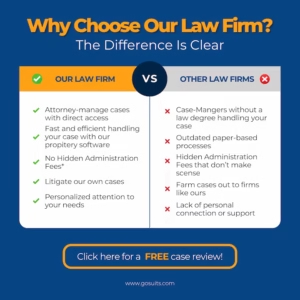
- Technology driven approach. GoSuits uses exclusive proprietary software to surface key facts sooner, organize evidence, and accelerate case milestones without losing accuracy.
- Real attorney access. Although technology expedites work, every client has a designated attorney. We do not use case managers for primary communications. You have direct access to your lawyer throughout the case.
- Proven results. Our team has secured meaningful outcomes for clients in transportation cases of many sizes. See a sampling of prior cases.
- Experienced trial team. With 30 years of combined experience, our attorneys prepare every case as if it may go to trial, which can improve negotiation posture and courtroom readiness.
- Practice coverage. We handle personal injury matters that include commercial vehicle collisions, serious roadway injuries, and related claims. Learn more about our practice areas and meet our attorneys. For firm background, visit about us.
If your Los Angeles UPS crash involves contested evidence, Los Angeles truck accident lawyers can help move quickly to secure dashcam clips, EDR imaging, driver logs, and maintenance files before they are overwritten.
When you need a steady legal team for a commercial delivery collision, our truck accident lawyers combine careful investigation with focused courtroom strategy to advance your claim efficiently and with care.
References and Resources
- Hours of Service of Drivers 49 CFR Part 395 – eCFR
- Inspection, Repair, and Maintenance 49 CFR Part 396 – eCFR
- Assistance in Investigations and Accident Registers 49 CFR 390.15 – eCFR
- Post-Accident Testing 49 CFR 382.303 – eCFR
- Event Data Recorders EDR Overview – NHTSA
- Event Data Recorders 49 CFR Part 563 – eCFR
- California Code of Civil Procedure Section 335.1 – California Legislative Information
- California Government Code Section 911.2 – California Legislative Information
- California Evidence Code Section 413 – California Legislative Information
- Federal Rule of Civil Procedure 37 Electronic Information – LII Cornell Law School
- Individuals Right under HIPAA to Access Health Information – HHS
- Collision Report Information and Requests – California Highway Patrol
- Company Snapshot Motor Carrier Profile – FMCSA SAFER
- Civil Jury Instructions CACI Resource Center – Judicial Council of California
- Current Rules of Practice and Procedure – United States Courts