- What should you do first at a Los Angeles truck crash scene to preserve evidence?
- What photos and videos are essential and how do you take them safely?
- Which official reports matter and how do you get them in Los Angeles?
- What medical records and logs help prove injury and causation?
- What witness evidence should you collect and how do you follow up?
- How do ELD and black box data help and how do you obtain them?
- Which trucking company records should be preserved after a crash?
- What digital evidence can support your claim?
- How do you send an effective spoliation letter in California?
- What deadlines apply in California truck crash cases?
- How do fault, comparative negligence, and insurance work in California?
- What damages can be documented in a civil truck crash case?
- How do you build a timeline and evidence vault?
- What common defense tactics target evidence and how do you respond?
- What if a government vehicle or road defect contributed?
- How do federal rules shape evidence in interstate trucking claims?
- Where can you request local Los Angeles records and data?
- Who is GoSuits and how can technology help your Los Angeles truck crash case?
- References and resources
What should you do first at a Los Angeles truck crash scene to preserve evidence?
If you can do so safely, start preserving evidence right away. Safety comes first. Move to a safe area, call 911, and accept medical evaluation. Once immediate danger has passed, your goal is to document conditions before vehicles move or debris is cleared. Photograph vehicle positions, skid or yaw marks, road surface defects, traffic control devices, lane markings, and any cargo on the roadway. Note weather, lighting, and visibility. If hazardous materials may be involved, keep a safe distance and wait for first responders.
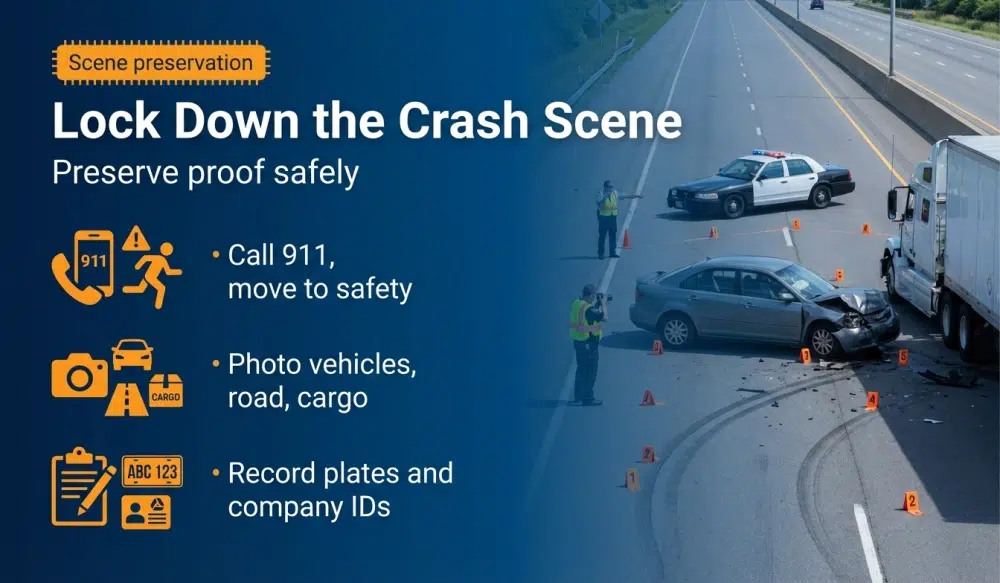
Ask the commercial driver for identifying information. Photograph the tractor and trailer unit numbers, the license plates, the United States Department of Transportation number on the cab, and any company branding. The DOT number helps identify the motor carrier responsible for records like hours of service, maintenance logs, and accident registers that federal regulations require motor carriers to keep [1] [4]. If you are transported for medical care, a trusted friend or family member can gather this basic documentation.
Exchange information with all involved drivers and request names and contact details of passengers and witnesses. Ask responding officers how to request the official collision report later, which often becomes a central record insurers and courts consult. The California Vehicle Code requires drivers to report qualifying crashes to the Department of Motor Vehicles within ten days, and the DMV makes the SR 1 form available online [9] [10].
What photos and videos are essential and how do you take them safely?
Photos and video can make or break a truck crash case. Take wide shots to capture context, then medium and close views for detail. Work in a clock pattern around each vehicle so that you preserve consistent angles. Include:
- Vehicle positions and damage front, rear, sides, undercarriage if visible, intrusion into the cabin, and airbag deployment.
- Roadway evidence skid marks, fluid trails, gouges, tire scrub, broken glass, guardrail or curb strikes, and debris fields.
- Traffic controls signals, signs, crosswalks, lane arrows, and any temporary construction controls.
- Environment sun position, shadows, wet or oily pavement, potholes, and landscaping that may limit sight lines.
- Cargo spilled freight, torn tarps, defective tie downs, or shifting loads that hint at securement issues governed by federal cargo rules [15].
- Injuries bruising, lacerations, and visible swelling photographed respectfully and privately, then continue to document healing and treatment milestones.
Record short narrated videos to capture what happened in your own words while memories are fresh. Back up files to a secure cloud folder the same day. When possible, capture nearby businesses that may have exterior cameras and note their addresses so that preservation requests can be sent quickly.
Which official reports matter and how do you get them in Los Angeles?
Official reports often anchor a civil claim. In Los Angeles, collisions are typically investigated by the Los Angeles Police Department, the Los Angeles County Sheriff’s Department, or the California Highway Patrol. Ask the officer for the report number and the agency’s records unit. Obtain:
- Traffic collision report the primary investigative document, often including diagrams, apparent violations, and contributing factors. Though not conclusive on liability, it guides follow up interviews and evidence requests.
- Supplemental reports commercial enforcement or scale reports if weight or securement are issues, and any reconstruction supplements.
- DMV SR 1 filing confirmation California requires drivers to file SR 1 for crashes involving injury, death, or property damage above the statutory threshold [9] [10].
- Emergency response records fire department and paramedic run sheets documenting initial injury observations and vital signs.
For broader safety context, California’s Office of Traffic Safety publishes city and county collision rankings and data tools that show how Los Angeles compares on key crash indicators [11].
What medical records and logs help prove injury and causation?
Medical records connect the crash to your injuries. Start a file with:
- Emergency department records triage notes, imaging, and discharge instructions.
- Primary care and specialist notes diagnosis, treatment plans, referrals, and restrictions.
- Therapy and rehabilitation logs physical therapy, occupational therapy, and home exercise notes.
- Pharmacy records prescriptions and over the counter medications used for symptom management.
- Work records time off, modified duties, and wage loss documentation.
- Pain and activity diary daily entries describing symptoms and the effect on sleep, mobility, and family responsibilities.
Consistency matters. Make sure symptom descriptions in your medical history match your lived experience and the mechanics of the crash. If you are referred to specialists or imaging, keep appointment confirmations and results together with your running medical index.
What witness evidence should you collect and how do you follow up?
Independent witnesses can validate how the crash occurred. Gather full names, phone numbers, emails, and short statements at the scene if safe. Ask witnesses for any photos or videos they captured. Within a few days, send a polite thank you and request permission to record a detailed statement. Note vantage points, distances, and any obstructions. If a business has security video, ask how long footage is kept and promptly send a preservation request, because many systems overwrite within days.

How do ELD and black box data help and how do you obtain them?
Commercial drivers generally must use electronic logging devices to record hours of service. HOS rules limit driving time and mandate rest to reduce fatigue, and violations can support negligence theories in civil cases [1] [2]. ELD data can reveal driving hours, duty status changes, and location breadcrumbs around the crash window.
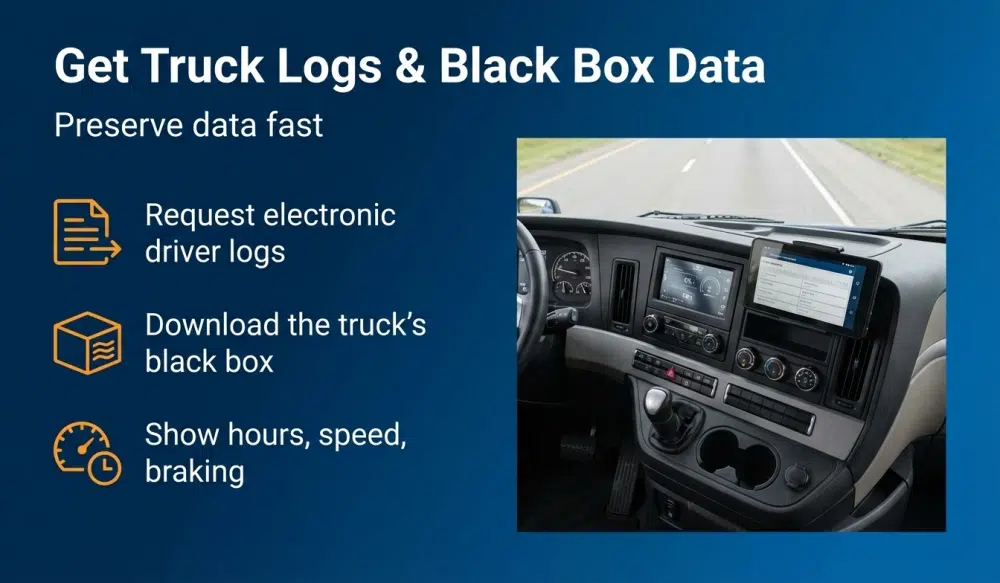
Many tractors also record engine control module or event data that captures speed, brake application, RPM, throttle, and fault codes seconds before and after impact. While not mandated like ELD, this black box style data is often discoverable and must be preserved once litigation is reasonably anticipated. A timely preservation letter puts the motor carrier on notice of its retention duties. If a carrier discards electronically stored information after notice, courts may impose sanctions under federal rules depending on intent and prejudice [12].
Ask promptly for ELD driver logs, supporting documents, and any event data from the tractor and trailer telematics. Request that the unit not be put back into service until downloads are complete by a neutral technician, or at least that a forensically sound image be taken.
Which trucking company records should be preserved after a crash?
Federal regulations require motor carriers to maintain specific safety and operational records. Your preservation request should identify categories relevant to fault and damages. Key items include:
- Hours of service ELD data, any paper logs, and supporting documents such as fuel, toll, and dispatch records for at least thirty days before the crash and thirty days after if relevant [2].
- Accident register carriers must keep an accident register with specified data points that can help identify trends and prior similar incidents [4].
- Driver qualification file application, motor vehicle records, road test or equivalent, prior employer safety inquiries, medical certificate, and annual reviews required for commercial drivers [2].
- Inspection and maintenance periodic and systematic inspection, repair, and maintenance records, driver vehicle inspection reports, and certifications of correctives after defects are noted [3].
- Cargo and weight bills of lading, weight tickets, and records showing securement methods subject to federal cargo securement standards [15].
- Drug and alcohol testing post crash testing records when testing thresholds are met, as well as random and reasonable suspicion program documentation, addressed by federal testing rules [14].
- Policies and training safety manuals, fatigue policies, dispatch protocols, and remedial training records.
These records, when combined with scene documentation and medical evidence, often reveal whether the motor carrier followed federal and California safety requirements. They can also expose systemic issues such as inadequate maintenance scheduling or unrealistic dispatch that pressures drivers to violate hours of service limits [1] [3].
What digital evidence can support your claim?
Digital traces can fill gaps. Consider:
- Dashcam and onboard camera video from your vehicle and the commercial vehicle, including driver facing and road facing feeds.
- Telematics and GPS device logs from fleet management systems showing speed, routes, harsh braking, and idling.
- Cell phone records call and data usage logs around the time of the crash if distraction is suspected. Request carrier preservation quickly.
- Surveillance video from nearby businesses, transit stops, or residences. Many systems overwrite within days.
- Smart intersection or traffic sensor data where available from municipal agencies.
- Social media posts from witnesses or involved parties that mention the crash.
Coordinate collection so that chain of custody is clear and file integrity is preserved. If a party fails to preserve relevant electronically stored information after notice, courts can apply remedies that range from additional discovery to sanctions depending on the jurisdiction and facts [12] [13].
How do you send an effective spoliation letter in California?
A spoliation or preservation letter should be sent as soon as possible to the motor carrier, its insurer, the trailer owner, the shipper or broker if cargo is relevant, and any maintenance or telematics vendors. The letter should:
- Identify the crash date, time, location, vehicle identifiers, and the parties.
- Describe specific categories of evidence to preserve, including ELD, event data, telematics, inspections, drug and alcohol test records, repair orders, and any video.
- Request a litigation hold for relevant custodians and systems.
- Propose a protocol for forensic imaging or supervised downloads of electronic systems.
- Remind the recipient of preservation duties once litigation is reasonably anticipated and of potential consequences for destruction or alteration of electronically stored information under the civil rules and California evidence law [12] [13].
Send by certified mail and email to create a clear record. If you believe a third party holds crucial video, follow up with a targeted request and be prepared to seek a subpoena after a lawsuit is filed.
What deadlines apply in California truck crash cases?
California’s statute of limitations for bodily injury arising from negligence is generally two years from the date of injury, and for wrongful death it is two years from the date of death [7]. If a public entity may be responsible, such as a city department or a county agency, a government claim often must be filed within six months, with limited exceptions [8]. Missing these deadlines can bar a civil claim regardless of fault.
Separate administrative deadlines may also apply to insurance policy notice provisions. Act quickly to identify the correct defendants and insurers, especially where the tractor, trailer, and broker are different companies with different policies.
How do fault, comparative negligence, and insurance work in California?
California uses pure comparative negligence, which means responsibility for damages can be divided by percentage of fault among all parties. In a truck crash, potential defendants can include the driver, the motor carrier, the trailer owner, a maintenance contractor, a shipper, or others. Evidence such as HOS violations, improper cargo securement, or poor maintenance may shift responsibility toward the carrier under federal safety rules and California negligence law [1] [3] [15].
Most commercial motor carriers maintain layered insurance that can include primary liability, excess policies, and sometimes separate coverage for trailer owners or shippers. Identify all policies early and request policy language and limits in discovery. Many people consult truck accident lawyers to coordinate investigations across multiple defendants and insurers while preserving critical electronic records before they are overwritten.

What damages can be documented in a civil truck crash case?
Damages in civil truck crash cases include economic and non economic harms. Build a record that is clear and verifiable:
- Medical costs hospital, clinic, therapy, imaging, and medication expenses with itemized bills and explanations of benefits.
- Wage loss pay stubs, tax returns, employer letters, and disability forms.
- Loss of earning capacity vocational assessments and work limitations supported by medical opinions.
- Property damage repair estimates, total loss valuations, and diminished value opinions where appropriate.
- Household services replacement costs for tasks you can no longer perform.
- Pain and suffering daily impact statements and corroboration from friends and family.
Nationally, large trucks are involved in a significant share of severe traffic outcomes. Federal safety data show thousands of large trucks involved in fatal crashes each year and a high number of injury crashes, underscoring the stakes for thorough evidence collection in these cases [5] [6].
How do you build a timeline and evidence vault?
A good case file pairs an evidence index with a simple master timeline. Start with the crash day and work backward and forward. Include dispatch orders, driver off duty and on duty periods, weigh station records, maintenance events, and medical milestones. Tag each event with a source document. A secure digital vault with organized folders lets you share materials with your legal team efficiently.
Consider two parallel timelines: one for the driver and vehicle and one for your medical course. The driver timeline should highlight HOS compliance, route choices, and inspections. The medical timeline should trace symptoms, diagnoses, treatments, and recovery benchmarks. When presented together, these timelines can clarify causation and damages for an adjuster or jury [1] [2] [3].
What common defense tactics target evidence and how do you respond?
Defense strategies often focus on narrowing or undermining evidence. Anticipate and prepare for:
- Pointing to missing records arguing that the absence of video or logs means the event cannot be proved. Respond with prompt preservation letters and sworn testimony about what existed and when it was requested, and rely on the court’s power to address spoliation where appropriate [12] [13].
- Blaming fatigue or distraction on you by referencing your phone records or work schedule. Counter with your phone usage logs, vehicle infotainment data, and independent witness accounts.
- Claiming unpreventable accident by focusing on sudden emergencies. Use maintenance and cargo records to test whether better inspection, securement, or speed control would have avoided harm [3] [15].
- Challenging medical causation by pointing to preexisting conditions. Meet this with clear imaging comparisons, treating provider opinions, and a consistent symptom timeline.
If evidence is lost after a preservation notice, courts have tools to address prejudice, from additional discovery to adverse inferences depending on the circumstances and the jurisdiction’s rules [12] [13].
What if a government vehicle or road defect contributed?
When a public entity or employee may be involved, special procedures apply. Claims against city, county, or state agencies often require a government claim within six months before a lawsuit can be filed, with limited exceptions [8]. If you suspect a road defect, preserve photos and measurements quickly and request maintenance logs and prior complaints. If a government truck is involved, request agency vehicle inspection and driver training records, which mirror many federal requirements for commercial fleets.
How do federal rules shape evidence in interstate trucking claims?
Federal safety rules provide a roadmap for what to request and why. Hours of service requirements limit driving time and require rest breaks, and ELD records support verification [1] [2]. Inspection and maintenance rules require carriers to keep systematic maintenance records and driver inspection reports, which can reveal chronic defects if they exist [3]. Carriers must also maintain an accident register with specified details that help identify patterns [4].
In a cargo shift or spill, the cargo securement standards outline the minimum number and strength of tiedowns and special rules for specific commodities [15]. Post crash, federal testing rules may require alcohol and controlled substances testing in certain circumstances, and those records may be relevant to fault and damages [14].
Where can you request local Los Angeles records and data?
Los Angeles crash investigations may be handled by city police, county sheriff, or the highway patrol depending on location and roadway type. Ask the investigating officer for the report number and the specific records unit to contact. For broader safety context, the California Office of Traffic Safety publishes city and county collision rankings and data dashboards that help compare collision trends across years [11]. California DMV provides the SR 1 form and instructions for filing crash reports when required by law [10].
National data from FMCSA and NHTSA offer additional context for large truck risk patterns, including annual counts of large trucks involved in fatal crashes and the most common driver and vehicle factors recorded in investigations [5] [6].
What is the complete Los Angeles truck crash evidence checklist you can use today?
Use this practical checklist to guide your documentation and requests:
- Safety and notifications call 911, move to safety, accept medical evaluation, notify your insurer promptly.
- Scene capture photos and video of vehicles, road evidence, cargo, traffic controls, weather, and lighting.
- Identifying details driver license, insurance, DOT number, unit numbers, plate numbers, company name, trailer owner, broker if known.
- Witnesses names, contact details, brief statements, consent for follow up.
- Official reports police or CHP report number, request process, EMS and fire run sheets, DMV SR 1 filing if required [9] [10].
- Medical records emergency, specialist, therapy records, imaging, pharmacy, work notes, symptom diary.
- Vehicle data request ELD logs, supporting documents, ECM event data, dashcam video, telematics, and GPS [1] [2].
- Carrier records driver qualification file, inspection and maintenance logs, driver inspection reports, accident register, cargo and weight records, policies and training [3] [4] [15].
- Drug and alcohol testing post crash tests if applicable and program documentation [14].
- Preservation letters send to all stakeholders, request litigation holds, propose download protocols, cite duties and consequences [12] [13].
- Timeline and index build a master timeline for driver and medical events, maintain a document index with source and date.
Given the complexity of federal and California rules, many people in Los Angeles choose to work with Los Angeles truck accident lawyers who can coordinate rapid preservation and targeted discovery while you focus on recovery.
What are the roles of the driver, carrier, shipper, and others in evidence collection?
Liability can extend beyond the driver. The motor carrier often controls hiring, training, dispatch, and maintenance. A trailer owner may be responsible for equipment defects. A shipper or loader may be responsible for improper cargo securement under certain circumstances, particularly if load securement was not apparent to the driver. Evidence requests should map to each party’s control of relevant systems and documents, including ELD servers, maintenance platforms, and shipping portals [3] [15].
Why is coordinated legal help important in truck crash evidence work?
Commercial cases move quickly because electronic data can be overwritten by normal operations. Coordinated legal help can send immediate preservation letters, identify all parties, and manage subpoenas and depositions. It can also frame requests using the structure of federal safety regulations so that responses arrive in a usable format. This coordination is especially important when multiple insurers are involved or when out of state carriers operate under federal authority in California [1] [2] [3].
Choosing the right support matters. Many people choose to speak with truck accident lawyers to align investigation resources, protect against spoliation risks, and prepare a claim that can be evaluated on the merits.

What do national and California statistics say about large truck crashes?
Federal safety agencies analyze crash trends each year. FMCSA’s annual crash facts report details the number of large trucks involved in fatal and injury crashes and highlights driver, vehicle, and roadway factors observed by investigators [5]. NHTSA’s traffic safety resources provide additional national context, including trends for fatalities, injuries, and risk factors associated with large truck traffic [6]. California’s Office of Traffic Safety publishes city and county comparisons that show how large urban areas like Los Angeles rank on key metrics among jurisdictions of similar size [11]. These data underscore why thorough evidence collection is vital in heavy vehicle collisions.
Who is GoSuits and how can technology help your Los Angeles truck crash case?
If you were hurt in a Los Angeles truck crash, a focused, evidence driven approach can make a difference. GoSuits handles civil injury matters across California and neighboring jurisdictions, bringing a technology forward process to collect, organize, and analyze complex trucking evidence quickly. We offer a free consultation so you can understand the process, the timelines, and the documents and data that will support your claim.
We built exclusive proprietary software to accelerate preservation letters, track deadlines, and assemble ELD, telematics, and maintenance records into a clear timeline. Our platform helps surface patterns and gaps early so we can act fast, while every client works directly with a designated attorney rather than a case manager. You have direct access to your attorney throughout the case.
Our team has more than 30 years of combined experience and a record of favorable results for clients in serious injury and wrongful death cases. You can review a selection of prior cases, learn about our attorneys, and read more about us. We prepare every case with trial in mind, which helps frame discovery and preserves your options if settlement is not possible. Our practice areas include truck crashes, car and motorcycle collisions, premises liability, product injuries, and other personal injury matters.
For many Angelenos, coordinating with truck accident lawyers in Los Angeles provides a practical way to gather and protect time sensitive evidence, communicate with multiple insurers, and move a case forward while you focus on medical care and family.
References and resources
- Summary of Hours of Service Regulations – FMCSA
- 49 CFR Part 395 Hours of Service and ELD – eCFR
- 49 CFR Part 396 Inspection Repair and Maintenance – eCFR
- 49 CFR 390.15 Accident Register and Investigations – eCFR
- Large Truck and Bus Crash Facts 2021 – FMCSA
- Large Trucks Safety Topic – NHTSA
- California Code of Civil Procedure section 335.1 – California Legislature
- California Government Code section 911.2 – California Legislature
- California Vehicle Code section 16000 – California Legislature
- Traffic Accident Report SR 1 – California DMV
- Collision Ranking Results – California Office of Traffic Safety
- Federal Rule of Civil Procedure 37 ESI Sanctions – LII
- California Evidence Code section 413 – California Legislature
- 49 CFR Part 382 Drug and Alcohol Testing – eCFR
- 49 CFR Part 393 Subpart I Cargo Securement – eCFR