- What is a Los Angeles T bone crash, and why is fault often disputed?
- Which California right of way rules shape fault in side impact collisions?
- How does comparative negligence in California affect your claim?
- What evidence best proves liability after a broadside crash?
- Are police reports usable in a civil case, and how should we read them?
- Can traffic camera footage and city records help prove fault?
- How do reconstruction and vehicle data strengthen a T bone case?
- What injuries and damages are common, and how are they valued?
- What deadlines apply to T bone crash lawsuits and claims in California?
- What defenses do drivers and insurers raise, and how can we respond?
- How should you communicate with insurers after a Los Angeles T bone crash?
- What step by step actions should you take after a broadside collision?
- What Los Angeles specific factors influence fault and proof?
- What does the civil litigation process look like, and how long does it take?
- Why does having legal help matter in a side impact claim?
- About GoSuits
- References and resources
What is a Los Angeles T bone crash, and why is fault often disputed?
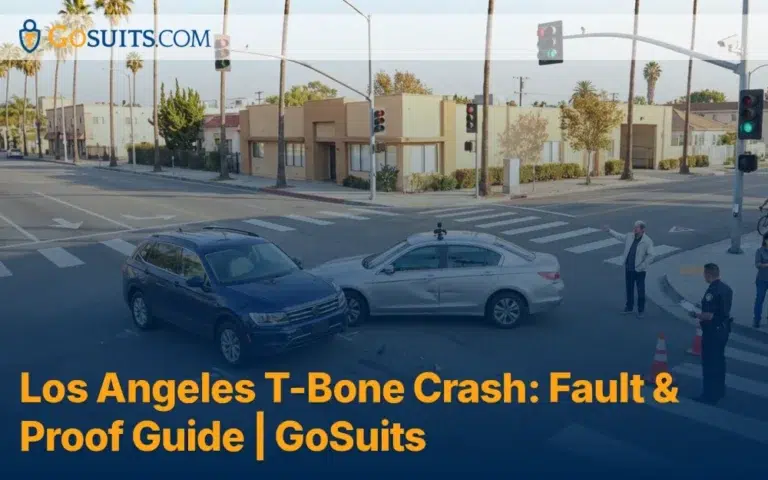
A T bone crash, also called a broadside or side impact collision, happens when the front of one vehicle strikes the side of another at or near a right angle. In Los Angeles, many T bone collisions occur at busy intersections where timing, right of way, and driver attention are decisive. Fault is often disputed because each driver may claim the green light or assert that the other ignored right of way. Witness memories may conflict, and video or physical evidence can be incomplete. Establishing liability usually requires a careful synthesis of traffic control rules, movement diagrams, event timing, and corroborating proof.
From a civil law perspective, you can recover compensation if you prove the other driver was negligent and that the negligence caused your injuries. The other side may argue partial fault to reduce what is owed under California’s comparative fault system [7]. Your case therefore turns on credible evidence and the legal standards that assign or share responsibility.
If you are sorting through this after a crash, you are not alone. It is normal to feel overwhelmed by calls, forms, and medical needs. Working with Los Angeles car accident lawyers can help you organize evidence and meet strict deadlines while you focus on healing.
Which California right-of-way rules shape fault in side impact collisions?
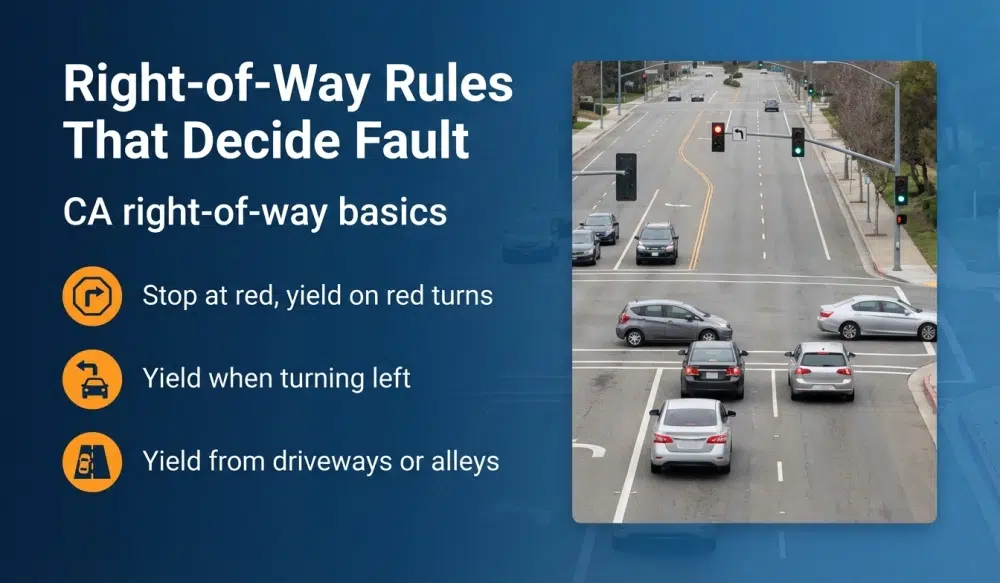
Right-of-way rules are central to fault in a T-bone crash. California Vehicle Code provisions govern who must yield in common intersection scenarios. Violations can be strong indicators of negligence and may support negligence per se if the violation caused the harm the law was designed to prevent [6].
What do red light and signal rules require?
In California, a driver must stop at a red signal and remain stopped until permitted to proceed by law. Entering against a solid red, or failing to yield when turning on a red, can directly lead to broadside crashes [3]. Establishing a red light entry often comes from signal phase data, video, or synchronized witness accounts.
Who has the right of way when making a left turn?
A driver turning left must yield the right of way to all approaching traffic that is close enough to be a hazard. Only when it is reasonably safe may the left turn be completed. In many T bone collisions, a left turning driver misjudges speed or distance and cuts into the path of oncoming traffic [1].
What about uncontrolled or stop sign only intersections?
At intersections without a traffic signal, the vehicle that arrives first generally has the right of way. If two vehicles arrive at the same time, the driver on the left must yield to the driver on the right. These rules can decide fault in T bone crashes that occur at four way stops or uncontrolled intersections [2].
How do right of way rules apply when entering from a driveway or private property?
Drivers entering a highway or street from a driveway, alley, or private property must yield to all traffic that is close enough to pose a danger. Failure to yield in this scenario can set up a side impact collision with through traffic [4].
Does the basic speed law affect fault even if the speed limit was obeyed?
Yes. California’s basic speed law requires driving at a speed that is reasonable and prudent for conditions, regardless of the posted limit. If visibility, weather, or traffic conditions demand reduced speed and a driver fails to adjust, that can be negligent and contribute to T bone collisions at intersections [5].
How does comparative negligence in California affect your claim?
California follows pure comparative negligence. This means a plaintiff’s damages are reduced by their percentage of fault, but recovery is not barred even if they share responsibility. The California Supreme Court recognized this doctrine, which now governs apportionment of fault in civil traffic cases [7].
For plaintiffs, comparative negligence allows recovery even when mistakes occurred, such as entering late in a yellow phase or hesitating during a left turn. For defendants, comparative negligence can reduce the payout by showing the other driver’s share of fault. Juries and insurers weigh evidence of signal timing, positioning, lookout, speed, and evasive actions to assign percentages.
What evidence best proves liability after a broadside crash?
Winning a side impact case in Los Angeles often depends on gathering and preserving a wide range of proof. Because memory fades and video may be overwritten quickly, early action can make a major difference.

Which scene evidence is most persuasive?
- Photographs and video of the scene: showing vehicle positions, debris, skid marks, yaw marks, and traffic control devices helps reconstruct movement and speed.
- Signal and intersection diagrams: help a fact finder understand lane geometry, sight lines, and turn pockets.
- Damage profiles: on the struck vehicle’s side and the striking vehicle’s front can indicate angle and overlap of impact, supporting reconstruction opinions.
Do witness statements matter?
Yes. Independent witnesses can corroborate which driver had the green, whether a left turn was attempted across traffic, or if a driver ran the red. Collect names and contact information at the scene, if safe to do so. Consistent witness accounts can be highly persuasive when matched with physical evidence.
How important are medical records to proving causation?
Medical records link the collision to your injuries and provide time stamped documentation of symptoms, diagnoses, and treatment. They anchor the claim for both economic losses and human damages. Keep copies of emergency care, imaging, specialist visits, therapy, and prescriptions. Detailed records strengthen the connection between the force of a T bone impact and injuries such as cervical sprain, shoulder trauma, thoracic injuries, hip fractures, and traumatic brain injury.
What role does the basic speed law play in evidence gathering?
If the other driver was traveling too fast for conditions, you can pair the law with evidence like skid distances, crush depth, and witness estimates to argue breach of duty under the basic speed standard [5].
How do we authenticate video and digital records?
Authentication typically requires testimony or records showing the camera’s location, the chain of custody, and that the system was operating properly. Basic steps include identifying the camera operator, obtaining metadata when available, and matching timestamps with independent markers such as dispatch logs or signal timing sheets. When the footage comes from a public agency, you can pair the video with the relevant public records response to demonstrate authenticity under California evidence rules, subject to the court’s discretion [11].
What if there is no traffic camera footage?
Cases can still be strong without video. You can build liability through scene photos, measured skid or yaw marks, crush analysis, contemporaneous 911 call timing, and consistent witness statements. Time distance analysis that fits the geometry and posted timing at the intersection often provides a clear narrative of how the collision occurred.
In a serious collision, car accident lawyers can coordinate with reconstruction professionals to secure data, map the scene, and preserve digital evidence before it is lost. This focused approach can give you a clearer picture of what happened and why.
Are police reports usable in a civil case, and how should we read them?
Police collision reports are important sources of facts, diagrams, and listed violations. In California, however, the Vehicle Code restricts the use of certain accident reports in civil actions. Reports required by state law are confidential and generally not admissible as evidence in a civil damages trial, though they can guide the investigation and negotiations [10].
There is also a public records exception to the hearsay rule for trustworthy records made by public employees within the scope of duty [11]. Courts apply these rules to decide what parts of an officer’s observations or conclusions may be allowed. Even where the written report is not admissible, the officer can sometimes testify in person about firsthand observations, subject to the rules of evidence.
To obtain a copy of a collision report, eligible parties can request it through the California Highway Patrol, or the local agency that took the report. The CHP provides instructions on requesting collision reports [14].
What should we look for in a police report?
- Primary collision factor and associated factors: which reflect the officer’s initial view of causation.
- Movement codes and diagrams: that show turning, straight through, or stop and go sequences.
- Traffic controls and signal phase: which note stop signs, signals, and flashing modes.
- Witness names and contact data: for follow up interviews.
- Noted Vehicle Code violations: such as failing to yield when turning left [1], running a red [3], or unsafe speed for conditions [5].
Can traffic camera footage and city records help prove fault?
Yes. In a dense urban network like Los Angeles, public cameras and agency records can be pivotal. Requests to city or county agencies for traffic signal data, maintenance logs, and available footage may be made under the California Public Records Act. While exemptions and retention limits apply, timely requests can secure crucial evidence that supports your account of the crash. The Public Records Act is codified in the California Government Code and provides a pathway to obtain public records held by state and local agencies [12].
Footage from nearby businesses or residences should also be sought quickly. Many systems overwrite data within days. A preservation letter can request that relevant video not be deleted while your claim is pending.
How do reconstruction and vehicle data strengthen a T bone case?
Modern vehicles often record select pre crash and crash data, sometimes including speed, brake use, throttle position, seat belt status, and delta V. When available, this information can corroborate testimony and help quantify severity of impact. Access is governed by federal and state laws, and not all vehicles are equipped. Federal regulations address event data recorders and define recorded elements for equipped vehicles [13].
Which reconstruction steps help most in a side impact case?
- Scene surveying and mapping: to document sight lines, lane widths, traffic control locations, and grade.
- Vehicle inspections: to analyze crush profiles, intrusion, and restraint system performance.
- Time distance analysis: to test whether a left turn or red light entry was possible given approach speed and gap.
- Signal timing analysis: using agency timing sheets and cabinet logs to determine phase sequence and clearance intervals.
For both plaintiffs and defendants, accurate reconstruction makes it easier to evaluate comparative fault and settlement ranges. It supports strategic decisions like whether to mediate or prepare for trial.
What injuries and damages are common, and how are they valued?
Side impact collisions can transfer significant energy into the occupant compartment, causing injuries to the neck, shoulder, chest, abdomen, pelvis, and head. National roadway safety agencies report that a substantial share of serious crashes occur at or near intersections. In particular, intersection related crashes account for a notable proportion of traffic deaths nationwide, and well over half of injury crashes occur at or near intersections [12]. Damages in a civil case fall into economic and non economic losses.
What economic losses are recoverable?
- Medical expenses: including emergency care, hospitalization, surgery, rehabilitation, therapy, and needed assistive devices.
- Lost income and reduced earning capacity: documented by pay records, tax returns, and employer statements.
- Out of pocket costs: including prescriptions, transportation to medical visits, and replacement services at home.
What non economic losses are considered?
- Pain and suffering: reflecting physical pain and the effect on daily activities and quality of life.
- Emotional distress: including anxiety, sleep disturbance, and trauma symptoms.
- Loss of enjoyment of life: for hobbies, family activities, and community engagement you can no longer pursue or must pursue differently.
How do we connect injuries to the crash?
Thorough medical documentation, consistent symptom reporting, prompt follow up, and physician opinions on causation are key. Photographs of bruising or device use, journals detailing limitations, and testimony from family or co workers can also help show the consequences of the crash. These help both fault analysis and damages evaluation.
How do insurers evaluate the link between vehicle damage and injury?
Insurers sometimes argue that modest visible damage equals modest injury. That assumption is not always accurate. The angle of impact, intrusion into the occupant space, and occupant position matter more than repair estimates alone. Correlating medical imaging and clinical findings with intrusion measurements, restraint use, and delta V data provides a more reliable picture of injury potential.
What documentation supports wage loss?
Collect recent pay stubs, W 2s or 1099s, prior year tax returns, and a written statement from your employer confirming missed time and duties. For self employed workers, provide profit and loss statements, invoices, bank statements, and a short explanation of how the injury affected capacity to fulfill contracts or generate work.
What deadlines apply to T bone crash lawsuits and claims in California?
Most personal injury lawsuits in California must be filed within two years from the date of injury. This is the general statute of limitations for bodily injury claims [8]. There are exceptions that may shorten or lengthen deadlines in certain cases, such as claims involving minors or when a defendant is a government entity.
If the at fault driver was an employee of a public entity acting within the scope of employment, you must usually present a government claim within six months of the injury before filing a civil lawsuit. Missing the government claim deadline can bar the case unless a limited exception applies [9].
Because evidence is time sensitive and deadlines are strict, connecting with attorneys in Los Angeles early helps protect your rights and gives your case a stronger start.
What defenses do drivers and insurers raise, and how can we respond?
What if the other side says you ran the red?
Respond with objective data. Seek signal timing sheets, traffic camera footage, and synced witness statements tied to the seconds before impact. If available, vehicle data and physical evidence such as skid marks can align with or contradict claims about a late yellow or red entry.
What if they argue you made an unsafe left turn?
Analyze closing speed, distance, and whether the approaching vehicle exceeded a reasonable speed for conditions. A violation of the basic speed law can rebut a claim that a left turning driver alone caused the crash [5]. Show how a safe gap became unsafe due to excessive approach speed.
What if they claim you were speeding?
Use mapping, time distance calculations, and, if available, event data to address actual approach speed. Witness estimates are commonly off. Physical evidence and data based methods carry more weight.
Can violations of right of way lead to negligence per se?
Yes. If a driver violates a safety statute such as failure to yield on a left turn, or entering against a red, and that violation causes the kind of harm the statute was designed to prevent, the violation may establish a presumption of negligence, subject to recognized excuses [6]. You still must prove causation and damages.
How should you communicate with insurers after a Los Angeles T bone crash?
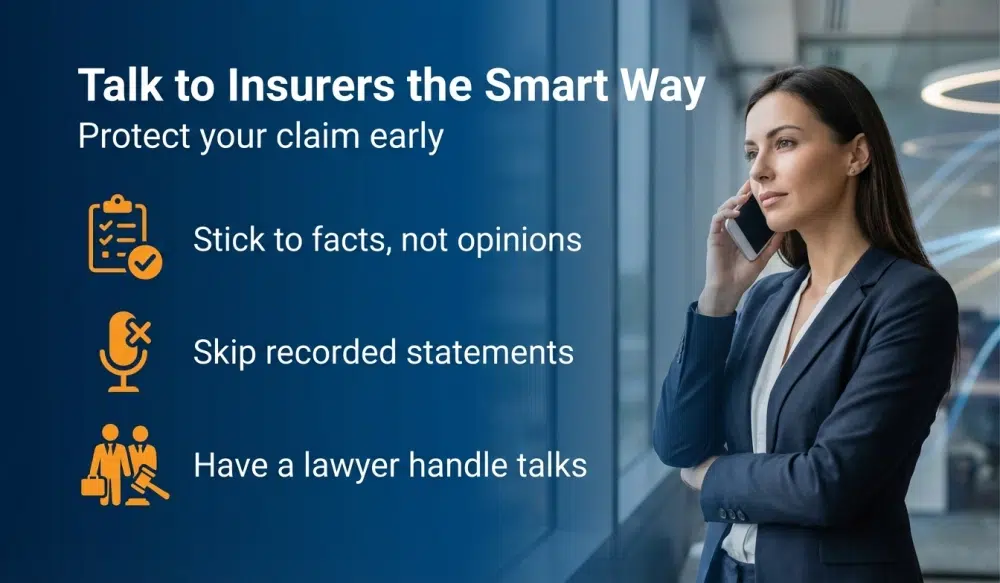
Be factual and concise. Provide the basics of what happened, your injuries, and the vehicles involved. Avoid speculating about fault or minimizing symptoms. Do not give a recorded statement to the other driver’s insurer before you have legal guidance. Insurers may seek admissions that limit recovery. Share photographs, repair estimates, and medical records in a measured way that builds your case rather than theirs.
When negotiations begin, remember that California’s comparative negligence rules may be used to push down offers. A clear liability package supported by statutes, diagrams, witness statements, and, where appropriate, reconstruction analysis gives you leverage [1][2][3][5].
If discussions stall, local counsel can file a complaint to preserve your statute rights and move the case forward in court.
What step by step actions should you take after a broadside collision?
- Get to safety and call 911: so first responders can secure the scene and help anyone who is injured.
- Request medical evaluation: even if you feel okay. Adrenaline can mask pain.
- Document the scene: by taking photos and video of vehicles, damage, traffic controls, and the surrounding area.
- Exchange information: including driver’s license, insurance, and contact details.
- Collect witness names: and phone numbers while memories are fresh.
- Seek the police report number: and later request the report through CHP or the local agency [14].
- Preserve potential video: by sending prompt preservation letters to nearby businesses and agencies.
- Follow medical advice: and keep all appointments to document your recovery path.
- Consult legal help: to protect your rights and evaluate the path toward settlement or trial.
If you are weighing options, attorneys can assess fault using California Vehicle Code rules on signals and right of way alongside the facts of your collision [1][2][3][4].
What Los Angeles specific factors influence fault and proof?
Los Angeles traffic volume, complex intersections, and frequent construction create conditions where attention and timing are critical. National authorities report that intersection related crashes represent a large share of serious roadway harm. More than half of injury crashes occur at or near intersections, and a substantial fraction of traffic deaths occur there as well [12]. These data points track real world experience in dense urban environments, where red light compliance, left turn decisions, and speed selection are vital.
California’s Office of Traffic Safety publishes annual crash ranking results by city and county. These reports provide context for collision trends in Los Angeles and can inform public safety priorities and legal strategy [15]. While rankings do not decide fault in any single case, they underscore the need for strong proof in intersection collisions where stories may conflict.
Nearby public agencies may retain signal timing data and related records for limited periods. Fast evidence preservation is therefore vital. Early requests for city records under the Public Records Act help prevent loss of key data [12].
What does the civil litigation process look like, and how long does it take?
Every case is different, but T bone crash litigation generally follows these stages:
- Investigation: where facts, witnesses, medical records, photos, and any video are collected. Reconstruction and professional analysis may begin here.
- Claim presentation: where a demand package outlines liability, injuries, and damages supported by statutes and evidence.
- Lawsuit filing: if needed to protect the statute of limitations or when negotiations stall [8].
- Discovery: including written exchanges, depositions, independent medical exams, and subpoenas for agency data and video.
- Motions and mediation: where parties narrow issues or explore settlement with a neutral mediator.
- Trial preparation and trial: which may include demonstrative exhibits such as scene animations, signal timing charts, and time distance analyses.
Timelines vary. Straightforward claims can resolve in months, while contested liability or high damages cases may take a year or more. California’s comparative negligence framework influences negotiation as each side assesses potential apportionment [7].
Why does having legal help matter in a side impact claim?
Civil cases turn on proof and deadlines. Lawyers can interpret California’s right of way statutes, build a persuasive liability narrative, and anticipate defenses. They can coordinate record requests, secure traffic signal data, and obtain event data recorder downloads when appropriate [1][2][3][13]. They also know how to present comparative negligence arguments strategically so that fault percentages are assigned fairly, not simply asserted by the insurer [7].
If you feel uncertain, connecting with car accident lawyers to discuss responsibility, evidence, and medical documentation can reduce stress and improve your claim presentation.
For readers looking for local guidance grounded in Los Angeles roads and courts, working with local lawyers in Los Angeles can make the process more manageable and focused.
About GoSuits
We built GoSuits for people facing life changing injuries who want clarity, speed, and trustworthy guidance. Our civil practice covers roadway injury claims across California, including Los Angeles, Orange County, San Diego, the Bay Area, and statewide cases with California courts.
We pair designated attorneys for every client with proprietary technology that streamlines evidence collection, medical record organization, and case modeling. Our exclusive software is designed to compress timelines, strengthen liability presentations, and support better decisions without sacrificing personal access to your lawyer. We do not route clients through case managers. Every client has direct, ongoing contact with their attorney.
When your case involves a T bone crash, the right of way rules, signal timing, and data sources create both opportunities and risks. A free consultation helps us listen, identify legal issues and deadlines, and outline smart next steps. You will learn how our approach translates complex facts into a clear fault narrative supported by statutes, records, and, where appropriate, reconstruction.
- Technology first, people focused: Our proprietary platform organizes photos, video, police data, and medical records into a trial ready format while your lawyer remains your primary point of contact.
- Thirty years of combined courtroom experience: Our team prepares every case with trial in mind, which supports stronger negotiations and informed choices about settlement versus verdict.
- Local and statewide reach: We handle cases in Los Angeles County and throughout California courts, including claims that require early government filings.
- Proven results: See a selection of outcomes across roadway injury claims at prior cases.
- Meet the team: Learn about the attorneys who will handle your case at our attorneys, and explore our story at about us.
- Full service injury practice: View our civil practice list at practice areas, including vehicle collisions and wrongful death.
Here is how a free case review can help you today:
- Fault analysis: We evaluate right of way rules, signal timing, and likely comparative fault percentages using the facts and governing California law.
- Evidence plan: We identify which records and video to request immediately and explain how we will preserve and use them.
- Medical documentation: We show how to organize records and track symptoms so your injuries are fully understood and valued.
- Timeline and options: We give you a clear path from claim to resolution and discuss when filing suit makes sense.
If you want a grounded conversation about your Los Angeles T bone crash, we are ready to help. Our aim is to protect your rights, move quickly where speed matters, and prepare fully where detail and accuracy win cases.
References and resources
- California Vehicle Code section 21801 Left turn yielding, California Legislature
- California Vehicle Code section 21800 Intersections and right of way, California Legislature
- California Vehicle Code section 21453 Red signals, California Legislature
- California Vehicle Code section 21804 Entry onto highway from property, California Legislature
- California Vehicle Code section 22350 Basic speed law, California Legislature
- California Evidence Code section 669 Negligence per se, California Legislature
- Li v. Yellow Cab Co. of California, 13 Cal.3d 804 1975, CourtListener
- California Code of Civil Procedure section 335.1 Two year limitation for injury, California Legislature
- California Government Code section 911.2 Government claims six month deadline, California Legislature
- California Vehicle Code section 20013 Confidentiality and inadmissibility of reports, California Legislature
- California Evidence Code section 1280 Official records exception, California Legislature
- Intersection Safety overview, Federal Highway Administration
- 49 CFR Part 563 Event Data Recorders, eCFR
- Collision Reports request process, California Highway Patrol
- Crash Ranking Results by city and county, California Office of Traffic Safety