- What makes motorcycle crash evidence different in Los Angeles, CA?
- What should you do in the first 10 minutes and first 48 hours after a motorcycle crash?
- How do you obtain a CHP or LAPD traffic collision report, and what do these reports contain?
- What photos and videos matter, and how do you preserve them for court?
- Which documents prove injuries and repair costs, and how do you collect them?
- How do California deadlines and comparative fault rules affect your case?
- How do plaintiffs and defendants use the same evidence differently?
- What is chain of custody, and how do you authenticate digital evidence?
- How do California subpoenas and discovery help you get third party evidence?
- What should you know about insurance, property damage, and repair estimates?
- What are quick answers to common Los Angeles motorcycle evidence questions?
- How does GoSuits help Los Angeles riders build strong evidence files?
- References and Resources
What makes motorcycle crash evidence different in Los Angeles, CA?
Motorcycle collisions in Los Angeles require a focused approach to evidence from the very first minutes. Riders face direct exposure, so injuries, helmets, jackets, and the bike itself can carry unique forensic details, including abrasion patterns, transfer marks, and impact angles that help reconstruct how a crash happened. Urban factors like dense traffic on the 405 and 101, frequent construction zones, complex intersections, and ride-share activity make third party video and data more likely to exist than in rural areas, but it also disappears quickly without fast action.
Helmet use and helmet condition carry significant weight. National data shows motorcycle helmets lower the risk of head injury and reduce the risk of death for riders, which in turn shapes arguments about injury causation and damages in civil cases [5]. Because the stakes are high, you should expect the other side to closely examine your gear, maintenance records, training background, and roadway conditions.
Los Angeles motorcycle accident lawyers often coordinate rapid preservation requests to nearby businesses and public agencies to secure surveillance footage and traffic data that can vanish in hours or days. If you wait, key proof can be overwritten or discarded, which can lead to disputes and evidentiary gaps that are hard to fix later.
What should you do in the first 10 minutes and first 48 hours after a motorcycle crash?
- Call 911, request police and medical response, and note the agency and incident number. If a California Highway Patrol unit responds on a state route, it will usually generate a CHP 555 collision report. LAPD typically responds on city streets.
- Move to safety if you can, and activate hazards or use flares to reduce secondary impacts.
- Document the scene with wide, medium, and close-up photos before vehicles move, including lane markings, debris fields, gouge marks, skid or yaw marks, fluid trails, traffic signals, and sight lines.
- Exchange information and photograph IDs, insurance cards, license plates, and VINs. Photograph the other driver’s phone screen if they display insurance digitally.
- Identify witnesses and capture their names, phone numbers, and email addresses. Ask if any vehicles have dash cams and whether nearby businesses have cameras pointed at the street.
What should you do within 24 to 48 hours?
- Obtain medical evaluation even if you feel okay, because adrenaline can mask symptoms. Keep discharge instructions and recommended follow ups.
- Complete the DMV SR-1 if anyone was injured or property damage appears to exceed the statutory threshold, and file within 10 days as required by California law [1].
- Confirm police reporting when there are injuries. California law requires written reporting of injury or fatal collisions and outlines prompt reporting duties [2].
- Preserve digital evidence by backing up helmet cam video and phone photos to multiple locations, and do not edit metadata. Send preservation requests to nearby businesses and agencies promptly, since many systems overwrite video quickly [8].
- Contact a qualified attorney to coordinate evidence preservation, medical documentation, and communications with insurers. Early guidance helps protect your claim and reduces the risk of missing legal deadlines.
How do you obtain a CHP or LAPD traffic collision report, and what do these reports contain?
CHP maintains collision records and releases reports to involved parties, their legal representatives, and insurers upon request. The agency provides instructions and forms for requesting the CHP 555 report and related materials [3]. Be ready to provide the date, time, location, and report number, plus proof you are an involved party or authorized representative.
Are collision reports admissible evidence in California civil trials?
California law restricts the use of traffic collision reports in civil cases. The Vehicle Code provides that written accident reports made by a person involved in a collision, or by a reporting officer, are confidential and, with limited exceptions, are not admissible in evidence at trial to prove negligence or liability [4]. That said, facts underlying the report can be proved through witness testimony, photographs, and other admissible evidence. Statements by parties or witnesses may be handled under the Evidence Code and civil procedure rules rather than by using the report itself.
What if LAPD created the report?
LAPD traffic collision reports are typically requested by involved parties, their insurers, or counsel. Although the request process is agency specific, the same confidentiality and admissibility constraints under state law apply to traffic collision reports created within the City of Los Angeles, and the officer’s narrative is often used for investigation, not as trial evidence [4].

What photos and videos matter, and how do you preserve them for court?
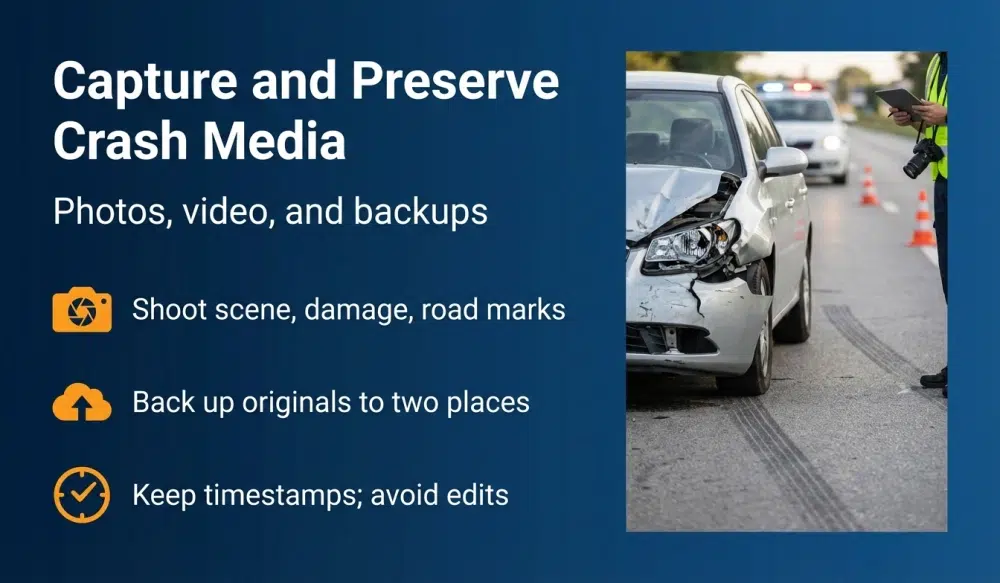
- Scene orientation shots that show traffic controls, lanes, lighting, weather, and unobstructed sight lines.
- Damage profiles of both vehicles, including crush points, transfer marks, and broken components. Photograph the motorcycle from all quadrants, plus close-ups of the fork, bars, pegs, calipers, and wheel rims.
- Roadway evidence like skid marks, debris, and gouges that can support a reconstruction of speed, braking, and impact angles.
- Injury-documentation photos across time to show swelling, bruising, or surgical sites, with date stamps and consistent lighting.
How valuable are helmet cam and traffic camera videos?
Helmet cam footage can capture approach angles, traffic signal phases, and evasive maneuvers better than nearly any other source. Urban corridors in Los Angeles often have business surveillance systems and public cameras. You or your attorney can request preservation under the California Public Records Act from relevant public agencies, and send timely preservation letters to private businesses to prevent routine overwriting [8]. For admissibility, digital files must be authenticated, meaning a witness can explain what the video shows and how it was recorded and kept [6].
How do you maintain chain of custody for digital media?
- Immediate backups to two or more separate locations, such as a secure cloud drive and a physical external drive.
- Read only copies to preserve the original. Avoid editing the original file, and preserve metadata like timestamps and GPS if available.
- Hash values and logs to create a verifiable digital fingerprint and a record of who accessed or copied the file.
- Authentication planning so a knowledgeable witness can explain how the device works, how the data was stored, and that the content accurately depicts the events, consistent with California Evidence Code requirements [6].
Which documents prove injuries and repair costs, and how do you collect them?
- EMS and ER records including paramedic narratives, triage notes, imaging, and discharge instructions.
- Primary care and specialist notes outlining diagnoses, causation opinions, treatment plans, and work restrictions.
- Physical therapy records that document functional limitations and progress over time.
- Itemized bills and EOBs to show gross charges, contractual adjustments, and out of pocket responsibilities.
You have a federal right of access to your medical records, generally within 30 days, and you can request them in the format you prefer if the provider can readily produce them that way [9]. Keep a running index of records and bills with dates of service to avoid gaps in proof.
How do you document wage loss and other economic damages?
- Employer letters verifying missed work dates, hourly rates or salary, and the reason for absences.
- Pay stubs and tax forms to substantiate earnings history.
- Self employed documentation such as invoices, profit and loss statements, and client communications to show missed opportunities.
What about property damage photos and repair estimates?
- Multiple written estimates from reputable shops with parts lists and labor hours. Include frame and fork measurements when applicable.
- Pre loss condition evidence like recent maintenance records, upgrades, and high quality photos to support valuation.
- Accessories and gear receipts for helmets, jackets, gloves, boots, and electronic add ons that were damaged in the crash.
When negotiations begin, detailed repair estimates, supported by high resolution photos and part numbers, can shorten disputes about whether a motorcycle is repairable or a total loss. This documentation also supports claims for loss of use and any diminished value where appropriate under California law.
Many riders prefer to work with motorcycle accident lawyers who can coordinate records, billing, and valuation evidence efficiently and present it in a clear, chronological package during settlement talks or litigation.
Los Angeles motorcycle accident lawyers can also help pursue third party video and subpoena records if voluntary cooperation fails, which can be decisive in urban intersection cases.
How do California deadlines and comparative fault rules affect your case?
In most California personal injury cases, you generally have two years from the date of the incident to file a lawsuit [10]. There are exceptions that can shorten or extend the period, so early review is important.
What if a public entity is involved?
If your claim is against a public entity, such as a city agency or a transit authority, you must usually file a written administrative claim within six months of the injury under the Government Claims Act [11]. After a claim rejection, further deadlines apply for filing suit. Failing to meet these time limits can bar your claim.
How does comparative fault work in California?
California follows pure comparative negligence. If a jury finds both sides share fault, a plaintiff’s damages are reduced by their percentage of responsibility [12]. Evidence about speed, lane position, signal phases, and lookout are commonly contested. Compliance with California’s helmet law is required for riders and passengers, and helmet condition and use can become part of the factual analysis [13].
What is chain of custody, and how do you authenticate digital evidence?
Chain of custody refers to the documented handling of evidence from collection to courtroom, so a judge can find that an item is what you claim it is. For physical items like a damaged helmet, that means logging who took possession, where it was stored, and under what conditions. For digital files like helmet cam footage, it includes keeping an original, logging access, and maintaining file integrity with hash values. Courts look for reasonable assurances that the item was not altered, substituted, or contaminated before trial.
What are the legal standards for authentication?
California Evidence Code requires sufficient evidence for a finding that a writing or other item is what its proponent claims it to be [6]. For electronically stored information, federal rules address preservation failures and sanctions, which makes early preservation and documentation critical [8]. A witness with knowledge, device logs, and file metadata can meet the foundation required for admission.
How do definitions help frame your approach?
Law dictionaries define chain of custody in straightforward terms, focusing on tracing possession and handling at every step. Keeping a simple log and treating digital originals as read only is a practical way to align with those expectations in a civil case.
How do California subpoenas and discovery help you get third party evidence?
California permits deposition subpoenas for business records directed to non parties in possession of relevant materials, such as a store with external cameras or an employer with wage records. The statutory framework and Judicial Council forms guide how to command production, where to serve, and what to include in the notice [15][16].
What privacy notices are required?
When seeking consumer or employee records, California law requires advance notice so the person whose records are sought can object or move to quash. This is especially important for medical, employment, and other sensitive records [15].
How do you target public agency evidence in Los Angeles?
Public entities may hold traffic signal timing logs, maintenance records, or bus dash cam video. Your attorney can use the California Public Records Act for requests and, if litigation is pending, civil discovery to compel production. Preservation requests should be sent promptly to reduce the risk of routine deletion, and any response should be cataloged, authenticated, and backed up for use at deposition and trial [8].
What should you know about insurance, property damage, and repair estimates?
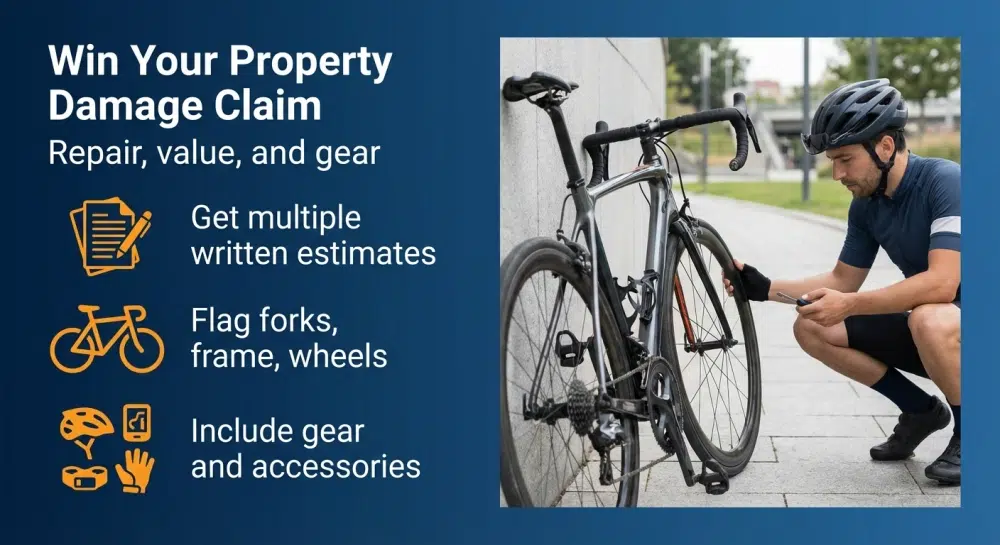
- Organize estimates and photos by date and vendor, include VIN, mileage, and part numbers to reduce adjuster questions.
- Address safety critical parts like forks, triple tree, frame straightness, rotors, ABS sensors, and wheels that can be masked by cosmetic damage.
- Include gear replacement for helmet, jacket, gloves, boots, and communicators damaged in the crash.
What if the bike is a total loss?
Provide evidence of pre loss condition, aftermarket parts, and maintenance history. If valuation is disputed, consider comparable listings and parts documentation. California insurance regulators publish consumer guidance on total loss disputes, and organized evidence can speed resolution.
How do you protect your bodily injury claim while property damage is pending?
Do not inadvertently sign broad releases while resolving property damage. Keep injury documentation current and communicate clearly that a property settlement does not include bodily injury claims. Work with counsel to coordinate both tracks and to preserve evidence that supports future medical needs and wage loss.
How does GoSuits help Los Angeles riders build strong evidence files?
We built this Los Angeles motorcycle crash evidence checklist to help you protect your rights after a serious collision. Our personal injury team handles cases throughout California, and we focus on building meticulous evidence files that stand up in settlement and at trial.
- Technology driven approach using exclusive proprietary software to track evidence, automate lawful preservation notices, and assemble medical and billing records into a clear, chronological proof package built for negotiation and courtroom presentation.
- Attorney access, not case managers so you always have a designated attorney who knows your file and is available for direct communication. We use technology to move faster, but your relationship is with your lawyer.
- Trial ready preparation from day one, which improves outcomes in settlement and gives you leverage when liability or damages are contested.
- Results and experience with 30 years of combined experience and a history of strong outcomes for injured clients. See our prior cases and meet our attorneys.
- Full scope personal injury practice that includes motorcycle collisions, car crashes, truck crashes, pedestrian injuries, premises liability, product injury, brain injury, and wrongful death. Explore our practice areas and learn more about us.
- Free consultation to discuss your situation, timelines, and an evidence plan tailored to your case in Los Angeles, CA.
References and Resources
- Complete a Traffic Accident Report SR 1 – California DMV
- Vehicle Code section 20008 – California Legislative Information
- Collision Records – California Highway Patrol
- Vehicle Code section 20013 – California Legislative Information
- Motorcycle Safety and Helmet Effectiveness – Centers for Disease Control and Prevention
- Evidence Code section 1400 Authentication – California Legislative Information
- Federal Rule of Civil Procedure 37(e) ESI Preservation and Sanctions – Legal Information Institute
- ESI Preservation Duty and Consequences – Legal Information Institute
- Individuals’ Right under HIPAA to Access Their Health Information – U.S. HHS
- Code of Civil Procedure section 335.1 – California Legislative Information
- Government Code section 911.2 – California Legislative Information
- Li v. Yellow Cab Co., 13 Cal.3d 804 – CourtListener
- Vehicle Code section 27803 Helmet Law – California Legislative Information
- CACI 200 Burden of Proof Preponderance of the Evidence – California Courts
- Code of Civil Procedure section 1985.3 Consumer Records – California Legislative Information
- Code of Civil Procedure section 2020.410 Deposition Subpoena – California Legislative Information