
- What is the Los Angeles injury treatment timeline and why does it matter?
- What should you do in the first 72 hours after an accident in Los Angeles, CA?
- How does ongoing medical care progress week by week after an accident in Los Angeles?
- What are common injury recovery timelines in Los Angeles cases?
- How do liens, insurance, and billing work in California injury cases?
- How do you document injuries for a California personal injury claim?
- What legal timelines control your right to sue in California?
- How do plaintiffs and defendants view the treatment timeline differently?
- What are actionable next steps you can take today in Los Angeles?
- Why choose GoSuits for help with your Los Angeles injury case?
- Where can you find references and resources?
What is the Los Angeles injury treatment timeline and why does it matter?
After a crash or fall in Los Angeles, the injury treatment timeline is the sequence of care from the first minutes through full recovery. It typically includes emergency or urgent evaluation, follow up with a primary care clinician, specialist referrals, diagnostic imaging, rehabilitation, and periodic rechecks to reach maximum medical improvement. This timeline matters for your health and for your civil claim, because prompt, consistent care documents the connection between the accident and your injuries, helps quantify damages, and aligns with legal deadlines in California. Delays, missed appointments, or gaps in care give insurers and defense counsel room to argue that symptoms came from something else or that you did not mitigate damages.
We walk through the steps you can expect in Los Angeles, how to coordinate care among emergency departments, primary care, orthopedics, neurology, and physical therapy, and how to protect your claim with good documentation, timely insurance notices, and awareness of California statutes and regulations [4] [11].
What should you do in the first 72 hours after an accident in Los Angeles, CA?
If you have symptoms such as loss of consciousness, severe headache, neck pain, new weakness, chest pain, shortness of breath, or uncontrolled bleeding, call 911 or go to the nearest trauma center. Los Angeles County operates a regional trauma system with designated centers that receive patients by ambulance or walk in for evaluation by emergency physicians and trauma teams [14]. For milder symptoms, urgent care or your primary care clinic may be appropriate within the next day.
Concussions and whiplash often present without dramatic findings at the scene. Head injuries can evolve over hours, so monitor for worsening headache, vomiting, confusion, dizziness, or vision changes, and seek medical attention if symptoms progress. National public health guidance recommends an evaluation and a gradual return to activity under medical supervision after a concussion [1].
How do you report the crash and meet early legal deadlines?
California has early reporting rules. If anyone was injured or if property damage exceeds one thousand dollars, you must submit a Traffic Accident Report SR 1 to the California DMV within ten days, even if law enforcement took a report [2]. The California Vehicle Code also requires the driver to make a written report to police or the California Highway Patrol within twenty four hours when an accident results in injury or death, unless a responding officer already filed a report [3]. Timely reporting preserves your driving privileges and helps your civil claim by capturing facts while they are fresh.
What initial documentation helps your civil claim in California?
Preserve evidence early. Right after you are safe and stable, gather:
- Photos and video of vehicles, scene, skid marks, debris, and visible injuries.
- Names and contacts for witnesses and all drivers or property owners involved.
- Insurance information for all parties, and police report details or incident numbers.
- Medical paperwork such as discharge instructions, prescriptions, and visit summaries.
Simple steps like saving damaged personal items, keeping clothing, and noting weather and lighting can matter later. If you are unsure where to start, car accident lawyers can help organize early evidence, coordinate with insurers, and schedule follow-ups without interrupting your medical care timeline.
How does ongoing medical care progress week by week after an accident?
Within a few days of the event, schedule a primary care follow up to review emergency findings, update medications, and confirm referrals. Primary care can coordinate imaging and specialty consultations in orthopedics for fractures or joint injuries, neurology for head and nerve symptoms, otolaryngology for dizziness or tinnitus, pain management for persistent pain, and behavioral health for anxiety or sleep disturbance that often follows trauma. For head injuries, follow clinical guidance on activity modifications and symptom monitoring [1].
What imaging or tests are typical and when do you get them?
Emergency departments use clinical decision tools to decide whether to order X rays, CT scans, or MRI. After discharge, your primary care clinician or specialist may order additional imaging if symptoms persist. Common pathways include X rays for suspected fractures, MRI for soft tissue or spinal injury, and nerve studies for numbness or weakness. You do not have to request every test immediately. Your clinicians will time imaging based on physical findings and your recovery trajectory.

How does physical therapy fit into the injury timeline?
Physical therapy is a frequent component of recovery from whiplash, sprains, and strains. A typical plan progresses from pain control and gentle range of motion to strengthening, posture work, and functional tasks like lifting, reaching, or sport specific movement. Your therapist and physician adjust frequency and duration based on progress and flare ups. Early active movement within medical advice often produces better function than prolonged immobilization for many soft tissue injuries, so communicate openly about what worsens or relieves your symptoms.
What does maximum medical improvement mean, and when might you reach it?
Maximum medical improvement is the point when your condition has stabilized and further significant recovery is not expected with customary care. Some people reach this point within weeks, while others need months and occasionally longer for complex injuries. From a legal perspective, waiting until you are close to this point before final settlement helps make sure your claim accounts for the full scope of medical bills, missed work, and any future care or limitations, subject to California law on proof of damages [13].
What are common injury recovery timelines in Los Angeles cases?
Whiplash symptoms include neck pain, stiffness, headaches, and difficulty concentrating or sleeping. Many people improve with conservative care such as early gentle motion, heat or cold, pain management, and physical therapy. Health information from public sources notes that symptoms often begin within a day or more after the accident and gradually improve with appropriate care [15]. Your clinician will adjust the plan if you show signs of nerve involvement, severe limitation, or other complications.
What is the concussion symptom timeline and when should you seek care?
After a concussion, you might experience headache, nausea, dizziness, sensitivity to light or noise, or changes in sleep and mood. Many people recover with rest and a gradual, stepwise return to activity guided by a clinician. Warning signs that require urgent evaluation include worsening headache, repeated vomiting, unusual behavior or confusion, seizures, or inability to wake up. Public health guidance emphasizes not returning to risky activity until cleared by a medical professional and following a staged plan for school, work, and exercise [1].
How do fractures and soft tissue injuries typically progress?
Simple fractures often heal with immobilization and periodic imaging to confirm alignment and healing, followed by a transition to weight bearing or activity as directed. Soft tissue injuries such as sprains and strains improve with a combination of rest from aggravating activity, guided movement, and strengthening. Severe ligament or tendon injuries can require surgical consultation. Keep your appointments and follow home programs, because consistent care becomes part of the record that connects your limitations to the incident.
How do liens, insurance, and billing work in California injury cases?

What is a medical lien in California and how does it affect your settlement?
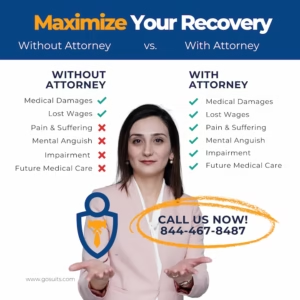
California law allows certain providers to assert a lien against personal injury recoveries for reasonable charges related to treatment. For example, hospitals may claim a statutory lien under the California Civil Code when they provide care to an injured person, with limits and procedures defined by statute [8]. A lien does not bill you twice, it preserves the provider’s right to be paid from the settlement proceeds. Your attorney negotiates these claims as part of the resolution process so that balances are satisfied correctly.
How do Medicare, Medi Cal, and private health plans coordinate with your claim?
Public and private health plans often have reimbursement rights if they paid accident related bills. Medicare is a secondary payer when another party is responsible, and the program can recover conditional payments from a settlement or judgment. The Centers for Medicare and Medicaid Services publishes rules and processes for reporting and resolving these obligations [1]. Medi Cal and private plans can assert their own recovery rights under state and contract rules. Speak with your medical providers about billing choices and provide your attorney with all plan information so liens can be addressed efficiently.
What insurance deadlines apply during your California claim?
Insurers must handle claims with reasonable promptness under California regulations. After an insurer receives a complete proof of claim, it generally has forty calendar days to accept or deny the claim in whole or in part, or provide a written update on why more time is needed, with follow up every thirty days until a decision is made [11]. Keep copies of all communications, send requested documents promptly, and avoid recorded statements without counsel present when liability or injuries are disputed.
Do you have to notify the DMV or police about the crash, and why does it matter to your case?
Yes. California requires you to file a DMV SR 1 within ten days when a crash results in injury or when damage meets the statutory threshold, even if you already spoke with police [2]. The Vehicle Code also requires a driver involved in an injury or fatal crash to report to the California Highway Patrol or local police within twenty four hours unless an officer already documented the collision [3]. These reports create contemporaneous records that help support causation and damages in your civil case.
How do you document injuries for a California personal injury claim?
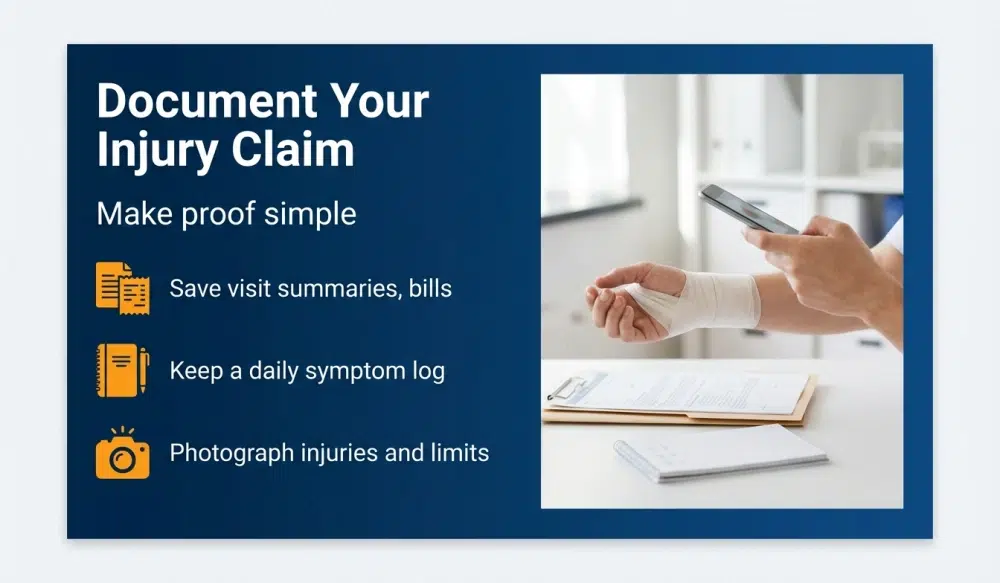
Gather every visit summary, imaging report, prescription, work restriction note, and therapy plan. In California, patients have a right to access their medical records, and providers must make records available within a defined time after your written request, subject to reasonable copying charges [9]. Federal privacy rules also give you the right to access and receive copies of your health information, including electronic records, within a reasonable period and in the format requested if readily producible [10]. Ask your providers for a complete itemized bill for each facility or visit, and keep digital and paper backups.
How should you track symptoms, limitations, and progress?
Maintain a simple journal. Each day, note pain levels, where it hurts, what makes pain better or worse, medications taken, sleep quality, missed activities or work, and care you received that day. Include concrete examples, like being unable to climb stairs at your apartment or missing a family event due to migraine. Share entries with your treating clinicians so they can incorporate them into your chart when appropriate.
How do photos, videos, and wearable data support your claim?
Photographs can show bruising, swelling, surgical incisions, and the evolution of scars. Short clips can demonstrate range of motion limits or changes in gait. If you use a fitness tracker, keep your pre accident and post accident activity data to illustrate changes in step count, sleep, or heart rate variability. Treat this as supplemental evidence alongside clinical records, not as a substitute for formal documentation.
What legal timelines control your right to sue in California?
What is the California statute of limitations for personal injury and property damage?
California generally gives you two years from the date of injury to file a civil lawsuit for personal injury [4]. For property damage to a vehicle or other personal property, the general time limit is three years [5]. Claims by minors and certain latent injuries have exceptions that can alter the timeline. The safest practice is to consult counsel early, because missing a filing deadline can bar your claim entirely.
What if a California government entity is involved in your case?
Special rules apply when a public entity or employee is a potential defendant. You must present a written claim to the government entity within six months for personal injury claims, unless a limited exception applies [6]. If the claim is rejected, you typically have six months from the date of the rejection notice to file suit in court [7]. These rules are strict, so track the dates carefully and keep copies of everything you send and receive.
How does comparative fault work in California injury cases?
California follows pure comparative negligence, which means a plaintiff’s recovery is reduced by their percentage of fault, but not barred unless the plaintiff is one hundred percent responsible. The California Supreme Court adopted this rule to apportion damages more fairly among parties, and courts apply it in a wide range of negligence cases [12]. From a practical standpoint, this underscores why the treatment timeline and documentation matter. Gaps in care or inconsistent records can magnify arguments about alternative causes and fault allocation.
What are actionable next steps you can take today in Los Angeles?
Start with your emergency department discharge instructions. They typically list return precautions and suggested follow ups. If you need trauma follow up, look to the Los Angeles County trauma system for designated centers and clinics that coordinate post discharge care [14]. For primary care, check your health plan directory to stay in network. For physical therapy, orthopedics, neurology, and behavioral health, ask for referrals that match your symptoms and location. Make it easy to keep appointments by choosing clinics near home or work and by arranging transportation if needed.

When should you speak with a lawyer and why can that help your recovery timeline?
Early conversations with car accident lawyers can reduce stress by offloading insurance calls, claims forms, and document requests while you focus on treatment. Counsel can also help you avoid missing key California deadlines such as the DMV SR 1 reporting requirement and the two year statute for injury claims [2] [4]. They coordinate with providers to obtain records under state and federal access rules and can address liens so you are not surprised at settlement [8] [10].
Los Angeles car accident lawyers often maintain relationships with local clinics and imaging centers and can help schedule timely follow ups if you are facing wait lists. If language, work schedules, or transportation are barriers, ask for help identifying options that fit your needs without disrupting your care plan.
Why choose GoSuits for help with your Los Angeles injury case?
If you were hurt in Los Angeles, CA, we align your injury treatment timeline with your claim strategy so your medical story is clear, well documented, and supported. GoSuits serves clients across California in civil injury cases. We use a technology driven approach that keeps your case moving and your care providers connected. Our exclusive proprietary software organizes medical records, lien information, appointments, and insurer communications in real time so nothing falls through the cracks.
- Designated attorneys for every client: You work directly with your attorney from start to finish. We do not assign case managers. Clients have open access to their lawyer for updates and strategy.
- Proven results: Our team has delivered meaningful recoveries in complex injury matters. See representative outcomes in our prior cases.
- Experienced trial team: With 30 years of combined experience and courtroom backgrounds, we prepare every case as if it will be tried. That preparation supports better negotiation and trial readiness.
- Full scope personal injury practice: We handle car, truck, motorcycle, pedestrian, rideshare, premises liability, brain and spinal injuries, product liability, and wrongful death. Explore our practice areas.
- Transparent communication: Our platform gives you clear timelines, task lists, and document status so you always know the next step. Meet our attorneys and learn more about us.
We offer a free consultation to map your medical care plan with your claim timeline, identify deadlines, and answer common questions about records, liens, and settlement timing. Whether your case involves whiplash, concussion, fractures, or multi system trauma, we integrate your care plan with your legal strategy so you can focus on recovery while we handle the legal process.
References and resources
- Concussion Signs and Symptoms – CDC HEADS UP
- Report of Traffic Accident SR 1 – California DMV
- Cal. Veh. Code § 20008 – California Legislative Information
- Cal. Code Civ. Proc. § 335.1 – California Legislative Information
- Cal. Code Civ. Proc. § 338 – California Legislative Information
- Cal. Gov. Code § 911.2 – California Legislative Information
- Cal. Gov. Code § 945.6 – California Legislative Information
- Cal. Civ. Code § 3045.1 – California Legislative Information
- Cal. Health and Safety Code § 123110 – California Legislative Information
- Individuals’ Right under HIPAA to Access Their Health Information – HHS
- California Fair Claims Settlement Practices Regulations, 10 CCR § 2695.7 – California Department of Insurance
- Li v. Yellow Cab Co. of California, 13 Cal.3d 804 – CourtListener
- Howell v. Hamilton Meats, 52 Cal.4th 541 – CourtListener
- Los Angeles County Trauma System – DHS
- Whiplash – MedlinePlus