<?xml encoding=”UTF-8″>
- What is this Los Angeles injury evidence checklist and why does it matter?
- What should you do at the scene in Los Angeles, CA?
- What photos should you take after an accident?
- How do you document injuries and medical records for personal injury claims?
- How do witness statements and police reports help?
- Which official forms and reporting deadlines apply in California?
- How do you preserve digital evidence like video, vehicle data, and phone records?
- What documents do insurers ask for in Los Angeles claims?
- How do you track damages, wage loss, and out of pocket costs?
- How does evidence get admitted in California civil cases?
- How do discovery rules help you obtain and preserve evidence?
- What checklists apply to common Los Angeles accidents?
- How do California and federal timelines affect your claim?
- Who is GoSuits and how can technology support your Los Angeles case?
- References and resources
What is this Los Angeles injury evidence checklist and why does it matter?
If you or a loved one was hurt in Los Angeles, the right evidence can shape both liability and the value of your civil claim. California uses fault based rules, and juries weigh the credibility and completeness of documentation. Photos, medical records, witness statements, police reports, and digital data all work together to tell the story of what happened, why it happened, and how the injuries changed your life. Evidence also supports negotiations with insurance carriers, which often turn on tangible proof rather than recollection.
Courts focus on whether evidence is relevant to a fact of consequence and not unfairly prejudicial, with federal guidance often used for clarity in civil procedure. Relevance under the Federal Rules of Evidence means a tendency to make a fact more or less probable than it would be without the evidence [1]. California juries apply comparative fault, so complete documentation is crucial to fairly allocate responsibility and damages [2].
Below you will find a practical, step by step evidence checklist tailored for Los Angeles, CA. It focuses on what to gather, how to keep it organized, how to preserve fragile sources like surveillance video, and how to avoid common pitfalls that can limit admissibility or reduce the credibility of your proof.
What should you do at the scene in Los Angeles, CA?
Your first priorities are safety and medical evaluation. Call 911 for emergencies. For non emergency collisions, request a police response when injuries, significant vehicle damage, or disputes exist. If it is safe, move vehicles out of traffic and use hazard lights.
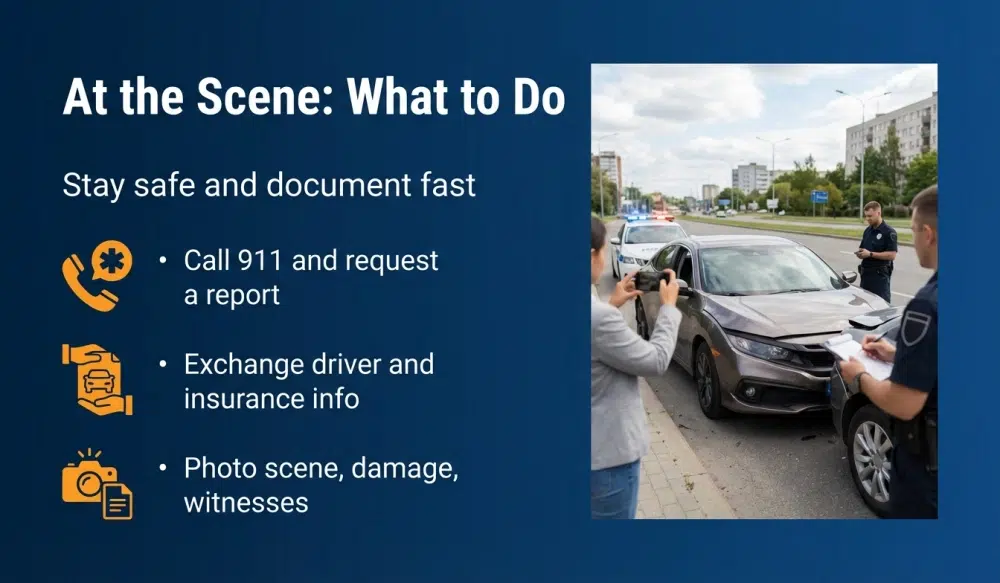
- Call for help and request a report. Ask for CHP or LAPD response when appropriate. A collision report helps identify drivers, vehicles, and insurance. It can also note witness names and initial facts that support later claims [14].
- Exchange information. Obtain driver names, license numbers, plates, insurance company and policy number, and vehicle VIN if possible.
- Identify witnesses. Politely ask bystanders for names, phone numbers, and email addresses before they leave.
- Document the scene. Photograph vehicles, roadway, skid or yaw marks, debris, lighting, traffic controls, and injuries. Details fade quickly due to cleanup, towing, or weather.
- Preserve short lived digital data. If nearby businesses or residences have cameras, note their address and camera locations. Video can overwrite within 24 to 72 hours unless a preservation request is sent promptly.
If you were not able to do these steps at the scene, do not worry. You can often return to photograph the area, request surveillance video from adjacent properties, and obtain a police report later. Swift follow up still matters because physical and digital conditions change quickly in Los Angeles traffic environments.
What photos should you take after an accident?
Photos and videos provide objective, time stamped context. They support liability and injury causation by showing forces, angles, and the environment. Take wide angle, mid range, and close up images.
- Vehicles and property damage. Capture each side of every vehicle, the crush zones, wheel alignment, undercarriage scrapes, and airbag deployment. Include license plates and VIN labels. Photograph any property damage such as guardrails, poles, or storefronts.
- Roadway and traffic controls. Show lane markings, stop signs, signals, crosswalks, bike lanes, speed limit signs, and construction zones. Photograph temporary conditions like road work cones and signage.
- Environmental factors. Record shadows, glare, street lighting, weather, and puddles. Take photos at the same time of day as the collision if possible.
- Injuries and recovery. With consent, photograph bruising, lacerations, casts, stitches, and assistive devices. Re photograph as injuries evolve to document healing and any scarring.
- Product or premises hazards. In a fall or premises case, capture liquids, debris, uneven flooring, handrails, missing warnings, and mats. Include a coin or ruler next to cracks to show size without using a dash or special character in your notes.
Good metadata helps. Keep the original file creation dates. Avoid filters or edits that could be challenged. Store originals securely in a cloud folder and a second physical drive for redundancy.
How do you document injuries and medical records for personal injury claims?
Accurate medical documentation connects the incident to your injuries and supports both causation and damages. Tell providers exactly how the injury occurred and all body parts affected. Follow through on recommended diagnostics and referrals when appropriate.
- Initial evaluation. Emergency room or urgent care notes within the first hours or days are powerful because they capture symptoms close in time to the event.
- Diagnostic tests. Keep copies of X rays, CT scans, MRIs, and lab results. Ask for the radiology reports and the image discs or digital access links.
- Treatment notes. Obtain primary care and specialist records, physical therapy notes, and surgical reports. In civil cases, medical records often fall within the business records exception, subject to proper foundation [3].
- Medication and devices. Save prescriptions, pharmacy printouts, and device instructions for braces, boots, or TENS units.
- Injury journal. Make dated entries about pain levels, sleep disruption, work limitations, childcare challenges, and missed activities. Contemporaneous notes may refresh recollection and support non economic damages when paired with medical evidence.
Organize medical bills separately from records. Bills quantify economic damages; records explain the need for care. For ongoing treatment, keep a running list of providers with addresses and dates to streamline requests and avoid gaps in proof.
Access to guidance from Los Angeles personal injury lawyers can help you identify which records and medical coding entries best support the elements of your civil claim.
How do witness statements and police reports help?
Neutral witnesses can strengthen liability proof, especially when drivers disagree. Ask witnesses for a quick audio or written statement while events are fresh. Note their vantage point, distance, and whether anything obstructed their view.
- Police reports. Collision reports list parties, vehicles, diagrams, and sometimes contributing factors. In California, a police officer’s observations may be admissible for certain nonhearsay purposes or exceptions, but written reports can raise hearsay issues if offered for the truth without a proper exception. Reports still guide insurers and help locate witnesses and physical evidence [14].
- Excited utterances. Statements made while under the stress of excitement caused by the event may qualify as exceptions to hearsay if a proper foundation is laid [4].
If the police did not respond, you can still build a strong file by collecting witness contacts, photographs, and medical documentation. Insurers often accept alternative evidence that credibly establishes fault and damages.

Which official forms and reporting deadlines apply in California?
California has several post collision reporting requirements, separate from insurance notifications. Missing these can delay claims and complicate litigation.
- Driver report to law enforcement for injury or death. California Vehicle Code section 20008 requires drivers to report a collision involving injury or death to the local police department or CHP within 24 hours if an officer did not take a report at the scene [12].
- DMV SR 1 within 10 days. Any crash with injury, death, or property damage of 1000 dollars or more requires filing an SR 1 with the DMV within 10 days, even if law enforcement took a report [13].
- Requesting a CHP report. If the CHP handled the incident, you can request the collision report by submitting Form CHP 190 with applicable information and identification [14].
- Statute of limitations. In most California personal injury cases, you must file a lawsuit within two years of the injury date, subject to specific exceptions [5].
- Claims involving public entities. If your claim is against a city, county, or state agency, you generally must present a government claim within six months before filing suit [6].
Calendaring these deadlines from day one reduces risk. Build your evidence file in parallel so you are ready to support notice, claim presentation, and litigation needs on time.
How do you preserve digital evidence like video, vehicle data, and phone records?
Digital data can be decisive but fragile. Many systems automatically overwrite footage within days. Early preservation letters are essential, and discovery tools can enforce retention later.
- Private surveillance and dashcams. Identify businesses, homes, or buses that may have captured the incident. Send a written preservation request as soon as possible. Kindly provide dates, times, and camera angles if known. Follow up with a formal subpoena or demand after suit if needed.
- Vehicle event data recorders. Modern vehicles may store speed, throttle, braking, and seat belt data. To avoid alteration, coordinate with insurers and storage facilities before vehicles are repaired or salvaged.
- Phone records and device data. Call logs and location data can corroborate timelines. Avoid altering device settings. If distracted driving is suspected, discovery may reach relevant use data subject to privacy and proportionality standards.
- Cloud backups. Save raw files to cloud and local storage. Keep unedited originals with creation dates intact to aid authentication.
Courts can impose measures for loss of electronically stored information, up to adverse inference instructions in serious cases, under rules addressing spoliation of ESI [9]. In California, separate tort lawsuits for spoliation are not allowed, but judges may instruct juries that a party who suppressed evidence should view it as unfavorable [11] [10].
What documents do insurers ask for in Los Angeles claims?
Insurance adjusters want a complete, well organized packet. That packet also becomes part of your litigation file if settlement does not occur.
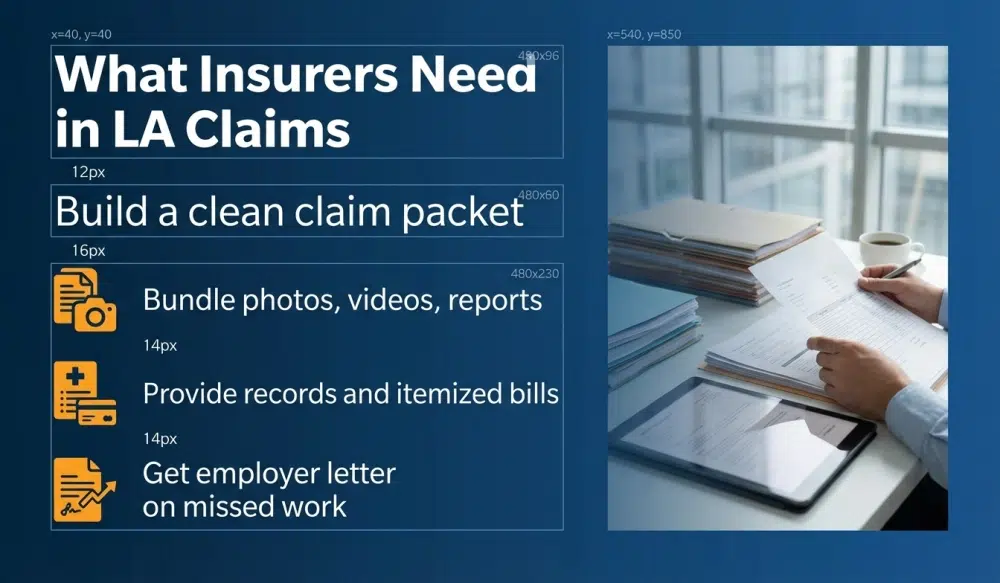
- Collision documentation. Photos, video links, police report number, and witness contacts.
- Medical proof. Records, itemized bills with CPT and ICD codes, operative reports, and therapy notes. Provide summaries that connect care to the collision.
- Wage loss. Employer letter specifying position, pay rate, hours missed, and dates off work. Include pay stubs and tax documents as applicable.
- Property damage. Body shop estimates, total loss valuations, repair invoices, and rental car records.
- Out of pocket costs. Receipts for medications, bandages, rides to appointments, and damaged personal items like phones or helmets.
Use a single folder with subfolders for scene, vehicles, injuries, medical bills, medical records, wage loss, and correspondence. A well indexed packet makes it easier for an adjuster to evaluate liability and damages promptly.
How do you track damages, wage loss, and out of pocket costs?
Compensation in California personal injury cases includes economic and noneconomic damages. Keep proof for each category.
- Medical bills. Save every bill and explanation of benefits. Maintain a spreadsheet listing date of service, provider, and amount billed and paid.
- Income loss. Keep pay stubs, W 2s, and a letter from your employer. For self employed individuals, retain invoices, 1099s, and profit and loss statements reflecting reduced capacity after the incident.
- Property loss. Photograph damaged items and keep purchase receipts. For high value items, consider an appraisal.
- Daily impact journal. Note missed events, sleep interruption, household tasks you can no longer perform, and the activities you had to curtail. Pair journal entries with treatment notes to strengthen credibility.
When both liability and damages are well documented, negotiations are more grounded in objective proof. If litigation becomes necessary, your organized file shortens the time needed to respond to discovery requests and improves clarity for the judge and jury.
How does evidence get admitted in California civil cases?
Courts decide admissibility based on relevance, reliability, and fairness. Evidence that helps a jury understand a disputed fact is usually admissible if it clears foundational and hearsay hurdles.
- Relevance. Evidence is relevant if it makes a material fact more or less probable [1].
- Hearsay and exceptions. Out of court statements offered for their truth are hearsay unless an exception applies. California recognizes exceptions for certain spontaneous statements and business records when a proper foundation is laid [4] [3].
- Authentication. Photos, videos, and digital records must be shown to be what the proponent claims. Keep original files and metadata. Witness testimony can authenticate images based on personal knowledge of what the image depicts.
- Jury instructions. If a party willfully suppresses evidence, the court may instruct the jury that the evidence would have been unfavorable to that party when the facts support it [10].
Plan early for admissibility. Save originals, track chain of custody where possible, and obtain declarations or testimony from custodians of records to satisfy business records foundations.
How do discovery rules help you obtain and preserve evidence?
Discovery unlocks evidence you cannot obtain informally. Parties exchange documents, answer written questions, and take depositions. Federal rules provide a helpful structure that California courts often parallel, including initial disclosures, scope, and proportionality considerations [7].
- Requests for production. Serve written demands for documents and electronically stored information, including formats for ESI and deadlines for response [8].
- ESI preservation and sanctions. Courts may impose measures if relevant digital evidence is lost because a party failed to take reasonable steps to preserve it once litigation is reasonably anticipated [9].
- Subpoenas to nonparties. Use subpoenas to obtain surveillance video, maintenance logs, delivery records, or other third party evidence not in a litigant’s custody.
- Protective orders. If sensitive information is involved, consider a protective order to control use and disclosure while keeping the discovery process moving.
Write preservation letters the moment you have reason to anticipate a claim. Identify the categories of evidence, relevant dates, and systems that might contain data. Follow up with formal discovery soon after litigation begins.
What checklists apply to common Los Angeles accidents?
Use these focused checklists to build a reliable record for different incident types in Los Angeles. Tailor them to the facts of your case and the venues where you may file suit.
What belongs in a car accident evidence checklist?
- Scene proof. Photos of vehicle positions, damage on all sides, skid marks, debris, and traffic controls.
- Driver and vehicle information. Licenses, registrations, VINs, insurance details, and ride-hail or commercial carrier numbers, if applicable.
- Witnesses. Contact info and brief statements.
- Police documentation. Report number and officer name. If CHP handled the scene, request via CHP 190 [14].
- Medical records. ER notes, diagnostics, specialist evaluations, physical therapy progress notes, and discharge summaries.
- Digital data. Dashcam files, nearby business video, and vehicle event data recorder downloads.
- Insurance and repairs. Repair estimates, total loss valuations, and rental receipts.
If you are comparing attorneys, reputable Los Angeles car accident lawyers can help coordinate vehicle inspections, arrange downloads of event data, and secure surveillance video before it is overwritten.
What belongs in a slip and fall evidence checklist?
- Hazard documentation. Photos and measurements of spills, uneven surfaces, broken steps, or poor lighting.
- Notice evidence. Cleaning logs, inspection checklists, and maintenance records to show how long the hazard existed.
- Witnesses and employees. Names of staff on duty, manager contacts, and third party witnesses.
- Incident forms. Obtain a copy of any store or property incident report if available.
- Medical documentation. Immediate evaluation and follow up notes to link injuries to the fall.
- Footwear and clothing. Preserve the shoes and clothing worn at the time without washing or altering them.
What belongs in a motorcycle crash evidence checklist?
- Scene and approach. Photos showing approach lines, lane splits, blind corners, and signage. Note road defects like potholes or loose gravel.
- Protective gear. Preserve helmet, jacket, gloves, and boots. Photograph impact marks.
- Vehicle condition. Document bike damage, aftermarket parts, and lighting.
- Medical impact. Document road rash treatment, imaging, and long term mobility limitations.
What belongs in a truck collision evidence checklist?
- Carrier and driver data. USDOT and MC numbers, bill of lading, and dispatch records if available.
- Hours of service and telematics. Preserve electronic logging device data, GPS, and dashcam files.
- Maintenance records. Brake inspections, tire replacements, and repair logs.
- Scene documentation. Skid lengths, gouge marks, trailer swing, and load shift indicators.
What belongs in a product defect injury evidence checklist?
- Product preservation. Keep the product and all parts in a safe container. Do not modify it.
- Packaging and manuals. Save the box, instructions, warnings, and receipts.
- Failure documentation. Photograph the defect, fracture surfaces, and any warning labels.
- Medical linkage. Treatment notes and photos that connect the product failure to the injury.
How do California and federal timelines affect your claim?
Deadlines are critical to preserve rights and evidence.
- Two year personal injury limit. Most California injury claims must be filed within two years of the injury date [5].
- Six month government claim. Claims against government entities require a claim presentation within six months [6].
- Law enforcement and DMV reporting. Report to law enforcement within 24 hours for injury or death if no officer took a report and file DMV SR 1 within 10 days when required [12] [13].
- Evidence preservation. Send preservation letters to drivers, property owners, carriers, and video custodians as soon as you anticipate a claim. Courts can address loss of relevant ESI if reasonable steps were not taken to preserve it [9].
Los Angeles roads are busy and cameras are everywhere. California Office of Traffic Safety data shows high collision counts in large metros, which also means more potential sources of video in nearby storefronts and transit. Early action increases the chance of capturing useful footage [15].
Who is GoSuits and how can technology support your Los Angeles case?
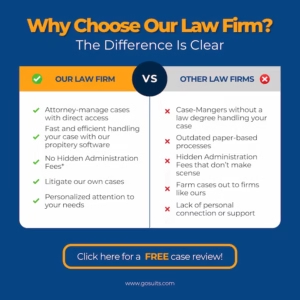
We focus on civil injury matters for people in Los Angeles, CA and across California. A free consultation with a personal injury attorney can help you understand what to collect in the first days, how to preserve video, and what timelines apply. Our team uses a technology driven approach grounded in litigation practice and courtroom experience. We built exclusive proprietary software that automates evidence intake, organizes medical and billing records, and tracks preservation requests to move cases faster while improving accuracy.
Every client works directly with a designated attorney from start to finish. We do not hand cases to case managers. Clients have direct access to their lawyer for strategy, updates, and preparation. GoSuits has 30 years of combined experience handling negotiations, discovery, and trial. We have secured meaningful results for clients in complex injury cases, including disputes with commercial carriers and multi vehicle crashes. For representative outcomes, see our prior cases.
Trial preparation influences every step we take. We develop themes, identify key exhibits early, and prepare witnesses so the story of your case is clear from day one. Our attorneys regularly appear in courts throughout California and are ready to take a case to verdict when settlement is not fair. Meet our attorneys, learn more about us, and explore our practice areas.
If you were hurt in a motor vehicle collision, it can be helpful to compare how different firms collect and preserve evidence. Some injured people speak with car accident lawyers to understand the process for event data recorder downloads and video preservation. If you are evaluating local options, you might also review how Los Angeles car accident lawyers coordinate scene inspections and subpoenas for third party video.
References and resources
- Federal Rule of Evidence 401 Relevance – Legal Information Institute
- Li v. Yellow Cab Co. of California, 13 Cal.3d 804 – CourtListener
- Cal. Evid. Code § 1271 Business Records – California Legislative Information
- Cal. Evid. Code § 1240 Spontaneous Statement – California Legislative Information
- Cal. Code Civ. Proc. § 335.1 Statute of Limitations – California Legislative Information
- Cal. Gov. Code § 911.2 Government Claims – California Legislative Information
- Federal Rule of Civil Procedure 26 Discovery – Legal Information Institute
- Federal Rule of Civil Procedure 34 Producing Documents and ESI – Legal Information Institute
- Federal Rule of Civil Procedure 37 Sanctions and ESI – Legal Information Institute
- CACI Civil Jury Instructions including CACI 204 Willful Suppression – Judicial Council of California
- Cedars-Sinai Medical Center v. Superior Court, 18 Cal.4th 1 – CourtListener
- Cal. Veh. Code § 20008 Reporting Collisions – California Legislative Information
- DMV Accident Reporting Requirements and SR 1 – California DMV
- Request a Collision Report CHP 190 – California Highway Patrol
- Traffic Safety Data and Collision Rankings – California Office of Traffic Safety