- What paperwork do you need to start a Los Angeles injury claim today?
- How do California deadlines affect what you gather first?
- Which accident documents should you collect right away?
- What medical records and bills matter for a California injury claim?
- What insurance and employment records help prove losses?
- How do liens and benefits impact your settlement?
- How should you organize, name, and secure your injury paperwork?
- What if some documents are missing or held by others?
- How does comparative fault change what paperwork you collect?
- What Los Angeles specific steps help your claim move faster?
- Frequently asked paperwork questions
- About GoSuits
- References and resources
What paperwork do you need to start a Los Angeles injury claim today?
If you were hurt in Los Angeles, beginning your injury claim is simpler when you have a focused, doable paperwork list. Your goal is to capture proof of what happened, your injuries, and your losses. Start with items that are easy to gather now, then add records only providers or insurers can produce. California law sets key deadlines and rules that shape what you should collect first, so we call those out where they matter [1] [2] [3].
At a high level, your Los Angeles injury claim paperwork list should cover:
- Accident documentation police report number, agency, report copy when available, incident or occurrence reports for falls, photos and video, scene diagrams, weather and lighting notes, and witness information.
- Medical documentation emergency room or urgent care records, diagnostic imaging reports, visit summaries, prescriptions, physical therapy notes, and all itemized bills and receipts.
- Insurance documentation claim numbers, adjuster names, correspondence logs, proof of coverage, and any reservation of rights letters or explanations of benefits.
- Income and expense documentation pay stubs, timesheets, tax forms, mileage logs to appointments, out-of-pocket receipts, childcare or household help records, and home or vehicle repair estimates.
- Legal deadlines checklist personal injury statute of limitations, special public entity claim deadlines, and insurer response timelines [1] [2] [3] [10].
This guide explains what each document is, where to get it, and why it matters in California. It is written for civil claims only. If you are dealing with a criminal case, different procedures apply.
How do California deadlines affect what you gather first?
California sets a two year statute of limitations for most personal injury claims. You generally must file a lawsuit within two years of the injury date, with some exceptions for minors and certain tolling scenarios [1]. If a state or local public entity is involved, California’s Government Claims Act usually requires you to present a written claim to the government within six months of the injury, and then to file suit within six months after a written rejection or denial by operation of law [2] [3].
These timeframes are a practical roadmap for your paperwork:
- Within days gather incident details, witness contacts, photos, and your first medical records. If a police report exists, note the agency and report number even if the full report is not yet available.
- Within weeks request and save complete medical records and itemized bills as you receive care, and keep all insurer communications. HIPAA allows you to request your medical records and generally requires providers to respond within 30 days, with narrow extensions [9].
- Before month six if a public entity may be responsible, work with counsel to prepare and present a government claim by the six month deadline [2].
- Before two years track the statute of limitations and coordinate with counsel to protect your claim by timely filing suit if needed [1].
Which accident documents should you collect right away?
What police report and incident details should you secure first?
If law enforcement responded to a vehicle crash, note the agency, incident number, and the officer’s name. California law requires an SR-1 accident report to DMV within 10 days for any crash involving injury, death, or property damage of $1,000 or more, which often prompts a formal record trail you can later request [7]. Separate from DMV requirements, drivers must report collisions involving injury or death to the appropriate police or CHP office as quickly as possible and follow with a written report, which supports later retrieval of collision documentation [8].
Ask for the report number at the scene. In Los Angeles, reports can take days to be released. Once available, request the full collision report and any supplemental narratives or diagrams. Official records are often admissible under California’s public records exception to hearsay where the statutory requirements are met [6].
How do photos and video help, and what should you capture?
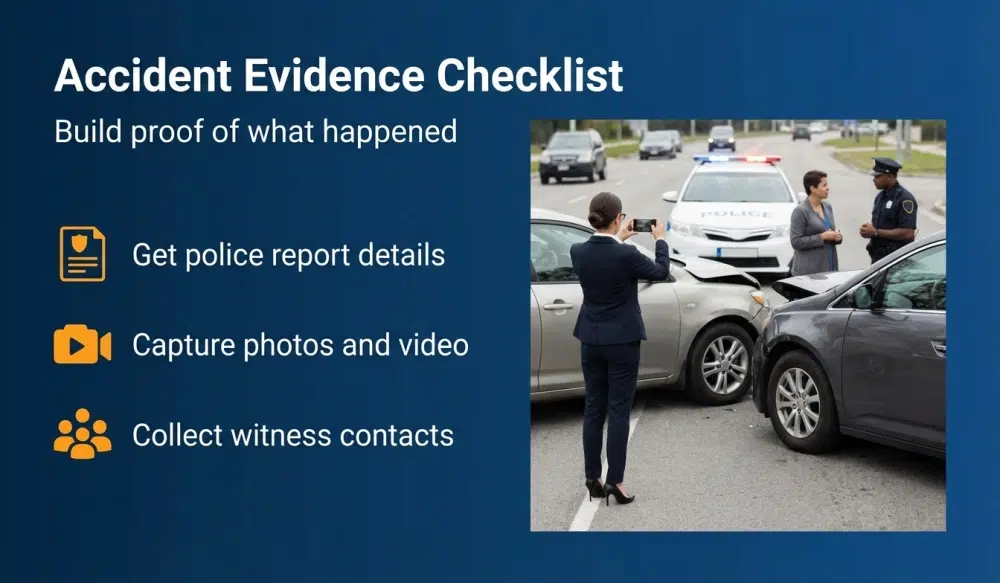
Photos and video preserve what changes quickly in Los Angeles traffic and on private property. Capture vehicle positions, skid marks, debris, license plates, traffic signals, signage, street lighting, weather, and any obvious hazards like broken pavement or liquid spills. Take wide shots to show context and close-ups to show detail. Preserve original files with metadata intact and avoid overwriting timestamps. Create a simple index that lists file name, date, location, and a short description for each image or clip.
What witness information matters most?
Eyewitness accounts can clarify disputes about speed, signals, or the sequence of events. Collect full names, mobile numbers, email addresses, and a short memory jog of what the person saw. If a witness is willing, ask them to write and sign a dated statement in their own words. While hearsay rules govern how statements can be used at trial, records made in the regular course of business and official records can meet exceptions when foundational elements are established [5] [6].
Should you obtain non police incident reports for falls or other injuries?
Yes. For incidents on commercial premises, ask a manager to create and provide an incident report, and keep any correspondence confirming the report was filed. Photograph the hazard and the area from multiple angles, and record conditions like lighting, weather, crowding, and the presence of warning cones or mats. Request any available surveillance footage in writing as early as possible and ask the business to preserve it. Early, specific preservation notices can be important because many systems overwrite video within days.
What medical records and bills matter for a California injury claim?

Which treatment records should you request, and when?
Request complete records as you go rather than waiting until the end of treatment. For a strong medical file, gather:
- Emergency care EMS notes, ER physician records, triage notes, radiology reports, discharge instructions, and prescriptions.
- Primary and specialty care visit notes, diagnoses, referrals, test orders and results, operative reports, and therapy notes.
- Itemized billing hospital UB-04 and physician CMS-1500 forms, explanation of benefits, and pharmacy receipts.
Under HIPAA, you generally have the right to access your records and to receive them within 30 days, subject to limited extensions, and providers may charge only reasonable cost-based fees for copying and postage [9]. When you request records, ask for both the medical records and the itemized bills because each serves a different purpose in valuing damages.
Why do “business records” rules matter to your paperwork?
Courts need reliable documentation. California’s Evidence Code recognizes a business records exception to the hearsay rule for writings made in the regular course of business, at or near the time of the act, and properly authenticated, which can help medical and billing records come into evidence when the elements are met [5]. Similarly, public employee records like certain collision reports can qualify under the official records exception when statutory requirements are satisfied [6]. Organizing and keeping your records in their original format supports authenticity.
What if you used urgent care or telehealth?
Telehealth and urgent care visits create the same type of records. Request the physician notes, diagnostic results, and any digital imaging or photographs from virtual exams. Note the platform used, date and time, and any messages exchanged through patient portals. Save emailed appointment confirmations and after visit summaries as PDFs and add them to your medical timeline.
What insurance and employment records help prove losses?
Keep a complete log of your communications with insurers. Document claim numbers, adjusters’ names, dates and times of calls, and a short note of what was discussed. Save all letters and emails. California’s Fair Claims Settlement Practices Regulations set duties for insurers, including timeframes to accept or deny claims and to explain needed information, which makes your correspondence file an important accountability record [10].
How do you show wage loss and missed work?
For wage loss, collect pay stubs, W-2s, 1099s if you are an independent contractor, and employer verification letters noting job title, hourly rate or salary, typical hours, and dates missed. California employers are required to provide itemized wage statements with specific information, which helps establish earnings before and after the incident [11]. If you track hours in an app, export timesheets. For self-employed workers, gather invoices, bank statements showing deposits, and a simple revenue summary comparing periods before and after the injury.
What out of pocket expenses should you track?
Track everything you pay that is linked to the injury. Save receipts for copays, deductibles, medications, medical devices, travel and parking for treatment, childcare, cleaning or yard services if you needed help, and vehicle towing or storage. Keep a single spreadsheet for date, vendor, amount, and description, and attach or scan the receipt. Store screenshots of digital receipts alongside PDFs in the same folder and naming system.
How do you document property damage and repairs?
If your case involves a vehicle crash, collect tow bills, storage invoices, pictures of the damage before any repairs, and multiple repair estimates. Include the body shop’s written diagnostics and parts lists. If a household item, bike, or phone was damaged, photograph the item, document model and serial numbers, and save repair or replacement costs. Keep your rental invoices and proof of payment if you needed a temporary vehicle.
How do liens and benefits impact your settlement?

What should you gather if Medicare, Medi-Cal, or other benefits paid for care?
Public and private payers may have reimbursement rights from your settlement. If you are a Medicare beneficiary, keep your Medicare Beneficiary Identifier, all Medicare Advantage plan details, and any letters about conditional payments. Medicare is a secondary payer when another party is responsible, and there is a formal recovery process that must be cleared before distributing settlement funds [12].
If you have Medi-Cal, save your client identification number, plan information, and any notices related to payments for your treatment. California statutes authorize the state to recover certain costs from third parties, and timely coordination helps avoid delays at the end of your case [13].
What about private health insurance and ERISA plans?
Private plans may assert subrogation or reimbursement claims depending on policy language and state law. Keep the plan document, summary plan description, and any subrogation correspondence. Save every explanation of benefits that lists “amount paid” and “member responsibility.” Matching EOBs to itemized bills helps reconcile what was actually paid for each service and clarifies what remains outstanding.
How should you organize, name, and secure your injury paperwork?
Use a simple structure you will follow every time:
- Top folder “2026-01 Smith v. Doe Injury Claim”
- Subfolders “Accident,” “Medical Records,” “Bills and EOBs,” “Insurance,” “Employment,” “Photos Video,” “Receipts,” “Legal Deadlines”
- File names “2026-01-15_ER_Discharge_Instructions.pdf,” “2026-02-03_MRI_Report_LSpine.pdf,” “2026-02-06_GEICO_DenialLetter.pdf”
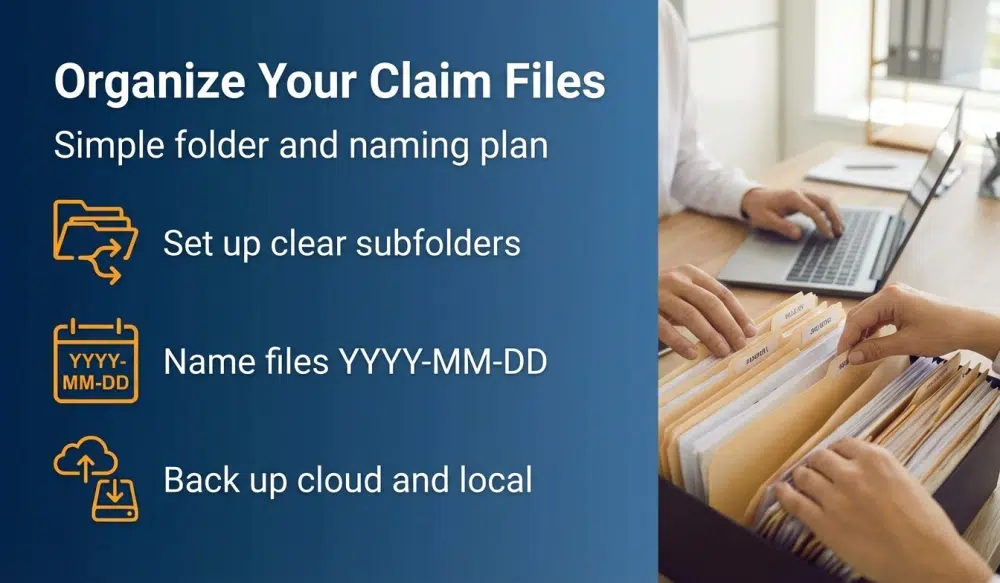
Keep a one page index in the top folder that lists each subfolder and its contents. Update it weekly during active treatment. If possible, maintain a mirrored cloud folder and a secure local backup so you have redundancy.
How do you create a living timeline of care and costs?
Build a simple spreadsheet with columns for Date, Provider, Service, Pain or Limitations that day, Amount Billed, Amount Paid, and Outstanding Balance. This timeline becomes the quickest way to answer an adjuster’s or attorney’s questions and helps you see which records you still need to request.
How should you store physical evidence and original documents?
Keep a labeled envelope or box for physical evidence like damaged items or broken shoe heels from a fall. Store paper bills and receipts in chronological order in a binder with monthly tabs. Photocopy or scan everything that is likely to fade, such as thermal receipts. If you receive CDs or USB drives with imaging, put a copy of their contents in your “Medical Records” subfolder and store the original media in a safe place.
What if some documents are missing or held by others?
How do you request records you cannot access directly?
Use written, dated requests. For medical records, submit a HIPAA compliant authorization to the provider’s records department and track the 30 day response timeline [9]. For wage records, ask your employer’s HR or payroll for wage statements and a work verification letter. California employers must provide itemized wage statements, which helps if you changed jobs or relocated [11].
What if a business or insurer refuses to share something important?
If a private party resists, ask in writing for preservation and specify the exact materials you believe exist, such as surveillance video from a particular camera and time window. California law allows courts to consider willful suppression of evidence when evaluating what inferences to draw, so documenting your preservation efforts matters [14]. Once a lawsuit is filed, formal discovery tools can compel production, including requests for production of documents and subpoenas, and courts can impose sanctions for discovery misuse.
How do you handle government records and collision reports?
Government records have their own request procedures and release timelines. Note that a collision’s reportability triggers DMV and police documentation requirements that you can reference when following up for a copy of the report [7] [8]. Include your incident number, driver’s license number, and date and location of the crash to speed processing.
How does comparative fault change what paperwork you collect?
California follows comparative negligence, which means a plaintiff’s recovery can be reduced by their percentage of fault rather than barred entirely. This makes it important to collect materials that fairly show what you did right as well as what the other party did wrong, such as obeying signals, wearing visible clothing at night, or using handrails on stairs where available [4].
What documents can help show your care and caution?
- Pre trip or pre activity photos showing working headlamps, reflectors, or protective gear.
- Receipts for recent tire replacement or brake service indicating a safe vehicle condition.
- Ride confirmations if you used a rideshare to avoid driving after medication that causes drowsiness.
- Training or safety certifications for job sites or activities if relevant to the incident conditions.
How do you quickly capture local agency details in Los Angeles?
Write down the responding agency and unit numbers at the scene. In Los Angeles, CHP and LAPD patrol different roadways. Get the incident number, officer name, and station phone if possible. Ask towing companies for their yard location and hours, keep the tow bill, and photograph your vehicle at the yard before repairs.

What if English is not your primary language?
Request medical and billing records in plain language and ask your providers for interpretation services. Take notes of who interpreted during each visit. If a family member interpreted, note their name and relationship in your timeline for context.
Why should you start a same day paperwork checklist?
Same day memory is the clearest. Text yourself a quick checklist right now: injury date and time, street and cross street, nearest block number, direction of travel, weather and lighting, names and numbers of witnesses, and the exact location of cameras you saw. Then open a new folder on your phone and move all photos and videos there so they are not mixed with unrelated images.
About GoSuits
We created this Los Angeles injury claim paperwork list to help you start strong on day one. GoSuits is a litigation law firm focusing on civil personal injury for people and families in Los Angeles, CA and across California. A free consultation can help you understand which documents to request first, how to meet California deadlines, and how to avoid common paperwork gaps that delay claims.
- Technology driven our exclusive proprietary software organizes medical records, bills, insurer communications, and deadlines on day one, accelerating claims without sacrificing accuracy.
- Designated attorneys every client works directly with a trial lawyer from start to finish. We do not use case managers. You have unfettered access to your attorney.
- Leadership in innovation we built tools that flag missing documents automatically, align medical and billing data, and prepare insurer ready claim packets faster.
- Past results see examples of outcomes across vehicle collisions, premises incidents, and other civil injury cases on our page for prior cases.
- Trial experience courtroom experience improves negotiations. From discovery to verdict, trial readiness shows your claim is built on admissible records and timelines that comply with California law.
- Practice areas browse our practice areas to see how we approach vehicle collisions, premises incidents, product claims, and more.
- Meet the team read about our attorneys and how 30 years of combined experience supports meticulous documentation and trial preparation.
- More about us learn about our firm’s approach at about us.
We use software to speed the process, but your lawyer remains your point of contact and advocate. If you want help assembling your Los Angeles injury claim checklist, we are here to talk through your next steps.
References and resources
- California Code of Civil Procedure § 335.1 Statute of limitations for personal injury – California Legislature
- California Government Code § 911.2 Claim presentation deadline – California Legislature
- California Government Code § 945.6 Time to file suit after claim rejection – California Legislature
- Li v. Yellow Cab Co. comparative negligence in California – CourtListener
- California Evidence Code § 1271 Business records exception – California Legislature
- California Evidence Code § 1280 Official records exception – California Legislature
- California Vehicle Code § 16000 SR-1 accident reporting threshold – California Legislature
- California Vehicle Code § 20008 Collision reporting to police or CHP – California Legislature
- Individuals’ Right under HIPAA to Access Health Information – U.S. HHS
- Fair Claims Settlement Practices Regulations 10 CCR § 2695.7 – California Department of Insurance
- California Labor Code § 226 Itemized wage statements – California Legislature
- Medicare Secondary Payer Overview – Centers for Medicare and Medicaid Services
- California Welfare and Institutions Code § 14124.72 Medi-Cal recovery – California Legislature
- California Evidence Code § 413 Willful suppression of evidence inference – California Legislature