- What should you do immediately after a commercial vehicle crash in Los Angeles?
- What evidence matters most at the scene?
- How can electronic data from trucks be preserved and collected?
- Which records must carriers keep under federal rules, and why does it matter?
- How do police reports and official records work in Los Angeles and California?
- What photos and videos should you look for after a crash?
- How do you document injuries, treatment, and time off work?
- What is a spoliation letter, and when should you send one?
- How do insurance claims and recorded statements affect your case?
- What deadlines apply in California civil cases after a truck crash?
- How do hazardous materials change evidence and reporting?
- How can a lawyer help with complex commercial truck evidence?
- What is the practical post-accident evidence checklist for Los Angeles cases?
- Why is Los Angeles a unique environment for commercial vehicle crash evidence?
- Which federal safety rules most often affect liability in a commercial vehicle case?
- Will the police test the commercial driver after a crash?
- How do you balance recovery with building a strong claim?
- Why choose GoSuits for a commercial vehicle crash case?
- References and resources
What should you do immediately after a commercial vehicle crash in Los Angeles?
If you are involved in a commercial vehicle collision in Los Angeles, CA, your safety comes first. Move to a safe location if you can, call 911, and accept medical evaluation even if you feel okay. Adrenaline can mask symptoms, and an early medical record helps link injuries to the crash. When law enforcement responds, cooperate with instructions, and request a traffic collision report number for later follow-up [13]. California law also requires drivers to report injury or fatal crashes within 24 hours to the police or the California Highway Patrol if no officer investigates at the scene [7].
After emergency needs are addressed, begin documenting. Take wide and close photographs, exchange information with all drivers and companies involved, and ask for the commercial driver’s company name, USDOT number, cab and trailer numbers, and any hazardous materials placard details. If there are witnesses, politely request contact information and ask whether they captured video on their phones or vehicles. Note nearby businesses, transit stops, and intersections that may have cameras. If you cannot collect these details due to injuries, try to ask a companion to do it. If nobody can safely gather this information, do not put yourself at risk. Much of this evidence can still be located, but time is critical for preservation.
Because commercial carriers are regulated at the federal level, key evidence such as driver logs, electronic logging device data, inspection records, and the company accident register may exist even when the scene changes quickly. These materials can be preserved through prompt written notice and formal discovery if litigation becomes necessary [1] [4].
What evidence matters most at the scene?
A focused checklist helps you and your legal team build a clear record. Consider the following categories while remaining mindful of your health and safety.
- Scene photographs: Take broad shots showing all vehicles, skid marks, debris fields, fluid spills, gouge marks, final rest positions, traffic controls, lane markings, weather conditions, and lighting. Then capture close images of damage points, license plates, USDOT numbers, company logos, and tire condition. Photograph any visible injuries and damaged personal property, such as a child car seat or bicycle.
- Short phone videos: Record a brief walk-through showing perspective from each driver’s approach, traffic signal phases if cycling, and any unusual noises or leaks. Narrate time, location, and orientation, if you can.
- Witness statements and contacts: Ask witnesses what they saw and whether they noticed speeding, lane weaving, sudden braking, or cargo issues. Request names, phone numbers, and email addresses. Identify bus stops or storefronts that may have staff witnesses.
- Commercial identifiers: Note tractor number, trailer number, carrier name, USDOT or MC number, and any placards for hazardous materials. These details help locate company records and federal filings.
- Police agency information: Confirm which agency is responding, such as the Los Angeles Police Department, the California Highway Patrol, or a local municipal police department, and obtain the report or incident number for future requests [13].
Even if you miss some items, later steps can fill the gaps using carrier records and regulatory data. Early collection, however, often captures critical tire scuffs, yaw marks, or road debris before cleanup.
How can electronic data from trucks be preserved and collected?
Modern commercial fleets rely on electronic systems that can reveal speed, braking, throttle, steering inputs, and duty status around the time of a crash. Key sources include electronic logging devices, engine control module data often called black box data, GPS and telematics, and onboard or dash-mounted cameras. Carriers must use electronic logging devices for most interstate drivers subject to hours-of-service rules, and they must retain records of duty status and supporting documents for at least six months [1].
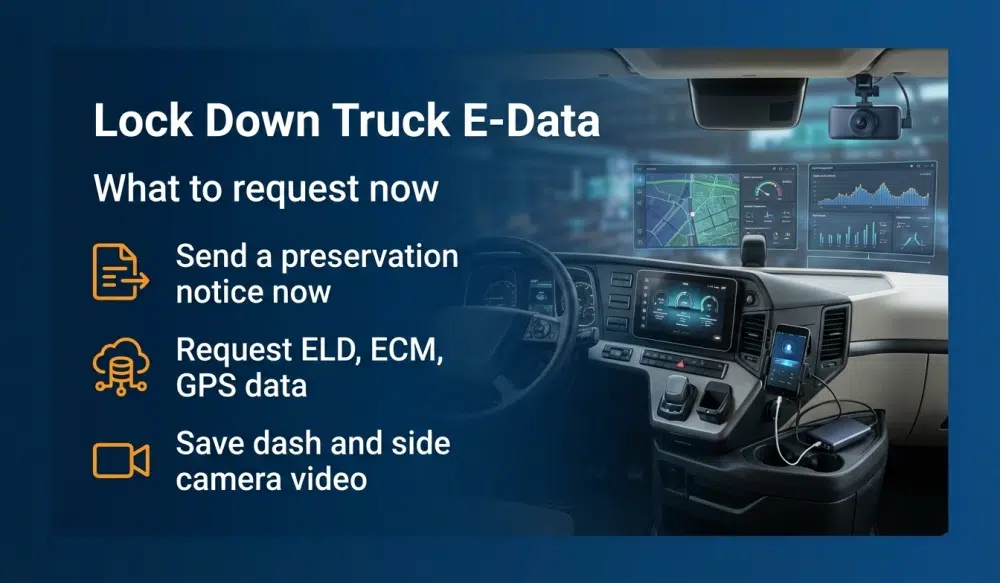
What should you request from the carrier right away?
- Electronic logging device data and backups: Request raw ELD data, any exported files, carrier server backups, and supporting documents such as fuel, toll, and dispatch records for the six-month retention window that surrounds the crash [1].
- Engine control module downloads: Ask for a full ECM download, including pre- and post-incident data, event and fault code histories, and hard brake or stability control activations.
- Onboard camera video: Preserve forward-facing, driver-facing if used, and side-view footage from before and after impact. Ask for the vendor name, because some systems auto-overwrite within days unless the clip is saved.
- GPS and telematics: Request breadcrumb location traces, speed profiles, and geofence alerts for the unit and any paired trailer asset trackers.
How do you keep electronic data from being deleted?
Send a detailed preservation notice as soon as possible. In federal court, loss of electronically stored information can result in sanctions if it should have been preserved in anticipation of litigation and cannot be restored or replaced [10]. In California state courts, judges may impose sanctions for misuse of discovery, including failure to preserve or produce evidence [11]. A prompt notice tailored to the carrier’s systems helps demonstrate diligence and reduces the risk that routine retention cycles will delete crucial logs or video.
Do you need special tools to read data?
Engine control modules often require manufacturer-specific software and adapters. A court order may be needed for physical access. Your legal team can coordinate with neutral forensic vendors to image data without altering it. If inspection becomes contested, courts can set protocols to protect both sides while allowing analysis and fair testing.
Which records must carriers keep under federal rules, and why does it matter?
Federal regulations create a baseline for the types of documents a motor carrier must maintain. These records frequently provide the most reliable picture of what the driver and company were doing before the crash.
- Hours of service and ELD records: Carriers must ensure drivers follow on-duty and off-duty limits, and they must retain records of duty status and supporting documents for at least six months [1]. Reviewing logs can reveal hours-of-service violations and patterns of fatigue.
- Inspection and maintenance logs: Carriers must systematically inspect, repair, and maintain vehicles, and retain records for each vehicle. Maintenance records must be kept while the vehicle is under control of the carrier and for six months after it leaves the fleet [2]. These files can show overdue brake service, tire issues, steering defects, and recalls.
- Parts and cargo securement compliance: Regulations detail how loads must be secured, including working load limits, tie-down placement, and special rules for logs, metal coils, and vehicles. Violations can directly cause or worsen crashes [3].
- Accident register and investigations: Carriers must keep an accident register for three years and maintain copies of crash reports and any findings. This helps identify prior similar incidents and potential notice of a safety problem [4].
- Post-accident drug and alcohol testing: Carriers must conduct testing when specific criteria are met, such as a fatal crash or citations combined with injury or disabling damage, under the timelines in the regulations [5].
These mandatory records often anchor a civil case for plaintiffs and defendants because they are contemporaneous business records, governed by retention rules, and commonly stored in electronic systems. A careful review can validate or contradict what witnesses recall.

How do police reports and official records work in Los Angeles and California?
Police involvement creates an official record that can include diagrams, scene measurements, officer observations, and sometimes commercial vehicle inspections. In California, when an injury or fatal collision occurs, the driver or the owner must report it within 24 hours to law enforcement if no officer takes a report at the scene [7]. The collision report itself may be requested by involved parties, their legal representatives, or insurers. California statutes outline who can access traffic collision reports and when certain personal information must be redacted [8]. The California Highway Patrol publishes a process for requesting collision reports that includes required forms and acceptable identification [13].
Why is the police report useful if it is not admissible for every purpose?
Police reports often guide insurance investigations and can help locate additional evidence, such as witness names or commercial inspection findings. While parts of a report may be hearsay in court, the report can point to admissible sources. Also, photographs, body camera video, field sobriety records, or scale house inspections referenced in a report can sometimes be obtained directly from the agency through proper requests or discovery. Timely requests are important because some data, such as dash camera clips, may be kept for limited periods.
What photos and videos should you look for after a crash?
Images tell the story of a commercial vehicle crash in a way words cannot. After the scene clears, consider a systematic canvass for additional footage.
- Public cameras: Identify traffic signal cameras, highway cameras, and transit station cameras near the intersection or freeway segment. Retention policies vary widely, and some feeds are not archived, so immediate inquiries help preserve clips. If a public agency manages the camera, your legal team can send a preservation notice quickly while also following agency request procedures.
- Private cameras: Canvass nearby businesses, gas stations, loading docks, and residential buildings. Most systems overwrite within days or weeks. Ask politely whether a manager can save the time window spanning at least 10 minutes before and after the crash.
- Vehicle dash cameras: Many passenger vehicles and commercial fleets record continuously. Witnesses may be willing to share files with a written request. If you own the dash camera, create a safe read-only copy, and keep the original card intact.
- Company cameras and telematics: Commercial fleets often use forward, side, and rear cameras integrated with telematics. These systems can be crucial for lane position, speed, and following distance. A well-drafted preservation letter covering these systems, vendors, and retention periods is key.
How do you document injuries, treatment, and time off work?
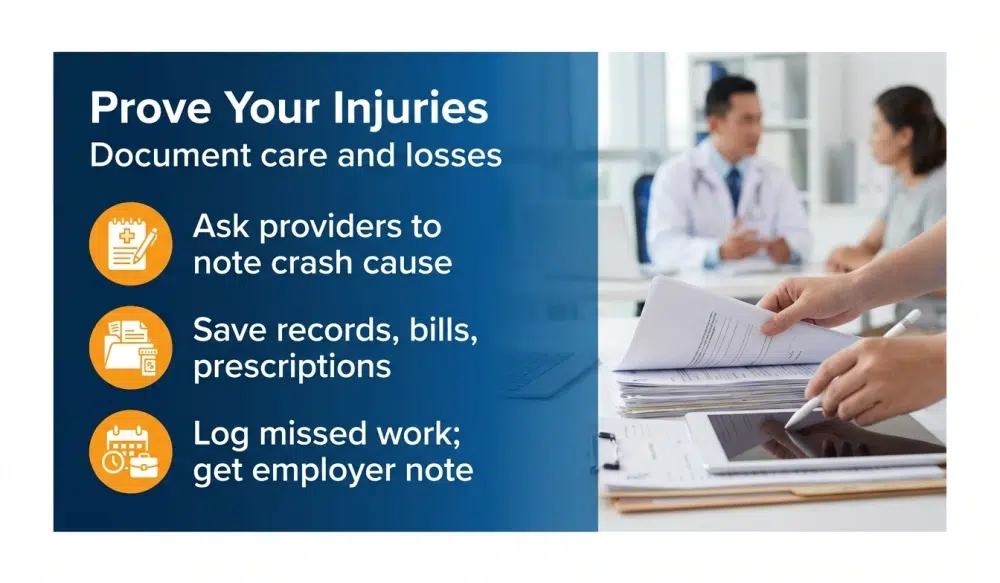
Medical records connect the crash to your injuries. Ask every provider to record the date and cause of injury as a motor vehicle collision. Keep copies of discharge instructions, prescriptions, imaging studies, and referrals. Under federal privacy rules, patients have the right to access their medical records, typically within 30 days of a request, with limited exceptions [6].
What non-medical documents help prove losses?
- Employment and wage records: Gather pay stubs, W-2s, and a calendar of missed shifts or reduced hours. Obtain a letter from your employer confirming dates you could not work and any reduced duties.
- Daily journal: Keep a brief daily log of pain levels, sleep difficulties, and activity limits. This helps explain how injuries affect daily life.
- Out-of-pocket costs: Save receipts for medications, medical devices, travel to appointments, and household assistance.
If you are speaking with insurers, avoid minimizing symptoms. Be accurate and consistent. If new symptoms emerge, seek care and update your records. Organized documentation helps both settlement discussions and trial presentation.
What is a spoliation letter, and when should you send one?
A spoliation letter is a written notice requesting that a person or company preserve specific evidence relevant to a potential claim. Send it as soon as you can identify the parties and likely sources of proof. In federal court, judges may impose measures if electronically stored information that should have been preserved is lost and cannot be restored [10]. In California state court, discovery misuse can result in issue, evidence, monetary, or terminating sanctions [11].
What should the letter include for a commercial vehicle case?
- Scope of materials: List ELD data, ECM downloads, driver qualification file, dispatch communications, pre-trip and post-trip inspections, maintenance records, cargo documents, camera footage, GPS traces, and accident register entries, with the crash date range [1] [2] [3] [4].
- Retention periods and legal hold: Ask the carrier to suspend routine deletion under its retention policies and to issue a legal hold to relevant personnel, including third-party vendors managing telematics or video.
- Inspection protocol: Request advance notice before repairs or salvage of the tractor or trailer, so both sides can arrange a joint inspection.
- Hazardous materials records: If placards or bills of lading indicate hazardous materials, ask the carrier to preserve shipping papers and incident reports required by the federal hazardous materials rules [14] [15].
How do insurance claims and recorded statements affect your case?
Insurance carriers often reach out within days of a crash. While timely reporting is important, be cautious with recorded statements. Provide basic facts, such as date, time, and location, and defer detailed discussions about fault, injuries, or treatment until you have legal guidance. Request the claim number and the adjuster’s contact details. Keep copies of all correspondence and forms you submit. If a commercial insurer requests broad medical authorizations, consider limiting them to relevant time periods and providers. A focused, written claim history supported by documents is more persuasive than a hurried phone call.
In commercial vehicle cases, insurers and motor carriers will be evaluating hours-of-service compliance and maintenance history right away. A structured approach to evidence helps align your claim with what federal and state rules require, which, in turn, can facilitate productive negotiations based on objective records rather than speculation [1] [2].
Many people prefer to have truck accident lawyers handle insurer communications so nothing is missed or compromised in the early stages of a claim. This can reduce the risk of incomplete statements and help keep the record consistent.

What deadlines apply in California civil cases after a truck crash?
California law sets a two-year time limit to file most personal injury lawsuits arising from negligence. If the case is not timely filed, rights can be lost [9]. Other deadlines can be shorter if a public entity is involved and may require a claim notice within months. Evidence deadlines also arise naturally from how long certain records are kept. For example, electronic logging device and records of duty status supporting documents must be retained at least six months, and maintenance records have their own time frames [1] [2]. Preservation notices should be sent well before those windows close.
What timeline should you expect for evidence collection?
- First 7 to 14 days: Scene canvass, vehicle inspections if available, preservation letters to carriers and vendors, and public records requests to law enforcement.
- 30 to 90 days: Initial medical records and bills, insurance claim setup, early witness interviews, and follow-up preservation for video or ELD backups.
- 90 to 180 days: Formal discovery if litigation begins, depositions of drivers or safety managers, and forensic downloads of ECM and telematics.
A disciplined schedule prevents loss of electronic and video evidence that often auto-deletes, and it aligns collection with federally required retention periods.
How do hazardous materials change evidence and reporting?
Hazardous materials can create additional layers of documentation and reporting in a commercial crash. If a hazardous materials release, a fire, or significant risk occurs, certain incidents require immediate telephonic notice to the National Response Center, followed by a written report to the Department of Transportation within the specified time frame and format [14] [15]. Shipping papers, placards, emergency response information, and incident reports may become critical evidence of what was being carried, how it was packaged, and whether required precautions were followed.
What should you request in a hazardous materials crash?
- Shipping papers and emergency response information: Obtain bills of lading, hazard class, UN or NA numbers, packing group, and emergency contact information listed for the load.
- Placard and container photographs: Capture placards on all sides and any tank markings. Note whether responders documented placard codes in the police report.
- Incident notifications: Request copies of any telephonic notifications and written hazardous materials incident reports filed after the crash [14] [15].
Not every commercial vehicle carries hazardous materials, but when it does, these specialized records often clarify how the crash unfolded and what risks emergency responders managed.
How can a lawyer help with complex commercial truck evidence?
Commercial vehicle cases bring together transportation safety rules, electronic data, biomechanics, and insurance practices. A lawyer can coordinate preservation letters, manage discovery to obtain ELD, ECM, maintenance, and cargo records, and retain appropriate experts when needed to analyze compliance with the federal rules governing hours of service, inspections, and cargo securement [1] [2] [3]. An organized approach makes it easier to cross-check driver statements with electronic data and to present a clear story supported by documents and timelines.
Insurers pay close attention to whether a claim is supported by official records. By aligning your submission with the carrier’s accident register, law enforcement reports, and medical documentation, your lawyer can present a claim that is ready for serious evaluation [4] [13] [6]. If settlement is not possible, a litigation plan addresses spoliation risks, inspection protocols, and deposition strategy under both federal and California procedures [10] [11].
What is the practical post-accident evidence checklist for Los Angeles cases?
Use this research-backed checklist to guide your steps after a commercial vehicle crash in Los Angeles.
- Safety and medical care: Call 911, accept medical assessment, and follow discharge instructions. Document symptoms the same day.
- Contacts and identifiers: Exchange names, license numbers, insurance, employer, tractor and trailer identifiers, USDOT number, and hazardous materials placard details.
- Police and report number: Note the agency, and get the incident or report number for later requests [13].
- Scene photos and videos: Capture the roadway, traffic controls, skid or yaw marks, debris, vehicle positions, and damage points.
- Witnesses: Collect names, numbers, and email addresses, and ask if anyone recorded video.
- Medical records and bills: Keep every visit summary, imaging report, and prescription, and request records under your right of access [6].
- Work impact: Save pay stubs, absence notes, and any work restrictions.
- Preservation notice: Send a spoliation letter to the carrier asking to preserve ELD data, ECM, camera video, GPS, driver logs, inspections, maintenance, dispatch, cargo, and accident register entries [1] [2] [4].
- Insurance claim setup: Open claims without detailed recorded statements until you have legal guidance. Keep copies of everything you send.
- Calendar deadlines: Note the two-year lawsuit deadline for most injury claims in California, and shorter notice deadlines if a public entity is involved [9].
Why is Los Angeles a unique environment for commercial vehicle crash evidence?
Los Angeles roadways carry dense freight traffic, complex freeway interchanges, and frequent construction zones. Nationally, fatalities in crashes involving large trucks have trended upward in recent years, underscoring the importance of robust safety compliance and evidence collection [12]. In an urban region, video sources are more numerous but also more likely to be overwritten quickly. That makes early canvassing and tailored preservation notices especially important.
Local enforcement agencies, such as the California Highway Patrol and the Los Angeles Police Department, respond to many commercial vehicle crashes. Requesting and reviewing collision reports, supplemental diagrams, and referenced attachments helps identify whether a specialized commercial vehicle inspection was done. If a scale house inspection or a level-one inspection was triggered after the crash, the records may include violations related to brakes, tires, or cargo securement that may be relevant to liability and causation [2] [3].
Which federal safety rules most often affect liability in a commercial vehicle case?
How do hours of service and fatigue relate to fault?
Fatigue impairs reaction time and decision-making. Hours-of-service regulations limit daily and weekly driving, call for rest breaks, and require logging through ELDs for most interstate drivers. Evidence of hours-of-service violations may support allegations of negligence and can be cross-checked against fueling, toll, and dispatch records maintained by carriers [1].
Why do maintenance records matter?
Brake performance, steering control, and tire condition are common contributors to crash severity. Carriers must have a program for inspection, repair, and maintenance, and keep records for each vehicle. Maintenance logs and work orders can reveal overdue service or patterns of defects that tie directly to a collision mechanism [2].
How can cargo securement affect crash dynamics?
Load shifts can cause jackknifes, rollovers, or loss of control. Federal cargo securement rules dictate required tie-downs and working load limits for different load types. Photographs of the trailer interior and securement devices, together with bills of lading and driver statements, help evaluate compliance [3].
Will the police test the commercial driver after a crash?
Post-accident testing is governed by federal rules and depends on the crash type. A fatal crash triggers testing. Injury or disabling damage crashes may also require testing when a citation is issued, within the time frames set by the regulations [5]. Those results, if obtained, are part of the evidence record and can influence liability assessments and settlement positions. Preserve all notices and communications regarding testing, and request the carrier to maintain the results under its legal hold.

How do you balance recovery with building a strong claim?
Health comes first. Keep follow-up appointments and communicate symptoms. At the same time, assign someone you trust to help collect and organize documents. Set up a shared folder for medical records, bills, work notes, photos, and insurance letters. A step-by-step approach helps your legal team present a complete picture when negotiating with a commercial insurer or preparing for trial.
Many people find it less stressful when truck accident lawyers handle communications with multiple insurers and defense teams. This allows you to focus on treatment while your legal team manages preservation, inspection, and discovery timelines.
Why choose GoSuits for a commercial vehicle crash case?
Commercial vehicle crashes involve sophisticated evidence. A free consultation with a personal injury attorney can help you understand timelines, preservation steps, and how federal and California rules apply to your situation. At GoSuits, we represent clients in Los Angeles and across California in state and federal courts. We combine litigation experience with technology that accelerates evidence gathering without sacrificing personal attention.
Our platform uses exclusive proprietary software to track deadlines, send targeted preservation notices to carriers and vendors, analyze ELD and telematics files, and create synchronized timelines that integrate police reports, medical records, and maintenance logs. We pair these tools with designated attorneys for each client, not case managers. Every client has direct access to their lawyer from start to finish.
We have obtained strong results for injured clients in complex motor carrier and roadway cases. You can review our track record at prior cases and learn about the trial-ready lawyers who will stand beside you at our attorneys. Our firm is built for courtroom advocacy when settlement is not possible. Trial experience often improves case preparation, negotiation leverage, and outcome quality because evidence is developed with admissibility and jury understanding in mind.
We handle a full range of injury matters, including truck crashes, vehicle collisions, motorcycle incidents, hazardous roadway cases, and wrongful death claims. See our practice areas and read more about us. With more than 30 years of combined experience, our team blends innovation and tested advocacy to move cases faster and more clearly for clients who need answers and recovery.
If you prefer a team that uses personalized attention backed by technology, our Los Angeles truck accident lawyers can coordinate scene investigation, vehicle inspection protocols, ELD and ECM preservation, and focused communications with insurers, so that you can focus on medical care.
References and resources
- Hours of Service of Drivers and ELD Requirements – eCFR
- Inspection Repair and Maintenance – eCFR
- Cargo Securement Subpart I – eCFR
- Accident Register and Accident Records 49 CFR 390.15 – eCFR
- Post Accident Testing 49 CFR 382.303 – eCFR
- Access of Individuals to Protected Health Information 45 CFR 164.524 – eCFR
- California Vehicle Code section 20008 Duty to Report Accidents – California Legislative Information
- California Vehicle Code section 20013 Traffic Accident Reports Availability – California Legislative Information
- California Code of Civil Procedure section 335.1 Two Year Limitation – California Legislative Information
- Federal Rule of Civil Procedure 37 Failure to Make Disclosures or to Cooperate in Discovery – LII
- California Code of Civil Procedure section 2023.030 Discovery Sanctions – California Legislative Information
- Pocket Guide to Large Truck and Bus Statistics – FMCSA
- Collision Report Requests – California Highway Patrol
- Immediate Notice of Certain Hazardous Materials Incidents 49 CFR 171.15 – eCFR
- Detailed Hazardous Materials Incident Reports 49 CFR 171.16 – eCFR