- What makes Amazon delivery van crashes in Los Angeles different?
- What immediate steps should you take at the scene in Los Angeles?
- What photos and videos should you collect after an Amazon van crash?
- How can dashcam and telematics data help your case?
- Which official records matter for a delivery accident in California?
- Which medical records and bills prove your injuries?
- What employer and route documents help in delivery van claims?
- How do you secure witness statements and contact information?
- What deadlines and statutes can affect a Los Angeles claim?
- How do liability and comparative fault work in California delivery collisions?
- How should defendants and insurers preserve and produce evidence?
- What is the complete Los Angeles Amazon delivery van accident evidence checklist?
- What common mistakes should you avoid after a delivery crash?
- When and how should you seek legal help in Los Angeles?
- How does GoSuits support delivery van accident cases?
- References and resources
What makes Amazon delivery van crashes in Los Angeles different?
Los Angeles roadways move a high volume of delivery traffic every day on corridors such as I 5, I 10, US 101, and SR 60. Delivery vans operate on tight schedules and frequent stops across neighborhoods, commercial districts, and freeway interchanges. These conditions increase interactions with pedestrians, cyclists, and passenger vehicles at driveways, alleys, and loading zones. While every crash is unique, collisions involving delivery vehicles often add layers of evidence and responsibility that go beyond a typical two car accident.
There are several reasons the evidence picture can be more complex:
- Multiple potentially responsible parties including the driver, the delivery service provider, the shipping platform, a vehicle owner company, a maintenance contractor, or parts manufacturers when a defect is alleged.
- Operational data trails such as route assignments, GPS pings, dispatch communications, stop confirmations, and sometimes telematics measuring speed, harsh braking, or cornering, which can corroborate or contradict narratives.
- Commercial insurance and claims handling practices that can require prompt and formal evidence preservation to avoid loss of digital logs and camera footage.
At a national level, crashes involving large trucks result in thousands of fatalities each year, underscoring the need for careful documentation even when a delivery van is classified below heavy truck thresholds [1] [2]. Locally in Los Angeles, the combination of urban density and freeway speed differentials makes timing and accuracy of evidence collection especially important.
What immediate steps should you take at the scene in Los Angeles?
Your health and safety come first. Once it is safe to do so, focus on the information that tends to disappear quickly. Here is a prioritized approach you can use:
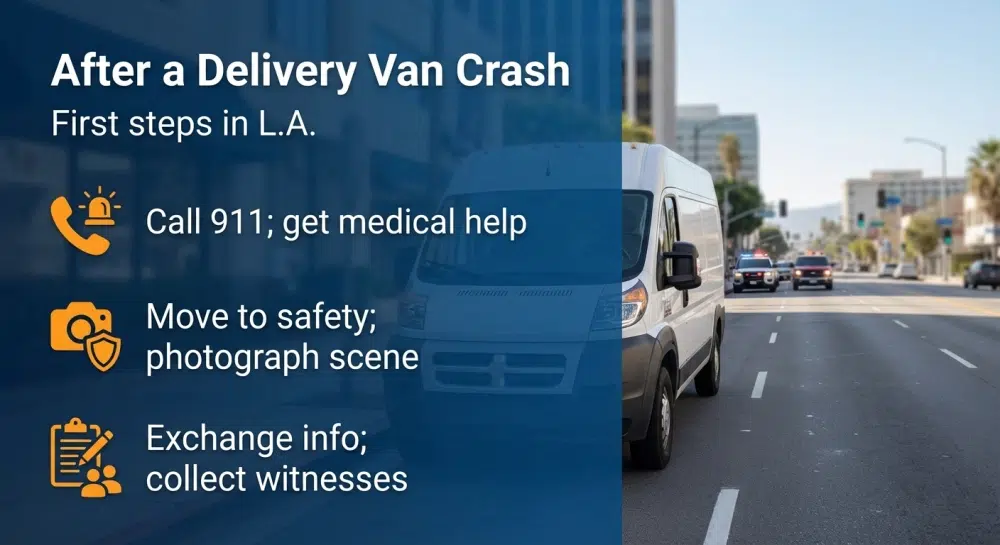
- Call 911 and request police and medical response so the incident is documented and injuries are assessed. In California, drivers must report certain injury collisions to police within a short period, and many crashes must be reported to the DMV as well [4] [3].
- Move to a safe location if possible while preserving the scene. Use hazard lights and, if available, flares or reflective triangles at a safe distance.
- Exchange information including names, driver license numbers, license plates, employer or delivery contractor name, insurance carriers, and policy numbers.
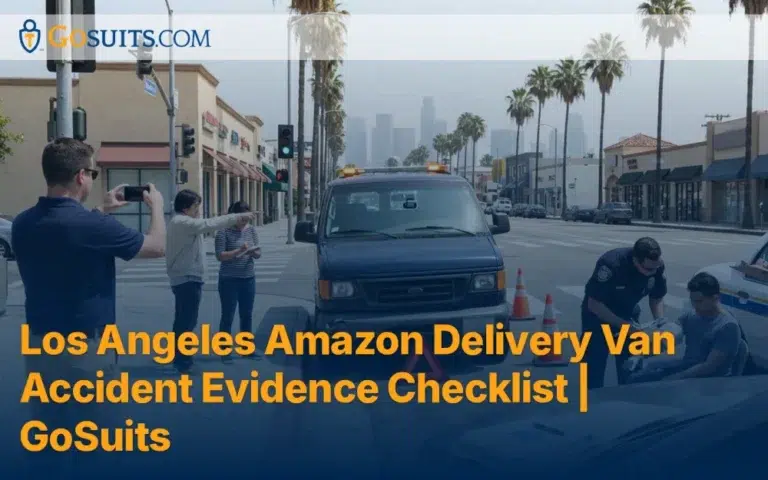
- Photograph the vehicles before they move if it is safe. Capture angles that show location, lanes, and final rest positions.
- Identify potential witnesses and save contact details before they leave the area. Ask nearby businesses if exterior cameras may have captured the crash approach, impact, or aftermath.
- Note road and weather conditions and any unusual traffic controls, lane closures, or construction activities.
Within ten days of most injury or significant property damage crashes in California, a party must submit the DMV SR 1 report, regardless of fault, when the statutory thresholds are met [3]. Failing to complete this step can complicate insurance processing.
What photos and videos should you collect after an Amazon van crash?
Photos and videos can establish mechanism of injury, property loss, and liability. Courts generally require evidence to be relevant and authenticated by someone with knowledge before it can be used, which clear photographs can support [10]. Organize your media with time stamps and short captions.
- Wide scene views showing both vehicles, their orientation, and landmarks like intersections, signal heads, lane markings, and signage.
- Vehicle exterior damage including crush zones, transferred paint, scrape directions, and debris fields, which can show point of impact.
- Interior views such as deployed airbags, seat belt condition, and cargo shift if relevant to occupant movement.
- Skid, yaw, and gouge marks with a reference for scale, captured promptly before traffic or weather erases them.
- Roadway and environment factors like potholes, puddles, oil, sun glare, obscured signs, or obstructed sight lines.
- Injuries and medical devices with sensitivity and privacy in mind, capturing progression over days or weeks as appropriate.
- Nearby cameras and vantage points such as building corners, storefronts, and transit stops so a preservation request can be sent quickly.
If you have a dashcam, preserve the original memory card and make two working copies. Avoid altering file names or metadata. If your device records both video and audio, keep in mind that special California rules may apply to audio capture, and safe mounting is regulated for windshield placement [15].
How can dashcam and telematics data help your case?
Dashcam video can show vehicle paths, speed estimates, traffic signals, and driver inputs. Many delivery fleets also use telematics or mobile device based tracking that records speed, hard braking, and route progress. If the vehicle qualifies as a commercial motor vehicle under applicable federal or California rules, hours of service logs and related records may be relevant to fatigue and scheduling issues [16].
- Preserve native files including original video formats, GPS logs, and metadata. Conversions or compressions can be challenged if authenticity becomes disputed [10].
- Request company held data fast because some systems overwrite or purge data in short retention cycles. Written preservation notices should be specific about data types and dates.
- Corroborate timing by aligning dashcam timestamps with 911 call records, photos, and texts to build a reliable timeline.
National safety data confirms the importance of speed management and attentive driving in commercial operations, which telematics can help to evaluate [1] [2].
Which official records matter for a delivery accident in California?
Official documents can anchor the narrative and support insurance processing. Some records are admissible, while others are primarily for administrative use. Understanding the differences helps you plan what additional proof to collect.
- Police collision reports often include diagrams, statements, and officer observations. California law controls the confidentiality and use of these reports, who can access them, and whether they can be used as evidence at trial [5] [6].
- DMV SR 1 report is mandatory within ten days for crashes that meet state thresholds for injury, death, or property damage, regardless of fault [3].
- Traffic citations or incident numbers can help locate related records and witness names.
- Public entity notices if a roadway defect or traffic control maintenance issue is alleged, followed by timely claim procedures where applicable.
When using records created in the course of business, California has a hearsay exception that may allow properly proven business records into evidence, if foundation elements are met [7]. Authentication is also a threshold requirement before any exhibit can be considered [10].
Which medical records and bills prove your injuries?
Medical documentation connects the crash to your injuries and the care you need. Insurers, courts, and juries look for consistency and completeness.
- Emergency medical services run sheet showing mechanism of injury, initial complaints, vital signs, and treatment administered.
- Emergency department records and imaging including X rays, CT scans, MRI studies, and radiologist reports.
- Treating physician notes and referrals that show diagnoses, differential diagnoses, and treatment plans tied to the collision.
- Therapy and rehabilitation notes covering physical therapy, occupational therapy, and home exercise programs.
- Pharmacy records that document prescriptions, dosage, and duration.
- Itemized billing and explanation of benefits to prove the amount charged and paid, including any liens.
A clear record of symptoms over time helps reduce disputes about causation and the natural course of healing. California law provides multiple evidentiary paths for admissibility, including the business records exception when a qualified witness lays the proper foundation [7].
What employer and route documents help in delivery van claims?
Because delivery work is schedule driven, there are often digital footprints that reveal what happened before and after a crash.
- Daily route assignments and manifests showing scheduled stops, time windows, parcel counts, and route density.
- GPS and geofence pings that confirm vehicle location, speed samples, and stop durations.
- Dispatch communications such as in app messages, phone logs, and radio traffic that may reflect delays, weather, or customer escalations.
- Training, safety policies, and corrective action records to evaluate compliance with company rules and safety expectations.
- Vehicle maintenance records including brake inspections, tire replacements, recalls, and repair orders.
For vehicles that qualify under commercial motor vehicle rules, hours of service records can be relevant to fatigue and scheduling. Federal summaries provide a helpful overview of how those logs work [16].
How do you secure witness statements and contact information?
Neutral witnesses often have the most persuasive vantage point. Their phone video or a short contemporaneous note can settle factual disputes.
- Ask for names, phone numbers, and emails from anyone who saw the approach, the impact, or the aftermath.
- Invite witnesses to save any media they took and to preserve it without edits. Provide a simple written preservation request if possible.
- Follow up soon while memory is fresh. A short, factual statement about signals, speed, and positions can be more reliable than a much later recollection.
If surveillance cameras are nearby, act quickly. Many systems overwrite within days. A prompt preservation notice reduces the risk of loss and allows a later subpoena if needed. California courts recognize sanctions and instructions that may apply when evidence is willfully suppressed or electronically lost contrary to preservation duties [11] [12] [13].

What deadlines and statutes can affect a Los Angeles claim?
Deadlines can be outcome determinative. Several time limits often apply in California crash cases:
- Police and DMV reporting includes prompt police notification for injury crashes and the DMV SR 1 within ten days when statutory thresholds are met [4] [3].
- California personal injury statute of limitations is generally two years from the date of injury for most negligence claims [14].
- Public entity claims against government agencies require early written claims with shorter deadlines before a lawsuit can be filed.
- Preservation and discovery duties arise early in litigation and can lead to court orders, evidence or issue sanctions if evidence is not preserved appropriately [11] [13].
Because dates and exceptions vary, it is important to speak with a qualified attorney early to protect your rights and avoid losing key claims.
How do liability and comparative fault work in California delivery collisions?
California follows comparative fault principles, meaning each party can be assigned a percentage of responsibility and damages are adjusted accordingly. The California Supreme Court recognized comparative fault, which allows partial recovery even when a plaintiff shares some responsibility [15].
On the plaintiff side, you build liability with location data, speed estimates, sightline photos, and industry rules where applicable. On the defense side, you look for intervening causes, compliance evidence, and consistent statements. Both sides rely on admissible proof and credible narratives. Police reports can guide early evaluation but are governed by statutes concerning their use at trial [6].
Commercial operations may also raise issues of vicarious liability, negligent hiring or supervision, and maintenance practices. Business records can substantiate training, telematics alerts, and compliance if properly authenticated and supported by a custodian declaration under California evidence rules [7] [10].
How should defendants and insurers preserve and produce evidence?
Courts expect parties to preserve relevant evidence once litigation is reasonably anticipated. In California, there is no separate tort claim for intentional third party spoliation, but courts can instruct juries and impose sanctions for willful suppression or failure to preserve electronically stored information under applicable rules [12] [11] [13].
- Send a prompt preservation letter that lists camera systems, dashcams, telematics, driver mobile data, vehicle modules, work order files, and training materials with clear date ranges.
- Suspend routine deletion for all relevant systems, including cloud backups and rotating camera storage.
- Collect in native formats with metadata, audit logs, and chain of custody documentation to support authenticity [10].
- Coordinate with vendors who host telematics or fleet camera platforms to export complete datasets, not just screenshots or summaries.
Insurers and companies that respond quickly with full preservation will often avoid disputes and motion practice later. Plaintiffs benefit from early, specific requests that match the technology actually used by the delivery operation.
What is the complete Los Angeles Amazon delivery van accident evidence checklist?
Use this practical checklist to organize your proof for a Los Angeles amazon delivery accident. Tailor it to your situation and update it as new information arrives.
Scene and vehicles
- Emergency response data including 911 call times, incident numbers, and responding agencies.
- Location photographs and video from multiple angles capturing lanes, signals, signs, debris, and resting positions.
- Vehicle identification including VIN, license plates, fleet numbers, and any unit barcodes on delivery vans.
- Damage documentation with close ups and wide shots of both vehicles, cargo area conditions, and any loose items.
- Roadway factors such as construction, detours, temporary signs, or obscured markings.
People and statements
- Driver and company details names, driver license numbers, employer or contracting entity, and insurance cards.
- Witness contact list with phone numbers and emails, plus short factual statements gathered soon after the crash.
- Occupant injury notes recording immediate symptoms, mobility limits, and visible injuries.
Official records
- Police collision report and any supplemental diagrams or photos, obtained according to California access rules [5] [6].
- DMV SR 1 filed within the statutory deadline when required [3].
- Traffic citations or court dates associated with the incident, if any.
Technology and data
- Dashcam files saved in original format with the memory card secured and two working copies created.
- Telematics or route data including speed samples, stop confirmations, and GPS traces exported in native formats.
- Company communications such as dispatch messages, exception alerts, or customer escalations around the time of the crash.
Medical and wage loss
- Emergency department and diagnostic records with imaging studies and radiology reports.
- Treating provider notes and therapy records showing progression, restrictions, and prognosis.
- Itemized bills and liens that tie charges to dates of service and providers.
- Wage and benefit documentation including employer letters, time sheets, and disability paperwork.

Vehicle and property costs
- Repair estimates and invoices from body shops and parts suppliers.
- Rental and loss of use documentation including dates and daily rates.
- Personal property damage list such as child seats, electronics, or damaged cargo.
For admissibility, keep in mind the foundational requirements for business records and authentication under California rules [7] [10]. For fleet camera mounting and visibility rules in California, review the state’s windshield obstruction statute [15].
What common mistakes should you avoid after a delivery crash?
Even strong cases can be weakened by simple missteps. These pitfalls often appear in delivery van crash claims:
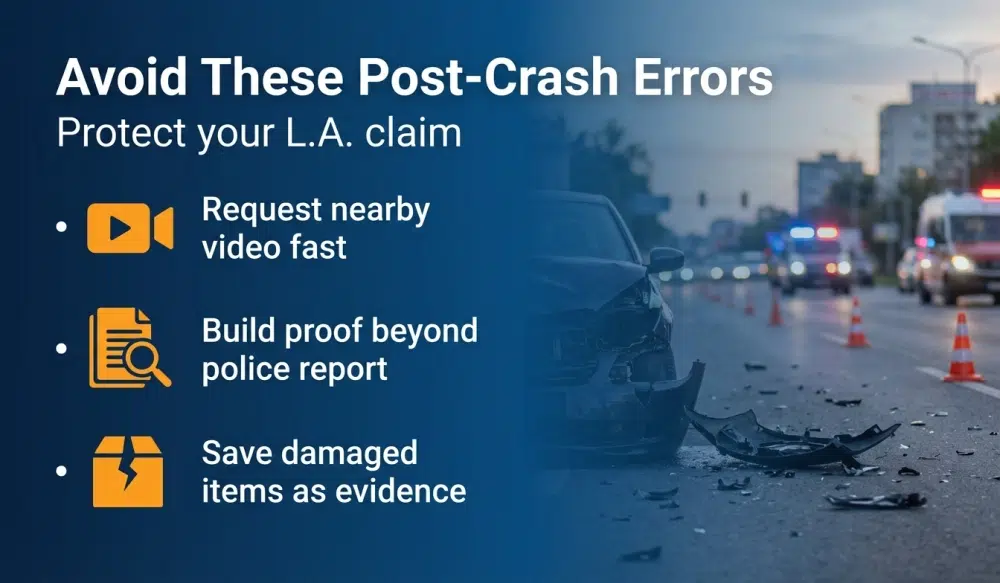
- Waiting too long to request video from nearby businesses or fleet cameras, which can overwrite within days.
- Relying only on the police report rather than building independent proof with photos, measurements, and witness follow up. California law limits how those reports can be used at trial [6].
- Posting on social media about the crash or injuries, which can be taken out of context later.
- Ignoring the DMV SR 1 requirement that applies to many injury and property damage crashes [3].
- Discarding damaged items like broken seats or child restraints that can serve as crucial physical evidence.
- Missing medical follow ups which creates gaps that insurers can exploit to dispute causation.
When and how should you seek legal help in Los Angeles?
Delivery crash cases often involve layered insurance policies and corporate documentation that you cannot easily gather alone. Prompt legal help can drive timely preservation of dashcam video, route data, and company records, and can navigate California rules on police reports, hearsay exceptions for business records, and authentication [6] [7] [10]. If you are comparing firms, ask about investigation speed, trial readiness, and how your attorney will communicate with you.
If you are already managing treatment and vehicle repairs, partnering with truck accident lawyers can reduce the risk of missed deadlines and incomplete documentation. Many people in Los Angeles look for a team that coordinates medical and wage loss records while they focus on healing and family obligations.
Some readers prefer locally focused guidance. It is common to consult with Los Angeles truck accident lawyers who understand the interplay between city driving patterns and freeway dynamics and who can move quickly to secure urban surveillance footage before it is erased.
How can statistics and safety research support a Los Angeles delivery claim?
Numbers help explain risk and context. National reports from transportation safety agencies detail the roles of speed, distraction, and time of day in serious crashes involving larger vehicles. Recent federal summaries show thousands of annual fatalities in crashes involving large trucks and many more injuries, reflecting why documentation of speed and attention is central to evaluating delivery crashes [1] [2]. Even when a delivery van is not classified as a heavy truck, the safety lessons apply, particularly in dense urban settings and at complex intersections.
What does the insurer need to evaluate before making an offer?
Insurers usually want a complete package. Anticipate their questions and assemble the following:
- Liability proof with scene photos, vehicle damage, witness statements, and any video or telematics that support how the crash occurred.
- Injury causation and severity with emergency and follow up records, imaging, therapy notes, and treating provider summaries.
- Economic losses including itemized medical bills, wage loss documentation, and repair or total loss valuations.
- Future needs such as ongoing therapy or procedures supported by physician opinions and reasonable cost projections.
Because California rules affect what may be shown to a jury, it is prudent to gather admissible forms of proof early and think ahead to foundation and authentication [7] [10].
How do you ask a business for surveillance video after a Los Angeles crash?
Local businesses frequently capture the approach to a crash or a critical traffic movement. Here is a practical path:
- Visit or call the location quickly and ask for the manager, explaining the date and time window to check.
- Deliver a short preservation letter with your contact details, the exact time range, and a request to hold the original file without editing. This also applies to residential cameras.
- Follow with a formal subpoena if needed during litigation, especially when the business cannot provide a copy informally.
- Note camera views and positions even if the business declines, so you can seek the footage later if it still exists.
Courts can instruct juries about willful suppression and may impose sanctions for failing to preserve electronically stored information when the duty to preserve has attached [11] [12] [13].
What if the police report seems incomplete or incorrect?
Police reports are useful, but they do not decide fault. California law governs who can access these reports and limits how they can be used in civil trials [5] [6]. If key facts are missing, supplement with your own photos, measurements, and witness statements. You can also provide a concise written statement to the insurer and request that they consider your independent evidence. Consider consulting an attorney to help gather additional proof such as dashcam files, cell phone logs, or third party videos.
How do you keep your evidence organized for a Los Angeles claim?
Organization helps both settlement and litigation. A simple folder structure and a running index can reduce stress and costs later.
- Create date based folders for scene media, vehicle repair, medical records, billing, wage loss, and correspondence.
- Maintain an evidence log listing file names, descriptions, dates, sources, and chain of custody notes.
- Store native files and working copies separately and avoid renaming originals.
- Back up securely in at least two locations to reduce the risk of loss.
This structure also makes it easier for a custodian of records to lay the proper foundation for business records or to authenticate exhibits when needed under California evidence rules [7] [10].
What should drivers know about hours of service and fatigue evidence?
Some delivery vehicles and operations fall within federal hours of service rules, while others do not. When applicable, logs and related documentation can help show whether rest requirements were followed, which may bear on fatigue arguments. A federal summary explains how limits on driving time, rest breaks, and duty cycles work in commercial settings [16]. Even when hours of service does not apply, route pacing, shift length, and dispatch communications can shed light on fatigue or distraction risks.
What language should you use in a preservation letter for a delivery crash?
Keep the language factual, specific, and courteous. Identify the date, time, and location, and list categories of evidence to preserve.
- Video systems including inward and outward facing cameras on the van, warehouse cameras, and any depot lot cameras showing departure and return.
- Digital data such as telematics metrics, GPS points, accelerometer flags, route assignments, exception alerts, and mobile app usage logs.
- Communications including emails, in app messages, and radio traffic contemporaneous with the incident.
- Maintenance and inspection records covering the period before and after the crash.
Reference the obligation to preserve electronically stored information once litigation is reasonably anticipated and note that courts may impose measures if relevant ESI is lost [11] [12] [13].
What should defendants document to fairly evaluate claims?
Delivery companies and insurers can accelerate fair outcomes by creating complete, verifiable records early.
- Driver account and diagram signed and dated soon after the event.
- Full telematics export including raw data files, not just screenshots or dashboards.
- Maintenance snapshots such as tire tread measurements, brake pad thickness, and fluid checks around the incident date.
- Training and policy confirmations that show the driver had access to and acknowledged safety rules.
Producing admissible, authenticated records tends to reduce disputes and motion practice, saving time and expense for everyone [7] [10].
Why is a police report not the final word on fault in California?
California statutes make police reports available to certain parties and place limits on their use at trial [5] [6]. Officers do valuable work in documenting scenes, but civil liability turns on the evidence admitted in court and the legal standards for negligence and comparative fault. That is why scene media, witness statements, and authenticated business records matter in both settlement and trial contexts.
How does comparative fault affect settlement talks?
Comparative fault allows a fair allocation of responsibility, and negotiations usually attempt to predict how a jury would apportion percentages under California law [15]. Expect discussions about speed, signals, lane position, visibility, headlight use, and reasonable following distances. Telematics and dashcam can be decisive when they objectively show speed and relative positions near impact.

How do you talk to your doctors about documenting injuries?
Explain how the crash happened and where you hurt, using plain language. Ask your providers to record functional limits at work and at home. Consistent notes and imaging results align with the business records exception when proper foundation is laid by a custodian of records or qualified witness [7]. Keep copies of visit summaries and bring a running list of symptoms to each appointment.
What is the bottom line for a Los Angeles Amazon delivery van accident evidence plan?
A strong plan collects the quickest disappearing proof first, preserves digital sources before they cycle out, and organizes medical and financial documentation so insurers and, if necessary, jurors can follow the story. Use the checklist above, act promptly on preservation, and ask for legal help early so nothing essential is lost. Delivery crash cases benefit from focused investigation and clear presentation of admissible, authenticated evidence under California law [7] [10].
How does GoSuits support delivery van accident cases?
We help people in Los Angeles, CA and across California who are navigating the aftermath of delivery vehicle crashes. A free consultation with a personal injury trial team can clarify timelines, evidence priorities, and how to request and preserve dashcam, telematics, and business records. We emphasize careful documentation and trial ready preparation from day one.
- Technology driven approach using exclusive proprietary software that accelerates evidence collection, organizes native files and metadata, and builds secure timelines for faster, better results.
- Direct attorney access with designated attorneys for every client. We do not use case managers, and you have unfettered access to your attorney for strategy, case milestones, and questions.
- Proven courtroom focus with trial experience that strengthens negotiations and prepares your case for a jury when needed.
- Past results available so you can review outcomes that matter to you at prior cases.
- Experienced legal team with 30 years of combined experience guiding clients through investigation, medical documentation, and litigation.
- Full scope personal injury practice including delivery and commercial vehicle collisions, pedestrian and bicycle injuries, rideshare incidents, and wrongful death. Learn more about our practice areas and meet our attorneys.
- Commitment to service grounded in communication, transparency, and timely action. Read about our values at about us.
If you are gathering records, we can help you apply the Los Angeles delivery truck accident documentation checklist, request telematics and dashcam files quickly, and prepare your claim for a fair result. Many clients tell us that partnering with truck accident lawyers reduces stress and keeps the case moving while they focus on recovery.
References and resources
- Large Truck and Bus Crash Facts – Federal Motor Carrier Safety Administration
- Traffic Safety Facts 2021 Data Large Trucks – NHTSA
- Accident Report SR 1 – California DMV
- Vehicle Code section 20008 – California Legislative Information
- Vehicle Code section 20012 – California Legislative Information
- Vehicle Code section 20013 – California Legislative Information
- Evidence Code section 1271 Business Records – California Legislative Information
- Evidence Code section 1400 Authentication – California Legislative Information
- Federal Rule of Civil Procedure 37 – Legal Information Institute
- Cedars Sinai Medical Center v. Superior Court – Stanford SCOCAL
- California Civil Jury Instructions CACI 204 Willful Suppression of Evidence – Judicial Council of California
- Code of Civil Procedure section 335.1 – California Legislative Information
- Li v. Yellow Cab Co. of California – Stanford SCOCAL
- Vehicle Code section 26708 Windshield Obstruction – California Legislative Information
- Summary of Hours of Service Regulations – Federal Motor Carrier Safety Administration