- What is a diverging diamond interchange in California and why do crashes happen?
- Who can be liable after a California diverging diamond interchange accident?
- How does California’s comparative negligence rule affect a DDI crash claim?
- When can Caltrans or a city be liable for a dangerous road design at a DDI?
- Does design immunity bar claims in a diverging diamond interchange crash?
- What evidence helps prove liability in a California DDI crash?
- How do you file a claim against Caltrans or a city under the California Tort Claims Act?
- What damages might be available in a California diverging diamond interchange crash?
- What defenses should plaintiffs and defendants expect in DDI cases?
- How do wrong way crashes happen at diverging diamond interchanges?
- How can legal help make a difference in a California DDI crash?
- About GoSuits
- References and resources
What is a diverging diamond interchange in California and why do crashes happen?
A diverging diamond interchange, often called a DDI, is a modern interchange where traffic briefly crosses to the left side of the road while passing through the interchange and then crosses back to the right. This layout eliminates left turns across oncoming traffic by providing direct, protected left movements onto freeway ramps. The Federal Highway Administration reports that DDIs can reduce conflict points and lower the rate of severe crashes compared with conventional diamond interchanges, with studies showing meaningful decreases in injury crashes when the design is implemented and operated correctly [10].
California has begun deploying DDIs at select interchanges where heavy ramp volumes and left turn conflicts have caused delays and prior incidents. While DDIs can improve safety and operations, they are still subject to human factors, traffic volume spikes, and site specific conditions. Confusion during the crossover, inadequate signs or pavement markings, sight distance limitations near ramp terminals, and signal timing issues can contribute to collisions, including side impact, rear end, and the rare but serious wrong way crash at a diverging diamond interchange. When a DDI crash occurs, liability analysis focuses on the conduct of involved drivers, the adequacy of traffic control devices and lighting, and whether the public agency responsible for the roadway provided a reasonably safe design and adequate warnings [10].
From a statewide perspective, California continues to face a high number of serious traffic injuries and fatalities. The California Office of Traffic Safety tracks annual collision data and trends that set the backdrop for any interchange safety discussion. Understanding these statewide statistics helps evaluate whether an isolated crash stems from driver behavior, local operational issues, or a systemic design or maintenance problem at a site [13].
Who can be liable after a California diverging diamond interchange accident?
Responsibility after a California diverging diamond interchange accident depends on a careful review of the facts and the law. Potentially responsible parties can include:
- Other drivers: A driver who speeds, runs a red light, makes an improper lane change through the crossover, fails to yield to pedestrians in crosswalks, or drives impaired can be liable for negligence. Their insurer may be the primary source of recovery for bodily injury and property damage.
- Public entities: Caltrans, a county, or a city may face a dangerous road design claim California if the DDI or its traffic control devices created a dangerous condition of public property that posed a reasonably foreseeable risk of injury and contributed to the crash [5]. These claims are strictly governed by statute and immunities.
- Maintenance and operations: If poor maintenance degraded visibility or usability of the crossover geometry or signals, or if an agency’s signal timing or phasing created confusing operations, a dangerous condition claim may arise if the public entity had actual or constructive notice and failed to correct it within a reasonable time [6].
Both plaintiffs and defendants should analyze how driver conduct and public property conditions interacted. For example, if a driver entered the wrong lane at the crossover because pavement markings were worn and signs were obscured, a trier of fact may apportion fault between driver negligence and a dangerous condition, depending on the evidence.
How does California’s comparative negligence rule affect a DDI crash claim?
California applies pure comparative negligence, so a plaintiff’s recovery is reduced by their percentage of fault rather than barred entirely. The California Supreme Court’s decision in Li v. Yellow Cab replaced contributory negligence with comparative fault and remains the foundational rule today [1]. In practice, if a jury finds a driver was 30 percent responsible for misreading a lane path at the crossover while the remaining fault rests with another driver or a property condition, the damages award is reduced by that share.
Comparative negligence California also applies in cases against public entities, where fault can be allocated among multiple tortfeasors and the public entity, if liability attaches under Government Code section 835 [5]. Expect apportionment arguments to be central to any diverging diamond interchange crash liability trial or settlement.

When can Caltrans or a city be liable for a dangerous road design at a DDI?
Under Government Code section 835, a public entity can be liable for injury proximately caused by a dangerous condition of its property if the condition created a reasonably foreseeable risk of the kind of injury incurred, and if the plaintiff proves one of the statutory pathways to liability, including that the entity had actual or constructive notice in time to protect against the condition [5]. The California Supreme Court’s decision in Cornette v. Department of Transportation explains key aspects of this framework and interacts with the defense of design immunity discussed below [2].
In the DDI context, dangerous condition theories may involve claims that:
- Signs, markings, or lighting failed to provide adequate guidance through the crossover lanes and ramp terminals, causing foreseeable confusion and conflicts.
- Signal timing or coordination produced unsafe queues that extended into crossovers or ramp merge areas, creating a risk of rear end or side impact collisions.
- Visibility and sight distance near pedestrian crosswalks or at the crossover approaches were insufficient, especially at night or during peak traffic.
- Known operational problems persisted despite repeated incidents or complaints, creating constructive notice under Government Code section 835.2 [6].
Courts recognize that an entity’s duty can include not only initial design decisions but also ongoing operational choices, including whether to adjust signal timing or renew worn markings when those conditions create an unreasonable risk.
Does design immunity bar claims in a diverging diamond interchange crash?
Public entities often raise design immunity under Government Code section 830.6, which can bar liability for injuries caused by a plan or design that was approved in advance by the entity in the exercise of discretionary authority and supported by substantial evidence of reasonableness at the time of approval [4]. Cornette v. Department of Transportation details the elements and proof burdens, including that a trier of fact may need to decide reasonableness if there is a triable factual dispute [2].
Two important limits on design immunity frequently arise in DDI cases:
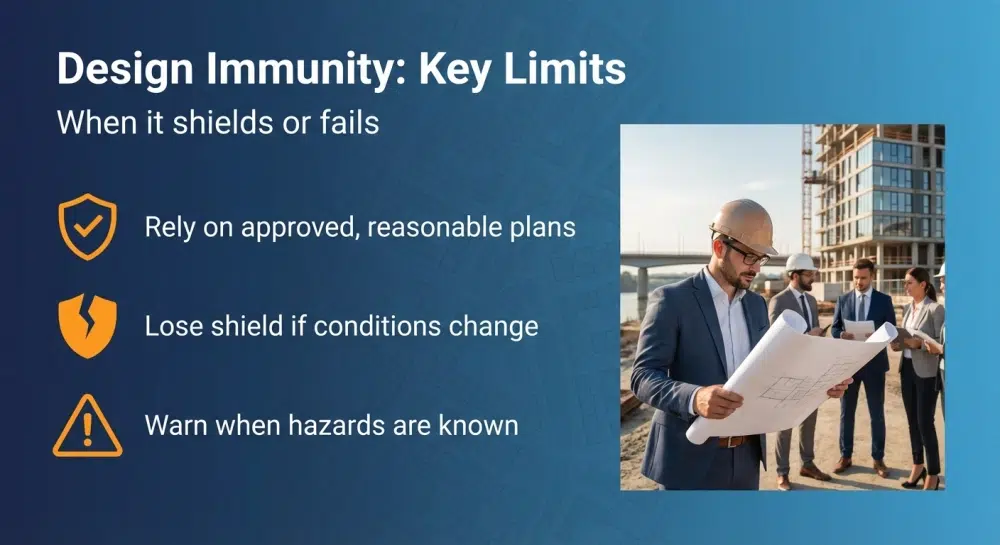
- Loss of design immunity due to changed conditions: If post construction conditions materially differ from those contemplated at approval, resulting in a new dangerous condition, and the entity had notice and a reasonable time to act, design immunity can be lost. Courts have addressed changed condition and notice issues where traffic volumes, collision patterns, or on site operations evolved after opening [11].
- Failure to warn theories: Even when design immunity applies, a claim that the entity failed to warn of a known dangerous condition can proceed if warning was not part of the approved design. The California Supreme Court recently confirmed that design immunity does not categorically bar failure to warn claims where a warning could be provided independent of the approved plans [3].
In practice, diverging diamond interchange crash liability often turns on whether the agency can show the DDI’s plan received discretionary approval supported by substantial evidence of reasonableness and whether subsequent conditions or known hazards required additional warnings or operational changes.
What evidence helps prove liability in a California DDI crash?
Clear, well organized evidence is vital in a California diverging diamond interchange accident case. Consider assembling:
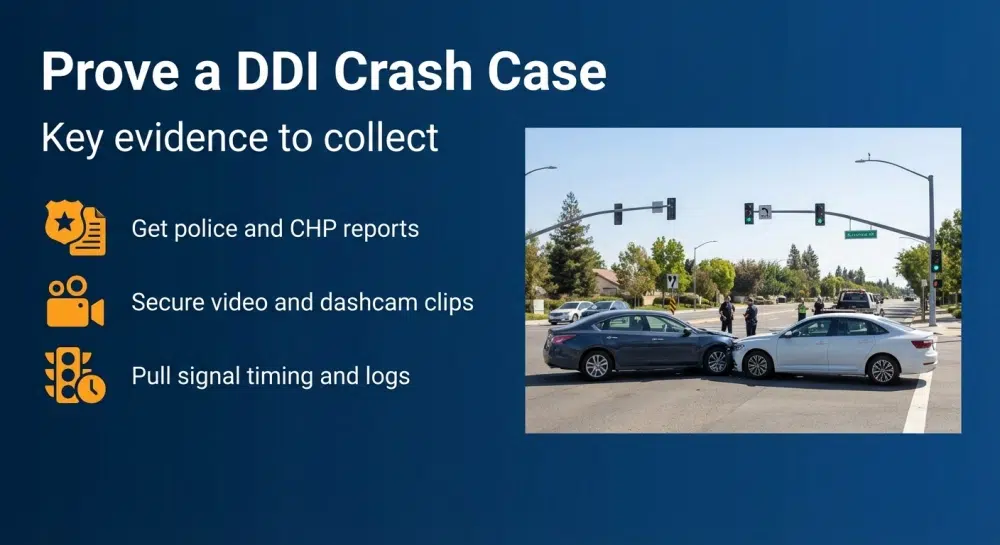
- Police and CHP collision reports: Obtain the official report, supplemental narratives, and any diagram or measurements. The California Highway Patrol provides a process to request vehicle collision reports, which are critical for initial fault assessment and witness information [14].
- Video and electronic data: Dashcam clips, nearby business surveillance, transit bus cameras, and in vehicle data help reconstruct movements through the crossover and signalized nodes. Early preservation requests reduce the risk of routine overwriting.
- Signal timing and phasing records: Request timing sheets, event logs, and controller data for the relevant periods. These records can help verify whether queues, clearance intervals, or pedestrian phases contributed to conflicts. California agencies follow the California Manual on Uniform Traffic Control Devices, which informs signal design and operations statewide [15].
- Signs and pavement markings condition: Document retroreflectivity, visibility, and compliance with standard designs. Photos and nighttime videos can demonstrate how guidance appears to drivers at typical approach speeds.
- Collision history and complaints: A pattern of similar crashes or complaints at the same conflict point can support constructive notice under Government Code section 835.2 [6].
- Design and approval records: If a public entity is involved, obtain plan sheets, traffic studies, and approval memoranda that speak to design immunity and the reasonableness of the DDI at the time of approval [4].
- Operations and maintenance logs: Work orders, inspection logs, and requests for change to signal timing or signage help show response to known issues and the timeline for corrective action.
Early legal steps often include preservation letters to Caltrans or a local agency, a California Public Records Act request for signal and operations data, and prompt outreach to nearby businesses for video. On the driver side, prompt notice to carriers can help secure vehicle inspection and data downloads.
How do you file a claim against Caltrans or a city under the California Tort Claims Act?
If you intend to pursue Caltrans liability or a claim against a city or county, California law requires timely presentment of a government claim before filing a civil lawsuit. Key timing and process points include:
- Six month claim deadline: Most personal injury or wrongful death claims must be presented within six months of accrual under Government Code section 911.2 [7].
- Presentment requirement: Lawsuits are barred unless a written claim is timely presented and then rejected or deemed rejected, as stated in Government Code section 945.4 [8].
- Suit filing deadline: If a public entity sends a written notice of rejection, you generally have six months from the date of that notice to file suit under Government Code section 945.6 [9].
These deadlines are strict. Because DDIs are often operated by Caltrans or a city, the government claims process is a central step in any dangerous road design claim California. Missing the six month deadline can foreclose a Caltrans claim. If you are uncertain about which public entity controls the interchange, present claims to each potentially responsible agency while the deadline is running.
What damages might be available in a California diverging diamond interchange crash?
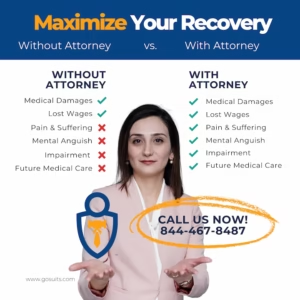
In civil cases, recoverable damages depend on the injuries and losses. For plaintiffs, categories can include medical expenses, lost income, loss of earning capacity, out of pocket expenses, and in appropriate cases pain and suffering. Property claims cover vehicle repair or total loss, diminished value where applicable, and loss of use. In a wrongful death case, statutory beneficiaries can recover certain wrongful death damages, and the decedent’s estate may pursue survival claims.
Defendants may contest causation, argue comparative fault, and challenge the reasonableness of claimed treatment or wage loss. In public entity cases, statutory immunities and limits on theories of liability also shape available recovery.
What defenses should plaintiffs and defendants expect in DDI cases?
In diverging diamond interchange litigation, expect a mix of negligence and public entity defenses. Common themes include:
- Comparative fault: Defendants may argue the plaintiff misread lane channelization, ignored a red signal, or drove at an unsafe speed, triggering an allocation of fault under California’s comparative negligence doctrine [1].
- Design immunity: Caltrans or a city may assert design immunity with evidence that the DDI plans were approved by authorized personnel and were reasonable at the time of approval, supported by studies or guidance, including federal references on DDI safety benefits [2][4].
- No dangerous condition: An entity may contend that the site complied with standards, that signs and markings provided adequate guidance, and that the crash was caused by isolated driver error with no unreasonable risk inherent in the property.
- No notice or reasonable response: For claims based on deterioration or operations, an entity may argue it lacked actual or constructive notice, or that it acted within a reasonable time once issues were identified, invoking Government Code section 835.2 [6].
- Failure to warn disputes: Plaintiffs may rely on failure to warn theories to proceed despite design immunity. Entities may respond that warnings were included in the approved plan or were unnecessary given site conditions, which can present fact questions under recent California Supreme Court guidance [3].
How do wrong way crashes happen at diverging diamond interchanges?
Wrong way entries at DDIs can occur if drivers fail to follow lane channelization during the crossover, if signs and markings are degraded or poorly visible, or if a driver is impaired or distracted. Although DDIs are designed to guide drivers smoothly with signing and markings, rare wrong way events remain possible, particularly during the early period after opening or at night when retroreflectivity is crucial. FHWA’s DDI resources emphasize the importance of clear signage, pavement arrows, and lighting to help drivers navigate the left side crossover correctly and reduce confusion [10].
When these crashes happen, litigation focuses on whether the driver’s conduct was the sole cause or whether conditions on the property created a reasonably foreseeable risk. Detailed site photos, nighttime video, collision history, and signal timing records can be decisive in proving or defending against liability. Agencies may cite design immunity, while plaintiffs may rely on unsafe conditions or failure to warn theories to show diverging diamond interchange crash liability despite immunity defenses [2][3].
How can legal help make a difference in a California DDI crash?
DDI cases blend standard motor vehicle negligence with the specialized statutory rules that govern public entity liability and immunities. A California diverging diamond interchange accident claim can require prompt evidence preservation, targeted public records requests, a careful reading of Government Code sections on dangerous condition and design immunity, and a thoughtful approach to comparative fault and apportionment. Timely compliance with the California Tort Claims Act claim requirements is often outcome determinative [5][7][8][9].
If you are recovering from injuries, focus on health, documentation, and practical next steps. Request the CHP accident report, collect dashcam and phone photos, save all medical bills and wage records, and note any witnesses. If a public entity may be involved, calendar the six month government claim deadline immediately and identify all potentially responsible agencies. Many people search for car accident lawyers after a serious interchange collision because the rules and timelines are complex, and an organized legal approach can protect your rights while you heal.
Whether you are a plaintiff or a defendant, early investigation and a clear plan for evidence can help frame the case for settlement or trial. Disputes in DDI cases often turn on technical but practical questions such as whether signal timing created unsafe queues, whether signs and markings met standards at night, and whether a failure to warn claim is viable even where design immunity is asserted [3][4][11].
About GoSuits
GoSuits helps people navigate complex California roadway cases, including claims arising from diverging diamond interchange operations. If you were hurt in a freeway interchange crash and are unsure whether another driver, Caltrans, or a city may share responsibility, a free consultation with a personal injury lawyer California can help you understand options, deadlines, and the specific steps to preserve evidence and pursue a claim under California law.
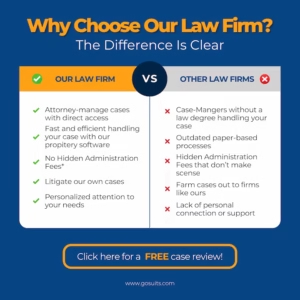
We represent clients across California. Our practice includes car accident attorney California services, wrongful death, motorcycle crash matters, and roadway dangerous condition claims against cities, counties, and the state. We use an exclusive proprietary software platform that organizes records, timelines, and evidence requests to move cases forward quickly while maintaining accuracy and a high standard of service. Technology driven processes speed up investigation and analysis, yet every client works directly with a designated attorney. We do not use case managers. You have direct access to your lawyer for updates, strategy, and decisions.
Our team brings thirty years of combined experience, including trial work. Trial readiness can improve outcomes by sharpening case theory, preserving issues for appeal, and encouraging fair resolution. We invite you to learn about our results and focus on innovation.
We handle a wide range of personal injury and roadway cases throughout the state and are available to talk through deadlines such as the six month government claim requirement for public entity matters.
References and resources
- Li v. Yellow Cab Co., 13 Cal.3d 804 California Supreme Court – CourtListener
- Cornette v. Department of Transportation, 26 Cal.4th 63 California Supreme Court – CourtListener
- Tansavatdi v. City of Rancho Palos Verdes, S267453 California Supreme Court – courts.ca.gov
- Government Code section 830.6 Design immunity – California Legislative Information
- Government Code section 835 Dangerous condition of public property – California Legislative Information
- Government Code section 835.2 Notice of dangerous condition – California Legislative Information
- Government Code section 911.2 Time for presenting claims – California Legislative Information
- Government Code section 945.4 Presentation of claim prerequisite to suit – California Legislative Information
- Government Code section 945.6 Statute of limitations after rejection – California Legislative Information
- Diverging Diamond Interchange Tech Brief Safety and Operations – FHWA
- Rodriguez v. Department of Transportation, F074027 California Court of Appeal – courts.ca.gov
- Menges v. Department of Transportation, G057643 California Court of Appeal – courts.ca.gov
- California Crash Rankings and Traffic Safety Data – California Office of Traffic Safety
- Vehicle Collision Reports Request – California Highway Patrol
- California Manual on Uniform Traffic Control Devices – Caltrans