- What is a sideswipe or lane change crash and why does it happen?
- Who may be liable in a sideswipe or lane change collision?
- What do California, Texas, and Illinois traffic laws say about lane use and signaling?
- How does comparative fault affect your recovery in California, Texas, and Illinois?
- What evidence helps prove an unsafe lane change or merge?
- Do police reports and citations decide who is at fault?
- How do claims change if a commercial truck or bus is involved?
- How are motorcycle sideswipe and lane change crashes different?
- How do insurers evaluate sideswipe and lane change claims?
- What compensation can you seek in civil court?
- What are the filing deadlines in California, Texas, and Illinois?
- What should you do immediately after a sideswipe or lane change crash?
- How do settlement negotiations and trial strategy work in these cases?
- Why choose GoSuits for sideswipe and lane change cases?
- References and resources
What is a sideswipe or lane change crash and why does it happen?
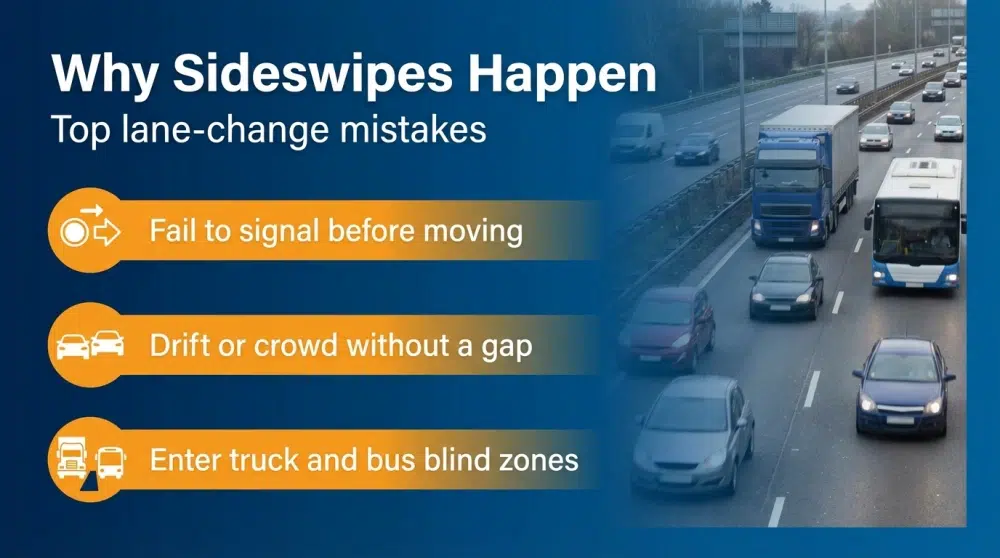
A sideswipe collision occurs when two vehicles traveling in the same or opposite directions make contact along their sides as one or both move laterally. Lane change and merge crashes often start with small errors that produce big consequences. Common contributing behaviors include failing to signal before moving laterally, drifting out of a lane, crowding an adjacent lane without a safe gap, or entering a blind spot where the approaching driver cannot see you. Many state codes require drivers to make lateral movements only when it is reasonably safe to do so and to give an appropriate signal beforehand [2] [3] [4] [5] [6].
At the national level, roadway fatalities remain a serious public health issue. In 2021 there were 42,939 traffic deaths nationwide according to federal data, underscoring the stakes when lateral movements go wrong [1]. While not every sideswipe is fatal, these events can trigger secondary crashes, rollovers, and multicar chain reactions.
Blind spots deserve special attention. Large vehicles such as tractor trailers and buses have No Zone areas along their sides where passenger cars disappear from the driver’s mirrors. Federal safety guidance advises that if you cannot see the truck driver’s mirrors, the driver may not see you. Equipment rules also require commercial motor vehicles to have mirrors that provide a view to the sides and rear, but even with compliant mirrors, blind zones remain and call for increased caution by all road users [16].
Who may be liable in a sideswipe or lane change collision?
Can the driver who changed lanes be held responsible?
Often the driver who initiated the lateral movement bears primary fault where the evidence shows a violation of a lane use or signaling rule, or a failure to make the movement when reasonably safe. In many jurisdictions, violating a traffic statute can support a negligence per se theory if the violation proximately caused the crash. You still need proof of the violation and causation, but the codified duty to signal and maintain a single lane is a central part of the analysis [2] [3] [4] [5] [6].
Can a driver in the through lane be partly at fault?
Yes. Even if another motorist makes an unsafe lateral movement, the through driver must still use reasonable care under the circumstances. Speeding into a narrowing gap, failing to keep a proper lookout, or lingering in a blind spot can lead to an allocation of fault to both drivers under comparative fault rules described below [7] [8] [9].
Does vehicle size or commercial status affect fault?
A professional driver’s duties include observing mirrors, monitoring blind zones, and making lane changes only when safe. If a commercial truck sideswipes a car while merging or changing lanes, evidence of regulatory compliance and training can be relevant, but it does not excuse negligent lateral movements. Federal equipment rules for mirrors set minimum standards yet do not eliminate blind spots or the duty of care [16]. Where facts show both parties contributed, comparative fault determines share of responsibility [7] [8] [9].
What do California, Texas, and Illinois traffic laws say about lane use and signaling?
What rules apply in California?
California law requires drivers to signal before turning or moving laterally and to complete such movements only when reasonably safe [2]. Drivers must also stay within a single lane as nearly as practical and only move from that lane when it can be done safely [3]. Evidence of a violation can support negligence theories in civil cases, subject to proof of causation and defenses [7].
What rules apply in Texas?
Texas requires drivers to maintain a single lane and only move from that lane when the movement can be made safely [4]. Drivers must use the appropriate signal to indicate intent to change lanes or turn [5]. A citation is not required to pursue a civil claim, but the underlying conduct matters in allocating fault.
What rules apply in Illinois?
Illinois requires a vehicle to be driven within a single lane as nearly as practical and prohibits moving from that lane until the driver has first ascertained that the movement can be made with safety [6]. Illinois law also requires proper signaling under the conditions specified by statute. Proof of compliance or violation is frequently central to evaluating liability in sideswipe scenarios [6].

How does comparative fault affect your recovery in California, Texas, and Illinois?
What is comparative negligence and why does it matter?
Comparative negligence is the rule that a plaintiff’s own share of fault reduces recovery rather than automatically barring it. Modern comparative fault grew from decisions and statutes meant to replace the harsh old contributory negligence doctrine. In California, the Supreme Court adopted pure comparative negligence, allowing a plaintiff to recover even if mostly at fault, with damages reduced by the plaintiff’s percentage [7].
How does California allocate fault in a sideswipe claim?
California applies pure comparative negligence through case law. Juries can apportion fault between drivers based on the evidence, including compliance with lane and signaling rules, speed, lookout, and avoidance opportunities. A plaintiff who is 40 percent at fault still recovers 60 percent of proven damages under California’s approach [7].
How does Texas law handle fault in lane change crashes?
Texas uses a modified comparative scheme with a 51 percent bar. A plaintiff cannot recover if more than 50 percent responsible. Otherwise, the award is reduced by the plaintiff’s percentage. This framework applies to unsafe lane change claims, merge collisions, and blind spot incidents alike [8].
What is the Illinois rule on comparative fault?
Illinois also follows a modified comparative negligence system with a 51 percent bar. If the plaintiff’s fault is more than 50 percent, recovery is barred. If 50 percent or less, damages are reduced in proportion to that share. This structure often drives factual battles over signaling, lane discipline, and visibility in sideswipe cases [9].
What evidence helps prove an unsafe lane change or merge?
Why are dash cams, video, and onboard data useful?
Dash cams, roadway cameras, and vehicle event data recorders can show turn signal use, lane position, speed, and timing of lateral movements in the seconds before impact. In civil court, evidence must be relevant and authenticated to be admissible. Relevance means it has any tendency to make a consequential fact more or less probable [13]. Authentication generally requires showing the item is what the proponent claims it is, which can be satisfied through witness testimony, metadata, or chain of custody for videos and digital files [14].
How do police reports play into the proof?
Police crash reports can identify involved parties, vehicle positions, and observed violations. They may contain diagrams and statements. Some portions are admissible under public records exceptions, while narrative opinions can be challenged. Even when not admissible for their truth, reports can guide investigation and lead to admissible evidence through witness contact and scene measurements. Your legal team can obtain the report and evaluate what parts help establish that a lateral movement was unsafe under the relevant statute.
What other proof should you collect?
- Scene photos and measurements showing lane markings, debris fields, yaw marks, and final rest positions.
- Turn signal indicator evidence from video or EDR where available, tied to timing and distance. Vehicle lighting equipment must meet federal standards, which can matter if a malfunctioned lamp plays a role [15].
- Witness statements that describe signaling, lane drift, and traffic flow.
- Vehicle damage profiles on both sides to corroborate sideswipe dynamics and direction of travel.
- Citation records for unsafe lane change, failure to signal, or speed too fast for conditions.
Do police reports and citations decide who is at fault?

Will a traffic ticket automatically prove negligence?
No. A citation is a data point, not a final civil determination. The court or jury decides liability based on the totality of admissible evidence. That said, a ticket for an unsafe lateral movement or failure to signal can support a plaintiff’s theory. Defendants can present contrary proof, such as a video showing the movement was safe and properly signaled under the circumstances [2] [3] [4] [5] [6].
Can a clean citation record help the defense?
Possibly. If the investigating officer issued no tickets, the defense may argue the lateral movement complied with lane and signaling rules. Plaintiffs often respond with independent evidence such as dash cam footage or expert reconstruction demonstrating that the movement still fell below reasonable care even if it did not generate a citation.
How do claims change if a commercial truck or bus is involved?
Are there special blind spot considerations for large vehicles?
Yes. Tractor trailers and buses have extensive blind zones along both flanks and directly alongside the cab. Federal guidance emphasizes that these areas hide adjacent vehicles from the operator’s view. Even with required mirrors, a lateral movement into an occupied adjacent lane can be negligent if the driver failed to make a proper safety check, account for closing speeds, or signal far enough in advance [16].
What evidence is unique to commercial vehicles?
- Telematics and EDR data showing speed, steering input, and signal activation.
- Driver logs and training records to establish qualifications and prior instruction on lane changes.
- Maintenance files confirming mirror and lighting compliance with federal equipment rules [16].
The presence of a commercial vehicle also raises issues like company liability, supervision, and allocation of fault among multiple parties. Careful evidence preservation is critical in these cases.
These collisions intersect with the work of truck accident lawyers when commercial vehicles are involved, especially where multivehicle sideswipes cause serious injuries.
How are motorcycle sideswipe and lane change crashes different?
Why are riders at particular risk in lateral movement conflicts?
Motorcycles are smaller and easier to miss, which increases the risk that a driver will merge into a rider’s lane space. Side contact can destabilize the bike, leading to ejection or secondary impacts. Courts will consider whether the merging driver properly signaled, checked blind spots, and yielded when it was not safe to move laterally, balanced against the rider’s duties to ride predictably and avoid lingering in blind zones. In this context, motorcycle accident lawyers often focus on scene mapping and video to show the rider occupied the lane lawfully before impact.
How do insurers evaluate sideswipe and lane change claims?
What do adjusters look for first?
Adjusters examine lane position, signaling, and the timing of lateral movement using photos, diagrams, and any available video. They will compare statements for consistency and look for corroboration. Many will argue shared fault where both drivers could have acted to prevent the crash through better lookout, speed moderation, or early signaling.
How do comparative fault arguments affect settlement value?
Settlement modeling usually starts with your total economic losses and reasonable noneconomic damages, then applies a percentage reduction for any alleged share of fault under applicable state law. In California, a plaintiff’s share reduces the award but never bars it [7]. In Texas and Illinois, recovery is barred if your share exceeds 50 percent [8] [9]. Lawyers frame liability to minimize any reduction and present the clearest narrative that the lateral movement violated codified duties to signal and change lanes only when safe [2] [3] [4] [5] [6].
What compensation can you seek in civil court?
What categories of damages are typical?
- Medical costs including emergency care, follow up, and rehabilitation.
- Lost income for time away from work and reduced earning capacity.
- Property damage for vehicle repairs or total loss.
- Pain and suffering based on the nature and duration of injuries.
In all three focus states, fault allocation rules will modify the award consistent with the comparative negligence or proportionate responsibility framework [7] [8] [9].
What are the filing deadlines in California, Texas, and Illinois?
How long do you have to file a personal injury lawsuit for a sideswipe crash?
Filing deadlines vary by state and claim type. In California and Texas, most personal injury claims must be filed within two years from the date of injury, with exceptions for government defendants and other specific circumstances [10] [11]. Illinois also generally applies a two year period for personal injury claims [12]. Because exceptions can shorten or extend deadlines, timely legal help is vital to preserve your rights.
What should you do immediately after a sideswipe or lane change crash?
What steps help protect your health and claim?
- Call 911 and request medical evaluation if you feel any pain or dizziness.
- Document the scene with photos of lanes, signals, and vehicle positions.
- Look for cameras on nearby businesses or vehicles that might have captured the lateral movement.
- Exchange information and obtain witness contacts.
- Seek prompt medical care and follow the treatment plan to create a clear record.
- Preserve devices and data such as dash cam files and vehicle telematics, which may require quick action to avoid overwriting.
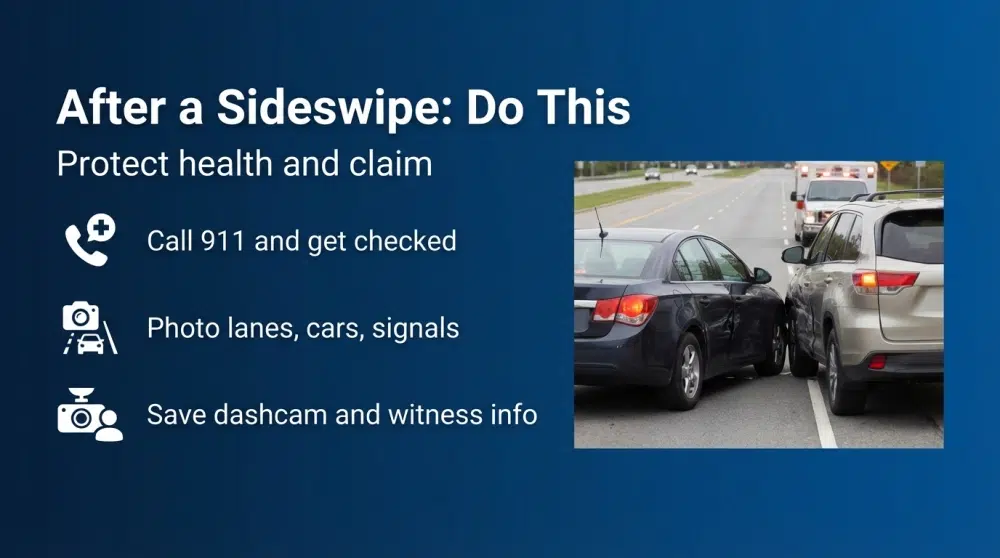
Building a strong civil case often turns on early evidence preservation and a clear narrative connecting a statutory duty to signal or maintain lane position with the moment of impact [2] [3] [4] [5] [6].

How do settlement negotiations and trial strategy work in these cases?
What is the arc from claim to resolution?
Most claims start with an investigation and notice to insurers. Settlement talks typically follow after liability and damages are documented. If the matter does not resolve, filing a lawsuit moves the case to discovery, depositions, expert analysis, and pretrial motions. At trial, video and physical evidence often take center stage, aided by testimony authenticating recordings and highlighting relevance to lane position, signal timing, and traffic flow [13] [14]. A clear state law framework helps jurors apply lane use and signaling rules to the facts [2] [3] [4] [5] [6].
Legal representation is important in opposing aggressive comparative fault arguments. For example, an insurer might argue you accelerated into a narrowing gap or stayed in a blind spot too long. Counsel can counter with time distance analysis and statutory compliance evidence.
If you are navigating a claim following a sideswipe or lateral movement crash, working with car accident lawyers who understand signal timing analysis, EDR downloads, and lane discipline statutes can help present a compelling claim. The same is true where commercial vehicles are involved and truck accident lawyers must obtain and interpret telematics and training records to show how and why a lateral movement was unsafe.
Motorcycle accident lawyers frequently focus on visibility and lane positioning evidence to rebut suggestions that a rider appeared suddenly or occupied a nonstandard lane position.
Why choose GoSuits for sideswipe and lane change cases?
We know a lateral movement can change your life in an instant. These cases call for careful evidence work, a firm grasp of lane discipline rules, and measured advocacy in negotiations and court. Here is how we help nationwide.
- Aligned with your needs Our practice focuses on personal injury. We help people hurt in sideswipe, merge, and lane change crashes build the strongest case possible while you focus on recovery.
- Nationwide representation We handle cases across the United States, with state specific strategy for California, Texas, Illinois, and other jurisdictions.
- Technology driven approach We use secure digital intake, rapid record retrieval, and advanced analytics to organize proof, model comparative fault scenarios, and present clear time distance narratives.
- Exclusive proprietary software Our in house platform accelerates evidence collection, video authentication workflows, lien analysis, and settlement modeling for faster, better outcomes.
- Leadership in innovation We continually refine data tools for dash cam workflows, EDR requests, and roadway video preservation so critical lane and signal timing proof is not lost.
- Attorney access without layers Although we use technology to move cases forward quickly, every client works directly with a designated attorney. We do not route your matter through case managers. You have unfettered access to your lawyer.
- Past results and trial readiness Our team has secured meaningful recoveries for clients and is ready for trial when needed. See our track record here: prior cases.
- Seasoned team with 30 years combined experience Our attorneys try cases and know how to present lane and signaling proof to juries. Meet the team: our attorneys and learn more about us.
- Full scope injury practice We handle car, motorcycle, and commercial vehicle matters, roadway defect claims, pedestrian cases, and other complex injuries. Explore our practice areas.
- Free consultation A no cost consultation helps you understand time sensitive steps to protect evidence, the role of lane and signal statutes, and comparative fault impacts on value.
In your recovery journey, car accident lawyers can take on the burden of dealing with insurers, gathering video and data, and preparing for court where needed. When commercial vehicles are involved, truck accident lawyers can move quickly to preserve telematics and company records before they are lost.
References and resources
- NHTSA Releases 2021 Traffic Crash Data – U.S. Department of Transportation
- California Vehicle Code section 22107 – California Legislature
- California Vehicle Code section 21658 – California Legislature
- Texas Transportation Code section 545.060 – Texas Legislature Online
- Texas Transportation Code section 545.104 – Texas Legislature Online
- 625 ILCS 5 11-709 – Illinois General Assembly
- Li v. Yellow Cab Co. – CourtListener
- Texas Civil Practice and Remedies Code Chapter 33 Proportionate Responsibility – Texas Legislature Online
- 735 ILCS 5 2-1116 – Illinois General Assembly
- California Code of Civil Procedure section 335.1 – California Legislature
- Texas Civil Practice and Remedies Code section 16.003 – Texas Legislature Online
- 735 ILCS 5 13-202 – Illinois General Assembly
- Federal Rule of Evidence 401 – Cornell Law School Legal Information Institute
- Federal Rule of Evidence 901 – Cornell Law School Legal Information Institute
- 49 CFR 571.108 FMVSS No. 108 Lamps Reflective Devices and Associated Equipment – eCFR
- 49 CFR 393.80 Rear-vision mirrors – eCFR