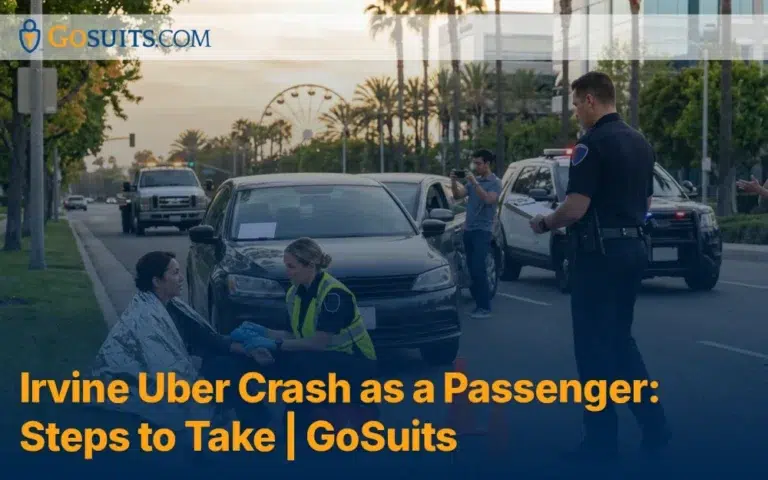
- What should you do immediately after an Uber or Lyft crash in Irvine as a passenger?
- How do you report the crash to police, the DMV, and the rideshare app?
- What medical steps should you take and how do you document injuries?
- Who pays for your injuries in a California rideshare passenger collision?
- How do California rideshare insurance periods work for Uber and Lyft?
- What are your rights as an Uber or Lyft passenger in Irvine?
- How does fault and comparative negligence work in California?
- How do claims, evidence, and negotiations work after an Irvine rideshare crash?
- What damages can a passenger claim in a civil case in California?
- What deadlines apply to an Irvine rideshare injury claim?
- What if a government vehicle or public road hazard was involved?
- What if multiple drivers share fault and how is payment split?
- What defenses do insurers raise and how are they addressed?
- What special issues apply to minors, out of state visitors, or undocumented passengers?
- How does a wrongful death claim work after a rideshare crash?
- What should rideshare drivers and other defendants know?
- Frequently asked questions about Irvine rideshare passenger collisions
- About GoSuits and how we help injured passengers in California
- References and Resources
What should you do immediately after an Uber or Lyft crash in Irvine as a passenger?
Your focus is safety, medical care, and preserving information. Collisions are disorienting. The steps below help protect your health and your rights in a California civil claim.
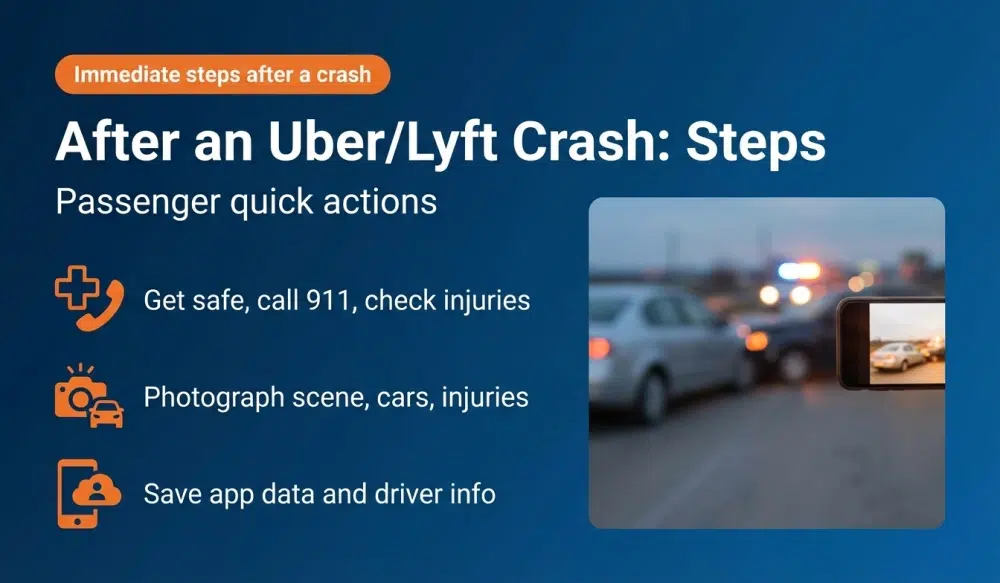
- Check for injuries. Call 911 if anyone is hurt. Even if you feel okay, adrenaline can mask symptoms. Nationally, more than forty two thousand people lost their lives in crashes in 2022 and many more were injured, which shows why prompt assessment matters [1].
- Move to a safe area. If possible, get to a sidewalk or shoulder away from traffic.
- Call law enforcement. For injury or death, California law requires reporting to police or CHP within 24 hours [6]. Request a crash report number at the scene.
- Document the scene. Take photos and short videos of vehicle positions, damage, debris, skid marks, traffic signals, weather, and your visible injuries.
- Exchange information. Collect the rideshare driver’s full name, license, plate, and proof that the trip was active in the app. Get the other driver’s info and any witness names and contacts.
- Preserve your app data. Screenshot your ride receipt, driver details, trip timeline, and in app messages showing pickup time and location.
- Seek medical evaluation. Many injuries are not obvious on day one. A prompt exam creates a record linking injuries to the crash.
- Avoid fault statements. Stick to facts. Do not guess about speed or fault. Evidence will answer those questions.
We understand how disruptive a crash can be. If you are feeling shaken or in pain, prioritize care and let a trusted advocate handle communications and claims later.
How do you report the crash to police, the DMV, and the rideshare app?
California has multiple reporting requirements after an injury collision. Meeting them supports your future claim.
- Police or CHP report. For collisions causing injury or death, report to police or CHP within 24 hours [6]. Ask how to obtain the report once available.
- DMV SR 1. California requires an SR 1 Traffic Accident Report within 10 days when anyone is injured or there is at least 1000 dollars in damage, regardless of fault [5]. The form is submitted to the DMV. Keep a copy.
- Rideshare app notification. Use the Help or Safety section to report an incident and request that the company open a claim with its insurer for the active trip period. Save confirmation emails or message receipts.
According to state safety tracking, California consistently reports high volumes of traffic injuries each year, making compliance important for documentation and claim handling [2].
What medical steps should you take and how do you document injuries?
Medical documentation is central in a civil case. It connects the collision to your symptoms, diagnoses, and treatment.
- Get an initial exam promptly. Even if you walked away, soft tissue, brain, and internal injuries can emerge later.
- Follow treatment plans. Attend follow ups, imaging, and therapy. Gaps in care can be used to question causation.
- Track all symptoms. Maintain a daily log of pain levels, headaches, sleep disturbance, difficulty concentrating, anxiety, and limits on work or family life.
- Keep receipts and records. Save discharge summaries, prescriptions, imaging reports, bills, and mileage to appointments.
- Request records as needed. You have the right to request your own treatment records to support a claim.
If you are worried about cost, remember that the liable insurer typically evaluates medical bills and related losses as part of your damages claim. Speak with a California attorney if billing or liens become complicated.
Who pays for your injuries in a California rideshare passenger collision?
For an active Uber or Lyft trip, California law requires Transportation Network Companies to provide specific insurance. When you are the passenger, coverage can include:
- Primary liability coverage. During a ride accepted and underway, state law requires at least 1 million dollars of primary liability coverage for third party bodily injury or death [3]. The California Public Utilities Commission regulates TNC operations in the state [4].
- Uninsured and underinsured motorist coverage. During an active ride, TNCs must provide uninsured and underinsured motorist coverage, often 1 million dollars, for injuries caused by drivers with no or too little insurance [3].
- Medical payments and collision coverages. Availability varies. Review the policy for the trip period at issue.
If the rideshare driver is at fault, the TNC policy typically responds during the passenger period. If another driver is at fault, that driver’s liability insurance is primary, and the TNC uninsured or underinsured motorist coverage may apply if the other driver has no insurance or not enough insurance [3].
California law sets negligence rules for civil claims. You must show duty, breach, causation, and damages, usually presented through medical evidence, witness statements, and other documents [7].
How do California rideshare insurance periods work for Uber and Lyft?
Insurers and TNCs analyze the driver’s app status at the time of the crash:
- Period 1. App on and available but no ride accepted. Contingent liability coverage applies at lower limits under California law. Personal auto insurance may also be involved [3].
- Period 2. Ride accepted while on the way to pick up. TNC liability coverage at required higher limits applies [3].
- Period 3. Passenger in the vehicle until drop off. TNC liability and uninsured or underinsured motorist coverage generally at 1 million dollars applies [3].
The proper period determines which insurer pays and how much coverage is available. The rideshare app logs and telematics are important evidence to establish the exact time and status of the trip.

What are your rights as an Uber or Lyft passenger in Irvine?
Passengers have several important protections in California civil law:
- The right to file a claim. You can bring a claim against any negligent driver who caused your injuries, including the rideshare driver or another motorist [7].
- The right to insurance benefits. During an active ride, TNC coverage is designed to respond even if the at fault driver is uninsured or flees the scene [3].
- The right to comparative fault allocation. If both drivers share blame, California apportionment rules apply to reach a fair result [8].
- The right to seek noneconomic and economic damages. This includes medical bills, lost income, and human losses such as pain and suffering, subject to California statutes and case law [7] [10].
You do not have to manage evidence and negotiations alone. Passenger claims can involve multiple insurers and detailed policy provisions. Speaking with a California attorney about next steps is a practical way to protect your claim.
How does fault and comparative negligence work in California?
California follows comparative negligence. A jury or claims adjuster can assign percentages of fault among all negligent parties. Your damages are reduced by your own percentage of fault, if any [8]. As a passenger, it is rare to be assigned fault, though unique facts can arise. California also makes defendants severally liable for noneconomic damages, meaning each pays only their share of noneconomic loss, while economic damages can be jointly and severally recoverable in many cases [10].
Violations of safety statutes can support negligence per se, a doctrine that helps establish breach when a defendant violates a statute designed to prevent the type of harm that occurred [9]. Traffic citations are not conclusive fault determinations, but they can be persuasive in claim negotiations.
How do claims, evidence, and negotiations work after an Irvine rideshare crash?
Effective claims are built on organized evidence and clear proof of liability and damages.
What evidence helps prove liability and damages?
- Rideshare app records. Trip acceptance time, route, and drop off time confirm the coverage period and can show speed or hard braking data.
- Vehicle and scene photos. Damage patterns, final rest positions, and road evidence help reconstruct events.
- Police report and 911 audio. Reports identify parties and witnesses and sometimes record preliminary fault assessments [6].
- Medical records and bills. These link injuries to the crash and quantify losses.
- Employment and income proof. Pay stubs, tax forms, and letters document lost earnings.
How do negotiations typically unfold?
- Notice and preservation. Send prompt notice to the TNC insurer and any other involved insurer, and request that app data and dashcam video be preserved.
- Demand package. A settlement demand summarizes liability, medical care, itemized damages, and supporting records, structured around California negligence standards [7].
- Counteroffers. Insurers may dispute fault, causation, or damages. Comparative fault and medical reasonableness are common issues [8].
- Litigation if needed. Filing suit can be necessary to access discovery and obtain sworn testimony if settlement stalls.
It is helpful to work with car accident lawyers who understand how to develop evidence for complex multi insurer claims.
What damages can a passenger claim in a civil case in California?
Recoverable damages depend on the injury and proof. Under California law you can seek both economic and noneconomic losses.


What economic damages are available?
- Past and future medical bills. Emergency care, imaging, specialist visits, therapy, home health, and medical devices.
- Lost income and reduced earning capacity. Wages, self employment income, bonuses, and long term changes to work opportunities.
- Out of pocket costs. Transportation to treatment, caregiving, and household services you can no longer perform.
What noneconomic damages are available?
- Pain and suffering. Physical pain, mental anguish, and loss of enjoyment of life.
- Inconvenience and emotional distress. Sleep issues, anxiety, depression, and activity limitations.
California rules on fault apportionment and noneconomic damages allocation will affect the final recovery if multiple parties are responsible [10].
What deadlines apply to an Irvine rideshare injury claim?
Missing a deadline can end a claim. California statutes set strict time limits.
- General personal injury deadline. Two years from the date of injury to file a lawsuit in most cases [11].
- Claims involving public entities. A government claim must usually be presented within six months of the incident [12], and if rejected, a short window to sue typically applies [13].
- DMV reporting. File the SR 1 with the DMV within 10 days for injury collisions or qualifying property damage [5].
Deadlines can vary for minors or if the injured person did not discover an injury until later. Speak with a California attorney promptly after an Irvine crash to protect the timeline.
What if a government vehicle or public road hazard was involved?
Special rules apply if a city, county, or state agency is a potential defendant.
- Government claim prerequisite. Before suing a public entity in California, you must present a written claim, generally within six months [12].
- Follow on lawsuit deadlines. If the claim is denied, you usually have six months from the denial notice to file suit [13].
- Roadway defect claims. Liability can involve design, maintenance, or failure to correct a dangerous condition, which requires prompt investigation and often expert analysis of sight lines and friction values.
What if multiple drivers share fault and how is payment split?
When more than one driver is negligent, California divides responsibility by percentage. For noneconomic damages like pain and suffering, each defendant typically pays only their share of fault. For economic damages like medical bills and wage loss, joint and several liability rules can allow full recovery from one responsible party who may then seek contribution from others [10].
As a passenger, you can generally pursue all responsible drivers and the TNC carrier to the extent coverage applies. Evidence such as app logs, dashcam video, and scene mapping helps sort out speed, following distance, and signal timing to fairly allocate responsibility.
What defenses do insurers raise and how are they addressed?
Insurers often take positions that reduce or deny claims. Common defenses and ways to respond include:
- Comparative fault. While passengers are rarely at fault, insurers may argue that you were not wearing a seat belt or that a pre existing condition caused symptoms. Medical records and biomechanical opinions can address these issues, and comparative fault is governed by California jury instructions [8].
- Causation challenges. Adjusters may claim treatment was not linked to the crash. Consistent medical documentation and provider opinions help demonstrate causation [7].
- Negligence per se disputes. If a driver violated a safety statute, negligence per se can apply, subject to statutory prerequisites [9].
- Noneconomic damages allocation. Defendants may argue for a lower percentage of fault to limit noneconomic exposure under state law [10].
What special issues apply to minors, out of state visitors, or undocumented passengers?
Rideshare passengers in Irvine include residents, students, business travelers, tourists, and families. A few scenarios require added care:
- Minors. Settlement of a minor’s claim often requires court approval to protect the child’s interests. The limitations period may also be tolled during minority in many cases.
- Out of state visitors. If you were visiting California, California law generally applies to a crash within the state, but insurance policies and health plans from your home state may add procedures for billing and subrogation.
- Undocumented passengers. Civil claims for injuries are based on negligence and damages. Immigration status does not change the underlying right to pursue injury compensation under California law.
How does a wrongful death claim work after a rideshare crash?
When a family loses a loved one in a rideshare collision, California law allows certain survivors to bring a wrongful death action for economic support and noneconomic losses, and the estate may pursue a survival claim for certain damages the decedent could have recovered had they lived. These cases involve sensitive timelines, layered insurance, and careful proof of both liability and the full measure of losses. California reported high statewide traffic fatality numbers in recent years, reflecting the public impact of roadway safety issues [2] [1].

What should rideshare drivers and other defendants know?
If you are a rideshare driver or another motorist involved in an Irvine crash, consider these steps to protect your defense and coverage rights.
- Notify all insurers. Report promptly to your personal auto insurer and, if you were on the platform, to the TNC so the correct trip period coverage applies [3].
- Preserve app and telematics data. Retain trip logs, dashcam footage, and vehicle module data that may establish your speed, braking, and signaling.
- Do not guess about fault. Provide factual statements only. Let investigators analyze distances, timing, and sight lines.
- Understand comparative fault. California allocates fault by percentage and governs noneconomic damage contributions accordingly [8] [10].
- Monitor deadlines. If a government claim arises, strict timelines apply [12] [13].
If a claim is made against you, cooperation with your insurer is generally required by policy conditions. A defense may be provided under the policy, and coverage counsel can address reservation of rights issues where necessary.
About GoSuits and how we help injured passengers in California
If you were an Uber or Lyft passenger injured in Irvine, you deserve attentive legal help grounded in California law and modern case management. GoSuits represents injured people in California courts and handles rideshare, car, pedestrian, bicycle, motorcycle, and truck collisions, as well as premises and product injury claims.
- Free consultation for personal injury cases. A short call helps you understand your options, timelines, and what documents to gather.
- California focused. We handle cases across California, including Orange County and Irvine courts.
- Technology driven approach. Our exclusive proprietary software streamlines evidence collection, medical record retrieval, and litigation workflows for faster, clearer case building.
- Direct attorney access. Although we use technology to move cases efficiently, every client works directly with a designated attorney. We do not use case managers. You have unfettered access to your lawyer for strategy and updates.
- Proven results. See a selection of outcomes on our prior cases page.
- Experienced trial team. With more than 30 years of combined experience, our team prepares every case as if it will be tried, which often improves settlement leverage.
- Full scope personal injury practice. Explore our practice areas, learn about our attorneys, and read more about us.
When you are ready, a brief call can help you coordinate medical care, preserve rideshare app data, and open the correct insurance claims. Many riders also find it helpful to have Irvine car accident lawyers handle insurer communications so recovery can stay the focus.
If you have questions about how TNC insurance works or how to value a passenger injury claim, car accident lawyers can guide you through California procedures and timelines.
References and Resources
- Traffic Fatalities 2022 Final Data – NHTSA
- California Crash Quick Stats – California Office of Traffic Safety
- TNC Insurance Requirements Article 7.5 – California Insurance Code
- Transportation Network Companies Overview – California Public Utilities Commission
- Traffic Accident Reporting Requirements and SR 1 – California DMV
- Duty to Report Accidents Resulting in Injury or Death – California Vehicle Code 20008
- Judicial Council of California Civil Jury Instructions including CACI 400 Negligence – California Courts
- Judicial Council of California Civil Jury Instructions including CACI 405 Comparative Fault – California Courts
- Negligence Per Se – California Evidence Code 669
- Several Liability for Noneconomic Damages – California Civil Code 1431.2
- Two Year Statute of Limitations for Injury to Person – California Code of Civil Procedure 335.1
- Government Claims Presentation Deadline – California Government Code 911.2
- Time to Sue After Government Claim – California Government Code 945.6
- Limitations on Noneconomic Damages for Uninsured Owners or Drivers – California Civil Code 3333.4