- What should you know about truck crashes on Irvine highways?
- What do recent crash statistics show for large trucks?
- What are the most common causes of truck crashes in Irvine?
- Who can be legally responsible in a California truck crash case?
- What evidence helps prove or defend an Irvine truck crash claim?
- How do claims, insurers, and regulations affect compensation?
- How is fault decided under California negligence law?
- What damages are available in California truck crash lawsuits?
- Where do truck crashes most often occur around Irvine highways?
- What deadlines apply to filing a California truck crash lawsuit?
- What defenses do trucking companies and insurers often raise?
- What steps should you take after a truck crash in Irvine?
- How can GoSuits support you if you were hurt in an Irvine truck crash?
- References and resources
What should you know about truck crashes on Irvine highways?
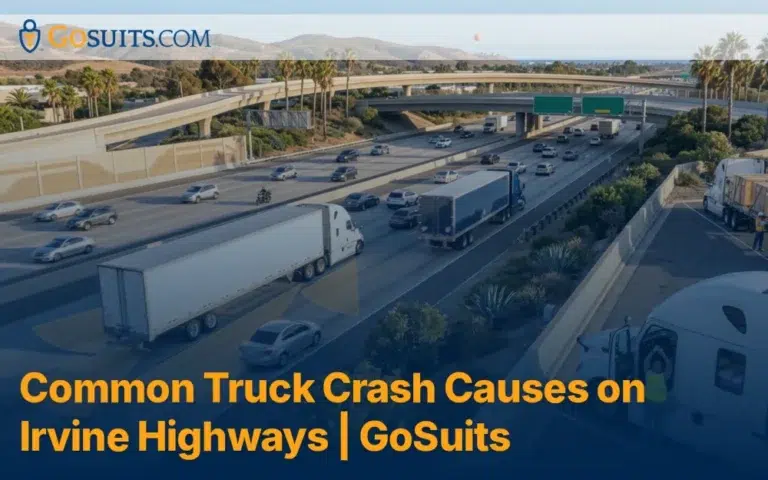
Irvine sits at the crossroads of major Southern California freight and commuter corridors, including I 5 and I 405 with connectors to SR 133, SR 241, and SR 73. Heavy commercial traffic mixes with fast moving passenger vehicles and complex interchanges. When a collision involves a large truck, the stakes rise. Trucks carry more momentum, take longer to stop, and create wider blind spots, which can turn a minor mistake into a serious multi vehicle crash [1] [7].
Truck crash claims are civil cases, not criminal prosecutions. They typically involve negligence theories under California law and federal motor carrier safety rules that set baseline standards for drivers and motor carriers [3]. The investigation often reaches beyond the driver to include the motor carrier, broker, shipper, and maintenance vendors, depending on how the trip was planned, who controlled the load, and whether equipment was safe when it left the yard.
Talking early with truck accident lawyers can help you understand how federal regulations, California statutes, and insurance layers interact in these cases. Timelines are short, key data can be overwritten, and witnesses’ memories fade quickly. Coordinated steps in the first days often shape the outcome.
What do recent crash statistics show for large trucks?
National data highlights why highway truck crashes demand careful attention. According to NHTSA’s Traffic Safety Facts, 5,788 people died in crashes involving large trucks in 2021, an increase from the prior year [1]. FMCSA’s Large Truck and Bus Crash Facts also reports more than one hundred thousand injury crashes involving large trucks nationally in 2021 [2].
These numbers reflect a mix of risk factors, including speeding, following too closely, impaired driving, fatigue, distraction, and equipment failures. While risk varies by corridor, the combination of heavy volumes on I 5 and I 405, frequent merges, lane changes, and work zones can amplify these hazards during peak hours around Irvine [15].
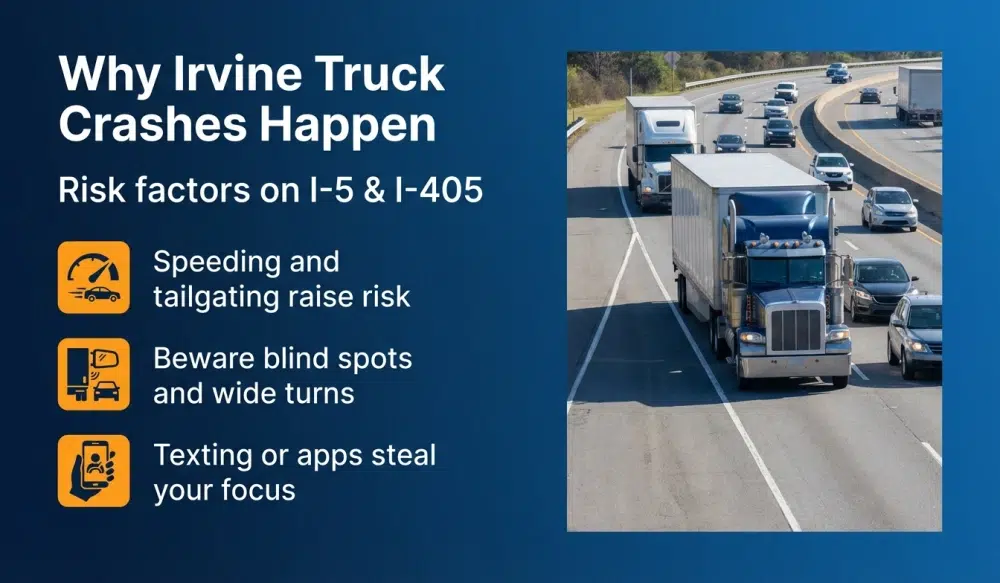
- Weight and stopping distance Trucks need more distance to stop, so sudden slowdowns and tailgating increase rear end crash risk [1].
- Blind spots The no zone areas along the sides, rear, and front of a tractor trailer can hide smaller vehicles, especially in congestion and on curved ramps [7].
- Complex interchanges Interchange weaves on I 5 and I 405 elevate lane change conflicts, especially when drivers speed or fail to signal in tight gaps [15].
What are the most common causes of truck crashes in Irvine?
How does driver fatigue contribute to Irvine highway truck crashes?
Fatigue slows reaction time and degrades judgment. Federal hours of service rules limit time on duty and require rest breaks to reduce fatigue risk [3]. When drivers or dispatch push beyond safe limits, reaction lag can turn a close call into a crash.
- Hours limits Federal rules cap daily driving and mandate off duty periods to help drivers recover [3].
- Scheduling pressures Tight delivery windows and port related delays can encourage risky decisions, especially late at night or before dawn.
- Warning signs Drifting within a lane, inconsistent speed, or missed signals often show up in dashcam or telematics data.
Why do speeding and tailgating cause so many truck crashes?
California sets a lower maximum speed for many large trucks on the highway. Exceeding that limit, or following too closely, sharply reduces the time drivers have to react to congestion on I 5, I 405, or entering traffic from SR 133, SR 241, and SR 73 [8] [9].
- California truck speed limits Many heavy trucks are restricted to 55 miles per hour on certain highways [8].
- Stopping distance Higher speed, heavier weight, and traffic variability combine to lengthen stopping distances [1].
- Following distance Tailgating is a frequent factor in rear end collisions and is prohibited by statute for all drivers [9].

How do blind spots and wide turns lead to collisions?
Tractor trailers have large blind zones along both sides, directly behind the trailer, and in front of the cab. When a car lingers in these areas during lane changes near Irvine interchanges, the truck driver may not see the vehicle until it is too late [7].
- No zone awareness Drivers of cars and trucks share responsibility for checking mirrors and scanning before moving into adjacent lanes [7].
- Wide turns Right turns by tractor trailers can swing outward or encroach into adjacent lanes if taken too fast or without adequate signaling.
- Lane restrictions Obeying lane use rules and speed limits helps reduce crossover conflicts on busy corridors [8].
Why do cargo securement mistakes trigger serious highway crashes?
Improper cargo securement can cause load shifts, rollovers, or cargo spills. Federal rules specify securement methods, working load limits, and inspections before and during a trip [4]. Even a small shift can destabilize a trailer in a high speed curve or during sudden braking.
- Pre trip checks Securement devices, tie downs, and blocking need inspection and proper tension before leaving the yard [4].
- En route inspections Re checks are required after the first miles and at intervals thereafter for certain loads [4].
- Shared responsibility Shippers, loaders, and motor carriers can share fault if their actions contributed to an unbalanced or unsecured load.
How do mechanical failures and poor maintenance cause crashes?
Braking systems, tires, steering, and lighting must be inspected, repaired, and maintained. Federal regulations require systematic maintenance programs and regular inspections by carriers and drivers [5].
- Brakes and tires Worn pads or out of service tires lengthen stopping distance and increase blowout risk [5].
- Driver inspections Drivers must inspect vehicles and report issues so that repairs occur before the next trip [5].
- Records Maintenance logs, driver inspection reports, and repair invoices can reveal patterns of missed repairs or shortcuts.
Does distracted driving increase Irvine highway truck crash risk?
Yes. California prohibits drivers from using handheld devices while driving, and distraction is a known factor in highway collisions [10]. For commercial drivers, in cab technologies, texting, and app use can take eyes off the road during critical moments in heavy traffic near the I 5 or I 405 interchanges.
- Handheld device rules Handheld use is prohibited, and violations can support negligence claims or defenses [10].
- Telematics and app data App usage logs and telematics data help show whether distraction played a role.
How do weather and work zones contribute to crashes in Irvine?
Southern California has fewer wet weather days, but even light rain can make roads slick. Work zones around improvement projects introduce lane shifts, reduced shoulders, and sudden slowdowns. Caltrans traffic counts and project updates show recurring congestion patterns that can overwhelm following distances [15].
- Reduced margins Narrowed lanes and shoulder closures raise the stakes for lane keeping and signaling.
- Speed adjustments Safe speed often falls below the posted limit when visibility drops or lanes shift.
- Advance warning Failing to heed signs, flaggers, or queue warnings can increase rear end collisions.
How can impairment lead to truck crashes even at low levels?
Drugs and alcohol impair judgment and coordination. Federal rules strictly prohibit alcohol or certain drug use for commercial drivers while on duty or within specified hours before operating a commercial motor vehicle [6].
- Zero tolerance while driving On duty alcohol use and certain drug use are barred for commercial drivers [6].
- Testing and records Carriers maintain testing programs that can produce critical evidence after a crash.
Who can be legally responsible in a California truck crash case?
Liability depends on who acted unreasonably under the circumstances and whether those actions caused the crash. In California, negligence is judged against what a reasonably careful person or company would do in similar conditions, and everyone has a duty to use ordinary care [11].
- Driver May be liable for speeding, tailgating, distraction, lane violations, or fatigue related errors [8] [9] [10] [3].
- Motor carrier May be liable for negligent hiring, training, supervision, dispatch, or for violating maintenance and inspection rules [5].
- Shipper or loader May share fault for improper cargo securement or weight distribution that contributed to instability [4].
- Maintenance vendor May be liable if faulty repairs or skipped service caused brake, tire, or steering failures [5].
- Vehicle or parts manufacturer May face product liability claims if a defect caused the failure. Civil claims here are distinct from warranty issues.
- Government entity May face claims for dangerous conditions of public property, subject to strict notice requirements, discussed further below [14].
What evidence helps prove or defend an Irvine truck crash claim?
Thorough evidence collection is central in both plaintiff and defense cases. Much of the most valuable data is time sensitive.
- Electronic data Electronic logging devices, engine control module downloads, telematics, and dashcam video can show speed, braking, lane position, and hours of service patterns [3].
- Driver records Qualifications, training, pre trip inspections, and dispatch notes can shed light on competence and supervision [5].
- Cargo documents Bills of lading, weight tickets, securement checklists, and photos reveal loading practices [4].
- Maintenance logs Inspection and repair histories help link mechanical failures to missed service or prior warnings [5].
- Scene evidence Physical marks, debris fields, road geometry, and work zone layouts help accident reconstruction.
- Witness statements Independent witnesses and first responders can clarify what occurred in fast moving multi vehicle events.
Preservation letters are often used to request that motor carriers retain electronic data, logs, and video. Because some systems overwrite data in days or weeks, prompt written notice can be critical.
How do claims, insurers, and regulations affect compensation?
Truck crash cases usually involve layered insurance. Primary liability policies, excess policies, and sometimes cargo or broker policies may become relevant depending on the facts. Claim handling often includes early investigations by insurers and motor carriers. Statements given to any insurer can affect the outcome, so proceed carefully and consider counsel before giving recorded statements.
- Federal safety rules Violations of hours of service, cargo securement, or maintenance requirements can support negligence claims and influence how insurers evaluate liability [3] [4] [5].
- California traffic rules Speeding, following too closely, and handheld device infractions can also weigh heavily in fault assessments [8] [9] [10].
- Recorded statements Inconsistent or speculative statements can be used to dispute liability or damages.
- Medical proof Records, imaging, and expert evaluations link injuries to crash forces and help quantify losses.
Because there are often multiple parties and insurers, coordination matters. Claimants and families often find it helpful to speak with Irvine truck accident lawyers who are familiar with local courts, traffic patterns, and the interplay between state law and federal motor carrier rules.
How is fault decided under California negligence law?
California uses comparative fault. Each party’s percentage of responsibility is determined from the evidence, and a plaintiff’s recovery is reduced by any share of fault assigned to the plaintiff. California’s civil jury instructions outline how juries weigh fault among multiple actors, including plaintiffs and defendants [12]. The Civil Code establishes the general duty to use ordinary care [11].
- Comparative fault The jury or judge can assign percentages of fault to each responsible party, including nonparties in some contexts [12].
- Negligence standard The benchmark is what a reasonably careful person or company would do in the same situation [11].
- Regulatory evidence Violations of safety regulations and traffic laws can inform the negligence analysis [3] [8] [10].
What damages are available in California truck crash lawsuits?
Damages in civil cases are intended to make you whole under the law. Truck crashes can cause significant losses that the court can assign to one or more responsible parties when liability is proven.
- Economic losses Medical bills, rehabilitation costs, lost wages, lost earning capacity, property damage, and out of pocket expenses supported by documentation.
- Non economic losses Physical pain, mental suffering, loss of enjoyment of life, inconvenience, and similar harms recognized in California law.
- Punitive damages Available in rare cases where the evidence shows conduct that meets California’s punitive standard, which is separate from ordinary negligence and requires a heightened proof showing. Plaintiffs and defendants often litigate whether this higher standard is satisfied.
- Wrongful death Families may bring civil claims when a crash results in a fatality, subject to California’s wrongful death and survival action frameworks and deadlines.
Calculating damages usually requires medical opinions, employment and tax records, and at times testimony from economists or life care planners to project future needs. Defendants may request independent medical examinations and challenge causation or the scope of claimed losses.
Where do truck crashes most often occur around Irvine highways?
Truck crashes in and around Irvine often cluster at or near major interchanges, merge areas, and work zones along I 5, I 405, SR 133, SR 241, and SR 73. Caltrans traffic census data shows very high volumes on these routes, particularly during peak commute times when commercial vehicles mix with dense passenger traffic [15].
- I 5 corridor Long grades, heavy freight movements, and frequent on ramps require extended following distances and disciplined lane use.
- I 405 corridor Interchange weaves and frequent lane changes increase sideswipe and rear end risks when drivers speed or follow too closely.
- SR 133 connector Transitions between different speed environments can cause sudden slowdowns.
- SR 241 and SR 73 Toll corridor merges and off ramps demand early signaling and awareness of blind spots, especially at peak times.
Local patterns matter. Photos, traffic camera footage when available, and precise scene measurements can help clarify how an event unfolded at these locations and whether a truck’s blind spot, load shift, or last second merge contributed to the collision [7] [4].
What deadlines apply to filing a California truck crash lawsuit?
California’s statute of limitations generally gives injured people two years from the date of injury to file a personal injury lawsuit, with different timelines for wrongful death and other claims [13]. Claims involving public entities have special rules. A government claim is typically due within six months, and failing to file a timely claim can bar a later lawsuit [14].
- Two year period Personal injury claims are generally subject to a two year filing deadline in California courts [13].
- Government claims Claims against cities, counties, or state agencies often require a claim presentation within six months before any lawsuit can be filed [14].
- Exceptions Some claims have shorter or longer deadlines, and other states’ laws can apply if the crash or parties have out of state ties. Do not wait to confirm your timeline.
What defenses do trucking companies and insurers often raise?
Defendants typically examine every causal factor to reduce or defeat liability. In comparative fault states like California, showing that a plaintiff or a third party bears a percentage of fault can lower the payout owed by a defendant [12].
- Comparative fault Allegations that the plaintiff was speeding, made an unsafe lane change, or lingered in a blind spot [7] [8].
- Sudden emergency Claims that another driver cut off the truck or that a mechanical failure occurred without prior notice, despite compliant maintenance [5].
- Medical causation Arguments that injuries predated the crash or are less severe than claimed, based on medical records.
- Compliance defenses Assertions that the driver and carrier complied with hours of service, securement, and inspection rules, shifting focus to other vehicles [3] [4] [5].
What steps should you take after a truck crash in Irvine?
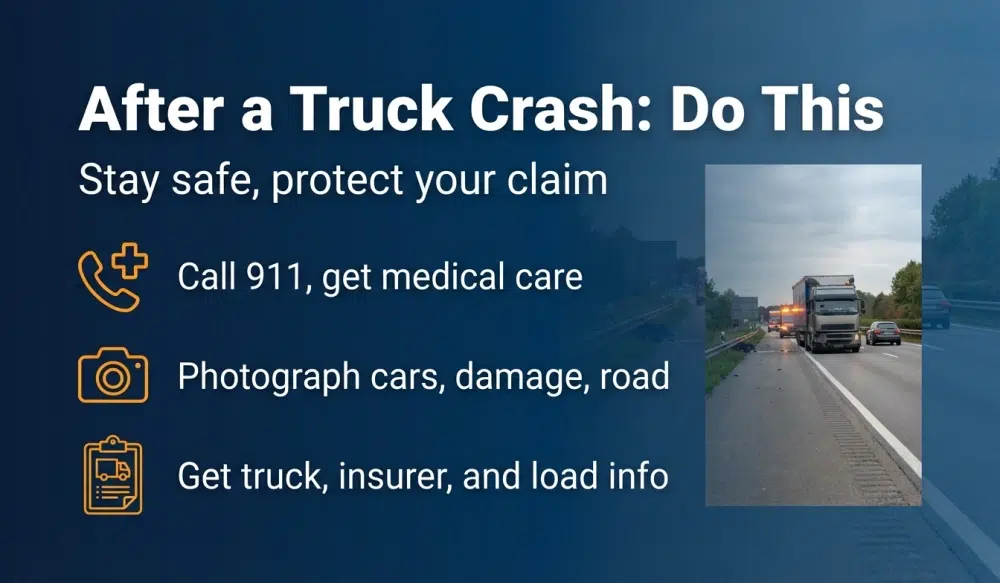
Your health and safety come first. If you can do so safely, gather information that later helps establish fault and damages. Because commercial carriers and insurers often mobilize quickly, timely action matters for both plaintiffs and defendants.
- Call 911 and seek care Emergency care, diagnostics, and follow up appointments create a clear record of your injuries.
- Preserve evidence Photograph vehicles, skid marks, debris, lane markings, signs, and any cargo issues. Note cameras that may have captured the crash.
- Exchange information Obtain the truck driver’s company, USDOT number if available, license, insurance details, and any broker or shipper information on bills of lading.
- Avoid assumptions Provide facts to law enforcement but avoid speculation about speed or fault at the scene.
- Notify insurers carefully Report the crash but be cautious with recorded statements. Consider legal help before providing detailed statements.
- Request preservation Early written requests can help secure electronic logs, dashcam, and telematics data before it is overwritten [3].
Seeking guidance from truck accident lawyers in Irvine can help align medical documentation, liability investigation, and insurance communications so that your rights are protected while you focus on recovery.
How can GoSuits support you if you were hurt in an Irvine truck crash?
Truck crash cases are complex, and a free consultation can help you understand timelines, the types of evidence that matter most, and how California negligence and federal motor carrier rules apply to your situation. Our team handles civil injury and wrongful death matters throughout California, including Irvine and greater Orange County. We combine human judgment with a technology driven approach that streamlines investigation and case building.
- Technology forward case strategy GoSuits uses exclusive proprietary software to surface critical facts faster, align medical and engineering proof, and keep your case moving without unnecessary delay.
- Direct access to your attorney Although we rely on technology to expedite tasks, every client has a designated attorney and unfettered access to that attorney. We do not use case managers to run files.
- Trial ready mindset Our attorneys prepare each case with trial in mind, which can improve negotiations and readiness for court when needed.
- Proven results See representative outcomes in our prior cases. Past results do not guarantee future outcomes, and each case is different.
- Experience More than 30 years of combined experience across personal injury litigation, including serious highway collisions, commercial vehicle claims, and related disputes.
- Coverage We practice across California. Learn more about about us, meet our attorneys, and explore our practice areas.
If you have questions about a collision on I 5, I 405, SR 133, SR 241, or SR 73, a brief call can clarify next steps, what information to gather, and how claims typically proceed in Orange County. For many, speaking with truck accident lawyers early reduces stress and helps you avoid avoidable missteps with insurers. In CITY terms, many clients prefer to consult locally, and Irvine truck accident lawyers are familiar with local crash patterns, courts, and medical providers.
References and resources
- Traffic Safety Facts 2021 Data, Large Trucks – NHTSA
- Large Truck and Bus Crash Facts 2021 – FMCSA
- Summary of Hours of Service Regulations – FMCSA
- Cargo Securement Rules – FMCSA
- 49 CFR Part 396, Inspection, Repair, and Maintenance – FMCSA
- 49 CFR 392.5 Alcohol Prohibition – FMCSA
- Large Trucks Blind Spots No Zone – FMCSA
- California Vehicle Code 22406 Truck Speed – California Legislative Information
- California Vehicle Code 21703 Following Too Closely – California Legislative Information
- California Vehicle Code 23123.5 Handheld Wireless Devices – California Legislative Information
- California Civil Code 1714 Duty of Ordinary Care – California Legislative Information
- California Civil Jury Instructions CACI, Comparative Fault – Judicial Council of California
- California Code of Civil Procedure 335.1 Personal Injury Limitations – California Legislative Information
- California Government Code 911.2 Claim Presentation Deadline – California Legislative Information
- Traffic Census Program and Counts – Caltrans