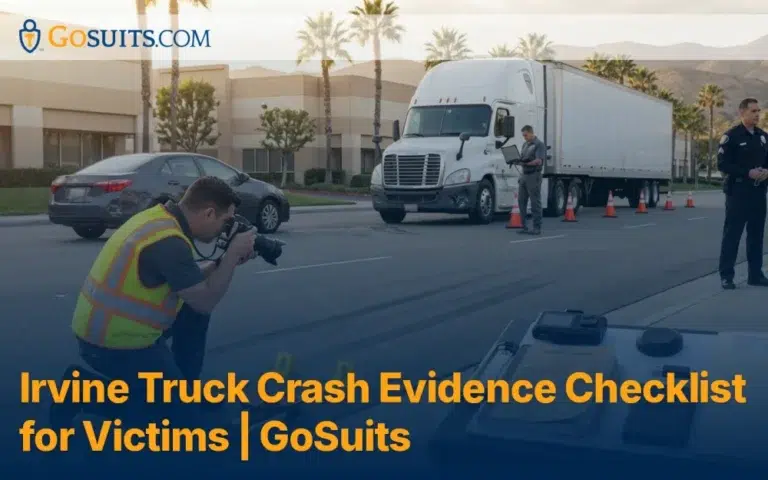
- What evidence matters most after an Irvine truck crash?
- How do you preserve EDR black box and truck ECM data?
- Which driver and carrier records should you request and how long are they kept?
- How do you obtain the police report and 911 audio in Irvine?
- Where can you find traffic, business, and dashcam video before it is erased?
- Which scene photos and measurements help prove fault?
- How should you track injuries, medical care, and billing records?
- What is chain of custody and how do you maintain it?
- What is a spoliation letter and when should you send one?
- How does California’s comparative fault rule impact your claim?
- What deadlines apply to California truck crash claims?
- What should motor carriers and insurers do to comply with preservation duties?
- Can you use a one page Irvine truck crash evidence checklist today?
- FAQs about Irvine truck crash evidence
- About GoSuits
What evidence matters most after an Irvine truck crash?
If you were hurt in a commercial truck collision in Irvine on I 5, I 405, SR 55, or city streets, the strongest civil cases are built quickly and carefully. Trucking companies control critical electronic data and paper records that can be overwritten or destroyed on routine schedules. Our goal in this guide is simple, give you a clear, research backed checklist to preserve the pieces that move liability and damages, then explain how plaintiffs and defendants should handle each category.
At a glance, priority items include the truck’s electronic control module or engine data, driver logs and electronic logging device data, dashcam or telematics video, police reports, 911 audio, witness contacts, scene photos and measurements, carrier vehicle inspection and maintenance records, post accident drug and alcohol testing compliance, medical records, and a documented chain of custody for every item you collect. Federal rules set short retention windows for key motor carrier materials, sometimes as little as six months, so early action is critical [1] [2] [3] [4].
Because evidence law and procedure are complex, we strongly encourage you to speak with a lawyer who handles truck crash litigation. Early legal help can secure preservation and access to records before they disappear, protect you from adjuster tactics, and coordinate accident reconstruction.
How do you preserve EDR black box and truck ECM data?
What is EDR or ECM data and why does it matter?
Many vehicles record pre crash and crash data. Light vehicles often have an event data recorder that captures speed, throttle, brake, seat belt status, and delta V. Heavy commercial trucks frequently store similar information through the engine control module or other telematics. This data can corroborate or contradict driver accounts, help reconstruct timing and speed, and is routinely used by courts and experts [5].
How quickly can EDR or ECM data be lost and what should you do?
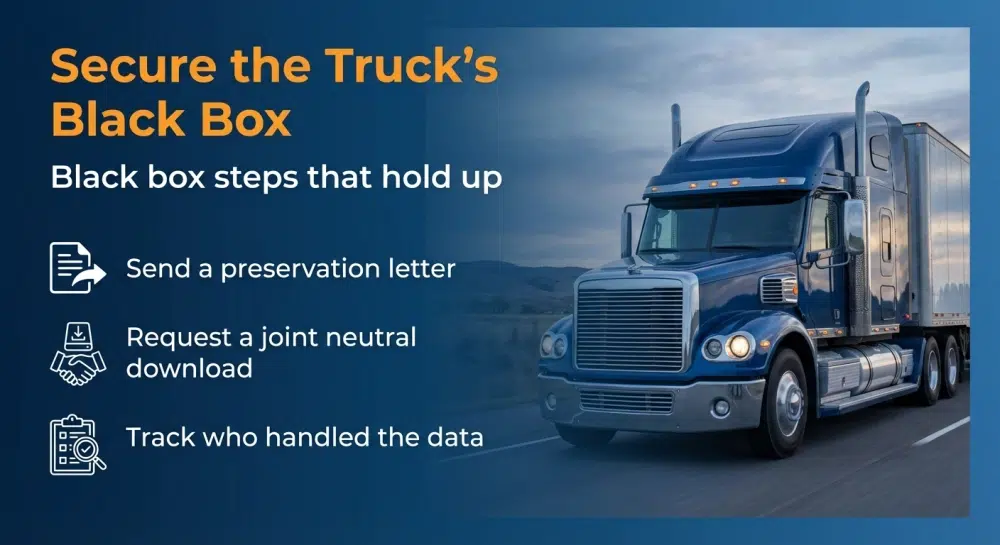
Recording systems may overwrite with normal use, disconnect when a vehicle is powered down, or be lost during repairs. A preservation letter should go out immediately to the motor carrier, insurer, any custodian, and the repair or salvage facility instructing them to hold and not alter the vehicle or its data until an agreed inspection occurs. Reference federal recordkeeping duties and request a cooperative download by a qualified, neutral technician if possible [4].
What are safe step by step actions to secure black box data?
- Identify the custodian Find out where the tractor and trailer are stored and who controls them.
- Send a preservation letter Demand that the carrier preserve ECM and telematics, including any over the air archives or cloud portals, and do not power the truck without notice [4].
- Request a joint inspection Propose dates, a neutral downloader, and copies to all parties.
- Document chain of custody Record who accessed the data, when, and how, and store original images or files securely, as discussed below [15].
Which driver and carrier records should you request and how long are they kept?
Which driver logs and ELD records are essential?
Driver hours of service records, including ELD data, edits, annotations, and supporting documents, can reveal fatigue, falsification, or dispatch pressures. Federal rules require motor carriers to retain records of duty status and supporting documents for six months, after which routine purges may occur [1]. This makes a prompt records request and preservation letter indispensible.
What about post accident drug and alcohol testing?
When a crash meets federal criteria for testing, the employer must conduct alcohol and controlled substances testing within specified time limits, document reasons if testing could not occur, and retain the records. These forms and lab results are relevant to negligence and compliance [2].
Which inspection and maintenance records can show defect related negligence?
Vehicle inspection, repair, and maintenance files can reveal whether brakes, tires, steering, and lighting were properly maintained and inspected. Federal regulations require motor carriers to keep certain maintenance records for at least 12 months while the vehicle is in service and for six months after the vehicle leaves their control [3]. Daily vehicle inspection reports, out of service notices, and repair orders are all important.
What is a required accident register and why ask for it?
Motor carriers must maintain an accident register for three years after each recordable crash, including basic facts, injuries, fatalities, and hazardous materials involvement. Request the register entry and any related internal investigation materials [4].
Which dispatch and freight documents matter?
- Trip records Bills of lading, trip sheets, route plans, weigh station receipts, toll and fuel records often corroborate timelines [1].
- Communications Qualcomm or telematics messages, emails, and texts may show scheduling pressure or directions that led to unsafe conduct.
- Safety program files Training, driver qualification, prior violations, and remedial actions can inform negligent entrustment or supervision theories.

How do you obtain the police report and 911 audio in Irvine?
Who handled your scene investigation and how do you ask for records?
In Irvine, city streets are typically handled by the Irvine Police Department, and freeways like I 5 and I 405 are typically handled by the California Highway Patrol. You can request a CHP collision report by submitting form CHP 190 to the appropriate area office identified by the responding agency. Include proof of involvement and valid identification [12].
Can you also request 911 calls, traffic enforcement, and photos?
Yes, many non confidential materials are subject to the California Public Records Act. Submit a targeted request to the agency for 911 audio, photographs, measurements, and any available supplemental reports, recognizing that certain exemptions may apply to protect privacy or investigations [10].
Do you need to file a DMV crash report?
If anyone was injured or property damage appears above the statutory threshold, vehicle owners or drivers must file a DMV SR 1 crash report within 10 days. This is required even if a police report was taken. Save proof of submission for your file [11].
Where can you find traffic, business, and dashcam video before it is erased?
How do you locate traffic cameras and public agency video?
City and state traffic cameras may exist at intersections and freeway facilities. Some feeds are not recorded, and many agencies overwrite data quickly. Use the Public Records Act to ask the responsible agency whether any recordings exist for the specific date, time, and location, and request preservation promptly [10].
What about nearby businesses, residences, and transit video?
- Canvas the area Identify storefront cameras, apartment cameras, and parking lots that may have captured the crash or approach.
- Act fast Private systems often overwrite within days. Ask the owner in person to preserve the file, then follow up with a written preservation request.
- Please include driver or fleet dashcams in your preservation letter and discovery list, as many carriers now record either forward-facing or dual-facing video. Make sure to highlight these systems when gathering evidence.
How should you preserve and authenticate video files?
Download and store the original file and metadata when possible. Document who obtained it, when, how, and the device or media used. Maintain a log to support authentication in court, consistent with California evidence authentication requirements [15].
Which scene photos and measurements help prove fault?
What should you photograph or map at the scene?
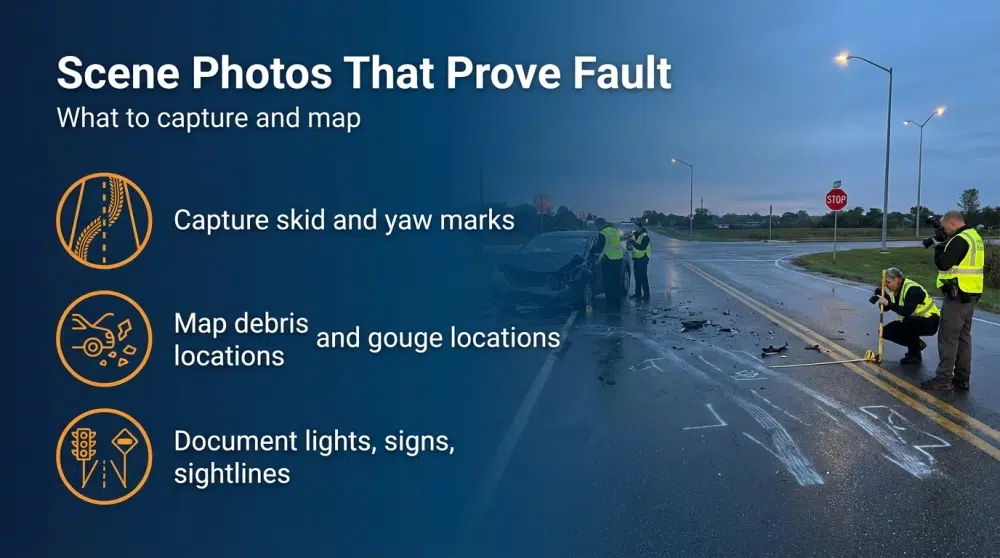
- Skid marks and yaw marks are essential elements for assessing accidents involving vehicles. To measure them accurately, experts take note of their lengths and positions in relation to fixed points around the accident scene. By studying these marks, valuable information about the speed, direction, and force involved can be determined, which is crucial when reconstructing the events that led up to an accident.
- Analyze gouge marks and debris to identify lanes and help determine impact position.
- In order to achieve a comprehensive and detailed set of photographs for vehicle inspection or documentation purposes, it is necessary to take both overall shots and close-ups, using relevant reference objects as guides in each case. This will allow you to capture all aspects of the vehicle from multiple angles and magnifications, providing a thorough visual record of its condition.
- Lighting, weather, and sightlines Document signal heads, signage, vegetation, sun position, and visibility.
- The damage profiles consist of photographed data on underride and override, bumper height measurements, as well as crush analysis.
If for any reason you are unable to securely gather the required data, it is recommended that you request the assistance of professional investigators. They can return to the scene to photograph and measure the details accurately, and create scaled diagrams or scans that will support accident reconstruction. Never compromise your own safety in order to obtain photographs.
How should you track injuries, medical care, and billing records?

Which medical records should you gather and why?
Injury documentation links the crash to your symptoms and treatment. Collect emergency department records, EMS run sheets, imaging reports, specialist notes, physical therapy notes, and pharmacy lists. In California civil cases, well organized medical records help quantify damages and respond to defense causation arguments. You are entitled to copies of your own medical records under federal privacy rules, often within 30 days upon request and payment of reasonable fees [14].
How do you track bills, liens, and subrogation?
- Please provide me with detailed invoices for each charge as well as explanations of what these charges are for.
- It is crucial to understand your health insurance plan and provider liens while dealing with injuries or accidents. To ensure that you’re protected, make sure to keep copies of all lien notices. This will provide evidence in case any disputes arise regarding your reimbursement rights. Addressing these rights early on can help avoid last-minute surprises near settlement which might impact your overall compensation. Remember, staying informed and prepared is key when dealing with such matters.
- It is crucial to keep track of your out-of-pocket expenses when it comes to medications, medical devices, mileage for doctor’s visits, and any necessary home assistance. Make sure you save all your receipts as a record to help manage your finances in this area.
What is chain of custody and how do you maintain it?
Why does chain of custody matter for photos, video, and digital evidence?
Courts require that evidence be authenticated before admission, which often includes showing it is what you claim it is and has not been altered. A clear chain of custody simplifies authentication and reduces disputes about reliability [15].
What are practical steps to lay a strong foundation?
- Keep a record of evidence Make sure to note down the date, time, source, and individual responsible for managing every entry.
- When you can, save your original files onto write-protected media (such as CDs or flash drives). This will ensure that you have a backup for the future and cannot accidentally overwrite any data by mistake. In addition to this, it’s wise to keep duplicate copies of these files in separate, secure locations, just in case something were to happen to your primary storage device or area. By taking these precautions, you will safeguard your valuable work from potential loss or damage.
- Keep metadata exported along with hash values or checksums, and avoid re-encoding files unless absolutely necessary.
- Record document transfers: Keep a track of each time an item is handed over, mentioning the recipient and the reason for the transfer.
What is a spoliation letter and when should you send one?
What is a spoliation or preservation letter?
A spoliation letter is a written notice instructing parties and nonparties to preserve relevant evidence because litigation is reasonably anticipated. In California, juries may be instructed they can consider willful suppression of evidence, and courts may impose discovery sanctions for misuse of the discovery process, including destruction or failure to preserve [7] [9].
What should your letter include for a truck crash?
- Specific categories List ECM and telematics, ELD data and audit trails, driver qualification and training files, dispatch and communications, maintenance, accident register, post crash testing, photos, and vehicle parts [1] [2] [3] [4].
- Retention windows Cite federal retention rules for clarity and urgency [1] [3].
- Proposed Inspection Protocol: Determine suitable dates and establish a neutral methodology for acquiring Electronic Control Module (ECM) data and evaluating the vehicle’s condition.
- A third-party custodian should send copies of information to storage locations like tow yards or repair facilities, as well as any telematics vendor in possession of the required data. This ensures that all relevant parties involved can properly assess and act on the information.
How does California’s comparative fault rule impact your claim?
What if both the truck driver and another driver share fault?
California follows pure comparative negligence. If both sides were negligent, each party’s recovery is reduced by their percentage of fault. The California Supreme Court adopted comparative negligence, replacing the older contributory negligence rule, in a landmark decision that guides modern apportionment of fault [13]. In practice, this means careful evidence development can change percentages and materially affect outcomes for both plaintiffs and defendants.
How do plaintiffs and defendants use evidence under comparative fault?
- Plaintiffs Use driver logs, ECM, and maintenance records to show regulatory violations and unsafe conduct, support higher fault against the carrier, and address any allegations about your own driving with scene measurements and independent witnesses [1] [3].
- Defendants Use third party video, scene evidence, and your own telematics to demonstrate compliance, highlight evasive action or unforeseeable hazards, and document plaintiff conduct that contributed to the event.
What deadlines apply to California truck crash claims?
How long do you have to file a lawsuit?
In most personal injury in Irvine, the statute of limitations is two years from the date of injury. There are exceptions and shorter deadlines for claims against government entities, so do not wait to evaluate your timeline [6].
Are there earlier administrative or records deadlines?
- DMV crash report Ten day deadline for SR 1 filing when criteria are met [11].
- Public records Agencies can purge audio or video fast, submit prompt CPRA requests [10].
- Motor carrier files Logs and supporting documents can be destroyed after six months without a preservation notice [1].
What should motor carriers and insurers do to comply with preservation duties?
How can defendants reduce sanctions risk and strengthen their defense?
- Issue a litigation hold Immediately suspend auto deletion of ELD, telematics, emails, and maintenance systems.
- Secure the vehicles Preserve the tractor and trailer in their post crash condition until inspections occur. Do not power or repair without notice if ECM data could be affected [5].
- Collect required materials Accident register entry, post accident testing efforts, driver qualification, dispatch communications, and maintenance documentation [2] [3] [4].
- Document efforts Keep logs of preservation steps and communications to demonstrate good faith if disputes arise under California discovery rules [9].
Can you use a one page Irvine truck crash evidence checklist today?
What is a practical, printable checklist to start now?
Use this commercial vehicle crash checklist as a working tool. Share it with your family member helping you or your legal team so everyone knows the plan.
- Immediate safety and care Get medical evaluation, follow doctor instructions, and keep all discharge paperwork.
- Police report Note agency and report number, request CHP 190 packet if CHP handled the scene [12].
- Witnesses Capture names, phone numbers, emails, and short summaries of what they saw.
- Photos and video Take wide to close photos of vehicles, scene, skid and gouge marks, traffic controls, and injuries.
- Public records Submit CPRA requests for 911 audio, traffic camera records, and any agency photos within days [10].
- Private video Ask nearby businesses or residents to preserve footage, then follow up in writing.
- DMV SR 1 File within 10 days when required, keep proof [11].
- Medical file Request your complete records and itemized bills from all providers, track out of pocket costs [14].
- Preservation letters Send to the motor carrier, insurer, and custodians listing ECM, ELD, communications, maintenance, and accident register materials [1] [3] [4].
- Accident reconstruction Discuss with your legal team whether to schedule a joint vehicle and ECM inspection and to retain a reconstructionist.
- Chain of custody Maintain a log for every file and physical item you collect to support authentication [15].
When you are ready to discuss your case, speaking with truck accident lawyers who regularly litigate against motor carriers can help you avoid common pitfalls and position your claim for a fair resolution.

About GoSuits
How does GoSuits support Irvine, CA truck crash victims using a technology driven approach?
We handle civil negligence claims arising from commercial vehicle collisions in California, including Irvine and Orange County. A free consultation connects you directly with a trial attorney to discuss preservation steps, accident reconstruction, and a plan for gathering the truck crash evidence outlined in this checklist. We use exclusive proprietary software to accelerate evidence capture, timeline building, and damages modeling, which helps cases move faster with better organization.
What sets GoSuits apart operationally for clients?
- Attorney access Every client has unfettered access to their designated attorney. We do not use case managers to run files.
- Innovation leadership Our in house platform automates spoliation notices, CPRA tracking, ECM and ELD data requests, and medical record collection.
- Trial readiness We prepare every file like it will be tried, which often improves negotiation posture.
- Past results See representative outcomes on our page for prior cases, keeping in mind that results depend on facts and law.
What are GoSuits’ practice areas and experience?
Our team brings more than 30 years of combined experience in civil litigation across practice areas that include truck crashes, motor vehicle collisions, wrongful death, and other injury matters. Explore our practice areas, get to know our attorneys, and learn more about us. When you are ready to talk through your Irvine truck crash evidence plan, Irvine truck accident lawyers at our firm can help you act quickly on preservation, EDR and ELD data requests, and expert engagement.
If you prefer, you can also meet with k in Irvine for a focused discussion about what to preserve this week, how to organize your medical file, and when to schedule a joint vehicle inspection. We are ready to help you put this checklist to work.
References and Resources
- 49 CFR 395.8 Records of duty status and supporting documents retention – eCFR
- 49 CFR 382.303 Post accident alcohol and controlled substances testing – eCFR
- 49 CFR 396.3 Inspection, repair, and maintenance records – eCFR
- 49 CFR 390.15 Assistance in investigations, accident register – eCFR
- Event Data Recorder information – NHTSA
- California Code of Civil Procedure § 335.1 Personal injury limitations – California Legislative Information
- CACI 200 series including 204 Willful Suppression of Evidence – Judicial Council of California
- FRCP 37 Failure to make disclosures, to cooperate in discovery, sanctions – Legal Information Institute
- California Code of Civil Procedure § 2023.030 Discovery sanctions – California Legislative Information
- California Public Records Act overview – Office of the Attorney General
- SR 1 Report of Traffic Accident form and instructions – California DMV
- How to get a Traffic Collision Report CHP 190 – California Highway Patrol
- Li v. Yellow Cab Co. comparative negligence decision – CourtListener
- Your right to access medical records – U.S. Department of Health and Human Services
- California Evidence Code § 1400 Authentication of writings – California Legislative Information
- Large Truck and Bus Crash Facts 2021 – FMCSA