- What should you do right after a motorcycle crash in Irvine to protect evidence?
- What evidence belongs on your Irvine motorcycle crash evidence checklist?
- How do California laws on motorcycles and fault impact your evidence?
- How do you get and authenticate police reports, medical records, and videos?
- What if the driver is uninsured or it is a hit-and-run in Irvine?
- How do you prevent evidence loss or spoliation after a motorcycle crash?
- What local Irvine and Orange County steps help your claim?
- How can a lawyer help with your motorcycle crash evidence checklist?
- Why choose GoSuits for motorcycle cases in Irvine, CA?
- References and Resources
What should you do right after a motorcycle crash in Irvine to protect evidence?
Your priority is safety and medical care. Once you are out of harm’s way and have called 911, small steps can make a big difference for preserving evidence. California law requires reporting injury collisions to police within 24 hours [6], and you may have to file a DMV report within 10 days if anyone was injured or property damage meets the statutory threshold [7]. If you can, start a simple checklist on your phone and work through it over the first few days.
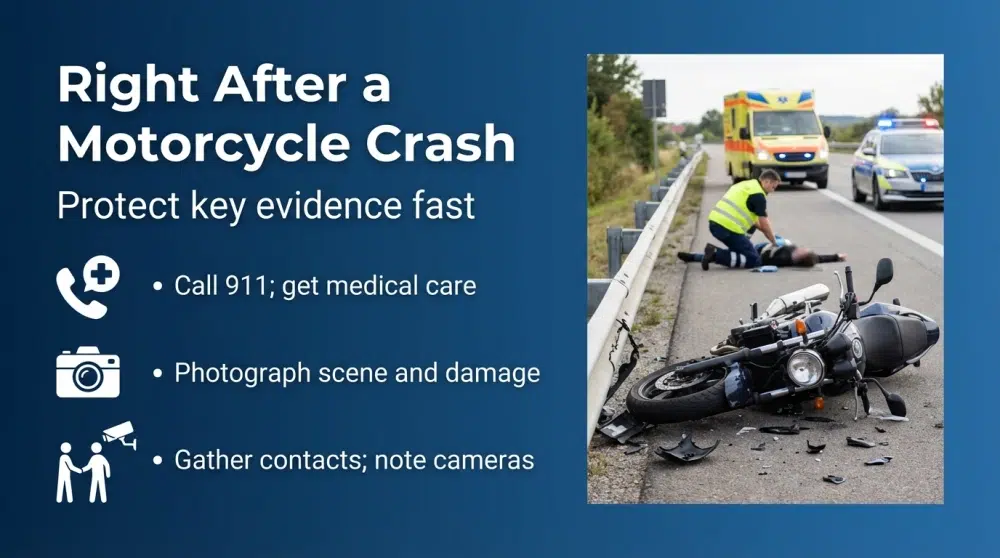
- Call 911 and get medical help. Your medical records and bills will become vital proof of injuries and causation [11].
- Secure the scene visually. Take wide and close photos of the roadway, skid marks, debris, final resting positions, traffic signals, lane markings, weather, and lighting.
- Record contact details. Get names, phones, and emails for drivers, passengers, and witnesses. Photograph driver’s licenses and insurance cards if possible.
- Preserve your gear. Do not dispose of your helmet, jacket, boots, or gloves. Helmet damage can be powerful physical evidence, and California requires DOT-compliant helmets for riders and passengers [5].
- Note cameras. Identify nearby businesses, homes, and intersections that may have cameras. Video often overwrites in 24 to 72 hours, so request preservation quickly.
- Avoid social media. Posts can be taken out of context and used to dispute injury severity or liability.
If police respond, cooperate and provide accurate, factual information. Later, you can request the collision report as a party of interest under California law [8].
What evidence belongs on your Irvine motorcycle crash evidence checklist?
Use this practical motorcycle crash evidence checklist to organize what matters for liability and damages. Gathering items early reduces disputes later and helps both plaintiffs and defendants understand the facts.
What scene photos and videos matter most?
- Overall context. Photograph the intersection or road from multiple angles, including approach paths. Capture signs, lights, lane arrows, and lane widths.
- Positions and distances. Document vehicle rest positions, debris fields, and any pre-impact tire marks. Use reference objects or a phone measuring app for scale.
- Conditions. Record weather, sun position, shadows, road surface defects, and construction zones. If lane splitting was a factor, photograph lane lines and traffic density during the incident time window; California recognizes lane splitting and directs the CHP to provide safety guidance [3] [4].
- Damage detail. Zoom in on crush points, paint transfers, broken parts, and helmet or gear damage.
How do you collect witness statements and contact info?
- Identify all witnesses. Ask bystanders for contact details. If they are willing, record a short statement on your phone with the time, date, and location. For audio, obtain consent to record consistent with California privacy law for confidential conversations [15].
- Preserve texts and emails. Save any messages where drivers or witnesses describe how the crash happened.
- Follow up promptly. Memories fade quickly. A short, polite confirmation message helps lock in accurate details.
What role does the police report play in your claim?
The officer’s report provides diagrams, contributing factors, and sometimes preliminary fault opinions. In California, collision reports are confidential but available to parties of interest, their insurance carriers, and legal representatives [8]. The report can also support DMV requirements if a statutory report is needed [7]. While some portions may be admissible as public records, courts scrutinize opinions and hearsay, and foundations matter under California’s Evidence Code [10]. Your attorney can obtain certified copies and evaluate admissibility.
How valuable is helmet cam or dashcam footage?
- Time-stamped video. Camera footage can show speed, lane position, signaling, and traffic behavior second-by-second. Keep original files and make working copies.
- Chain of custody. Do not alter or apply filters. Save to a new device or cloud folder and avoid editing. Retain metadata.
- Audio considerations. If audio captures private conversations, consult counsel about consent and privacy issues under California law [15].
Which medical records and bills should you gather?
- Emergency and hospital records. EMS run sheets, ER notes, imaging, and discharge summaries show mechanism of injury and acute symptoms.
- Treatment and recovery. Physical therapy notes, orthopedic or neurologic consults, prescriptions, and progress records help connect injuries to the crash.
- Itemized bills. Keep statements and explanation of benefits to document amounts billed and paid. You have rights to access your health records and many records electronically [11].
What about property damage photos and repair estimates?
- High-resolution images. Photograph all sides of your motorcycle, the VIN plate, accessories, and any aftermarket parts.
- Repair or total loss documents. Obtain written estimates, parts lists, and labor times. Keep receipts for towing, storage, and gear replacement.
- Pre-loss condition. Gather maintenance records, mileage logs, and recent photos to support value.
Can vehicle and phone data help prove what happened?
- EDR and telematics. Many cars store speed, braking, and throttle data. Request preservation from the at-fault driver’s insurer quickly to reduce the risk of loss.
- Smartphone data. Maps timelines, ride-tracking apps, and fitness trackers can corroborate route, speed windows, and impact time. Handle carefully to avoid altering metadata.
- 911 audio and CAD logs. Emergency calls and dispatch logs establish timing and may include witness statements. Government-held records can be admissible if foundation and reliability requirements are met [10].
How do employment and income records fit into the claim?
- Pay stubs and W-2s. Prove baseline income and overtime patterns.
- Employer letters. Confirm time missed and job duties affected by injuries.
- Self-employed documentation. Use invoices, bank statements, and tax schedules when pay stubs are not available.
Which documents show insurance coverage and communications?
- Declarations pages. Document liability, uninsured motorist, collision, and medical payments coverages.
- Claim correspondence. Save every email and letter exchanged with insurers, including claim numbers, adjuster names, and recorded statement requests.

How do California laws on motorcycles and fault impact your evidence?
How does lane splitting affect fault in California?
Lane splitting is specifically recognized in California law, and the California Highway Patrol provides safety guidance on it [3] [4]. Evidence showing relative speeds, traffic flow, signaling, and lane position can be critical, especially if riders filtered between lanes under 30 to 40 mph or in slow traffic. Photos, helmet cam footage, and witness accounts help establish whether conduct was reasonable in context.
Could not wearing a helmet reduce your recovery?
California requires compliant helmets for all riders and passengers [5]. If head injury causation is disputed, defendants may argue that helmet nonuse contributed to injury severity. Medical records, biomechanical opinions, and helmet inspection photos may become pivotal on this issue. Your lawyer will anticipate these arguments and gather the right evidence to address them.
What is the statute of limitations for California motorcycle crash claims?
In most California personal injury cases, you have two years from the date of injury to file suit [1]. If a public entity may be responsible, such as for a dangerous roadway condition or a vehicle driven by a government employee, you generally must present a government claim within six months [2]. Track these deadlines from day one and calendar them in multiple places. Evidence gathering should start immediately, long before deadlines approach.
How does comparative fault work in California motorcycle cases?
California follows pure comparative negligence. A plaintiff’s damages are reduced by their percentage of fault, not barred outright [12]. That makes objective evidence vital: speed estimates, perception-reaction time analysis, visibility at the point of approach, vehicle code compliance, and driver attentiveness. Quality photographs, data, and records can reduce disputes over percentages and provide a clearer factual picture for settlement negotiations or trial.
How do you get and authenticate police reports, medical records, and videos?
How do you request an Irvine police collision report or CHP report?
For collisions investigated by law enforcement, reports are confidential but available to parties of interest, their insurers, or legal representatives [8]. Injury collisions must be reported to police within 24 hours [6], and certain incidents require a DMV report within 10 days [7]. When requesting a report, have the report number, date, location, and involved names ready. If you do not have the report number, provide as much detail as possible so the agency can locate it.
What rules make records admissible in court?
Admissibility is different from discoverability. Police reports and other public records may be admissible if they meet the public records exception and trustworthiness requirements [10]. Medical records and business documents often come in under the business records exception if foundational elements are satisfied [9]. Your lawyer will decide what to subpoena or stipulate to, and how to authenticate digital files, photographs, and logs.
How do you obtain medical records and bills quickly?
You have a right to access your health information, including electronic copies in many cases [11]. Ask providers for itemized bills and detailed records. Keep proof of requests, track deadlines, and follow up. If an insurer has paid medical bills, those records may also reflect payment amounts useful for damages analysis.
Can you introduce 911 calls, traffic camera footage, and business videos?
Public records like 911 audio and dispatch logs can be admissible if they satisfy the public records exception [10]. Business surveillance often requires testimony or a certification to meet the business records exception [9]. For privately held footage, send prompt preservation requests and follow up with subpoenas if needed.
What if the police report contains mistakes?
Reports can contain transcription errors or incomplete witness details. Provide supplemental information to the investigating agency politely and in writing. If disputes remain, photographs, videos, electronic data, and sworn witness testimony typically carry greater weight than check-box opinions. At trial, foundations and evidentiary rules govern what the jury sees [10] [9].
What if the driver is uninsured or it is a hit-and-run in Irvine?
What evidence helps in a hit-and-run?
- Immediate reporting. Notify police as soon as possible; injury collisions must be reported within 24 hours [6].
- Video canvass. Doorbell cameras, business surveillance, and traffic-adjacent cameras can help identify plates or vehicle features. Note addresses and contact them quickly for preservation.
- Paint transfer and debris. Photograph paint traces, broken lens pieces, or unique damage patterns that may match a specific make or model.
- 911 logs. Other callers may have provided details captured in dispatch logs or recordings, often critical in early identification [10].
How do uninsured or underinsured claims change what you collect?
If you must rely on your own coverage, insurers will scrutinize liability and damages carefully. Keep consistent medical documentation, repair estimates, and photographs. Maintain a clear timeline of symptoms and treatment. The same objective proof that persuades a jury also persuades claims analysts.
How do you prevent evidence loss or spoliation after a motorcycle crash?
Why are preservation letters important?
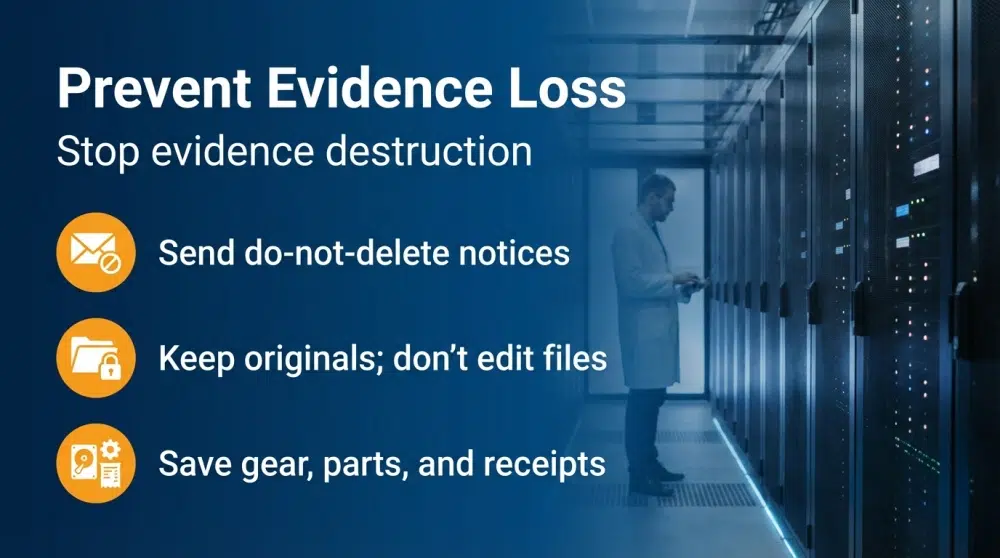
Evidence is often overwritten, repaired, or discarded unless preserved promptly. Send written preservation requests to involved drivers, their insurers, employers, nearby businesses, and any third parties with relevant data. Ask to preserve specific items: vehicle EDR data, dashcam files, surveillance video, repair orders, cell phone logs, and maintenance records. California courts can impose sanctions for discovery misuse, including destruction of evidence [13], and California law addresses spoliation issues in litigation contexts [14]. Early, specific, and reasonable requests reduce the risk of disputes later.
What should you preserve personally?
- Original digital files. Keep raw video and photos intact. Copy to secure storage and avoid editing.
- Damaged gear and parts. Store your helmet, jacket, gloves, and broken motorcycle parts. Photograph labels and DOT markings on the helmet.
- Paper trail. Save invoices, towing and storage receipts, rental records, and all communications with insurers.
How do you document the injury journey?
Maintain a journal capturing pain levels, sleep disruption, treatment dates, mileage to appointments, and activity limitations. Provide periodic updates to your lawyer. These contemporaneous notes support general damages and paint a fuller picture than medical records alone.
What local Irvine and Orange County steps help your claim?
Which agencies may be involved in an Irvine motorcycle crash?
Depending on the location and severity, the responding agency may be the Irvine Police Department or the California Highway Patrol. CHP collision investigations may involve detailed diagrams and measurements. Your lawyer can help route requests to the correct agency and identify whether a Multi-Disciplinary Accident Investigation Team was engaged for serious injuries.
How do local roads and traffic patterns affect evidence?
In Irvine, multi-lane arterials, freeway connectors, and high-traffic corridors often create lane density conditions where lane splitting and merging are common. Photographs and video that capture traffic density, speed, and driver signaling at the time of day of your crash are particularly important for establishing reasonable rider behavior under California lane splitting guidance [3] [4].
When should you file a DMV accident report?
If the crash meets California’s reporting thresholds, a DMV report is generally due within 10 days [7]. File promptly to avoid penalties and to maintain a clean paper trail for insurers.
What if a public entity might be responsible?
Claims involving roadway design, signal timing, or foliage obscuring signs may implicate a public entity. Strict claim presentment deadlines apply, generally six months from the incident for personal injury claims [2]. Evidence like engineering records, maintenance logs, and citizen complaints often needs quick preservation requests. Start these efforts early.
How can a lawyer help with your motorcycle crash evidence checklist?
Why is early legal help critical for preserving and presenting evidence?
Time-sensitive evidence can disappear within days. A lawyer can send preservation letters, coordinate expert inspections, and organize the document flow for admissibility. Strong cases rely on contemporaneous documentation, not later recollections. In negotiations, clear evidence reduces disputes over fault and injury causation, aligning with California’s comparative fault framework [12].
What specific tasks can a lawyer manage for you?
- Police and public records. Obtain certified collision reports, 911 audio, and dispatch logs with the proper statutory bases [8] [10].
- Medical documentation. Organize records and bills and request provider certifications consistent with your HIPAA access rights [11].
- Video and data. Secure surveillance videos, dashcam files, helmet cam footage, and vehicle EDR data with authenticated reproductions and chain of custody steps.
- Discovery and motions. Pursue subpoenas, depositions, and, when necessary, sanctions for discovery misuse or spoliation [13] [14].
- Negotiation and trial prep. Present evidence in a way that aligns with the business records and public records rules for admissibility [9] [10].
How should you use the motorcycle crash evidence checklist with your lawyer?
Bring photos, videos, names and contacts, medical records and bills, repair estimates, and all insurance communications to your first meeting. Expect a discussion about timelines, public entity claim deadlines [2], and the two-year statute for injury claims [1]. This preparation saves time and helps your legal team focus on disputed issues quickly.
Many riders start by searching for motorcycle accident lawyers and then compare experience, approach, and communication. In a local context, working with motorcycle accident lawyers in Irvine often means quicker site inspections and better access to local investigators.
What common insurer arguments can your evidence neutralize?
- Speed disputes. Use video timestamps, EDR data, and physical evidence to address speed estimates.
- Visibility. Photographs at the same time of day, demonstrating sun glare or shadowing, can contextualize perception-reaction time.
- Helmet and gear. Show helmet compliance and damage detail to address head injury causation disputes [5].
- Lane splitting. Establish traffic density, relative speeds, and signaling under California’s lane splitting framework [3] [4].
- Injury severity. Provide consistent medical documentation and treatment chronology, supported by your access to records [11].
How do safety statistics support your claim story?
National transportation data shows motorcyclists face significantly higher risk per vehicle mile traveled than passenger vehicle occupants, underscoring why clear evidence is essential to evaluate fault and damages [15]. Incorporating credible statistics into demand packages can help frame exposure for adjusters and, if necessary, for jurors.
What is the best timeline for using the checklist?
- First 24 to 72 hours. Medical care, scene photos, witness contacts, preservation requests, and claim reporting [6] [7].
- First 2 weeks. Obtain police report numbers, formal records requests, property damage estimates, and initial medical records.
- First 30 to 60 days. Secure third-party videos, EDR data, and 911 audio; finalize medical and wage documentation; consider public entity claim deadlines [2].
How can both plaintiffs and defendants benefit from a clear evidence plan?
For plaintiffs, a comprehensive record supports fair compensation for injuries and losses. For defendants, accurate evidence can reduce exaggerated claims and narrow disputed issues. In either role, your presentation should anticipate admissibility requirements and practical proof problems under California’s Evidence Code [9] [10].
Why choose GoSuits for motorcycle cases in Irvine, CA?
Motorcycle collisions are complex, and evidence can change the outcome. If your matter involves personal injury, a free consultation with our team can help you understand what to collect now and what to request later. We practice throughout California, including Irvine and greater Orange County, and handle civil injury claims from initial evidence preservation through trial.
We use an exclusive proprietary software platform to capture, organize, and analyze crash evidence faster. Our technology-driven approach speeds up record collection, video processing, and timeline building, while designated attorneys lead every case from day one. We do not use case managers for attorney access. Every client has direct, unfettered access to their attorney for strategy, updates, and preparation.
Our record includes meaningful results in contested liability and serious injury cases. Explore our prior cases for examples, learn about our attorneys, and read more about us. We bring over 30 years of combined experience across settlement negotiations, law and motion, and courtroom trials. That trial experience matters when insurers evaluate risk and when a jury evaluates credibility.
We handle a range of practice areas tied to roadway incidents and injuries, including motorcycle, car, and truck claims, along with catastrophic injury matters. For a broader overview of related services, visit our practice areas.
References and Resources
- Code of Civil Procedure § 335.1 Two-year statute of limitations for injury – California Legislative Information
- Government Code § 911.2 Time for presentation of claims to public entities – California Legislative Information
- Vehicle Code § 21658.1 Lane splitting guidelines authorization – California Legislative Information
- Lane Splitting Safety – California Highway Patrol
- Vehicle Code § 27803 Motorcycle helmet requirement – California Legislative Information
- Vehicle Code § 20008 Duty to report collisions to police within 24 hours – California Legislative Information
- Vehicle Code § 16000 Report of accident to DMV – California Legislative Information
- Vehicle Code § 20012 Confidentiality and release of accident reports – California Legislative Information
- Evidence Code § 1271 Business records exception – California Legislative Information
- Evidence Code § 1280 Public records exception – California Legislative Information
- Your Rights Under HIPAA to Access Health Information – U.S. Department of Health and Human Services
- Li v. Yellow Cab Co., 13 Cal.3d 804 Pure comparative negligence – CourtListener
- Code of Civil Procedure § 2023.030 Sanctions for misuse of discovery – California Legislative Information
- Cedars-Sinai Medical Center v. Superior Court, 18 Cal.4th 1 Spoliation issues – CourtListener
- Motorcycle Safety and Risk Statistics – National Highway Traffic Safety Administration