- Why should you see a doctor immediately after an accident in Irvine?
- What documents should you bring to your first medical visit after an injury in Irvine?
- Which symptoms should you monitor in the hours and days after a crash?
- What questions should you ask your doctor after an accident?
- How do you document injuries for an insurance claim or lawsuit in California?
- Where can you seek urgent care or emergency help in Irvine and Orange County?
- How do California and federal privacy rules affect your medical records?
- What California deadlines and rules could affect your claim?
- How do health insurance, Medicare, or Medi-Cal liens affect your bills and settlement?
- How should you prepare for follow up visits, imaging, and specialists?
- How do you organize a strong personal injury medical file?
- What common pitfalls should you avoid after an injury?
- What should children, older adults, and workers with third party claims know?
- Who is GoSuits and how can we help after an injury in Irvine?
- References and Resources
Why should you see a doctor immediately after an accident in Irvine?
Prompt medical care protects your health and your claim. Even if you feel “mostly fine” after a crash or fall, the body’s stress response can mask pain for hours. Certain injuries can be serious without obvious early symptoms, including concussion and internal injuries. The Centers for Disease Control and Prevention reports tens of thousands of traumatic brain injury related deaths annually, and hundreds of thousands of hospitalizations, underscoring how often these injuries occur and how variable symptoms can be [4].
Early evaluation creates a clear timeline between the incident and your symptoms, which insurance adjusters and courts look for when determining causation. Consistent treatment also helps your doctor rule out complications and adjust your care plan.
If your incident involved a motor vehicle in Irvine or anywhere in California, timely documentation can also help you comply with state reporting and claims processes. For example, California requires reporting certain crashes to the DMV within 10 days if there is injury, death, or at least $1,000 in property damage [2].
What documents should you bring to your first medical visit after an injury in Irvine?
Arriving prepared helps your clinician evaluate you thoroughly and generates records that support your insurance claim or lawsuit. Bring:
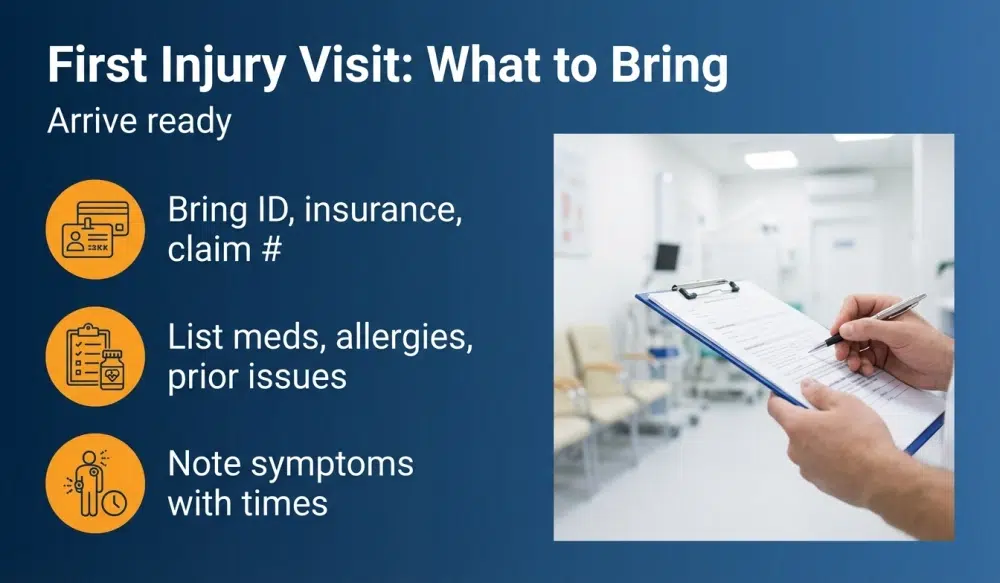
- Photo ID and insurance cards Driver license or other ID, plus health insurance and any auto med-pay or other coverage cards.
- Accident report information If available, bring a collision report number or any incident report details. If you must file a DMV accident report due to California’s rules, your provider visit notes may help you complete it accurately [2].
- Medication and allergy list Include dosages, over-the-counter drugs, herbal supplements, and known allergies.
- Symptom timeline Note what you felt at the scene, on the way home, later that day, and the next morning. Include dizziness, nausea, confusion, headaches, neck or back pain, numbness, or vision changes [4].
- Prior relevant medical history Old injuries or preexisting conditions do not bar claims, but disclosing them helps your doctor differentiate aggravation from new trauma and can strengthen credibility.
- Photos and videos Images of the scene, visible bruising, swelling, lacerations, vehicle damage, or hazardous conditions help document mechanism of injury.
- Witness and insurance info Names, contact details, and insurance claim numbers support consistent documentation across providers and adjusters.
In many cases, you will later request copies of your medical records to support your case. Under federal privacy regulations, patients have a right of access to their records, typically within 30 days, with limited exceptions [3].
Which symptoms should you monitor in the hours and days after a crash?
Certain symptoms can emerge hours or even days after an accident. Track these closely and seek urgent care if they worsen:
- Headache, confusion, memory issues, light or noise sensitivity These may indicate a concussion or other traumatic brain injury. Immediate evaluation is important, especially if accompanied by vomiting, worsening drowsiness, or unequal pupils [4].
- Neck or back pain, tingling, or weakness Could indicate whiplash, disc injury, or nerve involvement. Prompt assessment and imaging may be warranted based on exam findings.
- Chest pain or shortness of breath Seek emergency care, especially if there is a history of heart or lung disease or if the crash involved high force.
- Abdominal pain or swelling May signal internal injury and needs urgent evaluation.
- Changes in vision, balance, or speech Neurologic symptoms require immediate attention [4].
- Emotional changes or sleep disturbance Anxiety, depression, or insomnia can follow trauma and should be discussed with your provider.
National traffic safety data reflects the scope of injury risk on U.S. roads. In recent years, annual traffic fatalities exceeded 42,000 nationwide, and serious injuries are far more common, highlighting the need for prompt medical attention even after seemingly minor collisions [5].
What questions should you ask your doctor after an accident?
Prepare a list and take notes during your visit so you can follow instructions precisely:
- What is my working diagnosis and differential Ask what the most likely diagnosis is, what else is being considered, and how the plan will confirm or rule out conditions.
- What tests or imaging are needed Clarify whether X-ray, CT, MRI, or ultrasound is recommended and why, and whether watchful waiting is safe.
- How should I manage pain and function Discuss medications, physical therapy, at-home exercises, and activity limits.
- What symptoms require urgent recheck Know red flags that should prompt immediate care, including worsening headaches, new weakness, fever, or shortness of breath [4].
- What is the follow up schedule Confirm the timeline for rechecks and referrals to specialists.
- How should I document my recovery Ask what daily notes, photos, or logs would help guide treatment and capture your progress.
Statements made for purposes of medical diagnosis or treatment are treated with special weight in legal proceedings because they reflect your symptoms and needs at the time of care [7]. Clear communication with your clinician is both a health priority and a documentation strategy.
How do you document injuries for an insurance claim or lawsuit in California?
Documentation is the backbone of a California personal injury claim. A simple checklist helps you capture what insurers and courts expect:
- Consistent medical visits Follow the treatment plan and attend appointments. Gaps in care can be used to argue you recovered or were not injured.
- Complete medical records Request copies of visit notes, imaging, lab results, and referrals. Under federal rules, you have a right to obtain copies with narrow exceptions, usually within 30 days [3].
- Pain and activity journal Keep daily notes about pain levels, mobility, activities you cannot perform, missed work, and sleep.
- Expense ledger Save receipts for co-pays, prescriptions, medical equipment, rides to care, and parking. Organized expenses support damages claims.
- Photographic timeline Update photos of bruising, swelling, casts, braces, and scars over time.
- Work documentation Ask your employer for wage statements and absence records that tie missed time to the injury.
- Preserve communications Save letters, emails, and claim notes from insurers.
Your records are also evaluated under evidence rules. In California, regularly kept medical business records can be admissible if foundational requirements are met [6], and statements made for diagnosis or treatment are a hearsay exception in many courts [7]. Completeness and consistency are critical.
If you were in a car crash, California’s accident reporting requirement may apply, which can intersect with your medical documentation and timing [2]. For Orange County incidents, county traffic safety data also helps contextualize risk patterns seen by local physicians and claims professionals [13].
Where can you seek urgent care or emergency help in Irvine and Orange County?
For potentially life threatening symptoms, call 911. For non life threatening but urgent concerns, seek Irvine urgent care after a crash or visit a local emergency department. Orange County maintains emergency medical services resources that coordinate prehospital and hospital care across the region [11]. When in doubt, urgent evaluation is safer than waiting, especially for head injuries, chest pain, severe abdominal pain, or neurologic changes [4].
How do California and federal privacy rules affect your medical records?
Two key frameworks protect your health information while also enabling access for your claim:
- HIPAA right of access You have the right to obtain copies of your medical records from providers, usually within 30 days, and to request electronic copies when maintained electronically [3].
- California subpoena and notice rules If the defense seeks your medical records from providers, California requires a consumer notice before production of personal records to a third party, giving you an opportunity to object or limit scope [8].
Understanding these rules helps you and your care team gather complete records quickly and respond appropriately if broad or intrusive requests are made.
What California deadlines and rules could affect your claim?
Timing rules are critical to preserve your rights:
- Statute of limitations Most California personal injury claims must be filed within two years of the injury date, though exceptions exist for claims against public entities and for minors [1].
- DMV accident reporting Injury crashes must be reported within 10 days if the DMV criteria are met [2].
- Evidence preservation Even before filing suit, promptly preserve photos, vehicle data, and medical records. When a lawsuit is filed in federal court, discovery obligations require parties to disclose relevant information under the Rules of Civil Procedure [12].
Do not wait to speak with a lawyer about deadlines. A missed deadline can bar an otherwise valid claim in California [1].
How do health insurance, Medicare, or Medi-Cal liens affect your bills and settlement?
After an accident, medical bills can be paid by your health insurer, Medicare, or Medi-Cal. These payers may assert reimbursement rights from your settlement or judgment, often called liens. Knowing the basics helps avoid surprises:
- Medicare conditional payments Medicare often pays accident related claims up front, then seeks reimbursement from settlements under Medicare Secondary Payer rules [9].
- Medi-Cal lien procedures California’s Department of Health Care Services administers third party liability and lien recovery for Medi-Cal benefits paid due to an injury caused by another party [10].
- Private health insurance Many plans include subrogation or reimbursement provisions that must be addressed during settlement.
Experienced counsel can coordinate lien resolution so your net recovery is protected and billing errors are corrected. Discuss lien handling from the start of your case so your medical providers and insurers route bills appropriately.

How should you prepare for follow up visits, imaging, and specialists?
Follow up visits anchor your recovery timeline. To make the most of each appointment:
- Update symptom logs Bring a concise summary of pain levels, activity limits, and new or resolved symptoms since the last visit.
- Confirm treatment goals Ask what improvement is expected by your next appointment and what to do if goals are not met.
- Clarify imaging rationale If imaging is recommended, ask how results will change the plan. Document authorization numbers for MRI or CT.
- Obtain work notes Get return to work or modified duty letters that reflect medical restrictions.
- Request copies Ask for visit summaries and test results, or use your patient portal to download them, consistent with your right of access [3].
Some injuries benefit from multidisciplinary care with physical therapy, pain management, neurology, or orthopedics. Keep referral letters and track appointment dates to maintain continuity.
How do you organize a strong personal injury medical file?
A simple structure makes it easy to provide documentation to your attorney, insurer, or the court:
- Medical chronology A dated list of each medical visit, provider name, reason for visit, key findings, and plan.
- Records folder Copies of visit notes, test results, imaging discs or links, and referrals, grouped by provider.
- Billing and EOB folder Medical bills, itemized statements, and explanation of benefits letters, grouped by date.
- Correspondence folder Letters or emails with insurers and providers, including claim numbers and adjuster contacts.
- Photos and video folder Time stamped media of injuries, equipment, or environmental hazards.
- Work and income folder Pay stubs, employer letters, and disability forms relating to time off work.
This structure mirrors how claims professionals and lawyers review files, which helps avoid delays and disputes later.
What common pitfalls should you avoid after an injury?
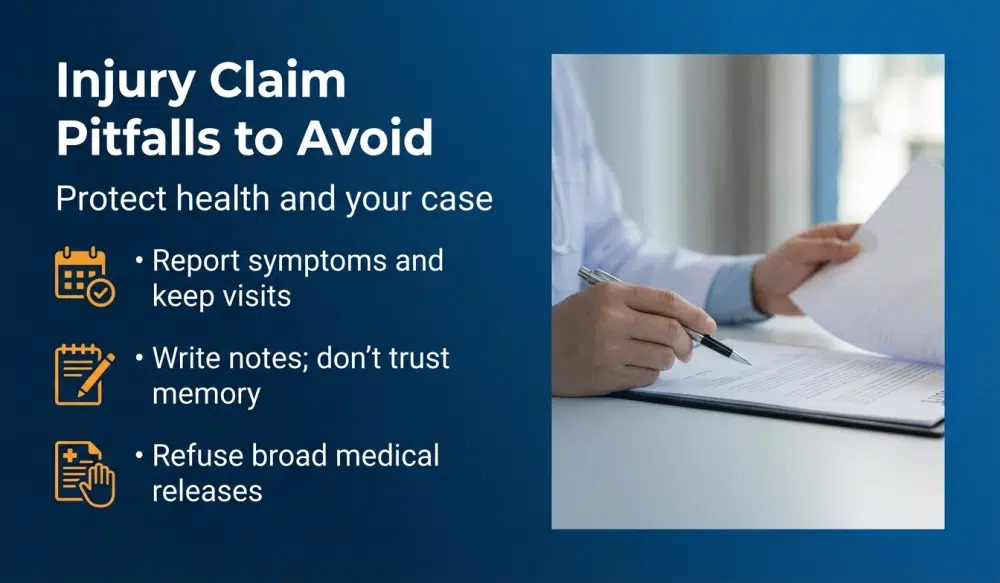
- Downplaying pain or skipping visits This can undermine your health and your claim. Follow medical advice and be honest about limitations.
- Relying on memory Create a written timeline of symptoms and care. Details fade quickly without notes.
- Posting on social media Photos or comments can be taken out of context. Discuss online activity with your lawyer first.
- Signing broad releases Do not sign blanket medical record releases without understanding the scope. California has consumer notice protections for subpoenas, and your right of access gives you a way to gather records without over sharing [8] [3].
- Missing deadlines Failing to file or report in time can end your claim. Track dates and consult counsel early [1] [2].
What should children, older adults, and workers with third party claims know?
How do pediatric injuries differ, and what should parents ask?
Children may not describe symptoms clearly. Watch for changes in behavior, sleep, appetite, and school performance. For head injuries, clinicians often use age specific concussion tools. Ask about safe return to school and activity, and seek immediate care for red flag symptoms such as repeated vomiting, severe headache, or confusion [4].
What should older adults consider after a fall or crash?
Older adults have higher risks of complications, including from blood thinners. Seemingly minor head trauma can be dangerous when anticoagulated. Seek evaluation promptly for any head impact, dizziness, or new neurologic symptoms [4]. Keep an updated medication list and discuss fall prevention with your provider.
How do work injuries factor into third party claims?
If you were injured on the job by someone outside your workplace, you might have both a workers’ compensation claim and a third party claim against the at fault driver, property owner, or manufacturer. Coordination with health insurers, Medicare, or Medi-Cal is often required and affects settlement timing and net recovery [9] [10]. Your medical visit documentation remains crucial in both contexts.
Where do local crash and safety trends fit into your medical checklist?
Local data can frame your care plan and documentation. Orange County traffic safety reports show patterns in collisions, such as common intersections or times of day. While your health needs drive your treatment, awareness of these trends can support context for mechanism of injury and expected treatment pathways [13]. That context can also be useful when discussing medical necessity with insurers.
How can a lawyer help you use this medical visit checklist effectively?
This checklist is designed to help you prepare for care and build clear records, but navigating California deadlines, privacy rules, and liens is challenging. A lawyer can request complete records, coordinate with your providers, and present your medical story persuasively under the applicable evidence rules [6] [7]. Avoid going it alone in complex injury cases.
If your injury involves a vehicle collision or premises hazard in Irvine, advice from personal injury lawyers can help you avoid documentation gaps and missed deadlines. As your case progresses, disciplined record keeping and timely care are the two pillars that support fair evaluation of your claim.

What if you were in a car crash in Irvine and do not feel hurt right away?
It is common to feel delayed soreness or headaches after a collision. Seek prompt evaluation and describe the crash mechanism and all symptoms, even if mild. Ask for written home care instructions and schedule a follow up visit if symptoms persist. Document your progression with daily notes and photos of visible injuries. If your crash meets the DMV reporting threshold, complete the required report within 10 days [2].
For readers searching for an Irvine medical visit after accident checklist, we hope this guide gives you structure for your next appointment and the weeks that follow. If you later decide to consult personal injury lawyers in Irvine, bringing your organized file and timeline to the consultation will save time and lead to a more precise assessment of your case.
What if you need help understanding medical bills, CPT codes, or insurance denials?
Ask your provider for itemized bills and CPT or HCPCS codes for each service. Compare those to your insurer’s Explanation of Benefits. If Medicare or Medi-Cal is involved, request a payment summary so you can identify conditional payments or liens that require repayment at settlement [9] [10]. Keep all documents together and share them with your attorney to expedite lien resolution.
How should you talk to insurers about your medical care?
Keep communications factual and concise. Provide claim numbers, dates of service, and copies of medical records or bills as needed, rather than broad authorizations. If asked for a recorded statement while you are still in acute care, consider postponing until you have consulted with counsel and collected your initial records and notes.
What legal concepts about medical evidence are worth knowing?
- Business records and authenticity Medical records may be admitted if created in the regular course of business and supported by a custodian declaration or testimony in California [6].
- Statements for treatment Your descriptions of pain and symptoms to medical providers are often admissible for their truth in many courts because they were made for diagnosis or treatment [7].
- Discovery and disclosures Litigation rules require timely exchange of relevant records. Courts may sanction parties that withhold or destroy evidence [12].
What local planning can help if you are injured again in the future?
Consider preparing an emergency information card for your wallet or phone with allergies, medications, and emergency contacts. Save your insurer’s claim number and your physician’s contact information. Familiarize yourself with Orange County emergency medical services channels and local hospitals so you can act quickly if needed [11].
What does a first appointment script look like?
Try this sequence during your initial visit:
- Describe the mechanism “I was rear ended at approximately 30 mph. My head hit the headrest and I felt neck pain 30 minutes later.”
- List all symptoms “Headache 5 out of 10, neck stiffness, mild nausea, light sensitivity.”
- Share relevant history “I had a minor neck strain 4 years ago, fully recovered.”
- Ask for a plan “What diagnoses are likely, what tests are needed, and what are red flag symptoms to watch for?”
- Request written instructions “Please include activity limits and a return to work note.”
How can organized documentation support settlement negotiations?
Insurers evaluate claims by weighing liability, causation, and damages. A clear set of records that tie your symptoms and limitations to the incident can shorten the time to a fair outcome. This includes objective findings, consistent doctor notes, and a coherent timeline. If your injury worsens or fails to improve, that too should be captured through follow up evaluations and imaging, where clinically indicated.
In discussions with the insurer, you can reference your organized ledger of expenses and the medical necessity reflected in your provider notes. This approach is far more persuasive than vague descriptions of pain and helps your lawyer present your case within the evidence framework used by courts [6] [7].
Which professionals should be part of your recovery team?
Your primary care physician or urgent care provider is often your first stop. Depending on findings, you may benefit from physical therapy, orthopedics, neurology, pain management, or behavioral health. Communication among your providers keeps treatment aligned with your goals. Share your symptom logs and daily activity notes so each professional has the full picture.
How can you stay consistent and credible throughout your recovery?
- Be specific Instead of “I’m fine,” say “I can walk 10 minutes, then my back pain is 7 out of 10.”
- Report changes promptly Worsening headaches, new weakness, or new numbness should be documented and evaluated quickly [4].
- Follow restrictions If your doctor restricts lifting or driving, follow those limits and document any work accommodations.
- Keep duplicates Save both electronic and paper copies of key records and bills in case originals are misplaced.
What if the insurer disputes causation or necessity of care?
Disputes often arise over whether care was necessary or related to the incident. Provide contemporaneous records, clinician notes connecting the mechanism to injury, and imaging findings if applicable. Your attorney can obtain declarations from treating providers and, if needed, consult independent experts to explain medical reasoning using accepted standards and evidence rules [6] [7].
Where do settlement taxes and reimbursements come into play?
While many personal injury compensatory damages for physical injuries are not taxable under federal law, certain categories and interest can be. Also, lien reimbursements to Medicare or Medi-Cal may be required from the settlement before you receive your net proceeds [9] [10]. Discuss these issues with your attorney early so planning can start before negotiation.
Can this checklist help if you were injured in a slip, trip, or fall in Irvine?
Yes. The same principles apply. Photograph the condition, report it promptly, seek medical care immediately, and document symptoms and treatment thoroughly. Ask your doctor to note any objective findings such as swelling, decreased range of motion, or positive orthopedic tests, and continue consistent follow up. Your organized medical file will support your claim just as it would in a vehicle case.
Are there special considerations for brain injuries and post concussion symptoms?
Yes. Some concussion symptoms are subtle or delayed. Carefully track headaches, dizziness, memory problems, light sensitivity, mood changes, and sleep disturbance. Ask your physician about graded return to activity and whether neuropsychological evaluation is appropriate. Seek urgent care if symptoms worsen suddenly or new neurologic deficits appear [4]. Document all school or work accommodations.
What is the role of a legal team in coordinating care and documentation?
Your legal team can synchronize record requests, manage billing inquiries, and prepare your medical chronology for settlement or litigation. They can also advise on responding to subpoenas and requests for protected health information under California and federal rules [8] [3]. This administrative support allows you to focus on treatment.
When you meet with personal injury lawyers, bring your checklist and folders. This allows quick identification of missing records, imaging, or billing statements and helps establish a strategy that aligns your care with claim requirements.

How can local legal help support your medical visit plan?
Local counsel understands Orange County courts and common practices among regional insurers and providers. That familiarity can speed up record retrieval, lien resolution, and settlement timing. In addition, your lawyer can connect you with nearby specialists and physical therapy resources that match your diagnoses and goals.
We often meet clients who started without representation and later realized their file lacked objective documentation, consistency, or timely follow up. A structured approach from the beginning leads to better clarity about diagnosis, treatment, and prognosis, which supports a fair evaluation by the insurer.
What role do keywords and local search play for your checklist?
Many people search for what to bring to doctor after car accident or how to document injuries for insurance claim. If you saved this checklist because you searched for an Irvine injury checklist or Irvine medical visit after accident, keep it handy as you schedule your first appointment, collect records through your patient portal, and continue follow up care.
For those considering a consultation, personal injury lawyers can help translate this medical story into a legal claim. If you prefer a local advocate, Irvine personal injury lawyers can coordinate with your care team and begin protecting your rights while you focus on recovery.
Who is GoSuits and how can we help after an injury in Irvine?
If you were hurt in Irvine or anywhere in Orange County, a free consultation with our team can help you understand how to use this medical visit checklist to protect your health and your claim. GoSuits is a California personal injury firm that serves clients across the state. We use an advanced, technology driven approach with exclusive proprietary software that streamlines evidence gathering, medical record retrieval, and case management for faster, clearer results. Even though we leverage technology to expedite your case, every client has a designated attorney, not a case manager, and you have direct, unfettered access to your lawyer from start to finish.
Our trial lawyers have more than 30 years of combined experience in civil injury litigation, including motor vehicle collisions, premises liability, product liability, brain injury claims, and wrongful death. Trial experience matters because it shapes early strategy, preserves key medical evidence, and strengthens negotiation. You can see a sample of past outcomes in our prior cases, meet our attorneys, learn more about us, and review our practice areas.
We regularly help clients apply this Irvine personal injury medical visit checklist after injury, from the first urgent care visit to complete record collection, lien resolution, and litigation if needed. We focus on clarity, speed, and preparation so your medical records tell a consistent story and your case is ready for negotiation or trial.
References and Resources
- Cal. Code Civ. Proc. § 335.1, two year statute of limitations for personal injury – California Legislative Information
- Accident Reporting Requirements, Form SR-1 and thresholds – California DMV
- Individuals’ Right Under HIPAA to Access Health Information 45 CFR 164.524 – U.S. Department of Health and Human Services
- Concussion and TBI Signs and Symptoms – Centers for Disease Control and Prevention
- 2021 Traffic Crash Data Highlights – National Highway Traffic Safety Administration
- Cal. Evid. Code § 1271, business records exception – California Legislative Information
- Fed. R. Evid. 803, exceptions to hearsay including statements for medical diagnosis – Legal Information Institute, Cornell Law School
- Cal. Code Civ. Proc. § 1985.3, consumer notice for subpoena of personal records – California Legislative Information
- Medicare Secondary Payer and conditional payments – Centers for Medicare and Medicaid Services
- Third Party Liability and Medi-Cal lien recovery – California Department of Health Care Services
- Emergency Medical Services in Orange County – Orange County Health Care Agency
- Federal Rules of Civil Procedure overview – United States Courts
- Traffic Safety Facts and data – California Office of Traffic Safety
- TBI data, hospitalizations and deaths – Centers for Disease Control and Prevention