- What should you do in the first hour after an accident in Irvine, CA?
- How can you protect your health in the first 24 hours?
- When and how do you report an accident in Irvine and California?
- How do you document injuries, vehicle damage, and scene details during the first week?
- What first week insurance steps should you take with California insurers?
- What California deadlines and statutes apply to injury claims?
- How does California comparative fault change the value of your claim?
- Do steps change for motorcycle, truck, rideshare, pedestrian, or slip and fall incidents?
- How do you handle property damage, rentals, and total loss claims in the first week?
- How do you track lost wages and out of pocket costs for your claim?
- Should you post about your accident on social media during the first week?
- What should you know about medical billing, liens, and health insurance coordination?
- What does a typical timeline from first week to settlement or lawsuit look like?
- What local Orange County and California resources can help you?
- Who is GoSuits and how can our technology driven personal injury team help?
What should you do in the first hour after an accident in Irvine, CA?
Safety comes first. If you can do so safely, move vehicles out of traffic, turn on hazard lights, and check for injuries. Call 911 for any injury, suspected injury, or if vehicles block traffic. California requires drivers to stop at the scene, exchange information, and render reasonable aid where needed. Taking calm, methodical steps in the first hour helps your health and protects your claim.
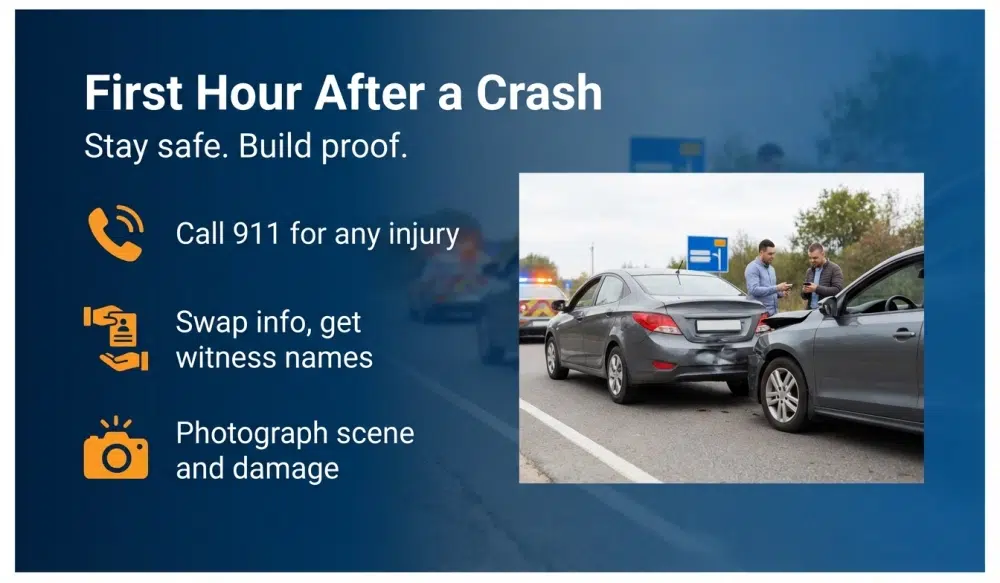
- Call for medical help even for symptoms that seem minor. Some trauma is delayed in onset, including head and soft tissue injuries [9].
- Call law enforcement to document the crash if anyone is injured or there is significant damage. Reporting supports later insurance and legal steps [2] [3].
- Exchange information with all drivers. Photograph driver’s licenses, license plates, VINs, registrations, and proof of insurance.
- Collect witness details. Ask witnesses for names, phone numbers, and brief written or recorded statements on what they saw.
- Photograph the scene. Capture vehicle positions, street signs, traffic controls, skid marks, debris, road conditions, weather, and visible injuries.
- Do not admit fault. Limit statements to facts for police and your insurer. Fault is a legal conclusion, and California uses comparative fault that allocates responsibility across parties [1] [13].
How can you protect your health in the first 24 hours?
Your health is the priority. The first day is about proper medical evaluation and symptom monitoring. Many injuries are not obvious right away. A prompt exam documents that the accident caused your injuries, which becomes vital during the claim process.
- Seek medical attention even if you feel okay. Concussions, internal injuries, and whiplash can develop over 24 to 72 hours. National public health agencies warn that motor vehicle crashes remain a leading cause of serious injury in the United States [9] [8].
- Tell providers this was an accident. Ask that all notes and diagnostic orders reference the crash mechanism.
- Follow discharge instructions. Fill medications, schedule follow ups, and complete imaging and referrals without delay.
- Begin an injury journal. Record pain levels, mobility limits, sleep issues, and missed activities. Daily entries create a contemporaneous record that insurers and courts find persuasive.
- Keep all receipts for co pays, over the counter supplies, prescriptions, and transportation to care. These are reimbursable damages in many claims.
When and how do you report an accident in Irvine and California?
California has specific reporting rules that can affect your license status and claim. Failing to meet these duties can complicate insurance and liability decisions.
- Police report timing. If anyone is injured or killed, California requires a report to police or the California Highway Patrol. Reporting promptly provides an official record and can include diagrams and statements that help resolve disputes [3].
- DMV financial responsibility report. California requires a written report to the DMV for crashes involving injury, death, or qualifying property damage. The DMV provides forms and instructions on when and how to file [2].
- Notify your insurer. Most policies require prompt notice of a loss. A timely first notice of loss helps preserve coverage rights. California regulations also require insurers to respond and investigate promptly [5].
- Consider government claim rules. If a public entity may be at fault, California’s Government Claims Program imposes early deadlines before a lawsuit. Acting during week one can prevent missed windows [7].
How do you document injuries, vehicle damage, and scene details during the first week?
Good documentation is the foundation of a strong California personal injury claim. In the first week, focus on collecting and organizing evidence that will be tough to recreate later.
- Medical records. Request visit summaries, imaging reports, and referrals. Create a folder for ongoing treatment.
- Photographs and video. Revisit the scene at the same time of day if possible to capture lighting and traffic patterns.
- Vehicle inspection. Photograph all sides, interior damage, seat belts, air bags, and child safety seats. Save damaged parts and do not authorize disposal without photographs and documentation.
- Property damage list. Itemize personal property losses from the crash such as phones, laptops, glasses, or child seats.
- Witness contact updates. Confirm witness contact info still works and ask them to save any photos or dashcam footage.
- Preservation letters. For commercial vehicles or rideshares, early preservation of telematics, dashcam, event data recorder, and dispatch logs can be important.
What first week insurance steps should you take with California insurers?
During the first week, you typically open claims, share essential documents, and maintain careful control over what you say. California’s insurance rules require fair and prompt claims handling, which you can use to your advantage [5].

- Open claims promptly. Provide only basic facts and contact information. Avoid recorded statements before you have gathered documentation.
- Provide must have documents. Police report number, photos, witness contacts, and proof of insurance coverage help adjusters confirm liability and coverage quickly.
- Confirm claim milestones in writing. California regulations require timely acknowledgment and investigation of claims. Follow up emails help create a record of compliance with these standards [5].
- Use medical pay coverage if available. Med Pay can help with early treatment bills regardless of fault, subject to your policy terms.
- Be cautious with early settlement offers. First week offers sometimes do not reflect the full scope of injury or future care. Comparative fault allocations can also reduce an initial number [1] [13].
If you prefer guidance, car accident lawyers understand how to present medical and wage documents so your losses are fully considered under California law.
What Irvine deadlines and statutes apply to injury claims?
California has key deadlines that often begin on the date of the accident. Missing a deadline can bar recovery, which is why the first week is the right time to map the timeline.
- Statute of limitations. California personal injury cases are generally subject to a two year statute of limitations in the California Code of Civil Procedure, measured from the date of injury. Confirm the time period for your claim type and any tolling that may apply [6] [4].
- Government claims. Claims against public entities follow a shorter administrative claim period before any lawsuit. The California Government Claims Program publishes instructions and forms [7].
- Insurance notice provisions. Your policy may require prompt notice of an incident or claim. Early notice protects coverage.
- Evidence preservation. Some electronic data is overwritten quickly. Request preservation of photos, surveillance, event data recorder data, and business logs during the first week.

How does Irvine comparative fault change the value of your claim?
California is a pure comparative fault jurisdiction. That means your recovery is reduced by your percentage of responsibility, rather than being barred if you contributed to the accident. The California Supreme Court adopted this system in Li v. Yellow Cab Co., which remains a landmark decision [1]. In practice, this rule often results in negotiations that focus on the percentage allocation.
- What if both drivers made mistakes. If you are found 30 percent at fault, your damages are reduced by 30 percent.
- Evidence matters. Photos, witness statements, and traffic control data influence fault allocations.
- Medical causation. Insurers may argue a preexisting condition. California law permits recovery for aggravation of preexisting conditions with proper proof. Your early medical records will be central to this analysis.
Understanding comparative negligence early helps you frame communications and evidence. As you move through the first week, organize proof that clarifies traffic control devices, speeds, lines of sight, and any vehicle defects. This is also where Irvine car accident lawyers can help evaluate the likely range of comparative fault based on local rules and evidence standards.
Do steps change for motorcycle, truck, rideshare, pedestrian, or slip and fall incidents?
Yes. While the first week framework is similar, there are case specific steps you should take depending on the mode of travel and the location of the incident.
What should injured motorcyclists do differently in the first week?
- Preserve protective gear. Store your helmet and gear. Photographs of impact marks can help prove mechanism of injury.
- Document lane position. California allows lane splitting in limited contexts. Sketch lane positions and traffic speed at the time of impact.
- Check for bias. Motorcycle safety training and compliance documentation can counter bias during fault allocation.
What early steps matter in a truck or commercial vehicle crash?
- Request preservation of driver logs, electronic logging device data, dispatch notes, maintenance records, and any dashcam footage during week one.
- Identify the carrier and insurer. Photograph DOT numbers, trailer numbers, and any placards. Commercial policies have different coverage structures.
- Note hazardous cargo. If cargo was hazardous, special regulations may apply. Federal safety resources explain general oversight regimes for motor carriers [8].
How does a rideshare crash change first week tasks?
- Screenshot the ride. Capture trip details, driver information, and timestamps inside the app.
- Identify coverage tiers. Rideshare coverage often varies based on whether the app was on, a ride was accepted, or a passenger was in the car.
What about pedestrians and cyclists?
- Map conflicts. Note crosswalks, walk signals, bike lane markings, and any visibility obstructions.
- Check nearby cameras. Ask nearby businesses to preserve footage. Many systems overwrite within days.
Do slip and fall incidents follow the same first week plan?
- Report the incident in writing to the property owner or manager that same day if possible.
- Document the hazard with photos, measurements, and weather data where relevant.
- Preserve footwear and clothing in their post incident condition. Do not wash items that may later be inspected.
How do you handle property damage, rentals, and total loss claims in the first week?
While you focus on medical care, property damage needs attention to keep you mobile and to preserve value.
- Open a property damage claim with both insurers. Ask for a rental or loss of use payment as your policy allows.
- Get multiple estimates. Confirm whether your policy allows you to choose a repair shop. Keep copies of all estimates and written approvals.
- Understand total loss valuation. If your vehicle is totaled, insurers must explain valuation sources and adjustments. Keep title documents and service records organized.
- Child safety seats. Replace child seats after a crash in line with manufacturer and safety guidance. Keep receipts.
How do you track lost wages and out of pocket costs for your claim?
Economic losses are a key part of a California personal injury claim. Begin tracking during the first week to avoid gaps later.
- Lost wages. Keep a weekly log of missed hours, sick leave used, and reduced duties. Request a wage verification letter from your employer.
- Self employed losses. Use invoices, contracts, and prior year tax records to show missed projects and revenue disruption.
- Out of pocket costs. Track transportation to medical appointments, parking, home care aids, medical equipment, and pharmacy items.
- Future care needs. Flag upcoming specialist visits or therapy that should be included in settlement discussions.
Should you post about your accident on social media during the first week?
It is safer to avoid social media posts about the incident or your injuries during the claim. Insurers often collect public posts and may misinterpret images or captions. Ask family and friends not to post about the crash or tag you in photos while your case is pending. If you already posted, take screenshots to preserve context and timing.
What should you know about medical billing, liens, and health insurance coordination?
Coordinating billing early helps reduce stress and prevents credit issues.
- Use health insurance and med pay as available. This helps you access care while liability is determined.
- Confirm provider billing. Ask providers to bill your health plan first, with med pay secondary where applicable.
- Track liens. Hospitals, public health plans, and some providers may assert liens. Keep notices and request lien itemizations.
- Explain subrogation. Your health plan may seek reimbursement from the at fault party’s insurer if you recover funds. Understanding this early can prevent surprises at settlement.
What does a typical timeline from first week to settlement or lawsuit look like?
Every case is unique, but here is a common path from the first week onward in California civil injury claims.
What happens in weeks 1 to 4?
- Medical evaluation and early treatment to identify the scope of injuries.
- Evidence collection including scene photos, witness statements, and vehicle inspections.
- Insurance communications to open claims and confirm property damage handling under California regulations [5].
- Rental and repair steps to restore transportation.
What happens in months 1 to 3?
- Ongoing treatment including therapy or specialist referrals.
- Damages documentation for lost wages and out of pocket expenses.
- Formal demands where liability is clear and medical treatment has stabilized.
- Negotiation with consideration of comparative fault, medical costs, wage loss, and pain and suffering under California law [1] [13].
If negotiations stall, what are next steps?
- Mediation or ADR may be used to resolve disputes without trial, which federal courts describe as a helpful path in many civil cases [11].
- Filing suit within deadlines keeps your claim active and allows formal discovery.
- Litigation includes written discovery, depositions, expert review, and pretrial motions. Many cases still resolve before trial.
If your case is heading toward litigation, car accident lawyers in Irvine can help tailor a discovery plan to the specific roadway, vehicle systems, and medical proof needed for your claim.
What local Orange County and California resources can help you?
Consider these public resources as you navigate the first week and beyond.
- California DMV. Forms and rules for accident reporting and financial responsibility [2].
- California Highway Patrol. Collision reporting and traffic safety information [3].
- California Department of Insurance. Claims practices regulations and consumer information [5].
- Orange County Superior Court. Local rules and civil filing information for lawsuits that proceed in court [12].
- California Courts Self Help. General guidance on civil timelines and court processes [6].
- California Legislative Information. Official California codes and statutes [4].
- National Highway Traffic Safety Administration. Vehicle and road safety data and guidance [8].
- Centers for Disease Control and Prevention. Transportation safety and injury prevention information [9].
- California Office of Traffic Safety. California crash trends, local rankings, and safety initiatives [10].
Who is GoSuits and how can our technology driven personal injury team help?
If you were hurt in Irvine, our team focuses on civil personal injury and related accident claims across California. A free consultation can clarify your options, help you prioritize medical care and documentation during the first week, and outline a strategy tailored to California law. We serve clients throughout Irvine and Orange County, as well as statewide where permitted.
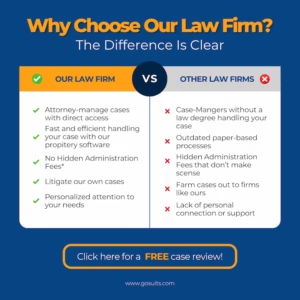
- Technology driven from start to finish. GoSuits uses exclusive proprietary software to streamline evidence collection, medical record retrieval, and claim valuation. This helps move cases faster while maintaining high quality documentation.
- Direct attorney access. Even though we leverage technology, every client has a designated attorney. We do not use case managers, and clients have unfettered access to their attorney for strategy and updates.
- Leadership in innovation. Our platform integrates claim analytics, comparative fault modeling informed by California authority including Li v. Yellow Cab [1], and insurer compliance tracking based on California claims regulations [5].
- Past results. See a selection of outcomes on our page for prior cases. Results depend on facts and law, and past outcomes do not guarantee similar results.
- Trial ready approach. Our attorneys prepare each matter as if it will be tried. This can improve negotiation posture and readiness for litigation if needed.
- Practice areas. We handle a range of civil injury cases including auto collisions, pedestrian and bicycle incidents, commercial vehicle crashes, premises injuries, product related injuries, and wrongful death. Explore our practice areas.
- Experience. Our team offers 30 years of combined experience handling investigations, negotiations, and trials in California courts.
- Meet the team. Learn more about our attorneys and our story on the about us page.
References and Resources
- Li v. Yellow Cab Co. of California 1975 comparative negligence decision – CourtListener
- Accident reporting and SR-1 financial responsibility resources – California DMV
- Collision reporting and traffic safety information – California Highway Patrol
- Official California Codes and Statutes – California Legislative Information
- Fair Claims Settlement Practices and consumer guidance – California Department of Insurance
- Civil case timelines and self help resources – California Courts
- Government Claims Program instructions and forms – California DGS ORIM
- Crash data and road safety guidance – National Highway Traffic Safety Administration
- Transportation safety and injury prevention – Centers for Disease Control and Prevention
- California traffic safety statistics and rankings – California Office of Traffic Safety
- Alternative dispute resolution and civil case resources – United States Courts
- Civil filing and local rules information – Orange County Superior Court
- Comparative negligence overview – Cornell Law School Legal Information Institute
- Legal definitions for negligence and damages – Dictionary.Law.com