- What is the Irvine injury evidence checklist and why does it matter?
- What photos should you take right after an accident in Irvine?
- How do you capture timestamped images and preserve metadata?
- What notes should you write in the hours and days after the incident?
- Which records strengthen a California personal injury claim?
- How do you gather witness statements and contact details safely?
- How do you obtain police reports in Irvine and what do they contain?
- How do you document property damage and repair estimates?
- What is chain of custody and how do you maintain it for civil cases?
- What is a spoliation letter and when should you send one?
- What deadlines apply under the California statute of limitations?
- How do insurance claims and litigation use your evidence?
- What mistakes should you avoid when building your evidence file?
- What local Irvine and Orange County resources can help you?
- How can a lawyer help you use this checklist effectively?
- Why consider GoSuits if you need help with a personal injury in Irvine?
- References and Resources
What is the Irvine injury evidence checklist and why does it matter?
Your evidence is the foundation of a personal injury claim. In Irvine and throughout California, photos, notes, and records help prove what happened, who is responsible, and the extent of your losses. Clear documentation can influence insurance evaluations and how a jury weighs your case. Recent national safety data shows tens of thousands of traffic deaths each year, underscoring how often sudden collisions disrupt lives and require careful documentation of injuries and damages [1].
This checklist summarizes what to collect after an incident in Irvine, CA. It covers photos, timestamped images, personal notes, medical records and bills, police reports, witness statements, and property damage documentation. It also explains chain of custody, spoliation letters, and key California timelines that can affect your rights [2][3].
What photos should you take right after an accident in Irvine?
If it is safe to do so, use your phone to capture the scene from multiple angles. Visual evidence helps reconstruct events and can support or challenge statements by drivers, pedestrians, or property owners. For traffic incidents near I 5, I 405, or local roads like Jamboree Road and Culver Drive, wide shots and close ups provide context.
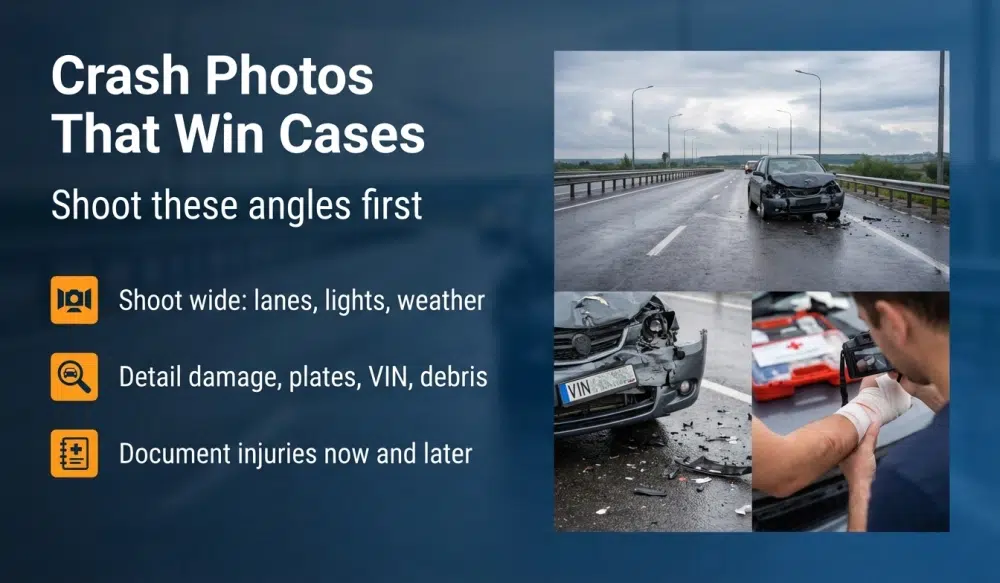
- Scene overview: Capture wide shots that show vehicle resting positions, traffic signals, signage, lane markings, crosswalks, lighting, and weather conditions. Include landmarks or street signs to anchor location.
- Vehicle and property damage: Photograph all sides of each vehicle, license plates, VIN plates visible through the windshield, and close ups of impact areas, debris, skid marks, and fluid spills. For premises incidents, photograph the hazard, lighting, warning signs, and floor or ground conditions.
- Injuries: Document visible injuries respectfully. Take initial photos and follow ups as swelling, bruising, or casts change over time. Photographs can help with later authentication if they fairly and accurately depict what they show [4][5].
- Environmental factors: Note obstructions, construction zones, lane closures, or temporary hazards. Irvine has active road work and bike lanes that can affect traffic flow.
- Emergency response: If first responders arrive, take photos of unit numbers, locations, and visible markings when safe. Do not interfere with emergency personnel.
When possible, video can add context such as traffic flow and sounds like horns or sirens. However, avoid posting images or video on social media. Preserve the originals for your claim or lawsuit.
How do you capture timestamped images and preserve metadata?
Most smartphones automatically embed EXIF metadata, which can include time, date, and GPS coordinates. This is helpful for establishing when and where a photo was taken. In court, you may authenticate a photo through testimony by the person who took it or by other evidence showing it is what it claims to be [4][5].
- Turn on location services: Enable location data in your camera settings before taking photos if you are comfortable sharing location for documentation. This may record GPS coordinates.
- Avoid altering originals: Do not edit or filter the original files. Save edited copies separately. Keep the originals stored in a secure folder. This supports authenticity and chain of custody.
- Use secure backups: Store photos in at least two places such as your phone and a reputable cloud service or external drive. Preserve file creation dates.
- Create a simple index: Keep a list with dates, times, brief descriptions, and who took the photo. Note any witnesses present when photos were taken.
Electronic evidence is a frequent focus in modern cases. Courts may address loss of digital evidence during litigation, and severe sanctions can follow if electronically stored information is destroyed after a duty to preserve arises [9].
What notes should you write in the hours and days after the incident?
Written notes help you capture details that are easy to forget. Record facts, not assumptions.
- Timeline: Write down the time and sequence of events as you recall them. Include your route, traffic or floor conditions, lighting, weather, speed estimates, and actions taken by others.
- Pain journal: Keep daily notes on pain levels, medication side effects, sleep changes, missed work or school, and activities you can no longer perform. This can support non economic damages and help your care team monitor progress.
- Contacts: List the names, phone numbers, and emails of witnesses, officers, adjusters, and repair shops. Include badge numbers and report numbers if provided.
- Expenses: Track out of pocket costs such as copays, rideshares to appointments, bandages, equipment, and over the counter medications.

Which records strengthen a California personal injury claim?
Medical documentation is central to proving injury and causation. California and federal rules give you rights to obtain and keep copies of your health records.
- Medical records: Request emergency room records, imaging, surgery reports, physical therapy notes, and follow up visits. You have a right to timely access to your own records, typically within 30 days, subject to limited exceptions [8].
- Medical bills: Keep itemized bills, explanations of benefits, pharmacy receipts, and equipment invoices. These demonstrate economic loss.
- Work records: Preserve pay stubs, sick leave logs, disability forms, and employer letters that reflect missed time and modified duties.
- Insurance communications: Save letters and emails from adjusters and providers. Keep a call log with dates and summaries.
- Repair estimates: Obtain written estimates and final invoices for vehicle or property repairs.
Organize records by category with a simple index. Accurate and complete records help opposing parties and courts understand your claim and can encourage fair resolution.
How do you gather witness statements and contact details safely?
Witnesses can be critical for clarifying what happened. If you are able at the scene:
- Collect contact information: Ask for full names, phone numbers, and emails. Many witnesses are willing to help if asked respectfully.
- Request brief statements: A short written statement or a voice memo can capture fresh recollections. Include date and time. Obtain permission before recording.
- Avoid leading questions: Let witnesses describe what they saw in their own words.
- Follow up promptly: Memories fade. A polite follow up message may help secure a final written statement.
Later in litigation, witness testimony and documents must be authenticated. Under federal and California rules, parties authenticate evidence through testimony or other proof that it is what it purports to be [4][5].
How do you obtain police reports in Irvine and what do they contain?
After a traffic collision in Irvine, a law enforcement agency such as the California Highway Patrol or the Irvine Police Department may prepare a collision report. If CHP handled your crash, you can request a copy through CHP procedures that describe who may obtain a report and how [6]. California law also requires drivers to report certain injury or death collisions to law enforcement within a specified time frame [7].
Police or collision reports often include:
- Party and vehicle information: Names, addresses, insurance, and vehicle details.
- Location and conditions: Roadway layout, traffic controls, weather, lighting, and diagrams.
- Narrative and preliminary findings: Statements from involved parties and witnesses, along with an officer’s observations.
- Citations: Notations of any cited violations.
These reports may contain hearsay and are not always admissible for the truth of statements. Still, they are valuable for investigation and settlement discussions. Your attorney can advise how best to use them alongside other evidence.
How do you document property damage and repair estimates?
Property damage proofs support the mechanism of injury and the financial impact of the incident.
- Photos and videos: Capture exterior and interior damage, airbags, car seats, and cargo. For premises incidents, photograph broken objects and fixtures.
- Repair shop materials: Keep written estimates, parts lists, and invoices. Ask the shop to store damaged parts if feasible so they can be inspected later.
- Appraisals: If the vehicle is totaled, retain the valuation report and any comparable listings used to determine value.
- Rental and loss of use: Save receipts for rentals and logs showing days without your vehicle.

What is chain of custody and how do you maintain it for civil cases?
Chain of custody is the documented history of where evidence has been and who had it. It increases credibility by showing the item presented in court is in substantially the same condition as when collected. Good chain practices help both sides and can reduce disputes.
- Log each transfer: Keep a simple log for physical items and digital media. Record dates, times, descriptions, who transferred and who received, and storage locations.
- Use secure storage: Store physical items in labeled containers and digital files in write protected folders when possible.
- Avoid unnecessary handling: Limit access to those who need it.
- Document condition: Photograph items when collected and at key stages to show no material changes.
Basic crime scene and evidence management guidance highlights the importance of documenting custody and preserving integrity. Although written for criminal investigations, those principles are commonly applied in civil litigation as well [12]. At trial, evidence must be authenticated by testimony or other proof that it is what the proponent claims it is [4][5].
What is a spoliation letter and when should you send one?
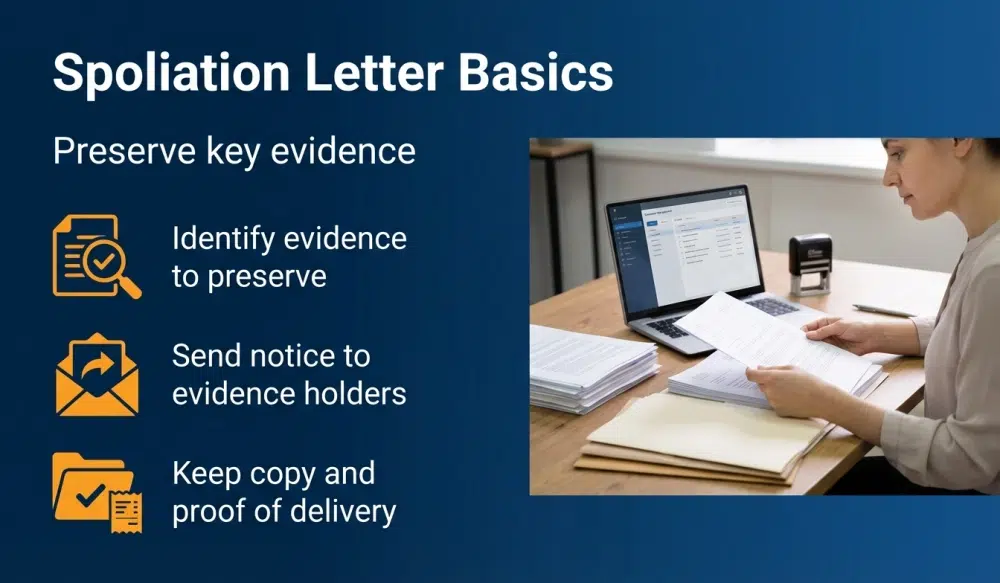
A spoliation letter is a written notice asking a person, business, or insurer to preserve relevant evidence. Send it promptly when you anticipate a claim. The letter should identify categories of evidence such as surveillance video, vehicle data, electronic communications, incident reports, and physical items. Keep a copy and proof of delivery.
Courts can respond to the loss of electronically stored information with measures ranging from additional discovery to jury instructions or other sanctions when evidence is destroyed after a duty to preserve arises [9]. In California civil cases, jurors may be instructed they can consider whether a party willfully suppressed evidence in evaluating the case [10]. California does not recognize a separate tort claim for spoliation by a party, but courts may impose sanctions or evidentiary consequences within the existing case [11].
What deadlines apply under the California statute of limitations?
California has specific filing deadlines for civil claims. Missing a deadline can bar your claim. For many personal injury claims, the general deadline is two years from the date of the injury [2][3]. Deadlines can be shorter for claims involving government entities and other special situations. Prompt documentation helps you and your attorney evaluate claims and file on time. The sooner you secure evidence, the less likely it is to be lost or overwritten.
How do insurance claims and litigation use your evidence?
Insurance adjusters assess liability and damages using the documents and media you provide. Clear photographs, consistent medical records, and independent witness statements can lead to more accurate evaluations. During litigation, admissible evidence must be authenticated. Under federal and California rules, testimony or other foundation is used to show an item is what it purports to be [4][5].
Comparative fault is often raised in California. Jurors may be instructed to assign responsibility among the parties based on the evidence presented [13]. That makes contemporaneous photos, notes, and records even more important, because they can counter arguments that you share a high percentage of fault.
What mistakes should you avoid when building your evidence file?
- Waiting to take photos: Conditions change quickly. Images taken days later can be challenged. Capture the scene as soon as it is safe.
- Editing or deleting originals: Keep original files. Create separate copies if you need to crop or enhance for clarity.
- Posting on social media: Public posts can be misunderstood and used against you later.
- Missing key records: Request all medical records and bills promptly. Confirm you receive complete sets.
- Not sending preservation notices: Consider a spoliation letter when another person or business controls critical evidence like surveillance video or vehicle data [9].
- Ignoring follow up care: Gaps in treatment can be used to argue that injuries resolved or were unrelated. Keep appointments and document reasons for any gaps.
What local Irvine and Orange County resources can help you?
Irvine collisions may involve response from the Irvine Police Department or the California Highway Patrol. For CHP investigated crashes, collision report requests follow CHP procedures [6]. Civil lawsuits arising from incidents in Irvine are typically filed in the Superior Court of California for Orange County, which provides public information about its civil divisions and filing processes [14].
If your injuries require ongoing care, keep a consistent record of appointments with local providers. Save discharge summaries and referrals. If imaging or therapy occurs across multiple clinics, request complete and certified copies where appropriate to avoid missing pages.
How can a lawyer help you use this checklist effectively?
Collecting evidence is only the first step. A lawyer can help preserve, authenticate, and present it in a way that meets court rules. Counsel can prepare spoliation letters, coordinate expert analysis when needed, and request records through proper channels. For vehicle collisions, lawyers also analyze crash dynamics, download vehicle data when available, and obtain surveillance video from businesses before it is overwritten [9].
For traffic cases in particular, car accident lawyers often coordinate with investigators to secure measurements, diagrams, and photographs that match the standards used by insurers and courts. If you are comparing options, Irvine car accident lawyers can help align your photos, notes, and records with California rules of evidence and local court practices [4][5][14].
If your claim proceeds to litigation, counsel can authenticate photos under the federal or California rules, obtain medical and billing records as business records, and prepare witnesses to testify about what they saw. Building a strong file early helps both settlement negotiations and trial preparation.
You may see the phrase car accident lawyers used across many sites. When you consult, ask how the firm will organize and present your photos, notes, and records, what preservation steps will be taken, and how they approach comparative fault arguments in California [13].

Why consider GoSuits if you need help with a personal injury in Irvine?
If you are navigating injuries after an incident in Irvine, we invite you to consider a free consultation to review your photos, notes, and records and to discuss next steps that fit your situation. GoSuits represents clients in personal injury matters across California, including Orange County and Irvine. Learn more about about us and meet our attorneys.
GoSuits uses a technology driven approach supported by exclusive proprietary software that streamlines evidence intake, organizes medical records and bills, and surfaces critical facts faster. While we leverage technology to accelerate timelines, you will work directly with a designated attorney. We do not route clients through case managers. Every client has direct access to their lawyer from day one.
Our team has more than 30 years of combined experience across negotiation, motion practice, and jury trials. Trial readiness often improves outcomes because opponents understand that we prepare each claim with a courtroom mindset. You can review a sample of our past work and results in prior cases, explore our practice areas, and learn more about the attorneys who will handle your case at our attorneys.
In a consultation, we can walk through your evidence file, identify gaps, and outline how preservation letters, formal record requests, and chain of custody can strengthen your case. We will explain timelines that apply in California and strategies for presenting your photos, notes, and records in a way that aligns with court rules and local Orange County practices.
References and Resources
- Traffic Fatalities 2022 Estimates and Updates – National Highway Traffic Safety Administration
- Statutes of Limitations in Civil Cases – California Courts
- California Code of Civil Procedure Section 335.1 – California Legislative Information
- Federal Rule of Evidence 901 Authentication – Legal Information Institute
- California Evidence Code Section 1400 Authentication of Writings – California Legislative Information
- How Do I Obtain a Copy of a Collision Report – California Highway Patrol
- California Vehicle Code Section 20008 Duty to Report Accidents – California Legislative Information
- Right to Access Your Health Records – US Department of Health and Human Services
- Federal Rule of Civil Procedure 37 Electronically Stored Information – Legal Information Institute
- CACI 204 Willful Suppression of Evidence – California Courts
- Cedars Sinai Medical Center v. Superior Court – CourtListener
- Crime Scene Investigation A Guide for Law Enforcement – National Institute of Justice
- CACI 405 Comparative Fault of Plaintiff – California Courts
- Civil Division Information – Superior Court of California County of Orange