- What is a wrongful death claim in Irvine, CA, and who can bring it?
- What evidence should you save at the scene after a fatal crash in Irvine?
- How do you preserve EDR black box data and onboard telematics?
- How can you obtain police and coroner records in Irvine and Orange County?
- Which documents and records should families secure in the first weeks?
- How are surveillance videos and third-party digital evidence preserved?
- What are the California deadlines for wrongful death and claims against public entities?
- How do you prove damages in a California wrongful death case?
- What should you do in the first 72 hours after a fatal accident in Irvine?
- What are the common preservation pitfalls and spoliation risks?
- How do insurance and carrier investigations affect the evidence you need?
- How can a lawyer help you preserve, collect, and present critical proof?
- Why consider GoSuits for an Irvine wrongful death matter?
- References and Resources
What is a wrongful death claim in Irvine, CA, and who can bring it?
In California, a wrongful death claim is a civil lawsuit brought when a person’s death is caused by the wrongful act or neglect of another. Eligible family members and representatives may seek compensation for losses that arise from the death, including financial support and the loss of the relationship. California law identifies who can file, generally including a surviving spouse, domestic partner, children, and in some circumstances dependent relatives, as set out in the California Code of Civil Procedure [2]. These claims are distinct from criminal cases and proceed under civil rules in Orange County Superior Court or federal court, depending on the circumstances.
The statute of limitations for most California wrongful death claims is two years from the date of death, per Code of Civil Procedure section 335.1 [1]. Certain cases, such as those involving public entities like a city or county, require an administrative claim within six months before filing suit, governed by the Government Claims Act [15]. Families in Irvine, CA should consider speaking with Irvine wrongful death attorneys early to map out deadlines, identify liable parties, and start preservation of critical evidence while it is still available.
California also allows a related type of claim called a survival action, which is brought by the decedent’s estate for certain harms the decedent suffered before passing. Damages in survival actions are limited by Code of Civil Procedure section 377.34, which governs what can be recovered by the estate [3]. A single case can include both wrongful death claims by family members and a survival claim by the estate, and the evidence needed for each can differ. The California Courts Self Help guide offers a plain-language overview of wrongful death and related topics that can help you understand the basics before you talk with a lawyer [5].
What evidence should you save at the scene after a fatal crash in Irvine?
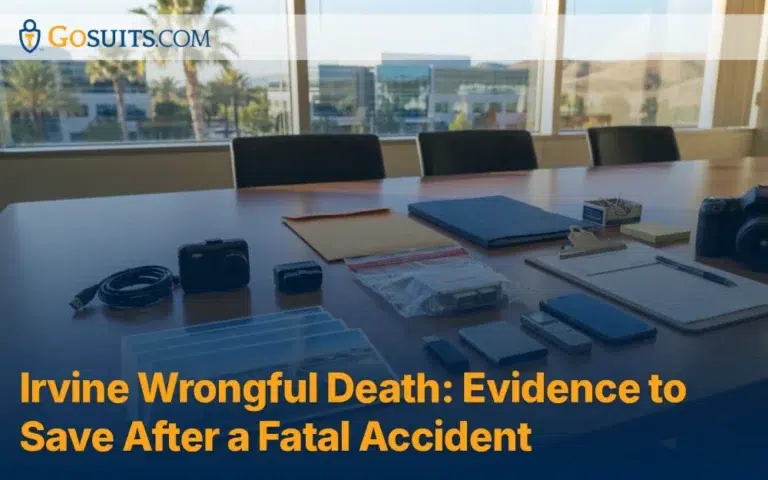
When a fatal crash occurs, physical and digital traces can disappear within hours or days. If you are physically able and it is safe, or if you have a trusted person helping you, focus on preserving the following:
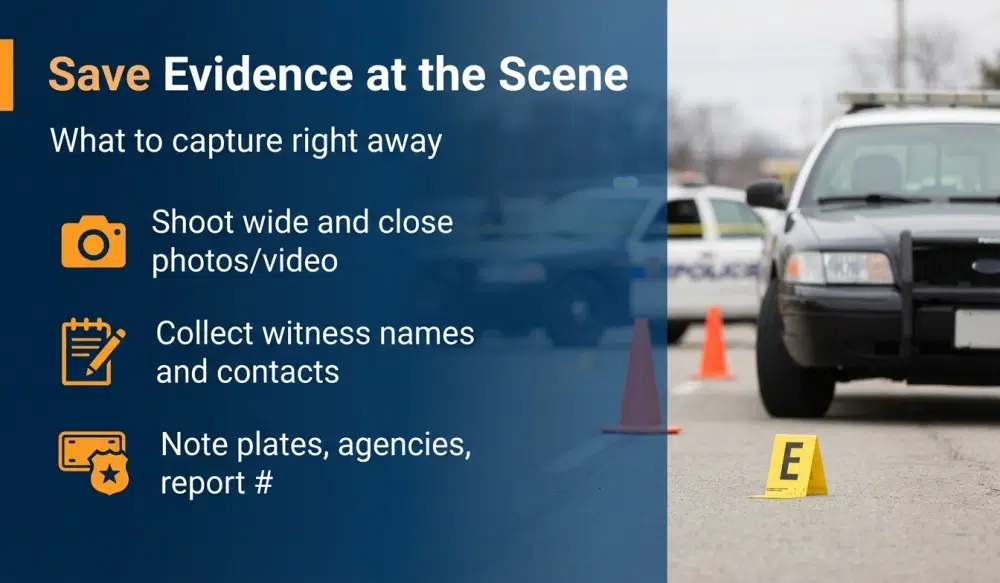
- Scene photos and video capturing final rest positions, skid marks, debris fields, lane markings, traffic control devices, and weather and lighting. Photograph from multiple angles and distances.
- Witness information including names, phone numbers, and email addresses. Ask nearby drivers, pedestrians, cyclists, and business staff if they saw or heard anything.
- License plates and vehicle details for all involved vehicles, including commercial trailers and tow vehicles. Note DOT numbers if a commercial truck is involved.
- Traffic signal timing and signage in the area, and any temporary construction or road closures.
- Immediate environment such as vegetation, sightlines, glare, road surface conditions, and construction equipment placement.
- First-responder details including agencies and report numbers. If Irvine Police Department responds, note the report number for later records requests.
These initial steps support later accident reconstruction. Even when police investigate, civil claims often require additional proof because the burden and scope of civil liability differ from criminal or traffic enforcement standards. Families should avoid moving vehicles or debris unless required for safety. If vehicles must be moved, document their positions first.
How do you preserve EDR black box data and onboard telematics?
Many vehicles contain Event Data Recorders, commonly called EDRs or black boxes. EDRs can record pre-crash speed, throttle, brake, and airbag deployment, among other data. The National Highway Traffic Safety Administration provides guidance on EDRs and data elements under 49 CFR Part 563 [6]. In California, Vehicle Code section 9951 governs ownership and access to EDR data, generally requiring owner consent, a court order, or specific law enforcement conditions to retrieve it [7]. The federal Driver Privacy Act further recognizes the vehicle owner as the EDR data owner, subject to limited exceptions, which is consistent with California’s approach [6].
EDR and telematics data can be overwritten by later driving or depleted if a vehicle’s battery is disconnected for too long. Rapid preservation is essential. In practice, counsel often sends a preservation letter to the owner, insurer, and any storage facility to prevent vehicle disposal or data loss. In federal courts, electronically stored information such as EDR data is protected by spoliation rules that can lead to sanctions if a party fails to take reasonable steps to preserve it after litigation is reasonably anticipated, as outlined in Federal Rule of Civil Procedure 37(e) [8]. California courts apply similar preservation principles under state discovery rules and evidentiary instructions that allow adverse inferences for willful suppression of evidence [4]. Early legal help can coordinate a neutral download by a qualified technician and maintain chain of custody records for later authentication.
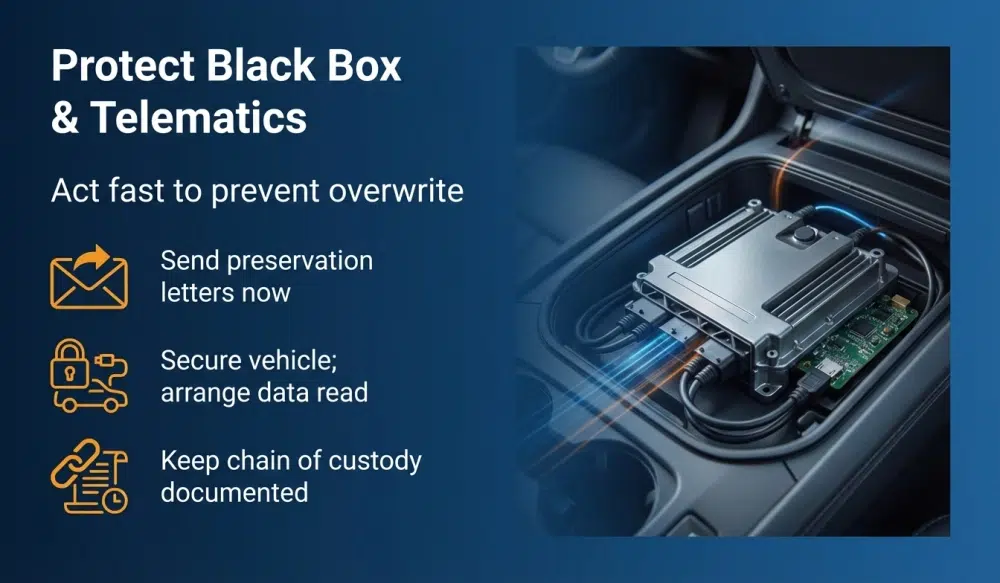
Other in-vehicle and third-party data sources can be equally important, including:
- Telematics and infotainment for GPS routes, call logs, and device pairings.
- Commercial fleet systems that log speed, hard braking, hours of service, and engine codes.
- Ride-hailing and delivery apps that track trip data and dispatch communications.
How can you obtain police and coroner records in Irvine and Orange County?
Police and coroner records provide official documentation that can support civil claims. In Irvine, traffic collision and incident reports can be requested through the Irvine Police Department Records unit, subject to privacy and eligibility rules [13]. California Vehicle Code section 20012 regulates who may obtain traffic collision reports and under what conditions, typically limiting access to involved parties, their representatives, and certain insurers [10].
The Orange County Sheriff-Coroner investigates many deaths in the county. Families can request coroner reports, autopsy findings, and tox screens as available under local policies and state law [14]. Processing times vary. Some materials may be withheld during active investigations. For public records that are not exempt, California’s Public Records Act requires agencies to respond within set timelines and to provide disclosable records or explain applicable exemptions [11].
When a fatal crash involves a public vehicle, roadway condition, or city-owned camera, you may need both a Public Records Act request and a timely Government Claims Act filing. Public entity deadlines are shorter than the general statute of limitations, so coordinating requests and claims together can protect your rights [15].
Which documents and records should families secure in the first weeks?
In the weeks following a fatal crash, families can gather documents that later help quantify damages and connect the facts. Consider the following:
- Medical and end-of-life records including emergency response notes, hospital summaries, and coroner reports when available [14].
- Employment and income documents such as pay stubs, tax returns, W-2s or 1099s, and employer benefit summaries.
- Financial dependency proof including shared bills, childcare costs, and caregiving schedules.
- Photographs and videos illustrating the family’s relationship, major life events, and the decedent’s daily routines.
- Insurance policies for all vehicles involved, as well as any applicable umbrella or commercial coverage.
- DMV filings including the required SR-1 report of a traffic collision resulting in injury or death, which must be submitted to the DMV within 10 days when applicable [9].
Organize all records by date, source, and type. Maintain an index, and keep a simple chain of custody log for items you receive from agencies or third parties. Good organization saves time and reduces the risk of missing deadlines.
How are surveillance videos and third-party digital evidence preserved?
Surveillance and traffic-adjacent videos can be decisive, yet many systems automatically overwrite data after a short retention period. Families and counsel typically send prompt preservation notices to businesses, homeowners’ associations, property managers, and transportation agencies to request retention of any footage that may show the incident or traffic conditions around the time of the crash. California’s Public Records Act can be used to request city- or county-held videos that are not exempt, subject to statutory response and disclosure rules [11].
When requesting third-party footage, include the exact date, time window, and camera location if known. If you can identify the system vendor, noting the likely retention policy can underscore the urgency. If an entity declines to preserve, a court order may be appropriate. Courts have authority to impose remedies when a party fails to preserve electronically stored information in anticipation of litigation, under rules like Federal Rule of Civil Procedure 37(e) in federal cases [8], and California law allows juries to consider willful suppression of evidence when evaluating credibility and inferences [4].

What are the California deadlines for wrongful death and claims against public entities?
Deadlines are critical in wrongful death litigation:
- General wrongful death deadline: Two years from the date of death under Code of Civil Procedure section 335.1 [1].
- Government Claims Act filing: Written claim within six months of the date of death when suing a public entity, per Government Code section 911.2, with limited exceptions [15].
- Survival action and damages constraints: Recovery by the estate is controlled by section 377.34 of the Code of Civil Procedure [3].
Some deadlines can be tolled in limited circumstances, but courts strictly apply these rules. If a claim is not filed on time, courts can dismiss the case, so calendaring these dates early is essential.
How do you prove damages in a California wrongful death case?
Wrongful death damages compensate the family for financial and relational losses caused by the death. California law and Judicial Council guidance describe the main categories, including the value of financial support the decedent would have contributed, loss of services and household support, and noneconomic losses such as the loss of love, companionship, and guidance. The California Courts Self Help resource provides an accessible overview of these concepts [5]. The estate’s survival claim, if any, is governed by Code of Civil Procedure section 377.34, which controls the damages available to the estate separate from the family’s wrongful death damages [3].
Evidence often used to prove damages includes:
- Worklife and earnings projections from a vocational expert and economist based on work history, career trajectory, benefits, and tax considerations.
- Household services valuations for childcare, eldercare, home maintenance, and transportation the decedent provided.
- Relationship proof such as messages, photos, and witness statements that show companionship and guidance.
- Benefits and retirement records including employer-sponsored plans and Social Security statements.
- Health and lifespan evidence where appropriate to project likely duration of support.
Nationwide data provide context for the scale of traffic fatalities and the importance of civil accountability. NHTSA estimates that 40,990 people died in motor vehicle traffic crashes in 2023, a slight decline from 2022, with an estimated fatality rate of 1.26 deaths per 100 million vehicle miles traveled [12]. While each case turns on its facts, these statistics underscore why thorough documentation and analysis matter.
What should you do in the first 72 hours after a fatal accident in Irvine?
Families face overwhelming decisions immediately after a loss. To protect your rights and preserve proof, consider the following steps:
- Secure the vehicles by locating where they are towed or stored, and ask that no repairs or salvage occur until inspections and downloads are arranged.
- Send preservation notices to potential defendants, insurers, storage facilities, and nearby businesses to protect EDR data, scene evidence, and surveillance videos.
- Request official report numbers from Irvine Police Department and obtain directions for collision report requests through the Records unit [13]. If the California Highway Patrol responded, note that access rules are set by law [10].
- Identify public cameras and records and prepare a timely Public Records Act request to the City of Irvine or other agencies for non-exempt public records [11].
- File DMV paperwork such as the SR-1 report when required within 10 days [9].
- Begin a document binder with contact lists, medical and coroner communications, funeral bills, and all correspondence.
- Avoid posting details online that might be misinterpreted or used out of context by insurers or defense attorneys.
It is natural to feel pressure to make quick decisions, but gathering information and preserving data in these first days has a long-lasting impact on the strength of a civil claim.
What are the common preservation pitfalls and spoliation risks?
Evidence spoliation occurs when relevant evidence is lost or destroyed when litigation is reasonably anticipated. Some common pitfalls include:
- Automatic overwrites of surveillance cameras and vehicle data, which can occur within days.
- Vehicle disposal or repairs by tow yards or insurers before inspections or downloads are completed.
- Digital data deletion on phones, apps, or cloud accounts that are not promptly preserved.
- Incomplete chain of custody that makes authentication and admissibility more difficult.
Courts can address spoliation in several ways. In federal court, if electronically stored information is lost because a party failed to take reasonable steps to preserve it, and it cannot be restored or replaced, the court may order measures no greater than necessary to cure the prejudice, and in some circumstances may give an adverse inference instruction or impose case-dispositive sanctions under Rule 37(e) [8]. In California courts, jurors may consider the willful suppression of evidence when evaluating the evidence [4]. These principles make it important for all parties to take prompt, reasonable steps to preserve relevant materials once they anticipate litigation.
How do insurance and carrier investigations affect the evidence you need?
Insurers often launch parallel investigations within days of a fatal crash. If a commercial vehicle or rideshare is involved, there may be sophisticated telematics, driver-facing cameras, and maintenance systems that capture critical operational data. From the claimant’s perspective, a well-drafted preservation letter should identify:
- Specific data classes such as EDR snapshots, telematics driver scorecards, dash camera video, dispatch logs, and maintenance records.
- Time windows before and after the crash for GPS breadcrumbs and communications.
- Storage locations including in-vehicle modules, cloud platforms, and vendor servers.
Where a public entity is a potential defendant, the Government Claims Act claim must be timely to preserve your right to sue, and discovery thereafter can address what systems are in place and how data are maintained [15]. Remember that collision reports are subject to access rules under California Vehicle Code section 20012 and agency-specific procedures [10][13].
How can a lawyer help you preserve, collect, and present critical proof?
Civil wrongful death cases demand fast action, coordinated requests, and clear documentation. A lawyer can take the lead on:
- Immediate preservation by sending litigation hold letters, scheduling vehicle inspections, and coordinating EDR downloads that comply with California Vehicle Code 9951 and applicable federal privacy rules [7][6].
- Public records requests that meet California Public Records Act timelines and seek disclosable records without overbreadth [11].
- Discovery and motions to obtain third-party data and to address spoliation or adverse inference instructions if evidence was not preserved [8][4].
- Damages development through economists, vocational experts, and structured witness presentations consistent with California wrongful death standards [5][3].
If fees and costs are a concern, ask about contingency arrangements and cost advancement so that necessary inspections and expert work can proceed without delay. A careful plan helps keep the record complete and credible for settlement discussions and trial.
When searching for guidance, avoid broad promises and focus on teams who communicate clearly and document each step. In complex matters with overlapping public and private defendants, wrongful death attorneys in Irvine can coordinate multi-agency requests, crash reconstruction, and timely filings under California’s rules [1][15].
What about privacy when retrieving EDR data from a decedent’s vehicle?
California law treats EDR data as owned by the vehicle owner, and access typically requires consent, a court order, or law enforcement authority under specific conditions. California Vehicle Code section 9951 governs access, while NHTSA’s guidance explains EDR data elements and the federal Driver Privacy Act context [7][6]. In practice, courts can resolve disputes over access, especially when multiple parties claim an interest in the vehicle or its data.
How do you request a police report with Irvine PD?
Irvine Police Department’s Records unit provides information about requesting collision and incident reports, subject to eligibility rules and state law [13][10]. If the CHP handled the scene, you would request the CHP collision report through their process, and the same Vehicle Code section controls who may receive it [10]. Keep the report number, date, time, location, and involved party information handy to speed the request.
Do you need to file anything with the DMV after a fatal crash?
California requires an SR-1 report to the DMV within 10 days for collisions involving injury or death, regardless of fault, in most circumstances. The DMV provides the form and instructions online [9]. Filing the SR-1 is separate from insurance claims and lawsuits.
What do current traffic fatality statistics tell us about risk?
NHTSA’s preliminary 2023 estimate reports 40,990 traffic deaths nationwide and a decrease in the fatality rate to 1.26 per 100 million vehicle miles traveled, which represents a 3.6 percent decline in deaths from 2022 [12]. Even with improvement, the volume remains high. In any single case, the immediate preservation of data and careful documentation can be the difference between a clear liability picture and an uncertain one.
What practical checklists help you preserve evidence after a fatal accident?
Use targeted checklists to keep your efforts focused:
- Scene and vehicle: Photos, video, measurements, vehicle positions, skid marks, debris, and contact information for responders and witnesses.
- Digital sources: EDR, telematics, dash cameras, rideshare logs, GPS breadcrumbs, phone records, and app time stamps.
- Public records: Police reports, coroner findings, traffic signal timing charts, sign plans, and maintenance logs.
- Third-party data: Nearby business cameras, HOA gate cameras, transit buses, and private security feeds.
- Damages documentation: Employment files, benefits data, tax returns, household services logs, and family statements.
Share these checklists with your legal team so that assignments are clear. One person can track deadlines, one can manage records requests, and another can coordinate with tow yards, storage facilities, and inspection vendors.
What communication tips reduce friction and protect your case?
Clear, respectful communication can help you get what you need without unnecessary conflict:
- Be specific about date ranges, locations, and camera identifiers in letters and requests.
- Confirm in writing and ask recipients to acknowledge holds and retention steps taken.
- Follow lawful channels for records, honoring privacy statutes and agency policies.
- Keep copies of all correspondence, proof of delivery, and any written agreements.
When disputes arise, your correspondence becomes part of the record the court will see when deciding preservation issues and discovery motions [8].
What local Irvine and Orange County factors matter for evidence preservation?
Irvine’s mix of residential communities, business parks, university zones, and arterial roadways means there are often multiple potential video sources within the crash area. Private business parks and HOAs commonly deploy cameras at entrances and along internal roads. City traffic management cameras may exist but can be subject to exemptions or time-limited retention. Early Public Records Act requests and targeted private preservation letters can capture perishable footage [11][13].
The Orange County Sheriff-Coroner’s office handles many death investigations countywide. Coordinating with the coroner for reports and the release of property can help unify the medical and factual record early in the process [14]. If a roadway defect or public vehicle is implicated, the six-month Government Claims Act deadline is critical to keep your legal options open [15].
How do wrongful death claims differ from survival actions in evidence needs?
Wrongful death focuses on the family’s losses, while a survival action belongs to the estate and addresses the decedent’s own claims. Evidence for wrongful death emphasizes dependency, household services, and the relationship, while a survival action often centers on medical, pain and suffering parameters as authorized by statute, and economic losses before death, all governed by Code of Civil Procedure section 377.34 [3]. This distinction affects which experts are retained and which documents are prioritized. Coordinating both paths under one litigation plan helps avoid gaps and duplication.
How does early evidence preservation influence settlement and trial?
Preservation strengthens negotiations and trial presentation:
- Early clarity about vehicle speeds, signal timing, and sightlines sharpens liability arguments.
- Reliable chains of custody improve admissibility and reduce motion practice.
- Complete damages files support credible, well-documented economic and noneconomic requests.
- Documented preservation efforts deter spoliation and support remedies if it occurs [8][4].
Defendants evaluate risk based on the quality and completeness of the record. Well-preserved EDR snapshots, synchronized videos, and clear timelines often lead to more focused negotiations.
When should you seek legal help for an Irvine wrongful death claim?
It is prudent to reach out promptly so that legal holds can go out within days, vehicles can be secured, and clock-sensitive requests can be made to public agencies and private entities. The two-year statute and six-month public entity claim deadline mean that waiting can foreclose options [1][15]. Early counsel involvement can also help families avoid unhelpful interactions with adjusters and opposing investigators while they are grieving.
In serious cases, wrongful death attorneys can coordinate investigators, reconstruction engineers, and medical and economic experts, while maintaining a respectful, organized approach that prioritizes your family’s needs and privacy.
Why consider GoSuits for an Irvine wrongful death matter?
If you lost a loved one in a fatal crash in Irvine, CA, you deserve clear guidance and focused action. A free, confidential consultation can help you understand timelines, what evidence to preserve, and how claims work in California civil courts. GoSuits practices throughout California, including Orange County, and helps families navigate wrongful death, catastrophic injury, and complex motor vehicle cases.
- Technology-driven casework: We leverage exclusive proprietary software to accelerate evidence preservation, track records requests, and organize discovery for faster, higher-quality results.
- Leadership in innovation: Our litigation platform integrates EDR downloads, surveillance video logs, subpoena calendars, and deposition timelines in one environment for strategic clarity.
- Attorney access: Although we use technology to move quickly, every client has a designated attorney, not a case manager, with direct, unfettered access for updates and strategy.
- Trial experience: We prepare every case with trial in mind, which strengthens negotiations and keeps the evidence presentation sharp.
- Proven results: See our track record in complex injury and wrongful death matters at prior cases.
- Who we are: Learn about our team at our attorneys and about us.
- Practice coverage: Explore our practice areas, including wrongful death, motor vehicle cases, premises liability, and product liability.
- Experience: Our lawyers bring 30 years of combined experience handling contested liability, complex damages, and multi-party litigation.
We meet families where they are, move quickly to preserve evidence, and build organized files that are ready for mediation and trial. If you want to talk through a plan for your loved one’s case, we are here to help.
References and Resources
- Code of Civil Procedure § 335.1 Statute of Limitations for Personal Injury and Wrongful Death – California Legislative Information
- Code of Civil Procedure § 377.60 Wrongful Death Plaintiffs – California Legislative Information
- Code of Civil Procedure § 377.34 Survival Action Damages – California Legislative Information
- Evidence Code § 413 Inferences from Willful Suppression of Evidence – California Legislative Information
- Wrongful Death Overview – California Courts Self Help
- Event Data Recorders and Driver Privacy Act Overview – National Highway Traffic Safety Administration
- Vehicle Code § 9951 Event Data Recorder Ownership and Access – California Legislative Information
- Federal Rule of Civil Procedure 37 Electronically Stored Information and Sanctions – Cornell Law School LII
- SR-1 Report of Traffic Accident Resulting in Injury or Death – California DMV
- Vehicle Code § 20012 Access to Accident Reports – California Legislative Information
- Government Code § 7922.530 Public Records Act Response Deadlines – California Legislative Information
- 2023 Traffic Fatality Estimates – National Highway Traffic Safety Administration
- Records Unit and Report Requests – City of Irvine Police Department
- Coroner Division Information and Report Requests – Orange County Sheriff-Coroner
- Government Code § 911.2 Government Claims Act Deadline – California Legislative Information