- What makes Irvine UPS delivery truck crashes unique and which laws apply?
- What immediate steps should you take after an Irvine UPS delivery accident to protect evidence?
- What evidence belongs on an Irvine UPS delivery truck accident evidence checklist?
- How do you preserve ELD, telematics, and company records before they are deleted?
- How do California negligence and comparative fault rules affect your claim?
- How should you work with insurers and UPS claims administrators in a commercial vehicle accident?
- What Irvine specific steps help you gather local proof and official reports?
- How long do you have to file suit and who can access the police report and records?
- When should you contact legal help and how can attorneys strengthen your evidence?
- Why choose GoSuits if you were hurt in an Irvine UPS delivery truck crash?
- References and Resources
What makes Irvine UPS delivery truck crashes unique and which laws apply?
Delivery truck collisions in Irvine involve both California negligence rules and federal motor carrier safety regulations. UPS vehicles are commercial motor carriers that must follow federal hours of service and electronic logging requirements intended to limit fatigue and document driver activity. These rules reside in federal regulations that govern drivers duty limits, rest breaks, log data, and carrier recordkeeping [1] [2]. Carriers must also keep an accident register and provide assistance in investigations, which can be crucial for your evidence plan [3]. Because UPS is an interstate carrier, minimum liability coverage amounts are set by federal law, affecting claim strategy and avenues for recovery [4].
California law provides the framework for proving negligence. You must show duty, breach, causation, and damages. California uses pure comparative negligence, which means a jury can assign percentages of responsibility to each party and reduce damages by your share of fault. The California Supreme Court adopted comparative fault in a leading case that remains the foundation for these apportionment rules [13].
Large truck crashes are a public safety concern. National data show thousands of fatalities in crashes involving large trucks each year. In the most recent national fact sheet, fatalities in crashes involving large trucks rose compared with earlier years, highlighting why a structured evidence approach matters for both plaintiffs and defendants [11] [12].
What immediate steps should you take after an Irvine UPS delivery accident to protect evidence?
When a crash happens, time sensitive evidence begins to disappear. Your first moves should prioritize safety, documentation, and preservation.
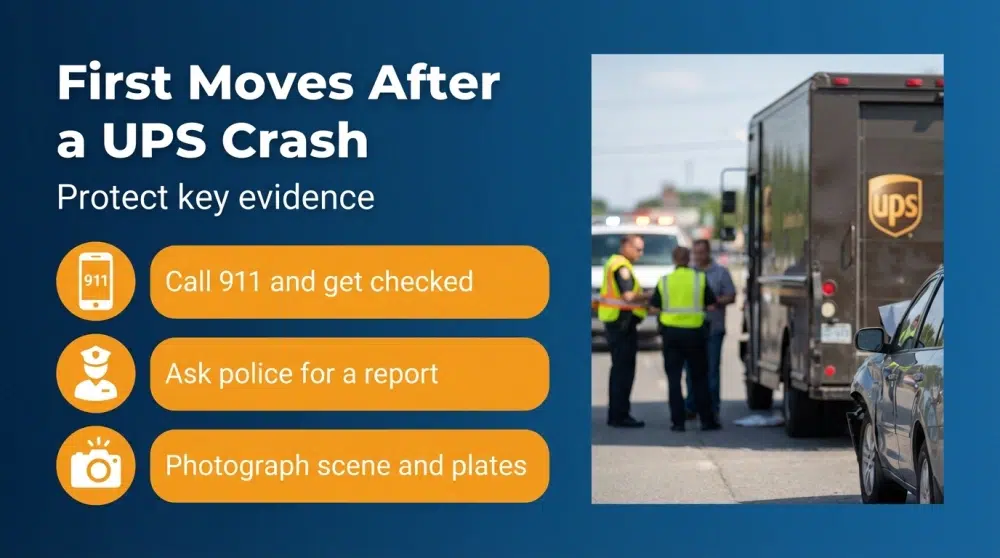
- Call 911 and request medical evaluation. Prompt care protects your health and creates contemporaneous medical records that later substantiate injury and causation.
- Ask for police response and a collision report. A police report records locations, parties, vehicles, and initial observations, which can anchor later testimony and claims.
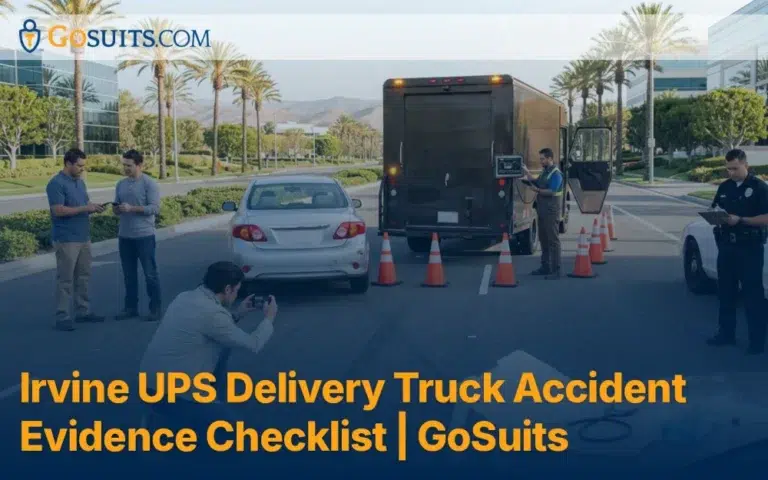
- Photograph the entire scene. Capture wide views, all vehicles, license plates, road surface conditions, skid or yaw marks, traffic control devices, debris fields, and any cargo spills. Photograph from multiple angles and distances.
- Record contact details. Get names, phone numbers, and emails for all drivers, passengers, and witnesses. Document the UPS truck number and any unit identifiers on the tractor, trailer, or step van.
- Note cameras and sensors visible nearby. Identify intersection cameras, business security cameras, residential doorbell cameras, and traffic monitoring devices. Prompt requests can prevent routine overwrites.
- Preserve your own data. Save dashcam video, mobile photos, telematics screenshots, and location history. Back up files with timestamps intact to maintain authenticity.
- Do not discuss fault at the scene. Provide factual information to officers and medical personnel but avoid speculative or apologetic statements that can be misinterpreted later.
- Notify your insurer. Provide notice as required by your policy while avoiding detailed recorded statements until you have guidance.
What evidence belongs on an Irvine UPS delivery truck accident evidence checklist?
Below is a comprehensive evidence checklist tailored to a UPS delivery vehicle crash. Use it to keep your investigation organized and to support both liability and damages analysis.
What scene documentation should you gather immediately?
- Scene photos and video. Take comprehensive images and clips of vehicles, surroundings, traffic controls, lane markings, signage, and environmental conditions such as lighting and weather. Include close ups of impact points and wide shots showing relative positions.
- Measurements and mapping. When possible, measure skid lengths, debris distribution, and resting positions. Save precise locations using phone GPS coordinates. Later, a reconstructionist can correlate these with physical laws.
- Witness statements. Collect brief written or audio recorded accounts. Ask what the witness saw, where they were located, and whether they observed speed, lane departures, or phone use. Obtain consent for any recorded statements.
How do you document vehicles and property damage?
- Vehicle identification. Photograph VIN plates, DOT numbers, fleet numbers, and license plates. This ties your evidence to specific units and helps locate maintenance and telematics records.
- Damage profiles. Capture close ups of crush, intrusion, wheel positions, lights, and tire conditions. For the UPS vehicle, photograph any exterior cameras or sensors that may have recorded the incident.
- Property losses. Catalog damage to barriers, landscaping, and personal property inside your vehicle. Save receipts and repair estimates to build a property claim file.

What official records should you request early?
- Police collision report. Obtain the report number at the scene and request the final report and any supplemental narratives once available. Police reports often include diagrams and statements that frame the facts.
- DMV accident reporting confirmation. California requires reporting certain collisions to the DMV, and the SR 1 process can generate additional identifiers and insurance information [13].
- 911 audio and CAD logs. Emergency calls and dispatch logs can confirm timing, road conditions, and initial observations from callers and responders. Request these quickly because many agencies purge audio on short cycles.
How should you handle dashcam, phone, and bystander video?
- Your dashcam and mobile media. Download and duplicate immediately to preserve metadata. Keep an original copy in read only storage. Authentication later relies on demonstrating an unbroken chain of custody and reliability of the process used to collect and store the media [9] [10].
- Third party videos. Politely ask nearby businesses or residents to save their footage. Provide the date and exact time window. If needed, send a preservation request the same day to prevent routine overwriting.
What carrier and driver documents can be critical in a UPS case?
- Electronic Logging Device data. ELD records reflect duty status, driving periods, location pings, and edits, which may show fatigue risks or violations. Carriers must keep records of duty status and supporting documents for a set retention period [2].
- Hours of service compliance. Compare driver logs to federal limits on daily driving, on duty windows, and required breaks. Patterns of violations can support a theory of negligence or negligent supervision [1].
- Accident register and investigative materials. Carriers must maintain an accident register with specific data points and are obligated to assist with investigations, making this a key early discovery target [3].
- Vehicle inspection and maintenance records. Maintenance schedules, defect reports, brake inspections, and tire replacement logs can support or refute mechanical failure theories.
- Driver qualification and training. A driver qualification file can include licensing, road tests, medical certifications, and training records. These materials help evaluate standard of care and hiring practices.
- Load, route, and dispatch records. Bills of lading, route plans, stop counts, delivery windows, and messages can reveal time pressure and routing issues that may contribute to risk.
- Telematics and speed data. Many fleets capture real time speed, harsh braking, cornering, and stability control events. Secure the raw data and any exception reports.
Which medical records matter for proving injury and causation?
- Emergency department and imaging. Initial triage notes, CT or MRI results, and physician narratives establish the mechanism of injury and early symptoms.
- Primary care and specialist follow up. Ongoing notes, treatment plans, and objective testing create a timeline of harm and recovery.
- Right of access to records. Federal regulations give you rights to obtain copies of your medical records within specific timeframes, which supports thorough documentation [8].
How do you establish wage loss and economic damages?
- Employment verification. Letters from an employer confirming missed work, role, schedule, and pay rate support wage loss claims.
- Pay stubs and tax records. These help quantify past earnings and establish a baseline for loss calculations.
- Self employment documentation. Provide invoices, profit and loss statements, and bank statements to show lost revenue and net income impact.

What is the best way to track non economic impacts?
- Daily symptoms and function journal. Note pain levels, sleep quality, mobility limits, and missed activities. This contemporaneous record can be persuasive when evaluating non economic harms.
- Family and caregiver notes. Observations from those assisting you can corroborate the extent of impairment.
How do you maintain chain of custody and authenticate evidence?
- Evidence log. Create a simple log that lists each item, date created, who collected it, and storage location. Keep unaltered originals and work from copies.
- Authentication standards. Trials require showing that an item is what you claim it is. Rules of evidence describe how to authenticate writings, recordings, and digital files. Federal and California rules align on the need for testimony and process evidence to support authenticity [9] [10].
How do you preserve ELD, telematics, and company records before they are deleted?
Many critical commercial records are subject to routine deletion. Carriers may overwrite ELD data and telematics dashboards after a limited window, and federal rules only require retention of certain logs for set periods. For example, records of duty status and supporting documents must be kept for a minimum period measured in months, not years [2]. The accident register, however, has longer retention requirements [3].
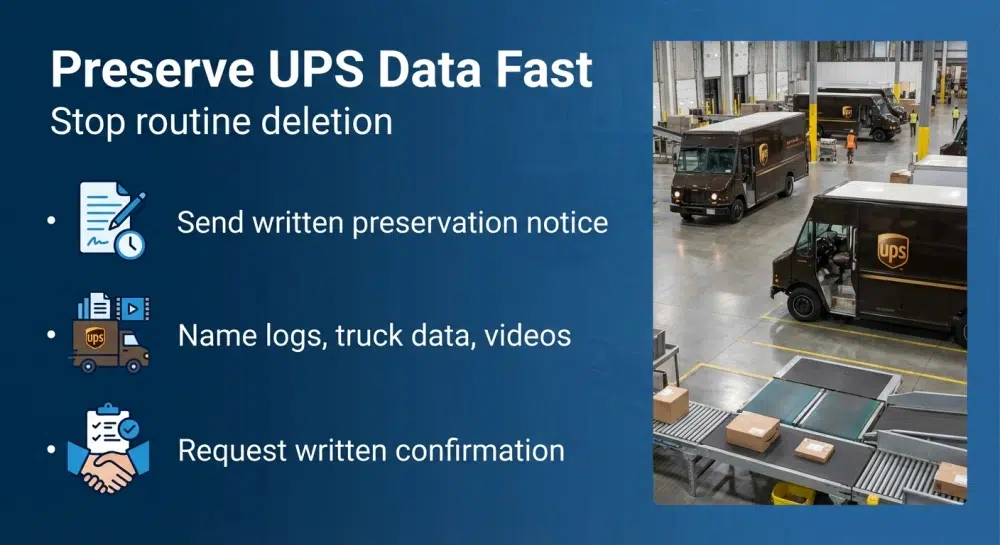
Send a written preservation notice to UPS and any third parties with relevant data as soon as possible. The notice should identify the incident date, vehicles, locations, and categories of evidence to preserve. Ask that routine deletion, alteration, or recycling be suspended for ELD data, telematics, route and dispatch records, driver qualification and training records, maintenance files, company dashcam video, third party camera footage, and 911 or dispatch recordings.
- Explain legal hold triggers. Once litigation is reasonably anticipated, parties must act to preserve relevant evidence. Courts can impose remedies if electronically stored information is lost because a party failed to take reasonable steps [8].
- Cite adverse inference and sanctions principles. California law authorizes sanctions for discovery misuse, and juries may draw inferences from willful suppression of evidence. Citing these standards can encourage cooperation when seeking preservation commitments [6] [7].
- Request confirmation. Ask for written confirmation of the hold and the specific systems involved. Document all communications and follow up regularly.
- Pursue early discovery if needed. If preservation is uncertain, seek early discovery or court intervention to secure time sensitive data before it disappears.
How do California negligence and comparative fault rules affect your claim?
California negligence law requires proof of duty, breach, causation, and damages. In a UPS delivery crash, potential breaches can include speed violations, following too closely, unsafe turns, improper backing, or operating while fatigued. Federal hours of service and ELD records provide objective data points to test for rule compliance and fatigue risks [1] [2].
Comparative fault allows a jury to apportion responsibility between the UPS driver, the company, other motorists, and you. California applies pure comparative negligence, adopted by the state supreme court, so even if you share responsibility, you may still recover a portion of your losses equal to the other parties percentage of fault [13].
Evidence tied to causation often becomes the center of disputes. Telematics, braking data, road conditions, sight lines, and driver attentiveness can shift allocated percentages. Clear documentation and independent corroboration give fact finders confidence in your position.
How should you work with insurers and UPS claims administrators in a commercial vehicle accident?
Commercial carriers operate under federal financial responsibility rules with higher minimum coverage than typical personal auto policies. Depending on vehicle weight and cargo, minimum limits can be significant, which changes how claims are evaluated and resolved [4].
- Expect rapid contact. Commercial insurers often reach out quickly. Be polite and factual but cautious with recorded statements. Early statements may be used to limit your claim.
- Build a complete demand package. Include medical records and bills, wage loss support, repair estimates, photos, and a clear narrative tying evidence to liability and damages.
- Use objective data. Reference ELD logs, telematics, and accident register entries where available. Objective time stamps and location points strengthen your position [2] [3].
- Anticipate comparative fault arguments. Insurers may argue shared fault to reduce payouts. Evidence completeness helps counter these arguments under California comparative negligence principles [13].
For many families, navigating a commercial claim is unfamiliar and stressful. Irvine truck accident lawyers can coordinate preservation efforts, structure discovery requests, and present your case using records that commercial carriers are already required to maintain.
What Irvine specific steps help you gather local proof and official reports?
- Identify the investigating agency. Crashes within Irvine may be handled by the Irvine Police Department or the California Highway Patrol, depending on the location and roadway. Record the report number and the officer name on scene.
- Request the final report promptly. Follow the agency process to obtain the report once it is approved. Ask about supplemental narratives, diagrams, and photographs captured by officers.
- Complete required DMV reporting if applicable. California law requires reporting certain crashes to the DMV within a short period. The SR 1 process contains instructions and helps capture insurance information for all parties [13].
- Canvas for private cameras within days. Many Irvine businesses and residences use security cameras that overwrite within days. A timely, polite request often preserves valuable footage.
- Document roadway conditions unique to the area. Note construction zones, school zones, bike lanes, and delivery heavy complexes. These contextual details often appear in surveillance video and can explain driver decision making.
How long do you have to file suit and who can access the police report and records?
California generally provides a two year statute of limitations for personal injury actions, measured from the date of the incident. Certain claims, such as those against public entities, may involve earlier presentment deadlines, so do not wait to evaluate timelines [5].
Access to police reports typically depends on agency policy and applicable disclosure laws. In most cases, parties to the crash, their insurers, and their representatives can obtain copies once the report is approved. Separate requests are often needed for 911 recordings or dispatch logs. For medical records, federal rules give you a right of access to your own records, subject to limited exceptions, which supports timely claim development [8].
When should you contact legal help and how can attorneys strengthen your evidence?
Commercial vehicle claims move fast. Fleet telematics and third party videos can be overwritten quickly, and early contact from insurers may pressure you into statements before the full picture is known. Engaging counsel early helps you send preservation notices, structure requests for carrier records, and coordinate experts who can analyze ELD logs, maintenance histories, and scene evidence grounded in federal and California rules [1] [2] [3].
Attorneys can also help you avoid common pitfalls, such as gaps in treatment or incomplete documentation of wage loss. A well built file with authenticated records, clear chain of custody, and objective data points can influence negotiations and trial outcomes under the authentication standards used by courts [9] [10]. With many moving parts, truck accident lawyers provide structure and momentum as you focus on recovery.
If you prefer a local team that understands Orange County roads and courts, Irvine truck accident lawyers can manage preservation, subpoenas, and expert analysis while keeping you informed at every step.

Why choose GoSuits if you were hurt in an Irvine UPS delivery truck crash?
At GoSuits, our practice is aligned with injury claims that arise from commercial vehicle collisions, including UPS delivery truck crashes in Irvine, CA and across California. We provide free consultations so you can understand your options and how a focused evidence plan protects your rights.
- Technology driven approach. We developed exclusive proprietary software to accelerate evidence collection, track deadlines, and surface key patterns in telematics and medical data for faster and better results.
- Designated attorneys for every client. Although we use technology to expedite the case, every client has direct access to their attorney. We do not use case managers to shield communication.
- Proven results. Our past work includes significant outcomes for injured clients in transportation cases. You can review a selection of prior cases that illustrate our approach and commitment.
- Leadership in innovation. We combine litigation experience with modern tools to move cases with clarity and speed, from preservation letters to trial exhibits.
- Trial ready mindset. Commercial carriers respond to well prepared cases. Our team has tried cases to verdict, which strengthens negotiations and provides leverage when needed.
- Breadth of practice areas. We handle personal injury, including trucking, motor vehicle, and wrongful death, as well as other select civil matters. Explore our full practice areas to see where your case fits.
- Experience you can count on. We bring 30 years of combined experience to each case, applying courtroom skills and data driven analysis.
- Transparent team. Get to know our attorneys and learn more about us.
If you were involved in a UPS delivery crash, organized documentation is the foundation of a strong civil claim. With structured processes, truck accident lawyers can turn complex records into a clear narrative that addresses liability, causation, and damages.
References and Resources
- Hours of Service of Drivers, 49 CFR Part 395 – eCFR
- Driver Records of Duty Status and Retention, 49 CFR 395.8 – eCFR
- Accident Register and Assistance in Investigations, 49 CFR 390.15 – eCFR
- Minimum Levels of Financial Responsibility, 49 CFR 387.9 – eCFR
- California Code of Civil Procedure Section 335.1 – California Legislative Information
- California Evidence Code Section 413 – California Legislative Information
- California Code of Civil Procedure Section 2023.030 – California Legislative Information
- Federal Rule of Civil Procedure 37(e) ESI Sanctions – Legal Information Institute
- Federal Rule of Evidence 901 Authentication – Legal Information Institute
- California Evidence Code Section 1400 – California Legislative Information
- Traffic Safety Facts 2022 Data Large Trucks – NHTSA
- Large Truck and Bus Crash Facts 2021 – FMCSA
- Li v. Yellow Cab Co. of California, 13 Cal.3d 804 – SCOCAL Stanford Law School
- Accident Reporting and SR 1 Requirements – California DMV