- What counts as a commercial vehicle in Irvine CA and why does it matter?
- What immediate steps should you take after a commercial vehicle crash in Irvine?
- What core evidence belongs on your Irvine commercial vehicle crash checklist?
- How do you secure electronic data like EDR black box GPS and dashcams?
- How do police reports and government records help in Irvine?
- What do federal and California laws require that creates evidence you can request?
- How do you document the scene measurements skid marks debris and road conditions?
- How should you handle witnesses and statements without hurting your case?
- How do you preserve medical records and billing and prove damages?
- What is a preservation letter and how does California handle spoliation?
- What timelines affect evidence in California civil cases?
- Why choose GoSuits for an Irvine commercial vehicle crash and how do we work with you?
- References and resources
What counts as a commercial vehicle in Irvine CA and why does it matter?
In everyday conversation, many people say truck or bus, but in a legal claim a commercial vehicle can include a tractor trailer semi, straight truck, delivery van, utility truck, passenger bus, charter coach, shuttle, and some rideshare or contractor vehicles when used in business operations. The category matters because the rules that govern the driver and the company are often stricter than those for private motorists. Federal Motor Carrier Safety Administration regulations can require driver qualification files, hours of service logs, electronic logging device data, and maintenance records that do not exist in regular car cases [1] [12] [3]. Those records can help prove who is at fault and how serious the collision forces were.
NHTSA and FMCSA publish national safety data showing that crashes involving large trucks and buses result in thousands of fatalities and many more injuries each year. These national statistics underscore how high the stakes can be in a commercial vehicle case and why a careful evidence plan is so important [5] [6].
What immediate steps should you take after a commercial vehicle crash in Irvine?
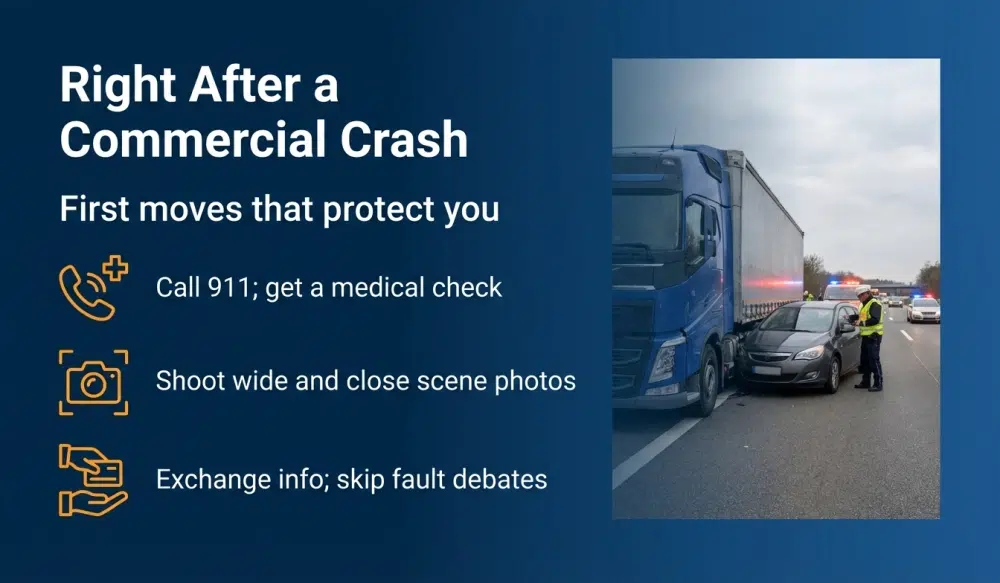
Should you call 911 and request police response?
Yes. Reporting the collision helps create an official record that can later be retrieved. In California, drivers involved in injury or death crashes have reporting duties to law enforcement and to the DMV under specific circumstances, and these records can be important during claims [7] [8]. If safe, ask for medical evaluation at the scene. Even if you feel okay, some injuries become apparent later.
What should you photograph or record before vehicles move?
When safe to do so, capture wide and close photos of vehicle positions, damage points, license plates, DOT or CA carrier numbers on the truck, trailer unit numbers, skid and yaw marks, gouges, fluid trails, debris fields, the roadway surface, traffic control devices, construction zones, and any visible cameras. Short phone videos that pan the entire scene can help a reconstruction later. If the collision occurred near freeway ramps or major arterials in Irvine, note any Caltrans camera poles or sensors you can see so counsel can request retention quickly [10].
Should you speak with the commercial driver or company representative?
Exchange identification and insurance only. Do not argue fault at the scene. If the trucking company sends a safety manager or adjuster to the site, you are not required to give a recorded statement to them at that time. Collect the driver’s name, employer, DOT number, trailer number, and bill of lading identifier if visible. Make a note if the driver appears fatigued or distracted so that counsel can later evaluate hours of service and cellphone use [1].
What core evidence belongs on your Irvine commercial vehicle crash checklist?
What vehicle and electronic records are key for trucks and buses?
- EDR or electronic control module data: Many heavy vehicles record speed, throttle, brake, and fault codes around a critical event. Preserve through a formal request and a neutral download protocol [11].
- ELD and hours of service logs: Required for most interstate carriers, these show drive time, duty status changes, and location pings. Federal rules also require certain retention periods [12] [2].
- GPS and telematics: Fleet systems often track location, hard braking, speed, and camera triggers. These can corroborate timelines and maneuvers.
- Dashcam and external surveillance video: Many commercial units have forward and driver facing cameras. Nearby businesses, buses, or traffic cameras may also have footage. Act promptly to request retention [10].
What paper or digital company records matter?
- Driver qualification file: Training, road tests, prior violations, and medical certifications when applicable [1].
- Maintenance and inspection records: Pre trip and post trip inspections, repair orders, annual inspections, and defect reports [3].
- Bills of lading and dispatch data: Cargo weight, loading point, special handling instructions, and route plans. Carriers must retain specified shipping records under federal preservation schedules [4].
- Company safety policies and training materials: Cellphone use, fatigue management, and speed monitoring policies can be relevant to liability.
What personal evidence should you secure immediately?
- Scene photos and measurements: Include landmarks so later investigators can scale distances.
- Witness information: Names, phones, emails, and a short note of what they saw.
- Medical records and billing: Save hospital discharge summaries, imaging reports, therapy plans, and mileage to appointments.
- Employment records for wage loss: Pay stubs and employer verification letters.
If you are looking for immediate guidance on who can organize this work, experienced Irvine truck accident lawyers can coordinate scene investigators, download protocols, and formal preservation notices while you focus on recovery.
How do you secure electronic data like EDR black box GPS and dashcams?
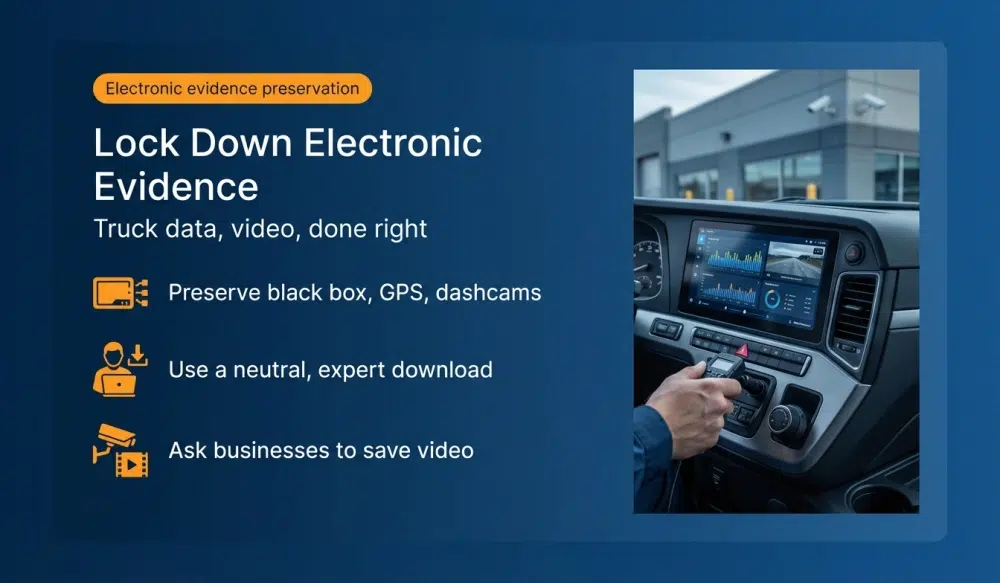
Is an EDR the same as an ELD or ECM?
Not exactly. An event data recorder is a crash related system defined for light vehicles by NHTSA and conceptually similar modules exist in many heavy trucks. An electronic logging device records driver hours of service and duty status for regulatory compliance. An engine control module stores engine performance and fault codes. All of these can be relevant and must be preserved promptly [11] [12].

Who should perform the download and what is the process?
Downloads are typically done by qualified technicians with proprietary tools. In contested cases, a joint protocol is often used so both sides can observe, document chain of custody, and avoid altering the data. Courts look favorably on cooperation that preserves accurate evidence for both parties. Where a truck is drivable, some data overwrites with ignition cycles or after a limited number of key hours, so early letters and agreements are important.
How long do carriers have to keep driver logs and telematics data?
Federal rules require carriers to retain certain records, including ELD records and supporting documents, for at least six months in many cases, with back up systems and privacy safeguards for location data [2] [12]. Other categories, like records of inspection and maintenance, have their own retention periods, often one year or longer at the maintenance location and for a period after a vehicle leaves the fleet [3]. Separate preservation schedules apply to shipping and financial documents [4].
What about business and traffic cameras in Irvine?
Retention practices vary widely. Many convenience stores and offices overwrite footage in as little as 7 to 30 days. Public camera feeds like Caltrans QuickMap can document traffic conditions and lane closures but are not continuously stored for individual claims. Prompt written requests can help secure copies before they are lost [10].
How do police reports and government records help in Irvine?
Where do you get an Irvine Police Department collision report?
For crashes investigated by Irvine Police Department, collision reports are generally available through the department’s records process after processing times. The IPD website explains how to request a copy and what information you will need to provide [9]. Crashes on state routes within Irvine may be investigated by the California Highway Patrol, and those reports are requested directly from CHP once ready.
Do you also need to file with the DMV?
Yes, California requires an SR 1 report to the DMV within ten days if anyone was injured or if property damage meets the statutory threshold, even if law enforcement took a report. This is a separate responsibility and failing to file can affect driving privileges [8].
What driver reporting duties apply after injury crashes?
California law requires drivers involved in injury or death collisions to report to local police or CHP within a specified period if a peace officer was not present at the scene. This is separate from an insurance report and from the DMV SR 1 requirement [7].
What do federal and California laws require that creates evidence you can request?
How do hours of service rules create discoverable records?
Drivers operating commercial motor vehicles subject to federal jurisdiction must follow hours of service limits that regulate maximum driving time, required rest breaks, and weekly duty cycles. Carriers are required to monitor compliance using ELD data and supporting documents such as fuel receipts, bills of lading, and dispatch logs. These records can show fatigue risks and route choices [1] [12] [4].
How do inspection and maintenance rules create a trail?
Federal maintenance rules require systematic inspection repair and maintenance programs, defect reporting by drivers, and periodic inspections. Documentation of these activities must be retained and made available for review. If a brake or tire issue is involved, this paper trail can be critical to liability and comparative fault analysis [3].
What other regulatory sources matter in bus and delivery cases?
Beyond federal rules, California Vehicle Code provisions govern reporting duties, phone use, and special operations. For example, California has strict rules against handheld device use while driving. While the exact code section varies by context, phone use policies, dispatch messages, and call logs are routinely requested to evaluate distraction in commercial driving [7].
How do you document the scene measurements skid marks debris and road conditions?
Why do skid marks and debris matter in a commercial vehicle case?
Skid length and type can indicate speed, perception reaction, and braking effort. Debris patterns and fluid trails help pinpoint impact location and orientation. In a truck or bus case, stopping distance is affected by gross vehicle weight, brake condition, grade, and load balance, so preserving this evidence early is vital. A reconstruction may also use EDR data to cross check measured distances [11].
How should you measure and map the scene?
Use reference points like lane stripes, crosswalks, gore points, and fixed objects. Measure with a tape or laser if available. Capture photos from multiple heights. If law enforcement conducts a scene diagram, obtain it with the report. When collisions occur near Irvine freeways, note ramp geometry and signage. Where possible, request that a qualified investigator revisit quickly before weather or traffic wear removes marks.
What role do road and traffic conditions play?
Temporary hazards like lane closures, signal outages, or debris can influence fault. Caltrans QuickMap can confirm planned lane closures or incidents at a time near the crash, supporting what you observed on scene [10].
How should you handle witnesses and statements without hurting your case?
What is the best way to collect witness information?
Ask for names, phone numbers, and emails. A short neutral note of what they observed is helpful. Avoid coaching or debating what happened. Timely follow up preserves memory while it is fresh.
Should you give recorded statements to insurers right away?
Be cautious. Statements can be used later and inconsistencies can be exploited. It is reasonable to wait until you have spoken with counsel who can coordinate timing and scope so the record is accurate and complete. Defendants and insurers likewise benefit from a structured process that captures all relevant facts without confusion.
How do you avoid contamination of testimony?
Share only essential information on social media and avoid posting about the crash. Defense counsel may request your public posts during discovery. Witness independence can be important to credibility in Irvine civil courts.
How do you preserve medical records and billing and prove damages?
What medical documentation should you save?
Keep emergency department records, imaging, consult notes, prescriptions, therapy notes, durable medical equipment receipts, and mileage to appointments. Organized records help show the trajectory from injury to recovery and the reasonableness of care. Providers in the United States must safeguard patient privacy under federal rules and can release records with proper authorization forms [13].
How do you connect medical evidence to crash forces?
In a commercial vehicle case, impact forces can be substantial, and documentation like EDR speed change, photos of crush profiles, and occupant kinematics notes from first responders can connect mechanism to injury. Defense counsel may seek prior records to evaluate preexisting conditions, so be prepared to distinguish old from new symptoms.
How should you approach billing and liens?
Collect itemized bills, explanation of benefits, and any lien notices. In complex cases involving health plans or workers compensation, counsel can help align the records so damages are presented clearly with appropriate offsets.
What is a preservation letter and how does California handle spoliation?
What is a spoliation or preservation letter?
It is a written notice sent to a carrier, broker, shipper, maintenance vendor, and sometimes nearby businesses advising them to preserve specific categories of evidence such as EDR downloads, ELD data, GPS, dashcam footage, inspection records, bills of lading, and cellphone logs. The letter identifies the collision date and unit numbers and requests a litigation hold so routine deletion or overwriting does not destroy relevant data.
What happens if electronic data is lost?
In federal courts, Rule 37 addresses remedies when electronically stored information is lost if a party failed to take reasonable steps to preserve it and the information cannot be restored or replaced through additional discovery. Courts can impose measures ranging from additional discovery to adverse inference instructions or other sanctions in severe cases [13].
What does California allow if evidence is destroyed?
California permits courts to impose discovery sanctions for misuse of the discovery process and recognizes jury instructions that allow an inference against a party who willfully suppresses evidence. California does not recognize a separate tort claim for intentional third party spoliation, but trial courts can address spoliation within the case through sanctions and instructions [14] [15].
What timelines affect evidence in California civil cases?
How soon should you request dashcam and surveillance video?
Immediately. Many systems overwrite within a few days or weeks. A formal preservation letter should identify each camera likely to have captured the event and offer to arrange prompt copying. Quick action is often the difference between having a clear view of the crash and no video at all.
How long are ELD and maintenance records kept?
Many ELD records and supporting documents must be preserved for at least six months under federal rules, with backup processes. Maintenance and inspection records have separate and sometimes longer retention periods, and shipping records follow federal preservation schedules. Knowing these periods guides the scope and timing of your requests [2] [3] [4].
What civil deadlines affect your claim?
Personal injury claims in California generally must be filed within a limited period, and claims against government entities have shorter pre suit requirements. Evidence work should not wait for those deadlines because many categories of data will be gone long before a lawsuit is filed. Prompt consultation with counsel allows time to send preservation notices, coordinate downloads, and retain neutral experts.
Why choose GoSuits for an Irvine commercial vehicle crash and how do we work with you?
You deserve a team that meets you where you are after a serious collision. If your case involves a truck bus or delivery vehicle in Irvine or anywhere in California, we can help you understand the evidence that matters and the steps to protect it. A free consultation lets us review your situation, outline the Irvine commercial vehicle crash evidence checklist, and explain what we can do next together.
- Where we practice: We handle personal injury matters across California including Orange County and Irvine, and we evaluate select cases in other jurisdictions with local counsel where appropriate.
- Technology focused approach: Our team uses secure digital tools to track ELD retention windows, schedule EDR downloads, and organize documents from providers so your case moves forward without delay.
- Exclusive proprietary software: We built our own case acceleration platform that flags time sensitive evidence like dashcam or store video, automates preservation letters, and aligns experts faster for better results.
- Leadership in innovation: We combine traditional litigation skills with data analytics that illuminate speed, location, and driver behavior patterns from telematics and logs.
- Dedicated attorneys for every client: Although we rely on technology to expedite your matter, you will work directly with a designated attorney from start to finish. We do not hand off your case to case managers. You will have direct access to your lawyer for updates and strategy.
- Past results: We have obtained significant outcomes for clients in complex transportation cases. See a sampling of our work here prior cases.
- Trial experience: We prepare every case as if it will be tried to a verdict. That discipline helps us evaluate liability and damages realistically and present evidence with clarity.
- Practice areas and experience: Our practice includes trucking, bus, and delivery collisions, motorcycle and pedestrian injuries, serious car crashes, product liability, and wrongful death. We bring more than 30 years of combined experience to each case. Learn more about our attorneys, our about us page, and our full list of practice areas.
If you want to talk through your Irvine commercial vehicle crash evidence checklist or have questions about police reports, hours of service logs, dashcam or Caltrans footage, or EDR downloads, we are ready to help you plan the next steps.
References and resources
- Summary of Hours of Service Regulations – FMCSA
- 49 CFR 395.8 Record of duty status and retention – eCFR
- 49 CFR Part 396 Inspection repair and maintenance – eCFR
- 49 CFR Part 379 Preservation of Records – eCFR
- Large Trucks Safety Overview – NHTSA
- Large Truck and Bus Crash Facts – FMCSA
- California Vehicle Code section 20008 – California Legislature
- Accident Reporting Requirements SR 1 – California DMV
- Traffic Collision Reports – Irvine Police Department
- QuickMap Cameras and Traffic – Caltrans
- Event Data Recorders Overview – NHTSA
- Electronic Logging Devices Program – FMCSA
- Federal Rule of Civil Procedure 37 – Legal Information Institute
- Code of Civil Procedure section 2023.030 – California Legislature
- Cedars Sinai Medical Center v Superior Court – CourtListener