- What injury symptoms should you watch for in the first 48 hours after an Irvine crash?
- Which delayed injury symptoms often appear after a collision?
- When should you see a doctor after a crash in Irvine?
- How should you document injuries, and why does it matter in California claims?
- What should you do at the scene and within 48 hours to protect your health and claim?
- How do California rules on fault and deadlines affect your case?
- How can defendants and insurers challenge early symptom claims, and how do plaintiffs respond?
- What local Irvine and Orange County resources can help you get reports and records?
- What common mistakes should you avoid in the first 48 hours?
- How is pain and suffering proven using early symptom evidence in California?
- How can GoSuits help after an Irvine collision?
What injury symptoms should you watch for in the first 48 hours after an Irvine crash?
If you were just in a collision in Irvine, CA, the first two days are often the most revealing. Many conditions become obvious right away, while others build over hours as inflammation and brain or soft tissue responses progress. Because people commonly minimize discomfort after a stressful event, it helps to know the specific warning signs that research and public health agencies highlight for the first day or two after a crash [1] [2] [3].
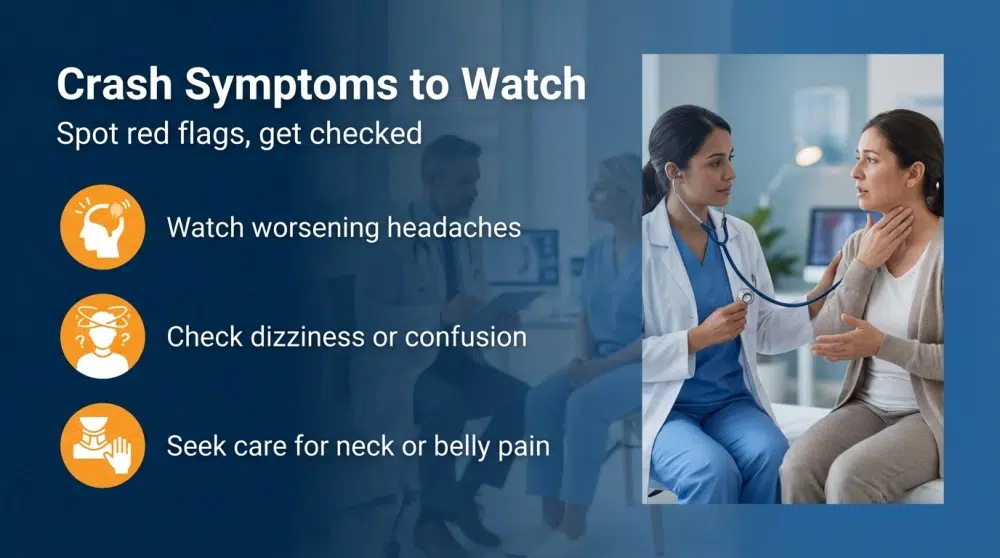
- Headache that does not go away or worsens: You may feel a dull or throbbing headache soon after impact, sometimes growing worse over the next day. Persistent or severe headache can indicate concussion or other head injury, and calls for prompt medical evaluation [1].
- Dizziness, confusion, or feeling foggy: Disorientation, trouble concentrating, or feeling slowed are classic concussion indicators. These may start immediately, or emerge hours later as brain swelling evolves [1].
- Nausea or vomiting: One or more episodes can follow a head impact. Worsening nausea or repeated vomiting is a red flag that should be addressed quickly [1].
- Neck pain and stiffness: Whiplash involves rapid flexion and extension of the neck. You may notice soreness, limited range of motion, or muscle spasm within hours to the next morning as soft tissues react [2].
- Back or shoulder pain: Soft tissue strain and facet joint irritation often present in the first 48 hours. Pain can radiate to shoulders, or down the back, sometimes accompanied by tingling if nerves are irritated [3].
- Bruising and swelling: Deep bruises may not be visible at the scene, and can blossom over 24 to 48 hours. Watch for expanding bruises and increasing swelling in the torso or limbs [3].
- Abdominal pain or deep tenderness: Even seat belt restraint can cause abdominal trauma. Pain that is steady or worsening, or paired with lightheadedness, can suggest internal injury and warrants immediate care [4].
- Fatigue and sleep disturbance: Feeling unusually tired, having trouble falling asleep, or sleeping more than normal are frequently reported after concussive injuries and stress responses [1].
- Changes in vision, or sensitivity to light or noise: These are frequent after head injury, and may show up later the same day or the next morning [1].
- Numbness or tingling: Pins and needles in the arms or legs can result from cervical strain or nerve involvement, and should be documented and checked by a clinician [2].
Carrying a simple symptom journal during this period can make a real difference. Short notes that record time, location, severity, and triggers help your doctor track the clinical picture, and provide evidence if a claim arises later [14].
Which delayed injury symptoms often appear after a collision?
Not every injury appears at the scene. Crash injuries can be delayed because adrenaline initially masks pain, or because inflammation and microtrauma evolve over a day or two. Recognizing common delayed signs can prompt you to act before they become emergencies [1] [2] [3].
- Whiplash pain peaking the next day: Many people feel neck pain peak 24 to 48 hours after the collision. Stiffness, headaches starting at the base of the skull, and shoulder blade pain are often reported [2].
- Concussion symptoms emerging overnight: Dizziness, memory glitches, irritability, or unusual sleepiness may appear hours after impact. Any worsening neurologic sign should lead to prompt evaluation [1].
- Deep bruising and hidden bleeding: Large bruises, especially on the abdomen or flank, can indicate deeper injury. Internal bleeding can present as weakness, faintness, or abdominal pain that intensifies over time [4].
- Back spasms and radiating pain: Lumbar strain and soft tissue injuries in the back can tighten over hours. Pain that radiates down a leg or arm, or changes with coughing or sneezing, merits medical attention [3].
- Jaw pain and ear ringing: Temporomandibular joint irritation or tinnitus can follow even low speed impacts, and may not be noticed until the next day [3].
It is common to want to wait and see. Still, delaying care can make symptoms worse, and can create gaps in medical documentation that insurers later argue undermine causation. Even if you think it is minor, consider an early evaluation and follow the treatment plan your clinician recommends [1] [15].
When should you see a doctor after a crash in Irvine?
Public health guidance stresses that you should seek medical evaluation as soon as possible if you experience concerning symptoms, particularly any sign of head injury. A same day or next day visit is prudent when you have headache, confusion, neck pain, abdominal tenderness, or numbness. The CDC’s concussion program lists specific danger signs that should never be ignored, including worsening headache, repeated vomiting, unusual behavior, slurred speech, weakness, seizures, or loss of consciousness [1].
Emergency care is well suited for severe or rapidly worsening symptoms. For milder symptoms, urgent care or a primary physician can evaluate, document, and set a care plan. Accurate, time stamped records from the first 48 hours establish a baseline that helps clinicians and, if needed, supports legal claims by tying symptoms to the collision date [14] [15].
How should you document injuries, and why does it matter in California claims?
Documentation ties your symptoms to the crash, which can be decisive in a California injury claim. In comparative fault states like California, you can still be compensated even if you are partly at fault, but you will need clear evidence that the crash caused your injuries and losses [10].
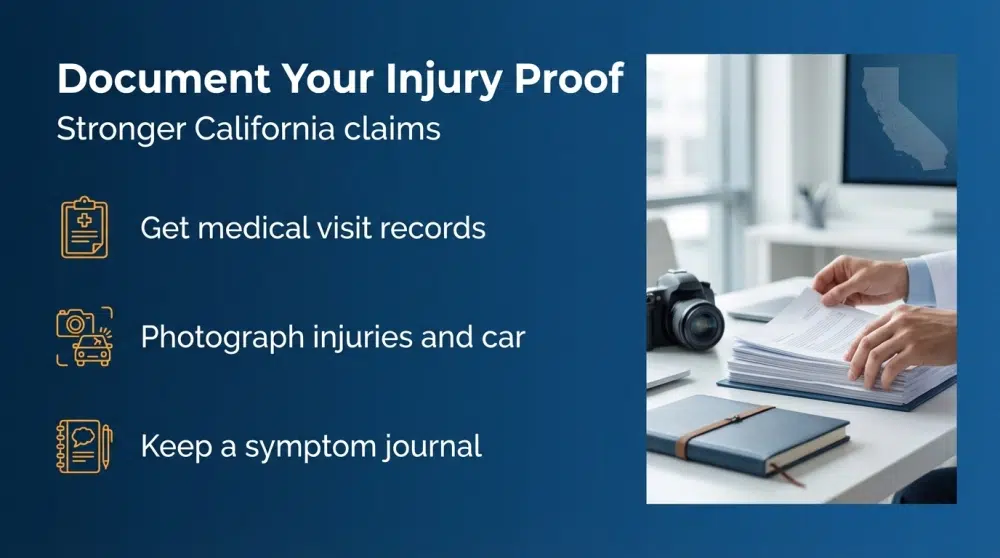
- Get medical records early: Ask for your visit summaries, imaging reports, prescriptions, and discharge instructions. These contemporaneous records carry particular weight because they are created in the ordinary course of care [14].
- Photograph injuries and the vehicle: Take multiple angles and include timestamps. Photos of bruises often become more revealing on day two as discoloration spreads [15].
- Keep a symptom diary: Record pain levels, limitations at work or home, and triggers. Note missed activities, and any sleep problems or mood changes after head injury [1] [14].
- Save receipts and out of pocket costs: Track copays, prescriptions, medical devices, rides to appointments, and any temporary assistance you hire [15].
- Order police and collision reports: Officer narratives, diagrams, and collision details can help reconstruct events and corroborate your account [12] [13].
If you choose to consult an attorney, early documentation also helps them evaluate liability, preserve evidence, and communicate effectively with insurers. Many people first search for car accident lawyers when injuries begin to flare up after the initial shock has worn off. Having detailed notes from the first 48 hours can make that first discussion more productive.
What should you do at the scene and within 48 hours to protect your health and claim?
National and state agencies publish simple steps to follow after a crash. These steps protect safety, comply with reporting rules, and build a clear record of what happened [6] [7] [13] [15].
- Check for injuries and call 911: Prioritize safety and medical evaluation. Move to a safe location if possible, and turn on hazard lights [6].
- Exchange information and photograph the scene: Get names, contact details, insurance, license plates, and take scene photos. Note road conditions, traffic controls, and any cameras nearby [6].
- Seek prompt medical care: Even if you feel okay, consider a professional evaluation within the first day because symptoms can be delayed [1].
- Report the collision as required: California requires a report in collisions involving injury or death, and in certain property damage scenarios. Drivers must submit the SR 1 accident report to the DMV within the required period, regardless of fault, when the criteria apply [7].
- Notify your insurer: Report the crash to your insurer promptly, provide accurate facts, and follow guidance on claim steps. The California Department of Insurance offers consumer oriented checklists for after accident tasks [15].
- Order official reports: If the Irvine Police Department responded, you can request reports through the department’s records unit. For incidents investigated by CHP, collision reports are available through CHP channels [12] [13].
Many residents of Irvine commute regionally, and collisions can involve multiple jurisdictions. If you are not sure which agency took the report, your attorney or insurer can help track it down. If you plan to contact Irvine car accident lawyers for guidance on next steps, having your claim number, treating provider names, and any photos ready can save time in the first call.
How do California rules on fault and deadlines affect your case?
California applies pure comparative negligence in civil injury cases. That means your damages are reduced by your percentage of fault, but are not barred unless you are entirely responsible. The California Supreme Court adopted this rule in a landmark case, which remains a foundation for how fault and recovery are decided when both driver and defendant share responsibility [10].

What deadlines apply to most California personal injury claims?
- General statute of limitations: Most California personal injury lawsuits must be filed within two years of the date of the injury. Missing this deadline can end the claim [8].
- Claims involving public entities: If a local or state government entity is potentially liable, a written claim generally must be presented within six months. If denied, a separate filing deadline applies for any ensuing lawsuit [9].
- Reporting obligations: When a collision involves injury or death, and certain property damage, drivers must submit an SR 1 to the DMV within the required period, even if a police report exists [7].
How do these rules interact with early symptom documentation?
- Causation and timing: Prompt medical evaluation creates a clean timeline that connects symptoms to the crash. This is vital in comparative fault cases, because the other side may argue that symptoms came from a different cause [10].
- Damages proof: California jury instructions recognize both economic and noneconomic harm. Early doctor notes, imaging, and a symptom diary can substantiate both types of loss [14].
- Public entity notice: If a roadway defect or government vehicle is involved, those first 48 hours are critical to identify the entity and protect the six month claim deadline [9].
How can defendants and insurers challenge early symptom claims, and how do plaintiffs respond?
What are common defense positions about symptoms in the first 48 hours?
- Gaps in treatment: Defendants may argue that waiting days to see a doctor means the injury is not related to the crash. They may also cite missed follow up appointments to downplay severity [15].
- Minor property damage: Photos of vehicles with limited visible damage are sometimes used to argue low forces and minimal injury, even though medical literature recognizes that symptoms can occur at low speeds for certain occupants [2] [3].
- Preexisting conditions: Defendants may claim that pain stems from an earlier condition or a later event, not from the collision, particularly if records are sparse in the first days [14].
- Comparative negligence: Under California’s rule, defense counsel may seek to shift a percentage of fault to the injured person to reduce damages [10].
What responses are effective in California civil cases?
- Early and consistent medical documentation: A same day or next day visit, followed by consistent follow up, provides objective notes that connect symptoms to the crash date [1] [14].
- Complete record requests: Obtain all related records, including imaging and therapy notes, to show diagnosis, treatment, and progress over time [14].
- Accurate scene and damage evidence: Photos, repair estimates, and official collision reports help contextualize forces and corroborate your account [13].
- Clear accounting of losses: Keep a file of out of pocket expenses, and missed work time, to quantify economic damages, which complements symptom documentation for noneconomic harm [15].
Consulting with car accident lawyers is often helpful at this stage to organize records and anticipate defenses raised by insurers. A structured approach in the first two days pays dividends months later when liability and damages are negotiated.
What local Irvine and Orange County resources can help you get reports and records?
Local resources make it easier to obtain the documents you will need to verify what happened, who responded, and what your initial medical picture looked like.
- Irvine Police Department records: You can request traffic collision and incident reports through the department’s records unit. The city provides details about requesting records, and any eligibility or identification requirements [12].
- California Highway Patrol collision reports: If CHP investigated, their collision report portal explains eligibility, required forms, and where to send requests [13].
- California DMV collision reporting: The DMV explains when an SR 1 is required, and how to file it. File within the required time if criteria apply [7].
- California Office of Traffic Safety data: OTS crash rankings provide context about traffic safety and risk profiles across cities and counties, including Orange County communities [11].
What common mistakes should you avoid in the first 48 hours?
- Downplaying symptoms: Many people minimize pain, and skip early care. Delays can worsen injuries and make your claim harder to prove later. Seek evaluation if you have concerning signs [1].
- Not documenting thoroughly: Failing to photograph injuries, or keep a symptom diary, loses detail that supports your story months later [14].
- Giving recorded statements too soon: Insurers may ask for recorded statements before your symptoms are fully assessed. Consider waiting until after medical evaluation, and after you have gathered basic facts [15].
- Missing required reports: Not submitting the DMV form when required, or failing to obtain police reports, can create avoidable problems [7] [12] [13].
- Ignoring potential government involvement: If a roadway defect, traffic signal issue, or government vehicle was involved, the six month public entity claim deadline makes early investigation essential [9].
How is pain and suffering proven using early symptom evidence in California?
California recognizes both economic losses and noneconomic harm. Pain, inconvenience, emotional distress, and loss of enjoyment are considered noneconomic damages. Juries rely on medical records, credible testimony, and consistent reports of symptoms to determine an appropriate amount. The more thorough and contemporaneous your early records are, the clearer the link to the collision and its impact on daily life [14].
What kinds of early evidence help prove noneconomic harm?
- Clinical notes that capture pain levels and function: Short entries like walking tolerance, neck rotation limits, or headaches with screen time are powerful because they are objective snapshots made by a clinician [14].
- Photographs over time: Day one and day two photos often tell an evolving story with bruising and swelling that words alone cannot capture [15].
- Symptom journal entries: Daily entries for the first week can display trends, failed attempts to resume activities, and lingering cognitive issues after head injury [1] [14].
What other questions do Irvine families ask about early crash symptoms?
Are head injuries common, and when do they become apparent?
Head injuries are frequent in vehicle collisions, and symptoms may appear immediately or over the next day. Health authorities track large numbers of traumatic brain injuries each year, including emergency department visits, hospitalizations, and deaths, underscoring the importance of early attention to new headaches, dizziness, or confusion [5].
Why do so many injuries feel worse the next morning?
Inflammation and muscle spasm increase over time, and the body’s stress response can initially mask pain. Soft tissue injuries such as neck strain, back strain, and bruising often intensify in the first 24 to 48 hours [2] [3].
Do I really need to report the collision if injuries seem minor?
California requires reporting in collisions involving injury or death, and in certain property damage scenarios. Submitting the DMV form on time when the criteria apply helps avoid license or insurance issues, and creates a consistent record [7].
What should I know about the scale of collisions nationally?
National traffic safety data show that millions of police reported crashes occur each year in the United States. While most are not fatal, the number of injuries is significant, and many injuries are not obvious at the scene. This is why the first 48 hours are important for assessment and documentation [6] [11].
What practical checklist can you use for the first 48 hours?
- Hour 0 to 2: Prioritize safety, call 911, accept medical evaluation on scene if offered, take photos, exchange information, and note witnesses [6].
- Hour 2 to 12: Arrange a medical evaluation if you have pain, headache, confusion, or any concerning symptom. Notify your insurer. Begin a symptom diary [1] [15].
- Hour 12 to 24: Photograph bruises that develop. Follow instructions for rest or restricted activity, especially after head injury. Avoid activities your clinician warns could worsen symptoms [1].
- Hour 24 to 48: Watch for delayed signs like intensifying neck pain, new dizziness, or abdominal tenderness. Obtain or request the incident number, and begin the process for official reports. File required DMV forms if criteria apply [7] [12] [13].

How do Irvine specific factors affect early injury management?
Irvine streets feature a mix of residential zones, high volume arterials, and freeway connectors that create varied crash profiles. City and state agencies track collision and injury patterns by roadway type and population group to target safety measures. Using those public resources can help you understand risk patterns, and the importance of prompt medical checks after any crash in the area [11] [12].
How can GoSuits help after an Irvine collision?
We understand how confusing the first 48 hours can feel after a crash in Irvine, CA. A free consultation with a personal injury attorney can help you sort out immediate questions about medical care, reporting, documentation, and the California timeline for claims. Our team handles civil injury matters across California, and we meet clients where they are, whether you are still at urgent care or at home recovering.
GoSuits uses an exclusive proprietary software platform that organizes facts, medical records, photos, and timelines in one secure hub, so your case progresses faster and with fewer paperwork bottlenecks. Our technology driven approach does not replace personal attention. Every client works directly with a designated attorney from start to finish, and has unfettered access to that attorney. We do not use case managers for legal strategy or communication.
Our attorneys bring 30 years of combined experience in personal injury litigation, including extensive trial work. That trial readiness influences every step of the case, from the first demand to settlement conferences. We have recovered meaningful results for clients in a wide range of cases. You can read about some of our prior cases, learn about our attorneys, and explore our about us page for background on leadership in innovation.
We handle a broad spectrum of practice areas, including collisions involving cars, commercial vehicles, motorcycles, premises injuries, product claims, and catastrophic harm. If your injuries surfaced or worsened in the first 48 hours after a wreck, we can help you gather records, request official reports, and communicate with insurers. Visit our practice areas to see the full list and how we tailor representation to your situation.
References and Resources
- Concussion Signs and Symptoms – CDC Heads Up
- Whiplash – MedlinePlus
- Soft Tissue Injuries – MedlinePlus
- Internal Bleeding – MedlinePlus
- TBI Data and Statistics – CDC
- What To Do After a Crash – NHTSA
- Traffic Accident Report SR 1 – California DMV
- Code of Civil Procedure Section 335.1 – California Legislative Information
- Government Code Section 911.2 – California Legislative Information
- Nga Li v. Yellow Cab Co. – CourtListener
- Crash Rankings – California Office of Traffic Safety
- Records Information – City of Irvine Police Department
- Collision Reports – California Highway Patrol
- Evidence Basics – California Courts Self Help
- After an Auto Accident – California Department of Insurance