
- What is insurance bad faith litigation and why does it matter to policyholders nationwide?
- What conduct by an insurer can amount to bad faith in first-party and third-party claims?
- How do federal law and key states like California, Texas, and Illinois treat insurance bad faith?
- How do you prove insurer bad faith and what evidence should be preserved?
- What damages, penalties, and remedies are available in bad faith cases?
- What timelines and claim-handling deadlines can influence your case strategy?
- How do you choose top firms for insurance bad faith litigation across the United States?
- How do property, health, disability, and life insurance bad faith claims differ?
- How can GoSuits help with insurance bad faith disputes nationwide?
- References and resources
What is insurance bad faith litigation and why does it matter to policyholders nationwide?
Insurance bad faith litigation addresses situations where an insurer unreasonably delays, underpays, or denies benefits, or fails to protect its insured from excess exposure when settlement is reasonably possible. The duty of good faith and fair dealing arises from the insurance contract and, in many jurisdictions, supports a civil tort claim for damages beyond the policy benefits. These cases help enforce fair claim practices and protect consumers and businesses when claims handling falls short of statutory or common law standards.
Across the country, courts and legislatures have set guardrails for claims handling. Many states adopt unfair claims settlement practices laws and regulations that specify prompt communication, fair investigation, and timely payment requirements. California’s Fair Claims Settlement Practices Regulations require acknowledgments and substantive decisions within specific timeframes, while Texas’s prompt payment statute sets strict decision and payment deadlines with interest penalties for delay [3] [5]. Federal law can also shape outcomes. For example, employee-benefit disability claims are governed by ERISA, which has specialized appeal timelines and limited remedies [12]. Understanding these frameworks is essential to evaluating whether an insurer acted reasonably under the circumstances.
What conduct by an insurer can amount to bad faith in first-party and third-party claims?
What is the difference between first-party and third-party bad faith?
First-party claims involve benefits owed directly to the insured, such as property damage, disability, or life insurance benefits. Third-party claims involve liability coverage, where an insurer must defend and reasonably settle claims against its insured to avoid exposing the insured to judgments above policy limits. In many jurisdictions, unreasonable delay, inadequate investigation, misrepresentation of coverage, or failure to pursue reasonable settlement opportunities can support a bad faith theory. California, for example, recognizes common law first-party and third-party bad faith claims rooted in the implied covenant of good faith and fair dealing, even though there is no private right of action under its Unfair Insurance Practices Act’s specific claims-handling provisions after Moradi-Shalal [1]. However, California allows certain unfair competition or false advertising theories against insurers when based on misrepresentations independent of those provisions [2].
Which types of conduct are commonly scrutinized as potential bad faith?
Courts and regulators often look at whether an insurer:
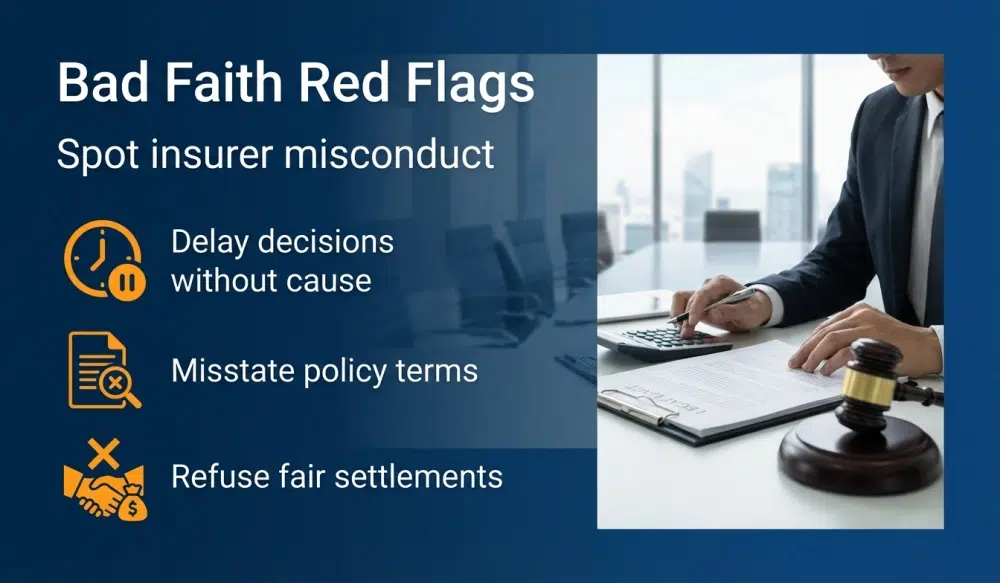
- Failed to promptly acknowledge and investigate a claim within regulatory timeframes [3].
- Misrepresented policy terms or applicable law during adjustment [9].
- Ignored readily available evidence or relied on biased examinations or estimates.
- Unreasonably delayed a coverage decision or payment without a legitimate basis, including failure to communicate what information is needed to complete a claim [5] [9].
- Refused to accept a reasonable settlement demand when liability was reasonably clear, exposing the insured to excess judgment risk [7] [8].
Each jurisdiction defines and applies these standards differently. In Texas, common law and statute prohibit unfair settlement practices and allow recovery for knowing violations, while Illinois focuses first-party remedies through statute and preserves certain third-party failure-to-settle duties under case law [6] [10].
How do federal law and key states like California, Texas, and Illinois treat insurance bad faith?
How does federal law affect bad faith claims in ERISA-governed disability or health plans?
When disability or health benefits are provided through most employer-sponsored plans, the Employee Retirement Income Security Act of 1974 can preempt state-law bad faith claims and remedies. In Pilot Life v. Dedeaux, the U.S. Supreme Court held that state common law claims arising from improper claims handling of ERISA plan benefits are generally preempted, restricting plaintiffs to ERISA’s civil enforcement scheme [11]. ERISA also imposes detailed claims and appeals procedures. For disability claims, plan fiduciaries generally must decide initial claims within 45 days with limited extensions, and appeals within 45 days, subject to one extension for special circumstances [12]. These timelines are critical both for policyholders seeking benefits and for evaluating whether process deficiencies occurred.
What is unique about California’s insurance bad faith landscape?
California recognizes a tort claim for breach of the implied covenant of good faith and fair dealing, allowing recovery of extra-contractual damages in appropriate cases. There is no private right of action to enforce Insurance Code section 790.03(h), which lists unfair claims settlement practices, after the California Supreme Court’s decision in Moradi-Shalal [1]. Nevertheless, separate statutory and common law theories can address misrepresentations or unfair competition in the insurance context. In Zhang v. Superior Court, the court confirmed that a policyholder may pursue a claim under California’s Unfair Competition Law based on false advertising or misrepresentation by an insurer, independent of section 790.03(h) [2].
California also has robust claims-handling regulations. For most first-party claims, insurers must acknowledge communications within 15 calendar days and accept or deny claims within 40 calendar days after proof of claim, with ongoing 30-day status updates if investigations continue [3]. Punitive damages require clear and convincing evidence of oppression, fraud, or malice under Civil Code section 3294 [4].

What Texas statutes and cases frame bad faith and prompt payment duties?
Texas recognizes a common law duty of good faith and fair dealing in the first-party context. In Arnold v. National County Mutual Fire Insurance Co., the Texas Supreme Court recognized a cause of action for an insurer’s breach of this duty [7]. Later in Universe Life Insurance Co. v. Giles, the court discussed standards for determining when liability is reasonably clear and whether an insurer lacked a reasonable basis to delay or deny payment [8].
Two Texas statutes are central. Chapter 541 of the Insurance Code prohibits unfair or deceptive acts or practices in the business of insurance, including unfair settlement practices, and provides a civil remedy [6]. Chapter 542, the Prompt Payment of Claims Act, sets deadlines to acknowledge, investigate, accept or reject, and pay claims. Violations can result in the amount of the claim, reasonable attorney’s fees, and an annual interest penalty for delayed payment [5]. These time-driven remedies give policyholders concrete leverage when delays occur.
How does Illinois address first-party and third-party bad faith issues?
Illinois does not generally recognize a separate tort of first-party bad faith for claim denials. Instead, Section 155 of the Illinois Insurance Code provides a statutory remedy for vexatious and unreasonable delay or denial, authorizing recovery of attorney fees and a statutory penalty in addition to the benefits owed [10]. Section 154.6 enumerates unfair claim settlement practices, including failure to adopt reasonable standards for prompt investigations and failure to effectuate prompt, fair, and equitable settlements where liability is reasonably clear [9]. Illinois law also recognizes a third-party duty to settle when an insurer’s failure to accept a reasonable settlement demand exposes the insured to an excess judgment, typically asserted through assignment or equitable subrogation.
How do you prove insurer bad faith and what evidence should be preserved?
What elements and burdens of proof are common in bad faith cases?
While the precise elements vary by jurisdiction, plaintiffs generally must show that the insurer lacked a reasonable basis for its conduct and knew or recklessly disregarded the lack of a reasonable basis. In third-party failure-to-settle cases, plaintiffs typically show that liability was reasonably clear and that a reasonable insurer would have accepted the settlement opportunity. Jurisdictions like Texas and California articulate these standards through common law and statutory frameworks [1] [6] [8]. Evidence should focus on contemporaneous claims handling decisions, objective indicators of liability or coverage, and whether timelines and regulatory requirements were met.
Which documents and data points are most important to preserve?
To evaluate and prove bad faith, it helps to secure:
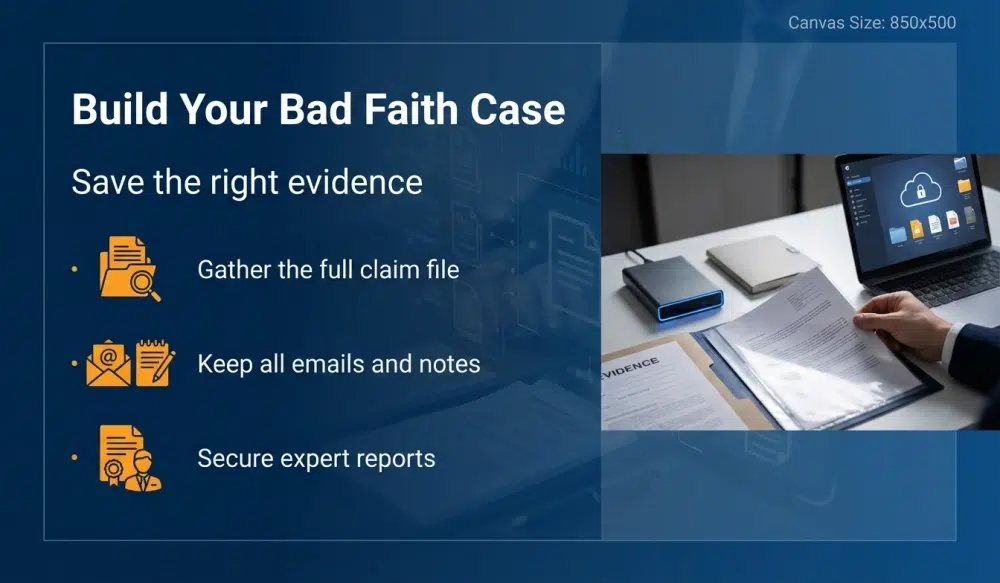
- Complete claim file, including adjuster notes, internal diary entries, and communications to and from the insured and third parties.
- Underwriting file and policy forms, endorsements, and declarations to confirm coverage scope.
- Independent medical examination reports, engineering or cause-and-origin reports, and expert reviews used by the insurer.
- Recorded statements, examinations under oath transcripts, and appraisal communications.
- Emails, letters, and claim system log entries reflecting decision points, requests for information, and settlement evaluations.
- Proofs of loss, estimates, invoices, and receipts that establish the amount of loss and repair timelines.
- Regulatory communications in states like California, where timing rules require 15-day acknowledgments, 40-day decisions, and 30-day status updates [3].
- Texas prompt payment milestones, such as the dates the claim was acknowledged, requested information was provided, decisions issued, and payment made, to assess statutory interest and fee exposure [5].
How can policyholders maintain credibility during the claim process?
Document every phone call, email, and request. Respond promptly with the documents the insurer reasonably needs. If you are asked to sit for an examination under oath, consult counsel. For employer-sponsored disability or health benefits, follow ERISA timelines closely and keep detailed records of claim submissions and appeal letters, including delivery confirmations and deadlines tracked under the regulation [12]. Consistent, thorough documentation improves the chances of a fair resolution and strengthens litigation if needed.
What damages, penalties, and remedies are available in bad faith cases?
What compensatory and extra-contractual damages are available?
In many jurisdictions, an insurer’s bad faith can support recovery of consequential damages caused by unreasonable claim handling, such as additional property damage from delay, loss of use, or in some cases emotional distress. California allows punitive damages when there is clear and convincing evidence of oppression, fraud, or malice under Civil Code section 3294 [4]. Federal due process principles guide the size of punitive awards, and the U.S. Supreme Court has suggested that ratios of punitive to compensatory damages in the single-digit range are more likely to satisfy constitutional limits [13].

What statutory penalties and attorney fees can apply?
Statutory regimes can add significant leverage. Texas’s prompt payment law provides for the amount of the claim, attorney fees, and interest on late payments when an insurer misses the statute’s decision and payment deadlines [5]. Illinois’s Section 155 authorizes attorney fees and a statutory penalty for vexatious and unreasonable delay or denial, supplementing contract benefits [10]. In ERISA-governed cases, remedies are narrower and typically limited to benefits due, interest, equitable relief, and possibly attorney fees, but state bad faith tort damages and punitive damages are generally preempted for employee-benefit claims [11] [12].
What timelines and claim-handling deadlines can influence your case strategy?
Which California timelines are most frequently litigated?
California’s regulations require insurers to:
- Acknowledge communications and provide necessary forms within 15 calendar days of receipt.
- Accept or deny claims in whole or in part within 40 calendar days after receipt of a properly executed proof of claim, or provide written status updates every 30 days if investigation continues.
- Pay accepted claims promptly upon acceptance.
Failing to meet these timing rules is not automatically bad faith, but timing evidence often informs whether an investigation was reasonable under the circumstances [3].
What Texas deadlines create exposure under the Prompt Payment of Claims Act?
Texas insurers must acknowledge a claim within set days after receiving notice, request all necessary items promptly, and generally accept or reject a claim within a defined period after receiving all requested information, followed by prompt payment after acceptance. Interest and fee exposure can accrue when these deadlines are missed, which encourages early and thorough compliance in claim handling [5].
How do ERISA disability claim deadlines affect litigation strategy?
For disability benefits under ERISA plans, claim administrators typically must issue initial determinations within 45 days with limited extensions, and resolve appeals within 45 days, subject to one extension when special circumstances exist. Failure to follow these procedures can affect standard of review and remedy considerations in federal court litigation [12].
Why do high-level federal civil filing statistics matter?
Federal courts regularly handle ERISA benefit cases and certain insurance disputes involving diversity of citizenship. Understanding filing patterns and processing timelines helps anticipate forum strategy. U.S. Courts publish annual caseload statistics that track the volume of civil filings by category, a useful backdrop for anticipating scheduling and resource needs across districts [14].
How do you choose top firms for insurance bad faith litigation across the United States?
What core capabilities should a top firm demonstrate?
When evaluating firms for insurance bad faith litigation nationwide, consider whether the firm can:
- Handle both first-party and third-party disputes, including property, auto, disability, health, and life claims.
- Litigate in state and federal courts, including ERISA benefit actions and removal or remand issues.
- Review claim files at scale, identify regulatory violations, and align facts with jurisdiction-specific standards like California’s claim timing rules or Texas’s prompt payment deadlines [3] [5].
- Develop damages models that integrate contract benefits, consequential losses, statutory penalties, interest, and punitive damages where allowed [4] [13].
- Engage qualified consultants for cause-and-origin, medical, or financial analysis when the insurer’s evaluation is contested.
- Negotiate policy-limit settlements to protect insureds from excess judgments in third-party settings, guided by standards in jurisdictions like Texas and California [1] [8].
Which credentials and case indicators are most telling?
Look for a history of courtroom results and published decisions in relevant jurisdictions, a track record managing complex multi-claim or catastrophe events, and familiarity with state insurance departments’ regulations and market conduct issues. Firms should demonstrate fluency with core authorities such as Moradi-Shalal, Zhang, Texas Insurance Code Chapters 541 and 542, and ERISA claims regulations [1] [2] [5] [6] [12]. Because many insurance disputes arise from serious injuries, firms that routinely coordinate liability and coverage litigation can streamline strategy for policyholders and insured defendants.
If your claim stems from a collision, your evaluation team may overlap with personal injury lawyers who are accustomed to building liability and damages narratives that complement insurance recovery efforts. That cross-functional approach can be valuable when an insurer’s failure to settle risks an excess judgment or when first-party benefits are underpaid.
Why is multi-jurisdiction experience important for nationwide claims?
Policyholders, businesses, and families move and operate across states, while insurers centralize claims handling. Multi-state coverage often requires litigating in different forums under different claim rules. A top firm should be able to manage venue strategy and apply specific state rules on claim timelines, settlement obligations, and remedies, while navigating federal preemption for ERISA-governed benefits [11] [12].
How do property, health, disability, and life insurance bad faith claims differ?
What distinguishes property damage claim bad faith from other lines?
Property claims often involve time-sensitive mitigation, scope of repair disputes, and valuation issues. Regulators in states like California require prompt communication and decisions, which gives policyholders clear benchmarks for reasonableness [3]. In Texas, the prompt payment statute adds a calculable interest penalty that can facilitate settlement discussions when deadlines were missed [5]. Documentation of damage progression, contractor bids, and inspection scheduling can be pivotal.
How do health and disability insurance bad faith issues arise?
Health and disability disputes often turn on medical necessity, functional capacity, vocational analysis, and policy definitions like own occupation versus any occupation. For employer-sponsored plans, ERISA typically governs, with specialized claim and appeal procedures and deadlines that must be followed by claim administrators and claimants alike [12]. In non-ERISA disability policies, state common law and unfair settlement practices statutes supply the framework.
What is unique about life insurance claim denials and delays?
Life insurance disputes often involve contested beneficiary designations, alleged material misrepresentations, lapse and grace period questions, or contestable claim investigations. Illinois’s Section 154.6 provides a checklist for evaluating whether the insurer adopted reasonable standards for investigating and settling claims, while Section 155 allows fees and penalties for vexatious or unreasonable conduct in first-party disputes [9] [10]. Clear communication, prompt provision of requested records, and careful timeline tracking are essential.
How can GoSuits help with insurance bad faith disputes nationwide?
We understand that a denied or delayed claim strains families and businesses. For civil insurance disputes nationwide, including first-party property, disability, health, life, and third-party settlement failures after serious injuries, a focused legal team can clarify your options and timing. A confidential, no-obligation consult helps you understand key deadlines, evidence to preserve, and viable paths to resolution under the laws in your state. If your matter overlaps with catastrophic injury or liability exposure, we integrate coverage and liability strategy so you are not forced to choose between them.
- Where we practice We handle civil insurance disputes nationwide, coordinating local counsel as needed.
- Technology-driven case building We use exclusive proprietary software to map claim timelines, identify regulatory breaches, and surface evidence gaps early for faster, better results.
- Innovation and leadership Our litigation dashboards and analytics give you transparent, real-time insight into case posture and options.
- Attorney access, not call centers Even with advanced technology, every client works directly with a designated attorney. We do not use case managers and clients have unfettered access to their lawyer.
- Trial readiness with track record Our team brings 30 years of combined experience and has secured impactful results for policyholders in courts and arbitrations across the country. See our prior cases.
- Comprehensive practice coverage We handle insurance disputes tied to auto, trucking, premises, product, construction, and property losses, along with ERISA disability benefits. Learn about our attorneys and about us, and explore our practice areas.
- Focused support for injury-related disputes If an insurer’s delay or denial complicates your recovery path after a crash or fall, a consult can clarify how liability, coverage, and damages interact so your civil claims move forward together efficiently.
References and resources
- Moradi-Shalal v. Fireman’s Fund Ins. Companies, 46 Cal. 3d 287 – CourtListener
- Zhang v. Superior Court, 57 Cal. 4th 364 – CourtListener
- Fair Claims Settlement Practices Regulations, Title 10 CCR § 2695.1 et seq. – California Department of Insurance
- California Civil Code § 3294 Punitive Damages – California Legislative Information
- Texas Insurance Code Chapter 542 Prompt Payment of Claims – Texas Legislature Online
- Texas Insurance Code Chapter 541 Unfair Methods of Competition and Unfair or Deceptive Acts or Practices – Texas Legislature Online
- Arnold v. National County Mutual Fire Ins. Co., 725 S.W.2d 165 (Tex. 1987) – Google Scholar
- Universe Life Ins. Co. v. Giles, 950 S.W.2d 48 (Tex. 1997) – Google Scholar
- 215 ILCS 5/154.6 Unfair Claim Practices – Illinois General Assembly
- 215 ILCS 5/155 Attorney Fees and Penalties – Illinois General Assembly
- Pilot Life Ins. Co. v. Dedeaux, 481 U.S. 41 – Legal Information Institute
- 29 C.F.R. § 2560.503-1 Claims Procedure Regulation – eCFR
- State Farm Mut. Auto. Ins. Co. v. Campbell, 538 U.S. 408 – Legal Information Institute
- Federal Judicial Caseload Statistics 2023 – U.S. Courts
- Bad faith insurance – Legal Information Institute Wex