
- What do five star reviews of injury law firms really show?
- How should you evaluate top rated personal injury law firms beyond stars?
- Which legal and ethical rules govern client reviews and lawyer advertising?
- What objective indicators can complement online ratings for injury firms?
- Do reviews relate to outcomes and client experience in civil injury cases?
- What questions should you ask during a consultation with a personal injury attorney?
- How do federal law and key states handle injury claims and advertising rules?
- How can you verify a firm record using public sources?
- How does GoSuits approach technology, service, and results for injury clients?
- References and resources
What do five star reviews of injury law firms really show?
When you search for top rated personal injury law firms, five star ratings and glowing comments can feel persuasive. Positive reviews can highlight responsiveness, clear communication, compassion, and a smooth client experience. They can also give you clues about a firm processes, such as regular case updates, convenient digital communication, and how well the team explains next steps.
At the same time, a star score is a limited snapshot. Ratings may not reflect the complexity of cases, the unique facts of your claim, or the range of results across clients. Publication of testimonials is regulated by federal and state rules to protect consumers from misleading claims about legal services. The Federal Trade Commission Endorsement Guides emphasize that reviews must reflect honest opinions, typicality cannot be implied without clear disclosure, and firms cannot suppress negative feedback or present fabricated endorsements [1].
You will find many firms with excellent client satisfaction. As a starting point in your research, it is reasonable to read comments about professionalism and clarity from personal injury lawyers, then go deeper to verify credentials, litigation history, and case evaluations grounded in law and evidence.
What does a five star review typically describe?
Clients frequently mention clear explanations, frequent updates, empathy during stressful moments, and organized handling of documents and deadlines. They may note timeliness: for example, returning calls within one business day, providing written summaries after key meetings, and sending reminders before medical appointments. They may also mention resolution paths, such as effective negotiation or preparedness if a lawsuit becomes necessary.
Which parts of the client journey do reviews usually cover?
- Intake and expectations: Whether the firm explained the process, timelines, and decision points.
- Communication cadence: How often updates arrived and whether the client reached the attorney directly.
- Case management: Organization around records, bills, lost wage documentation, and scheduling.
- Negotiation and litigation: Whether the firm described options clearly when offers arrived or when filing suit was considered.
How should you evaluate top rated personal injury law firms beyond stars?
Five star signals are most helpful when paired with objective information. Consider the following checklist as you compare nationwide injury law firms and local options in your state.
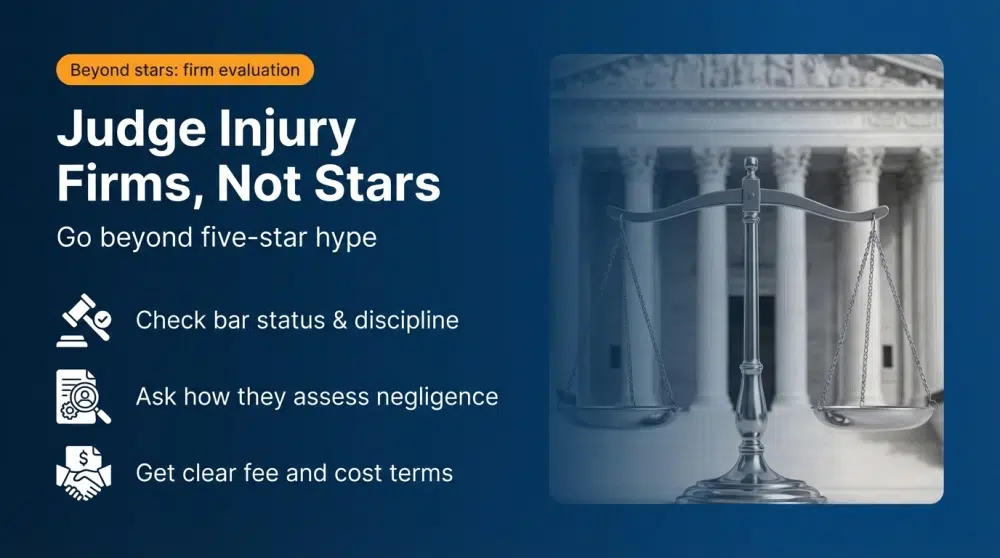
- Confirm licensing and disciplinary history: Look up the attorney on the state bar website to confirm standing, years in practice, and any public discipline. State bar portals typically allow public search and may provide links to ethics rules relevant to testimonials [2] [3].
- Review ethics compliant testimonials: Check that reviews are not promising results. The FTC requires that endorsements be truthful and not misleading, and that typicality disclaimers appear when outcome claims are made [1].
- Read comments about communication and clarity: Client satisfaction often centers on communication. Look for details about how often the firm updated the client, whether questions were answered promptly, and whether expectations were set realistically.
- Ask about case evaluation grounded in negligence law: A credible attorney will walk through duty, breach, causation, and damages in plain language, and will explain how comparative negligence might affect your recovery [12] [11].
- Seek transparent fee explanations: Reputable firms clearly explain contingency fees, costs, and what happens if there is no recovery. Written fee agreements and simple summaries help avoid surprises.
- Look for meaningful litigation experience: Many personal injury claims settle, yet trial readiness can influence negotiation. Public data indicate that only a small share of tort cases reach trial in state courts, and plaintiff win rates vary by case type [7]. Ask how the firm prepares if negotiations fail.
- Check public records and case summaries: You can review federal dockets through PACER and browse published opinions or filings through public legal databases to assess the complexity of matters the firm handles [13] [14].
- Confirm access to your lawyer: Reviews that praise a team for direct access to attorneys and timely personal attention often correlate with fewer misunderstandings and better alignment on strategy.
There is nothing wrong with beginning your search with ratings. The key is combining review insights with verifiable data about case handling, communication, and ethics compliance.
Many readers start with accident lawyers whose profiles show clear process explanations, documented communication practices, and realistic case assessments without overstating outcomes. That balance between empathy and careful analysis tends to show up in satisfied client feedback.
How should you weigh Google reviews against legal directories?
Google reviews can capture real time client impressions across a high volume of matters. Legal directories like Martindale Hubbell, Super Lawyers, and Avvo often incorporate peer feedback or structured criteria. Treat each source as a single lens: read narratives closely, note dates and recency, and look for consistency across platforms. Regardless of platform, apply the same test: truthful, specific, and non misleading statements are most useful [2] [3] [1].
What should you do if you see red flags in reviews?
- Repeated communication gaps: Several reviews describing long delays may signal workflow problems.
- Promises of guaranteed outcomes: Statements implying certainty conflict with ethics rules in many jurisdictions [2] [3].
- Inconsistent fee descriptions: Confusion about fees suggests that written agreements and explanations were unclear.
What is a reasonable timeline for communication and updates?
Many clients consider a response within one business day to be reasonable for routine updates, with quicker turnaround for urgent issues such as court deadlines or medical examinations. Monthly status updates during active treatment and additional updates at major litigation milestones are common approaches that align with high client satisfaction.
Which legal and ethical rules govern client reviews and lawyer advertising?
Lawyer advertising and reviews are governed by both federal and state standards. Understanding these guardrails helps you interpret five star testimonials correctly.

What do the Federal Trade Commission Endorsement Guides require?
The FTC Endorsement Guides apply widely to endorsements and testimonials in advertising. Key points include: honest opinions; no misleading implications; clear and conspicuous disclosure of material connections; and no suppression of negative reviews. Claims about results must not imply that outcomes are typical unless the ad clearly states what the typical result is, with competent and reliable evidence to support it [1].
How does California regulate lawyer testimonials and advertising?
California Rules of Professional Conduct prohibit false or misleading communications. Rule 7.1 bars untrue statements about results and qualifications. Testimonials must not create unjustified expectations about results. California also sets record keeping and other requirements for attorney advertisements [2].
What does Texas require for lawyer advertising and reviews?
Texas Disciplinary Rules of Professional Conduct address advertising content and specific limitations for statements about results. The rules prohibit statements that could mislead a prospective client, require disclaimers where appropriate, and regulate firm names and professional designations. The effective rules provide guidance for communications on websites and third party platforms that host reviews [3].
What about Illinois?
Illinois regulates attorney communications through rules that mirror the core principles of truthfulness and non deception. When you are comparing options in Illinois, verify that promotional materials and testimonials do not promise outcomes, and be mindful of the state two year limitation period for most personal injury actions [4].
How can law firms ethically request reviews?
Firms may invite clients to share honest feedback without offering incentives that would require disclosure or that could skew impressions. They should avoid editing or suppressing negative reviews and should provide context that past results are not guarantees, consistent with the FTC framework and state rules [1] [2] [3].
What objective indicators can complement online ratings for injury firms?
Objective indicators help you go beyond five star scores to real world capability and reliability. Consider combining the following data points with reviews and testimonials.
Which legal performance metrics are most useful?
- Case mix and complexity: Ask about the firm typical case types. Motor vehicle collisions comprise a large share of tort cases in state courts, while product liability and premises cases tend to be less frequent but can be more complex [7].
- Trial readiness: Because a small fraction of civil tort cases go to trial, trial preparation often affects settlement leverage. Public statistics from the Bureau of Justice Statistics show trial rates and plaintiff win rates by case category, which can inform realistic expectations [7].
- Documented procedural milestones: Verified motions practice, expert disclosures, and timely discovery are signals of organized case management. Federal dockets and many state court portals make these milestones visible to the public [13].
- Client communication indicators: Responsiveness within a business day, proactive updates at key milestones, and clear explanations of choices show up repeatedly in high quality client feedback.
- Use of secure technology: Safe messaging, encrypted document sharing, and accessible meeting options can shorten timelines and reduce stress while keeping your information protected.
What role do industry recognitions play?
Peer review and third party ratings such as Martindale Hubbell, Super Lawyers, and Avvo are commonly referenced. Treat them as one perspective among many. Focus on how the firm translates recognition into consistent client service, thorough legal analysis, and effective negotiation and trial work. Ethical rules still apply to how recognitions are described in marketing, including context and disclaimers where needed [2] [3].
Do economic and public safety data matter?
Yes. Serious crash injuries and other accidental harm carry significant economic costs in the United States. NHTSA estimates that motor vehicle crashes in a single recent year produced hundreds of billions of dollars in economic losses, including medical costs and lost productivity [9]. CDC injury surveillance shows the sustained burden of unintentional injuries across the nation [10]. Firms that explain how they quantify damages using medical records, wage records, and accepted economic methods are better positioned to negotiate or litigate effectively.

What is Net Promoter Score, and does it help?
Net Promoter Score is a simple gauge of client loyalty: clients rate the likelihood of recommending a firm on a zero to ten scale. While NPS can reflect client sentiment about communication and service, it is not a legal performance metric. Use it, if available, as a service indicator alongside objective litigation data, clear fee explanations, and verifiable public records.
Can client satisfaction coexist with strong litigation performance?
Yes. Process quality and litigation readiness are complementary. Clients often rate highly when they feel heard, informed, and respected. Those same disciplines support thorough investigation, early issue spotting, and persuasive presentation in negotiations or at trial.
Do reviews relate to outcomes and client experience in civil injury cases?
Client comments often highlight process quality more than raw dollar amounts. That matters, because outcome ranges depend on liability strength, comparative negligence, available insurance, venue, and the extent of damages. Reviews can reliably capture elements that are within a firm control, such as communication, transparency, and respect.
Outcome statistics from public sources tell a larger story. State court research indicates that most civil cases settle before trial, and that plaintiff win rates at trial vary by category. For example, motor vehicle cases have historically seen higher plaintiff win rates than medical treatment cases, while product liability trials are less common and more complex [7]. Federal court filings are a smaller slice of personal injury disputes relative to state courts, but national caseload data show trends in civil filings that matter for multi district or diversity cases [8].
The core idea here is that a five-star satisfaction rating usually reflects the efficiency with which a company manages your process. It doesn’t promise a specific outcome though – moral standards discourage even implying such an assurance [1] [2] .
How should you read case results pages alongside reviews?
Case results pages are valuable sources of information about the types of disputes a law firm has handled. They can give you an idea of how the firm approaches strategy and the lessons they’ve learned from previous cases. However, it is crucial to use this information carefully. Settlement details may be confidential, and even when specifics are public, the outcome often depends on the unique facts of each case. Look for disclaimers that clarify past results do not guarantee future success in line with FTC and state guidance [1] [2] [3].
What questions should you ask during a consultation with a personal injury attorney?
A free initial consultation can be very beneficial for assessing someone’s suitability, understanding, and adherence to ethical guidelines. Here are some topics you may want to discuss during this consultation: 1. Suitability: Determine if the consultant’s expertise and experience match your goals and requirements. 2. Comprehension: Discuss their problem-solving approach and how it aligns with your expectations and needs. 3. Ethical Standards: Clarify the values and principles they uphold to ensure confidentiality, transparency, and adherence to professional conduct.
- How will you evaluate duty, breach, causation, and damages in my case? Ask the attorney to apply negligence elements to your facts and to address potential comparative fault issues that could reduce recovery [12] [11].
- During the first 30 to 60 days, it’s crucial to collect the right kinds of evidence. Focus on developing a comprehensive plan that includes retrieving essential documents, gathering eye-witness testimonies, acquiring photos from the scene, and enlisting professionals when needed. This approach will help you build a strong case over time.
- The frequency of updates varies according to a client’s personal choice but generally clients prefer to receive regular updates from their designated lawyer. This helps them keep up-to-date about their case’s progress and improves their overall contentment with the services we provide.
- When an insurance company disputes liability or damages, it is important to consider preliminary case evaluations, mediation options, and ensuring that you are prepared to take legal action if necessary. This approach can help protect your interests throughout the entire process.
- What are the likely timelines and key deadlines in my state? You want a realistic timeline and a review of the statute of limitations to avoid rushed filings later [5] [6] [4].
- Fees and costs in legal cases can be complex, but we’ll provide a straightforward explanation. There are two main types of fees: contingency fees and hourly rates. Contingency fees are typically paid as a percentage of the final settlement or verdict, meaning your attorney only gets paid if you win. Hourly rates, on the other hand, require you to pay for legal services based on the time spent by your attorney working on your case. Case expenses refer to any out-of-pocket costs incurred during the course of a lawsuit, such as court filing fees or expert witness fees. These expenses may be advanced by the attorney and will be reimbursed from any settlement, judgment, or award received. If there is no recovery (meaning you don’t win your case), it depends on the type of fee agreement you have with your attorney. With a contingency fee arrangement, if you lose, you typically do not owe anything for legal fees. However, you may still be responsible for reimbursing any expenses incurred during the case. In contrast, if you have an hourly rate agreement, you will still owe your attorney for their time and work spent on your case, regardless of whether it’s successful or not. Remember to clarify your fee arrangement with your attorney upfront to avoid misunderstandings later.
In discussions, it is commonly observed that numerous clients are drawn to personal injury attorneys who articulate clearly the strengths as well as potential drawbacks of their representation. These lawyers do not resort to over-promises and in turn, this clarity often coincides with consistently receiving five star ratings across multiple platforms.
How can you compare contingency fee offers fairly?
We kindly request a detailed explanation on all fees charged at different stages, typical litigation costs, the process for transferring medical record charges without markup, as well as how deductions are managed when recovering payments. Transparency and clarity in our agreements are crucial to prevent client confusion and ensure they are satisfied with our services.
Which documents should you prepare for the consultation?
- Documentation of accidents and incidents includes photos, police reports, incident reports, as well as any communication with insurance companies.
- Medical records and bills: Diagnostics, treatment plans, prescriptions, and itemized invoices.
- Employment and wage documents: This includes pay stubs, employer letters, and benefit statements. These can be used as proof for any lost wages, or decreased earning ability that you may be trying to establish in a claim or case. Be sure to keep these records organized and up-to-date so they are easily accessible when needed.
- Out-of-pocket expenses: These include transportation costs for doctor visits or hospital stays, purchasing any necessary medical devices such as crutches or wheelchairs, making any needed home modifications like widening doorways or installing handrails, and paying for all other related recovery expenses.
How do federal law and key states handle injury claims and advertising rules?
Given that this serves as a national guideline, we emphasize crucial federal aspects, along with the legal systems of three particularly prominent states that handle numerous personal injury cases. Please always ensure you’re up-to-date by checking the rules in each respective jurisdiction via the relevant state authority.
What federal principles and resources matter to injury claims?
- Federal jurisdiction and dockets: Some personal injury cases are filed in federal court under diversity jurisdiction or involve federal questions. You can review federal case dockets and filings through PACER, the federal judiciary public access service [13].
- Public research tools: You can search court opinions and filings on public platforms used by academics and practitioners to assess precedent and litigation histories [14] [15].
- Advertising and endorsements: The FTC Endorsement Guides apply nationwide to lawyer testimonials and reviews that appear in advertising contexts, including on law firm websites and profiles [1].
How does California handle limitation periods and ads about results?
- Limitation period: In most California personal injury actions, the statute of limitations is two years from the date of injury, with exceptions for certain claims and defendants [5].
- Advertising rules: California Rule 7.1 prohibits false or misleading statements. Results oriented content must be truthful and cannot create unjustified expectations. Context and disclaimers may be required for testimonials [2].
How does Texas address time limits and testimonials?
- Limitation period: Most personal injury claims must be filed within two years in Texas, subject to specific statutory exceptions [6].
- Advertising rules: Texas rules regulate statements about results, firm names, and endorsements to prevent consumer deception. Review communications against the current rules to confirm compliance [3].
While evaluating different choices, it’s beneficial to consult with experienced accident attorneys in Texas who can discuss the specific nuances of state laws and local court systems that might influence the progression of your particular case.
What should Illinois clients know about timing and ethics?
- Limitation period: Illinois generally provides two years for personal injury suits, with exceptions in particular contexts. Always confirm the applicable statute for your claim [4].
- Ethical communication: Illinois applies core truthfulness principles to advertising, similar to other states. Testimonials that imply guaranteed outcomes are improper.
How can you verify a firm record using public sources?
Verifying what you read in five star reviews with independent sources can help you choose confidently. Use a layered approach to research.
Where can you find public court records and opinions?
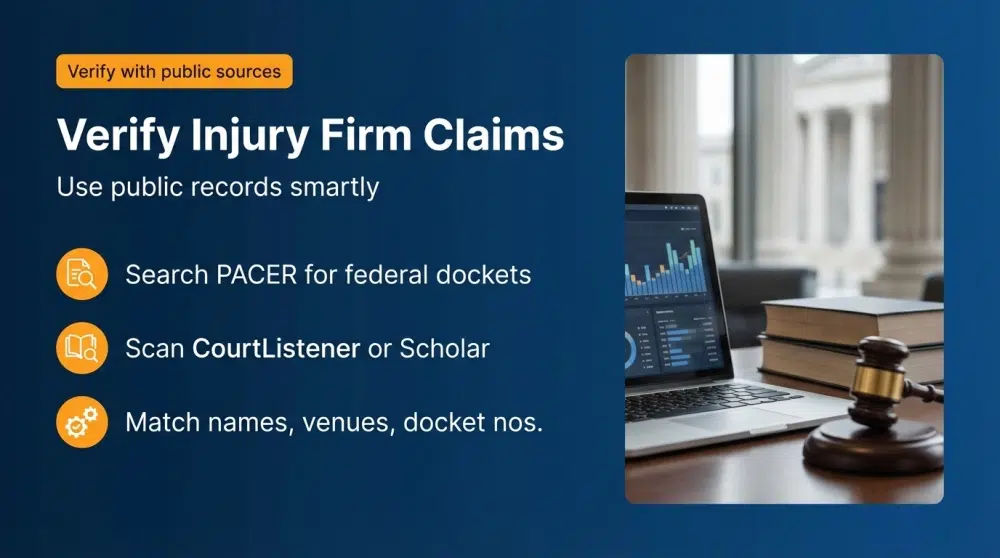
- Federal dockets through PACER: PACER provides access to case information, complaints, motions, and orders in federal cases across the United States [13].
- Open access opinion databases: Public platforms compile opinions and many filings so you can search by party or attorney names to see involvement in published matters [14].
- Scholarly databases: Google Scholar allows you to search case law and scholarly articles, which can help you understand legal standards relevant to your case [15].
How can you cross check a firm claimed results?
- Match parties and venues: If a firm publicizes a result, you can often verify the party names, venue, and docket number in public records.
- Distinguish published opinions from settlements: Many outcomes are confidential settlements and will not appear in public databases. That does not make them less valuable, but they cannot be verified in the same way.
- Check dates and typicality disclaimers: Ethical marketing clarifies that past results do not guarantee future outcomes, consistent with the FTC and state rules [1] [2] [3].
How should you organize your own documents for verification and strategy?
- Chronology of events: Create a simple timeline of the incident, treatment, and communications with insurers.
- Document index: Keep a list of records requested and received, including dates and sources.
- Questions list: Maintain a running list of questions for your attorney to address during scheduled updates.
How does GoSuits approach technology, service, and results for injury clients?
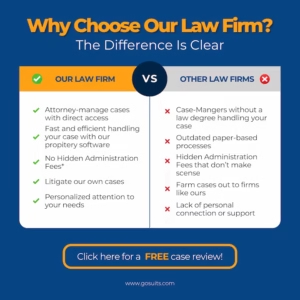
If you are comparing nationwide injury law firms with five star reviews, consider how technology and trial readiness translate into day to day service. At GoSuits, we combine modern systems with direct attorney access for every client. We do not route your case through case managers. You have unfettered access to your designated attorney from intake through resolution.
We practice in jurisdictions across the United States and focus on civil injury matters that include motor vehicle collisions, trucking incidents, premises liability, product liability, construction site injuries, traumatic brain injury, and wrongful death. Our team brings 30 years of combined experience in negotiation, motion practice, and trial. We prepare each case as if it may go to trial, which strengthens negotiation and helps us move promptly when a lawsuit is necessary.
Our exclusive proprietary software supports faster information gathering, secure client communication, and streamlined document management. That technology driven approach is designed to accelerate timelines and improve coordination, while keeping you informed at every step. Although we use advanced tools, your relationship is always with your attorney who leads strategy, answers your questions, and prepares you for milestones such as medical examinations, depositions, mediation, or trial.
We are proud of our past results for clients, while recognizing that each case is unique and that past outcomes do not predict future results. You can explore a selection of matters on our site at prior cases, meet the lawyers who will work with you at our attorneys, and learn more about our story and values at about us. For a broader view of what we handle, see our practice areas.
If you are deciding between firms with strong client satisfaction, a short conversation can make the picture clearer. We will listen, explain how negligence law applies to your facts, discuss likely timelines and costs, and outline next steps. That way, you can decide if we are the right fit for your situation.
As you weigh your options, it is common to start with personal injury lawyers who combine real courtroom experience, steady communication, and modern technology. We are glad to speak and help you plan your next step.
References and resources
- Guides Concerning the Use of Endorsements and Testimonials in Advertising 16 CFR Part 255 – eCFR
- Rule 7.1 Communications Concerning a Lawyer Services – State Bar of California
- Texas Disciplinary Rules of Professional Conduct including Part VII Information About Legal Services – Texas Courts
- 735 ILCS 5 13 202 Personal actions limitation – Illinois General Assembly
- California Code of Civil Procedure Section 335.1 – California Legislative Information
- Texas Civil Practice and Remedies Code Sec 16.003 – Texas Statutes
- Civil Bench and Jury Trials in State Courts 2005 – Bureau of Justice Statistics
- Federal Judicial Caseload Statistics 2023 – United States Courts
- The Economic and Societal Impact of Motor Vehicle Crashes 2019 – NHTSA
- Injury Key Data and Statistics – CDC
- Comparative negligence – Legal Information Institute
- Negligence – Legal Information Institute
- Public Access to Court Electronic Records – United States Courts
- CourtListener API and data resources – Free Law Project
- Google Scholar Case Law and Articles – Google Scholar