- What is the Los Angeles injury evidence checklist and why does it matter?
- What should you do in the first hour and in the first 24 to 72 hours after an accident?
- Which photos should you take at the scene and afterward in Los Angeles?
- What should you write in an injury journal and daily notes?
- Which medical records and bills do you need and how do you get them?
- How do police reports, 911 audio, and incident reports work in Los Angeles?
- How do you collect witness statements and contact information?
- How do you document property damage, repairs, and valuations?
- What digital evidence should you preserve and how do you avoid spoliation?
- What California deadlines and local rules could impact your evidence and claim?
- How does comparative fault affect evidence strategies for plaintiffs and defendants?
- What evidence matters most for car crashes and slip and fall incidents?
- How do you organize and share evidence with insurers without hurting your claim?
- What common evidence mistakes should you avoid after an accident?
- How can a Los Angeles personal injury lawyer use this checklist to help your case?
- Why choose GoSuits for technology driven personal injury representation?
- References and resources
What is the Los Angeles injury evidence checklist and why does it matter?
After a crash or a fall in Los Angeles, what you collect and how you store it can influence fault, liability, and damages. Insurers evaluate photos, diagrams, medical records, repair bills, witness statements, and time stamped digital data. Courts and juries test that evidence against the rules of admissibility and reliability. California and federal law also impose duties to preserve certain information, and missing or altered items can lead to sanctions or negative inferences at trial [9][10][11].
This injury evidence checklist focuses on practical steps you can take in Los Angeles, California, with citations to governing law. It covers scene photos, notes, and records for car crashes, pedestrian collisions, bike incidents, truck collisions, and slip and fall situations. We also flag key deadlines including the California statute of limitations for personal injury and the special six month public entity claim rule when a government agency is involved [1][2].
Los Angeles has faced high traffic injury numbers. City data and safety programs report elevated fatal and severe injury collisions in recent years, which means timely documentation is critical for claims and defenses throughout the county [15].
What should you do in the first hour and in the first 24 to 72 hours after an accident?
Immediate actions protect health first, then evidence. The following checklist is built for the first hour and the first few days after an incident in Los Angeles.
What should you do in the first hour at the scene?
- Call 911 for injuries. Request police and medical support. Emergency response creates time stamped records that can be crucial later.
- Move to a safe location. If safe to do so, reduce secondary collisions and hazards.
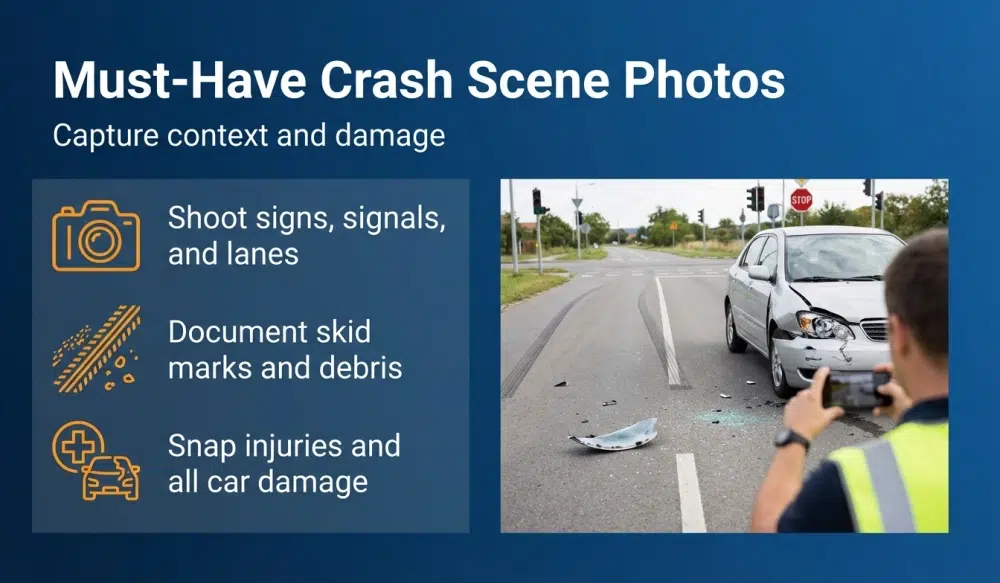
- Capture wide and close photos. Photograph vehicles, skid marks, debris, roadway lines, traffic signs, signals, lighting, weather, and your visible injuries. Take multiple angles.
- Turn on video. A short, narrated clip can show vehicle positions and hazards. Note time of day, exact location, and any immediate statements you hear.
- Exchange information. Collect driver license, insurance, license plate, and contact details. Photograph documents to avoid transcription errors.
- Identify witnesses. Ask bystanders for names, mobile numbers, and email addresses and record brief voice memos describing what they saw.
- Do not argue or assign blame. Limit conversations to safety and insurance exchange. Avoid apologizing or speculating about causes.
What should you do within 24 to 72 hours in Los Angeles?
- Seek medical evaluation. Some injuries emerge hours or days later. Prompt care creates records that can fit recognized evidence rules for medical documentation and business records [6].
- Report the crash if required. For crashes involving injury or death, California law requires a report to police or CHP within 24 hours [3]. You must also file a DMV SR 1 within 10 days if anyone was injured or if damage meets the threshold amount [4].
- Start an injury journal. Record pain levels, mobility limits, sleep changes, missed work, and daily impacts. Date each entry.
- Preserve digital data. Save dashcam, home security, and cellphone photos and videos in at least two locations. Do not overwrite or edit originals [9].
- Notify insurers carefully. Provide basic facts to begin coverage claims but avoid recorded statements before you have organized your documentation.
Which photos should you take at the scene and afterward in Los Angeles?
Photos provide context that written descriptions cannot match, especially in dense Los Angeles traffic where sight lines, lighting, and traffic controls vary block by block. Take these sets of photos and videos.
What scene photos matter most for car, bike, pedestrian, and truck incidents?
- Intersection context. Capture traffic signals, stop signs, lane arrows, speed limit signs, and construction zones.
- Roadway evidence. Photograph skid marks, yaw marks, debris fields, broken glass, fluids, and gouge marks that may show impact points.
- Vehicle positions. Before moving vehicles, document final rest positions if safe. Include distances to crosswalks and curb lines.
- Contact points and damage. Photograph each panel, bumper, wheel, airbag deployment, and interior damage from multiple angles.
- Lighting and weather. Capture sunlight position, night lighting, rain puddles, or surface conditions that affect braking or visibility.
- Injury images. Photograph swelling, bruising, cuts, and use repeat photos as conditions evolve across days and weeks.
How should you photograph slip and fall locations?
- Hazard detail. Close ups of spills, uneven surfaces, broken steps, loose mats, or missing handrails.
- Surroundings. Warning signs, lighting levels, nearby cameras, and the path you took.
- Footwear and clothing. Take photos of shoes and garments worn at the time, including any substance transfer.

How do you preserve photo authenticity?
- Keep originals. Save raw files with metadata intact. Store backups to cloud and external drive.
- Document when and where. Note the date, time, and address in your journal, and label folders clearly.
- Avoid edits. Do not crop, filter, or compress originals. If you make working copies, keep a separate untouched set. Courts consider how digital evidence was preserved when deciding any spoliation issue [9][11].
What should you write in an injury journal and daily notes?
An injury journal helps you remember details months later and can refresh your recollection for testimony. Keep entries factual and dated. You may share summaries with your attorney and medical providers to align treatment and documentation.
- Pain and symptoms. Rate pain and describe where it is located and what triggers it.
- Limitations. Note activities you cannot perform or that take longer than before the incident.
- Work and school effects. Record missed shifts, reduced hours, or performance impacts.
- Sleep and mental health. Track sleep interruptions and anxiety related to driving or walking near traffic.
- Appointments and medications. Log each visit, provider, prescribed medications, and side effects.
- Expenses. Save receipts for co pays, over the counter items, rides, parking, and home support services.
Which medical records and bills do you need and how do you get them?
Courts generally accept medical records and billing when they satisfy the business records exception if a qualified witness or certification establishes regular creation and trustworthiness [6]. Patients also have rights under federal and California law to access and obtain copies of their records.
How do you request your medical records?
- Use your right of access. Federal health privacy rules grant you the right to inspect and receive copies of your medical records within a reasonable time and at reasonable cost [7].
- Use California access laws. California Health and Safety Code provides rights to request and receive copies of records and summaries, often within 15 business days after the provider receives your written request [8].
- Request itemized billing. Ask for CPT coded bills and explanation of benefits for each date of service to tie costs to treatment.
- Ask for radiology images. Include DICOM files on disc or secure link with the radiology report, which can be important in orthopedic and brain injury cases.
Which medical documents should you save for your claim?
- Emergency department and urgent care notes. Triage, HPI, diagnosis, imaging, and disposition.
- Primary care and specialist notes. Orthopedics, neurology, pain management, and physical therapy progress notes.
- Prescriptions and pharmacy printouts. Medication names, dosages, and refills.
- Diagnostic imaging. X rays, CT scans, MRIs, and the radiologist’s interpretation.
- Work restrictions. Doctor notes placing you off work or on modified duty to support wage loss claims.
How do police reports, 911 audio, and incident reports work in Los Angeles?
Police and incident reports can guide investigations and insurance decisions, but California law restricts their use at trial. Vehicle Code section 20013 limits admissibility of accident reports in related civil trials [5]. Still, insurers typically request these for claim evaluation, and they can lead to admissible evidence through witness identification and scene diagrams.
How do you report and obtain collision records in Los Angeles?
- Report injury crashes. In addition to contacting 911, California Vehicle Code requires reporting an injury or fatal crash to police or CHP within 24 hours [3].
- File the DMV SR 1 when required. File within 10 days if there is injury, death, or property damage meeting the threshold amount [4].
- Request the police report. You can request a traffic collision report through the Los Angeles Police Department records portal if you are an involved party or authorized representative [14].
How do you collect witness statements and contact information?
Witness accounts can resolve disputes about traffic signals, speeds, lane changes, or hazards on a property. Early outreach helps preserve memories.
- Get contact details. Names, mobile numbers, emails, and a short description of what they observed.
- Confirm availability. Ask about work schedules and preferred contact times for later follow up.
- Document a short statement. If the person is willing, record a brief audio or written statement with the date and your name. Keep the original recording.
- Avoid coaching. Do not suggest answers. Ask open questions and let the witness describe in their own words.
How do you document property damage, repairs, and valuations?
Property damage photos and estimates help establish impact forces and the cost of repairs, which can correlate with injury probability. In Los Angeles, you will often work with body shops and rental car providers in the same week.
- Photograph all damage. Exterior and interior, including undercarriage if visible.
- Save estimates and invoices. Keep itemized repair estimates with part numbers and labor hours.
- Keep rental receipts. Retain documentation that shows your rental dates and daily rate.
- Retain totaled vehicle valuations. If the car is a total loss, keep valuation worksheets and pre loss condition photos.
What digital evidence should you preserve and how do you avoid spoliation?
Modern cases rely on electronic data. Courts can impose sanctions or allow juries to infer facts against parties who fail to preserve relevant electronically stored information when a duty to preserve has arisen [9][10][11].
Which sources of digital evidence are common in Los Angeles injury claims?
- Dashcam and vehicle data. Dashcams capture pre impact footage. Some vehicles log speed and braking data.
- Cellphone photos and videos. Time stamped images of the scene and injuries.
- Business and city cameras. Storefronts, garages, buses, and intersections sometimes retain footage briefly.
- Wearables and apps. Heart rate, step counts, and GPS data can corroborate activity levels before and after the incident.
How do you issue a preservation request?
- Send a written preservation notice. Promptly notify opposing parties and relevant third parties to preserve specific categories of evidence and ESI.
- Follow up. Confirm receipt and ask for retention policies and timelines.
- Avoid deleting your own data. Do not reset devices, overwrite SD cards, or uninstall apps that may store relevant data [9].
California courts authorize sanctions for misuse of the discovery process, including destruction or concealment of evidence [10]. Jurors may also receive an instruction allowing them to consider whether a party suppressed evidence when evaluating the case [11]. California does not recognize a separate tort for spoliation against an opposing party, but courts address evidence loss within existing procedures and instructions [13].
What California deadlines and local rules could impact your evidence and claim?
Deadlines can affect the availability of evidence and your right to file a lawsuit.
- Two year statute for most personal injury claims. In California, most personal injury actions must be filed within two years from the date of injury [1].
- Six month public entity claim deadline. If a city, county, or state agency may be responsible, a government claim often must be presented within six months before any lawsuit [2].
- Vehicle reporting deadlines. Report qualifying crashes to police or CHP within 24 hours and file the DMV SR 1 within 10 days when required [3][4].
Timeliness also affects third party footage. Many businesses overwrite video after a short retention period. Early preservation requests can prevent loss.
What evidence matters most for car crashes and slip and fall incidents?
What belongs on a car accident evidence checklist?
- Scene and vehicle photos. All directions, all damage, airbags, seats, child seats, and cargo.
- Traffic control records. Signal timing plans or construction notices if available.
- Police report details. Officer name and badge number, incident number, and diagram. Understand admissibility limits at trial under Vehicle Code section 20013 [5].
- DMV filings. Copy of the SR 1 submission and confirmation [4].
- Vehicle data. Dashcam memory cards and available event data recorder downloads.
- Medical and wage documentation. ER records, physical therapy notes, work restrictions, and payroll history.
When car crashes lead to injury in Los Angeles, insurers often evaluate liability quickly. The clarity of your photo set and the completeness of your medical records can change how fast they assess claims.
Many readers look for lawyer context when dealing with multi car pileups or disputed fault at complex intersections. Car accident lawyers can coordinate preservation requests, secure camera footage from nearby businesses, and handle communications with insurers.
If you prefer local support, you can also look for car accident lawyers in Los Angeles when gathering and reviewing your evidence to keep efforts focused while you recover.
What belongs on a slip and fall evidence checklist?
- Hazard documentation. Photos and videos of the exact surface condition and how long it existed if known.
- Inspection and cleaning logs. If available, records showing the property owner’s maintenance routine.
- Incident reports. Copies of in store or property incident reports and contact information for employees who responded.
- Footwear and clothing. Preserve items unwashed in sealed bags and photograph any residue.
- Medical follow up. Prompt evaluation can document injuries typical in falls, such as wrist or hip issues, with imaging and specialist notes.
Falls are a significant source of injury, especially among older adults nationally, and careful documentation strengthens both causation and notice arguments in premises cases [16].
How do you organize and share evidence with insurers without hurting your claim?
Insurers request documents in phases. Provide what is necessary to evaluate liability and damages without guessing or offering unsupported statements. Keep copies of everything you submit.
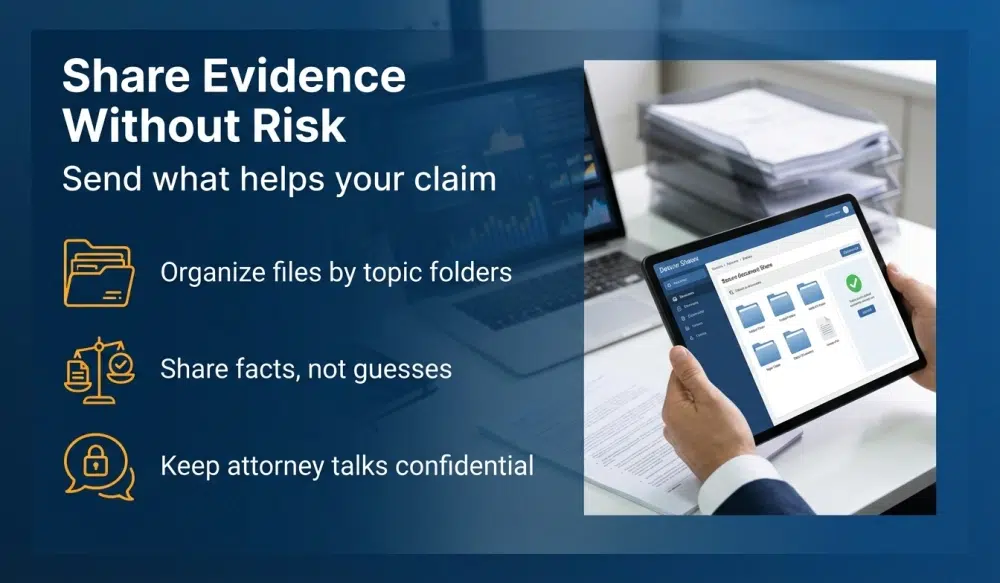
- Create a simple folder system. Scene photos, medical records, bills, pay records, property damage, and correspondence.
- Use a timeline. Summarize key dates for injuries, treatments, work absences, and expenses.
- Protect privilege. Do not share private attorney communications. If you are unsure whether something should be shared, hold it until you can get guidance.
- Be consistent. Make sure journal entries, medical notes, and work records tell a consistent story of injury and recovery.
What common evidence mistakes should you avoid after an accident?
- Waiting to seek care. Delays create gaps that insurers may argue are unrelated to the incident.
- Relying on one set of photos. Revisit the scene at a similar time of day to capture lighting and traffic patterns.
- Editing or overwriting files. Keep originals safe and make any working copies in separate folders [9].
- Missing legal deadlines. The two year statute for injury and the six month public entity claim rule are critical in California [1][2].
- Ignoring admissibility limits. Police reports may guide negotiations but have limits at trial under California law [5].
- Not sending preservation notices. Without notice, valuable video may be overwritten in days or weeks [9].
How can a Los Angeles personal injury lawyer use this checklist to help your case?
Coordinating evidence is time consuming. A lawyer can help gather time sensitive footage, interpret medical records, and prepare discovery. Organized documentation helps them evaluate liability, damages, and defense positions. They can also manage formal requests, subpoenas, and depositions under California discovery rules and address any spoliation concerns through motions and jury instructions when appropriate [10][11].
In serious highway pileups, intersection collisions, and freeway lane change disputes, accident lawyers can deploy preservation letters, request camera footage from adjacent properties, and work with treating providers to obtain certified medical records that satisfy the business records exception [6]. If you prefer to work with a local team that understands Los Angeles streets and agencies, Los Angeles accident lawyers can help manage communications with adjusters while you focus on treatment and recovery.
If you are dealing with a vehicle collision claim, many people look for car accident lawyers to organize documents and negotiate with insurers promptly. For those who want a local option, car accident lawyers in Los Angeles can align your photo set, police information, medical records, and wage documents into a clear package for claim evaluation.
Why choose GoSuits for technology driven personal injury representation?
Personal injury claims in Los Angeles often turn on the quality and timing of evidence. A free consultation can help you understand how photos, notes, medical records, and digital data fit together to support your claim in California courts. GoSuits represents clients in California civil injury matters throughout Los Angeles County and across the state.
- Technology first case building. We use exclusive proprietary software to collect, tag, and analyze evidence faster so we can move from intake to demand more efficiently.
- Designated attorneys for every client. Although we leverage technology to expedite litigation and negotiation, your case is handled by a dedicated attorney. We do not use case managers, and clients have direct access to their attorney for strategy and updates.
- Proven results and trial readiness. Our team brings 30 years of combined experience to negotiations and the courtroom. When cases need to be tried, trial experience helps present evidence clearly and respond to defense arguments.
- Broad personal injury coverage. We handle vehicle collisions, pedestrian and bicycle injuries, premises incidents, product cases, traumatic brain injuries, and wrongful death. See our full practice areas.
- Transparent track record. Review representative outcomes in our prior cases.
- Meet the team. Learn about the lawyers who will handle your case at our attorneys and visit about us to see how we lead with innovation.
With local knowledge of Los Angeles procedures and agencies, our technology driven process helps organize your injury evidence checklist into a clear, persuasive claim file while your attorney stays hands on from start to finish.
References and resources
- Cal. Code Civ. Proc. 335.1 Statute of limitations for injury to person – California Legislative Information
- Cal. Gov. Code 911.2 Time for presentation of claims to public entities – California Legislative Information
- Cal. Veh. Code 20008 Duty to report accidents involving injury or death – California Legislative Information
- SR 1 Traffic Accident Report requirements – California DMV
- Cal. Veh. Code 20013 Inadmissibility of accident reports in civil trials – California Legislative Information
- Cal. Evid. Code 1271 Records of regularly conducted activity – California Legislative Information
- Individuals right under HIPAA to access health information – U.S. Department of Health and Human Services
- Cal. Health and Safety Code 123110 Inspection and copies of patient records – California Legislative Information
- Federal Rule of Civil Procedure 37 ESI spoliation and sanctions – Legal Information Institute
- Cal. Code Civ. Proc. 2023.030 Sanctions for misuse of discovery – California Legislative Information
- Civil Jury Instructions CACI including willful suppression of evidence – California Courts
- Li v. Yellow Cab Co. of California 13 Cal.3d 804 – CourtListener
- Cedars Sinai Medical Center v. Superior Court 18 Cal.4th 1 – CourtListener
- Traffic collision and incident report requests – Los Angeles Police Department
- 2022 was the deadliest year for traffic collisions in Los Angeles – Los Angeles Department of Transportation
- Important facts about falls – Centers for Disease Control and Prevention