- What counts as a hit-and-run in Los Angeles and which California laws apply?
- What steps should you take immediately after a Los Angeles hit-and-run to protect your claim?
- How do you report a hit-and-run to LAPD and get the police report?
- Which insurance coverages can help after a hit-and-run in California?
- How do you file a UM or UIM claim and what deadlines apply?
- When and how do you file the DMV SR-1, and why does it matter?
- What evidence should you collect to support a Los Angeles hit-and-run claim?
- Can you recover if the at-fault driver is never identified?
- How does comparative negligence work in California hit-and-run cases?
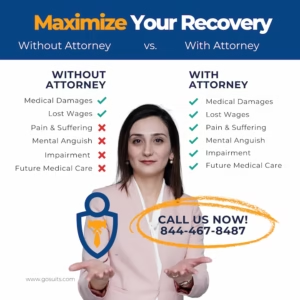
- What damages can you claim and how do you document them?
- What is the statute of limitations for California hit-and-run civil claims?
- What common mistakes should you avoid after a hit-and-run in Los Angeles?
- How do you request traffic camera or nearby video after a Los Angeles crash?
- What should defendants and insurers consider in a civil hit-and-run claim?
- Who is GoSuits and how do we help Los Angeles hit-and-run clients?
- References and resources
What counts as a hit-and-run in Los Angeles and which California laws apply?
In California, a hit-and-run occurs when a driver involved in a collision leaves without stopping and performing legal duties. If anyone is injured or killed, the driver must stop at the scene, provide identifying information, and provide reasonable assistance, including arranging medical help when needed under California Vehicle Code 20001 and 20003 [1] [3]. For property damage only collisions, the driver must stop and exchange information or leave a note on unattended property with contact details and promptly notify the owner under California Vehicle Code 20002 [2].
Separate from the criminal consequences, these duties also matter in civil claims. Violating a safety statute can create a presumption of negligence in civil court if the violation proximately caused the harm under Evidence Code 669, often called negligence per se [10]. That means if a driver flees and the underlying collision was caused by negligence, the statutory breach can weigh heavily in a civil liability analysis.
California also requires a driver to report any crash involving injury or death to a local police department or the California Highway Patrol within 24 hours if no officer has already documented the incident, under Vehicle Code 20008 [4]. This is distinct from insurance and DMV reporting, which are separate obligations discussed below.
What steps should you take immediately after a Los Angeles hit-and-run to protect your claim?
Safety and documentation come first. After any collision in Los Angeles, CA, especially a hit-and-run, take these practical steps to protect your health and your civil claim rights.
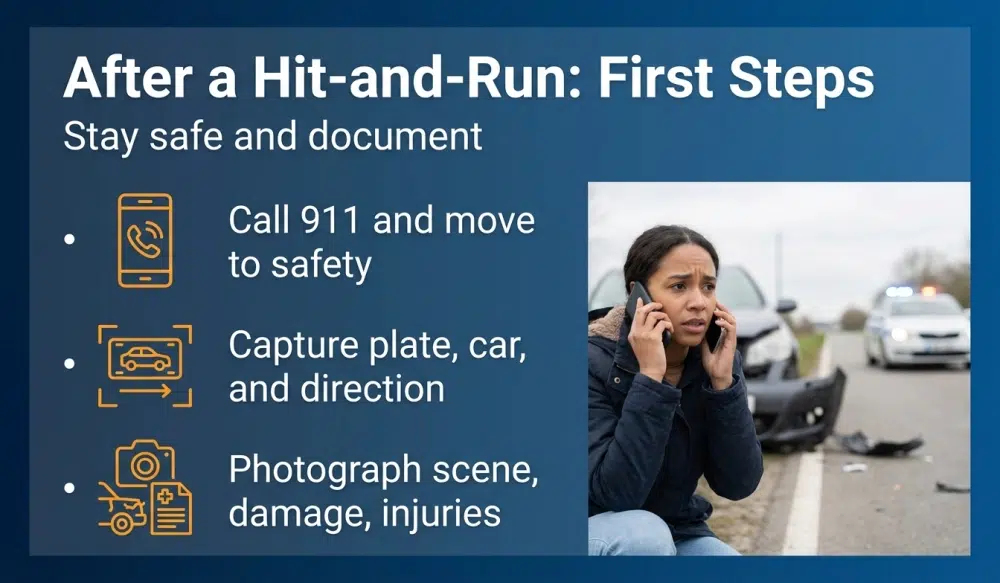
- Get to safety and call 911. Request police and medical help if there is any injury. Prompt care supports your health and creates contemporaneous records that insurers and courts rely upon [4].
- Do not chase the fleeing driver. Pursuit can create more danger. Focus on recalling what you can safely observe about the fleeing vehicle.
- Capture details immediately. Write down a license plate, partial plate, vehicle make, model, color, direction of travel, damage locations, and any distinguishing features. These details can help police locate the driver and can support an uninsured motorist claim if the driver is not found [5].
- Record the scene. Take photos and video of vehicle positions, debris, skid marks, traffic control devices, lighting, weather, and your injuries. Photograph damage close up and wide angle. Preserve dashcam footage if available.
- Identify witnesses. Collect names, phone numbers, and emails for any eyewitnesses or nearby businesses that may have cameras. Ask witnesses to text or email you their photos or videos right away.
- Report to law enforcement. If no officer responded, you must report any crash involving injury or death within 24 hours under Vehicle Code 20008. For property-only collisions, a prompt report can still be helpful for evidence and claim handling [4].
- File the DMV SR-1 within 10 days when required. California requires an SR-1 accident report to the DMV within 10 days for any crash with injury, death, or property damage over $1,000, regardless of fault and even if a police report exists [11].
- Notify your insurer quickly. You generally must report collisions promptly to preserve coverage. Early notice supports a stronger claim record and can trigger uninsured motorist and collision benefits when available [5] [13].
If you are evaluating whether to contact Los Angeles car accident lawyers, reaching out early can help you avoid missteps with statements, privacy waivers, and critical deadlines that affect your rights.
How do you report a hit-and-run to LAPD and get the police report?
In Los Angeles, you can call 911 for emergencies or injury collisions and ask for LAPD response. For non-emergencies, you can use local non-emergency lines or visit a station to complete a counter report. California law requires reporting an injury crash within 24 hours if no officer has already documented it under Vehicle Code 20008 [4]. When you speak with police, mention that you need to report hit and run LAPD, give all details you collected, and provide any video or photographs.
To get a copy of your police report, ask the officer for the DR number or incident number. In some situations, especially collisions on state freeways or unincorporated areas, the California Highway Patrol may handle the report. CHP provides instructions for requesting traffic collision reports, typically using their request process and form with the report number and a fee [12].
Keep in mind that a police report is not always admissible to prove fault at trial, but it is often crucial for insurance investigations and for locating the fleeing driver. If the report is not ready, mark your calendar to follow up.
Which insurance coverages can help after a hit-and-run in California?
California requires liability insurance with minimum limits of 15,000 per person, 30,000 per occurrence for bodily injury, and 5,000 for property damage under Vehicle Code 16056, sometimes called 15-30-5 [6]. These minimums apply to the at-fault driver. If a hit-and-run driver is identified and insured, a claim proceeds against that liability policy.
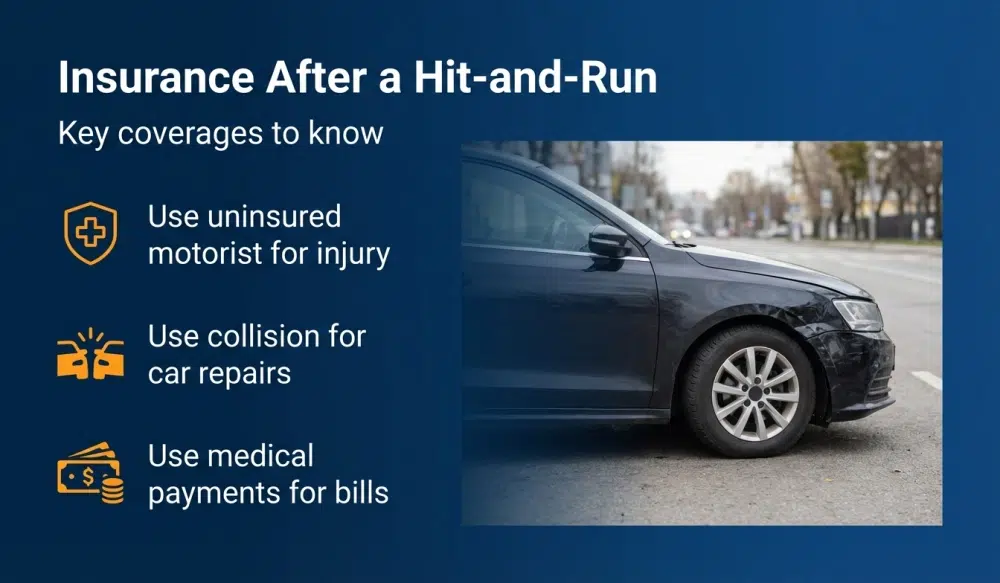
If the hit-and-run driver is not located or is uninsured, your own coverages may apply:
- Uninsured Motorist Bodily Injury. California insurers must offer uninsured and underinsured motorist coverage, which you may accept or reject in writing. This coverage can pay for bodily injury caused by an uninsured or unknown hit-and-run driver, subject to policy terms [5].
- Uninsured Motorist Property Damage. Some policies include UMPD that can pay for vehicle damage caused by an uninsured or unknown driver. Many policies require physical contact with the hit-and-run vehicle to reduce fraud risk. Review your declarations and policy wording [5].
- Collision coverage. Collision can pay for damage to your vehicle regardless of fault, subject to your deductible. Your insurer may later pursue subrogation if the hit-and-run driver is found.
- Medical payments coverage. MedPay can cover reasonable medical expenses regardless of fault, up to policy limits, without copays or deductibles, which can be helpful while liability is investigated.
Insurers must acknowledge claims promptly, investigate, and accept or deny coverage within specific timeframes under the Fair Claims Settlement Practices Regulations administered by the California Department of Insurance [13]. If coverage applies, these timelines help keep your claim moving.

How do you file a UM or UIM claim and what deadlines apply?
For a hit-and-run, you typically open a claim with your own insurer under Uninsured Motorist coverage. Important steps include notifying the insurer, cooperating with reasonable requests, and proving the other driver was at fault and uninsured or unknown. California Insurance Code 11580.2 governs UM and UIM coverage and contains key procedural requirements [5].
- Notify promptly in writing. Give the carrier the date, time, location, and a description of the hit-and-run. Provide the police report number once available and any witness information.
- Submit proof of claim. Provide medical records and bills, wage loss documentation, photos, and estimates. Insurers must respond within regulatory deadlines and make a fair coverage decision [13].
- Mind the formal UM timeline. California law sets a two-year deadline to commence a lawsuit against the uninsured motorist or to formally demand UM arbitration, subject to policy terms. Missing that can bar the claim, so track it carefully [5].
- Be careful with recorded statements. Provide truthful information, but avoid speculation about speed or fault. It is reasonable to request to submit a written statement after you have reviewed the police report.
If you are working with car accident lawyers, they can organize a demand package, calculate damages, and calendar the Insurance Code and policy timelines to protect the UM/UIM claim path.
When and how do you file the DMV SR-1, and why does it matter?
California requires every driver to submit a Report of Traffic Accident Occurring in California, known as the SR-1, to the DMV within 10 days if the crash involved injury, death, or property damage over $1,000. This applies regardless of who was at fault and even if a police report was taken [11].
- Where to find the form. The DMV publishes the SR-1 form and instructions online [11].
- What to include. Provide date, time, location, vehicle information, insurance details, and a brief description. If the at-fault driver fled, note that the driver is unknown and provide any identifying details you collected.
- Why it matters. The SR-1 helps the DMV enforce financial responsibility laws. Failure to file can affect license status and can complicate insurance claims if the DMV records do not reflect the accident [6] [11].
What evidence should you collect to support a Los Angeles hit-and-run claim?
Strong evidence can make the difference in proving fault, damages, and coverage under UM provisions. Use this practical checklist.
- Scene documentation. Photos and video of roadway layout, traffic signals, skid marks, debris, and vehicle rest positions.
- Vehicle damage mapping. Close-ups of impact areas, paint transfers, and crush patterns that can show the angle and force of impact.
- Injury evidence. Immediate medical evaluations, follow-up records, prescriptions, and diagnostic imaging support causation and damages.
- Witness statements. Obtain contact information and short written or recorded statements while memories are fresh.
- Digital evidence. Preserve dashcam video, phone photos, and any telematics data. Save files redundantly with date stamps.
- Nearby cameras. Ask adjacent businesses and residences for surveillance footage. Many systems overwrite within days, so act quickly.
- Public records requests. For government-held records like certain city video or dispatch logs, use California’s Public Records Act process to request copies. Departments must respond within statutory timelines, with limited exemptions [15].
- Police and CHP reports. Obtain the completed report, supplemental reports, and any traffic collision photos or diagrams through the agency’s records request process [12].
Can you recover if the at-fault driver is never identified?
Yes, many California policies provide Uninsured Motorist coverage that applies when a driver cannot be identified, subject to policy conditions such as requiring evidence of physical contact with the fleeing vehicle. To recover under UM, you still need to prove negligence, causation, and damages, and comply with the Insurance Code and policy procedures [5].
Two civil timeframes matter in these cases. First, California’s general personal injury statute of limitations is two years from the date of injury under Code of Civil Procedure 335.1 [7]. Second, to preserve UM benefits, you must meet the formal demand or filing timeline under Insurance Code 11580.2, commonly two years, though policy terms can add notice requirements [5]. Early action helps align both tracks.
How does comparative negligence work in California hit-and-run cases?
California follows pure comparative negligence. A plaintiff’s damages are reduced by their percentage of fault, but recovery is not barred unless the fault is 100 percent. The Supreme Court adopted comparative negligence in Li v. Yellow Cab Co., which remains the foundation for apportioning responsibility at trial and in settlement discussions [14].
Comparative fault can arise in many scenarios, such as disputes over speed, signaling, or lane changes. If the fleeing driver is identified, their violation of safety statutes like the duty to stop and render aid can support negligence per se under Evidence Code 669 when the statutory breach is a substantial factor in the injuries [10]. If the driver is never found, UM claim evaluators still analyze comparative negligence with available evidence like scene measurements, vehicle damage, and witness accounts.
What damages can you claim and how do you document them?
California civil law allows recovery of economic and non-economic damages in personal injury cases caused by negligence. After a hit-and-run, common categories include:
- Medical expenses. Ambulance, emergency care, imaging, follow-up visits, therapy, and necessary future care, supported by medical records and billing statements.
- Lost income and earning capacity. Wage statements, employer letters, tax returns, and expert analysis for longer-term impairments.
- Property damage. Vehicle repair or total loss value, towing, storage, and personal property damaged in the crash.
- Out-of-pocket costs. Transportation to medical visits, home modifications, and medical equipment with receipts.
- Pain, suffering, and inconvenience. Daily impact evidence like symptom journals, family statements, and activity limitations.
Document everything from day one. Maintain a single claim folder with bills, records, photos, and correspondence. Organized documentation accelerates insurer evaluation under California’s fair claims rules [13].
What is the statute of limitations for California hit-and-run civil claims?
California’s general deadline to file a personal injury lawsuit is two years from the date of injury under Code of Civil Procedure 335.1 [7]. Property damage claims often carry a three-year deadline under Code of Civil Procedure 338 [8]. There are important shorter deadlines:
- Government claims. If a government entity may be liable, you generally must file an administrative claim within six months under Government Code 911.2 before any lawsuit [9].
- UM arbitration or suit. Many UM claims must be formally demanded or filed within two years under Insurance Code 11580.2, subject to policy wording [5].
- DMV report. The SR-1 must be filed within 10 days if the thresholds are met, which is separate from any lawsuit deadline [11].
Because deadlines can overlap, calendar all time limits as soon as possible and avoid waiting until the end of any period, especially where investigation and medical treatment are ongoing.
What common mistakes should you avoid after a hit-and-run in Los Angeles?
These preventable errors often undermine otherwise valid claims:
- Not calling 911. Delayed reporting can weaken causation and injury proof, and injury crashes must be reported within 24 hours under Vehicle Code 20008 [4].
- Skipping medical evaluation. Waiting days to see a provider invites disputes over whether the crash caused the injury.
- Missing the SR-1 filing. Failing to submit the DMV SR-1 within 10 days when required can affect license status and complicate insurance handling [11].
- Giving speculative statements. Guessing about speed or fault in recorded calls can be used against you. Stick to facts you know.
- Repairing the vehicle too quickly. Arrange insurer and, if needed, expert inspections first. Photos alone may not capture all evidentiary value.
- Posting on social media. Public posts can be misconstrued. Keep details private while your claim is pending.
- Letting deadlines lapse. Track the two-year personal injury period, three-year property damage period, any government claims deadline, and the UM arbitration timeline [5] [7] [8] [9].
- Not leveraging fair claims rules. California regulations require timely insurer responses and fair evaluation. Use those requirements to keep the claim on track [13].
How do you request traffic camera or nearby video after a Los Angeles crash?
Video evidence can be decisive. In Los Angeles, city-operated traffic management cameras are designed primarily for real-time traffic flow and may not retain recordings for public release. However, you still have several avenues:
- Private cameras. Ask nearby businesses, residences, and parking structures to preserve and share footage. Many systems overwrite within days.
- Public records requests. For any government-held footage or dispatch logs, submit a California Public Records Act request to the appropriate agency. Agencies must respond within statutory timelines and identify any applicable exemptions [15].
- Law enforcement. Provide your incident details and request that police seek video from nearby sources during their investigation. Follow up politely and document your requests.
- Preservation letters. Send written preservation notices to potential custodians as soon as you can. Prompt, specific requests help avoid loss of relevant evidence.
What should defendants and insurers consider in a civil hit-and-run claim?
Defendants and claims professionals in California face unique issues in hit-and-run scenarios:
- Coverage triggers. UM coverage applies only if policy conditions are met. Confirm physical contact requirements, reporting timelines, and proof standards under Insurance Code 11580.2 and policy terms [5].
- Fair claims compliance. Acknowledge, investigate, and accept or deny promptly. Keep clear claim notes and provide reasons for decisions under California’s Fair Claims regulations [13].
- Comparative fault analysis. Evaluate all evidence for apportionment, including scene geometry, vehicle damage, and visibility conditions. Consider the effect of negligence per se where statutory duties were breached [10] [14].
- Subrogation and restitution. If the driver is later identified, pursue reimbursement and coordinate with any criminal restitution orders.
- Government claims. If roadway conditions or signal timing are alleged factors, calendar Government Code claim deadlines and evaluate design immunity and notice issues [9].
Who is GoSuits and how do we help Los Angeles hit-and-run clients?
Hit-and-run cases can be stressful and complex. A focused legal team can organize evidence, coordinate with police, and navigate UM coverage and deadlines while you heal. At GoSuits, we represent injured people and families across Los Angeles, CA and throughout California in civil injury and property damage cases. We offer a free consultation so you can understand your options and next steps without pressure.
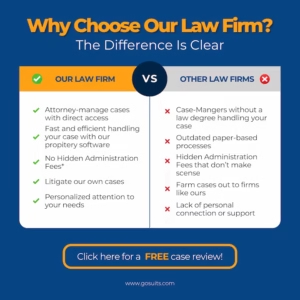
We use an exclusive proprietary software platform to accelerate case investigation, claims submissions, and litigation workflows. Our technology-driven approach is paired with hands-on lawyering. Every client works directly with a designated attorney from start to finish. We do not pass clients to case managers. You have unfettered access to your attorney for strategy, updates, and preparation.
Our team brings 30 years of combined experience and a record of outcomes across negotiations, arbitrations, and trials. We prepare cases for trial from day one, which strengthens settlement leverage and positions your case for the courtroom when needed. You can see a selection of outcomes at prior cases, learn more about the people who will stand with you at our attorneys, and explore our practice areas and about us.
We routinely handle car, truck, motorcycle, pedestrian, and rideshare collisions, as well as premises incidents and serious injury cases in Los Angeles Superior Court and other California venues. If you were injured in a Los Angeles hit-and-run, we can help you document the scene, coordinate the SR-1, open and pursue a UM/UIM claim, and press forward in court when appropriate. We are committed to clarity, communication, and speed, supported by modern tools tailored to civil litigation.
References and resources
- Vehicle Code 20001 Duty to Stop at Scene of Injury or Death – California Legislature
- Vehicle Code 20002 Duty in Property-Damage-Only Collisions – California Legislature
- Vehicle Code 20003 Duty to Give Information and Render Aid – California Legislature
- Vehicle Code 20008 Duty to Report Injury or Death Collisions Within 24 Hours – California Legislature
- Insurance Code 11580.2 Uninsured and Underinsured Motorist Coverage – California Legislature
- Vehicle Code 16056 Financial Responsibility Minimum Limits – California Legislature
- Code of Civil Procedure 335.1 Two-Year Personal Injury Limitations Period – California Legislature
- Code of Civil Procedure 338 Three-Year Property Damage Limitations Period – California Legislature
- Government Code 911.2 Government Claims Act Presentment Deadline – California Legislature
- Evidence Code 669 Negligence Per Se – California Legislature
- SR-1 Report of Traffic Accident Occurring in California Form – California DMV
- Traffic Collision Report Request Instructions – California Highway Patrol
- Fair Claims Settlement Practices Regulations Overview – California Department of Insurance
- Li v. Yellow Cab Co. of California, 13 Cal.3d 804 – CourtListener
- California Public Records Act Overview – Office of the Attorney General