- What counts as a hit and run in Dallas under Texas law?
- What are the first steps to take at the scene to protect your claim?
- How do you report a Dallas hit and run and get the CR 3 crash report?
- What evidence should you gather and how do you preserve it?
- Can dash cam and business video help and how do you secure it fast?
- How does Texas insurance handle hit and run claims including UM UIM, PIP, and MedPay?
- What if the at fault driver is never found in Dallas?
- What deadlines and statutes of limitations apply to Texas hit and run claims?
- How does Texas spoliation law affect your evidence and case strategy?
- How are damages proven after a hit and run and what documents matter?
- Do witness statements and 911 recordings help and are they admissible?
- What should you tell insurers after a Dallas hit and run and what should you avoid?
- How do criminal hit and run charges relate to your civil injury claim?
- How can GoSuits help with a Dallas hit and run injury claim?
- References and resources
What counts as a hit and run in Dallas under Texas law?
In Texas, a hit and run is a crash where a driver fails to stop and meet their legal duties after causing injury, death, or property damage. For crashes with injury or death, the law requires the driver to immediately stop at or return to the scene, determine whether anyone needs aid, and remain until they provide identifying information and reasonable assistance. Leaving the scene can be charged as a felony when there is injury or death [1]. For crashes with vehicle damage only, a driver must stop and exchange information with the other person or leave a note and report to police when the owner cannot be located [2]. Regardless of fault, drivers have duties at the scene and serious penalties can apply for failing to comply [1].
Texas also requires drivers to notify law enforcement of certain crashes. When injury, death, or disabling damage to a vehicle occurs, you must immediately report the crash to police, the sheriff, or highway patrol. Officers who respond must complete an official crash report when the statutory conditions are met [3].
What are the first steps to take at the scene to protect your claim?
Your choices in the minutes after a Dallas hit and run can shape the evidence your civil claim will rest on. Consider the following steps focused on safety, compliance, and preserving proof.
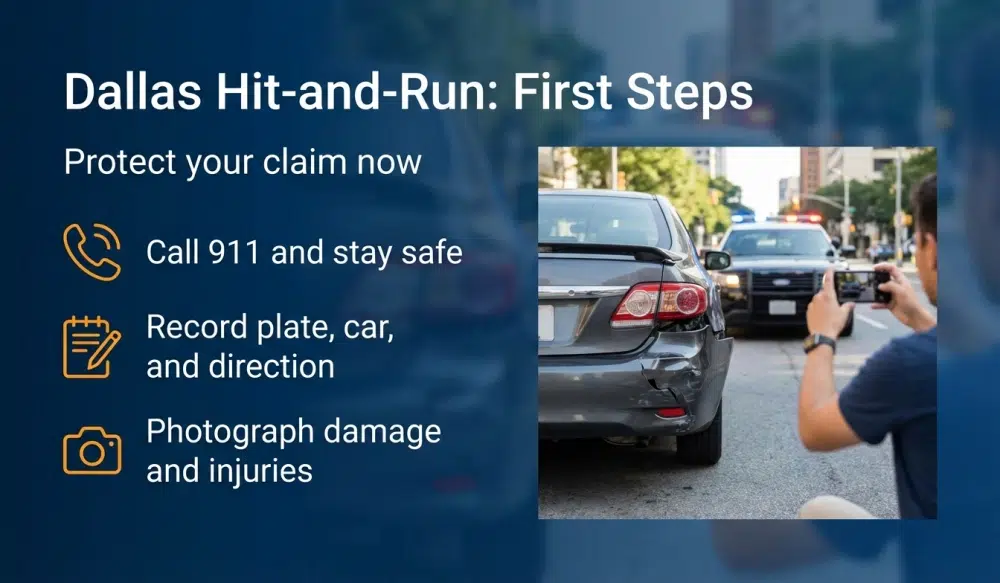
- Prioritize safety and call 911. Move to a safer location if possible, activate hazard lights, and call 911 to report the crash, request medical help, and document the event. Immediate reporting is required in crashes with injury or disabling damage [3].
- Do not chase the fleeing driver. Pursuits can increase the risk of additional harm. Use your attention to observe details that can help identify the vehicle and driver.
- Capture identifying details. Write down the license plate if seen, vehicle make, model, color, unique markings, direction of travel, and any description of the driver. Even partial plates can be useful.
- Check for cameras. Note any nearby businesses, homes, or traffic cameras that might have recorded the collision or the fleeing vehicle. Time is critical to secure that footage.
- Document the scene. Take photographs and short videos showing your vehicle damage, skid marks, debris, road conditions, traffic signals, injuries, and the scene context from multiple angles.
- Identify and save witnesses. Get names, phone numbers, and emails for anyone who saw the crash or the fleeing vehicle. Ask witnesses to record a quick voice memo on your phone while details are fresh.
- Seek medical care. Tell providers you were in a hit and run so your records reflect the mechanism of injury. Follow up and keep every medical bill and record.
- Notify your insurer. Promptly notify your insurer about a hit and run. Uninsured motorist claims often require a timely police report and prompt notice to your carrier [8].
If your injuries are serious, engaging car accident lawyers early can help preserve evidence, coordinate with investigators, and guide communications with insurers while you focus on recovery.
How do you report a Dallas hit and run and get the CR 3 crash report?
After emergency responders arrive, officers investigate and, when required by law, complete the official Texas Peace Officer’s Crash Report, known as the CR 3. Many insurers and courts rely on the CR 3 for basic facts about the collision, road conditions, and any citations or suspected contributing factors. Once processed, you can request a copy directly through the state system. The Texas Crash Records Information System provides an online purchase portal where you can search by name, date, and location to obtain the CR 3 report when it is available [4]. Retain the transaction confirmation and the report itself for your claim file.
Statewide crash statistics can help contextualize your claim. Texas continues to experience a significant number of serious crashes each year, with thousands of fatalities and many more injuries reported statewide [7]. This backdrop underscores why detailed documentation and timely reporting are so important.

What evidence should you gather and how do you preserve it?
Evidence drives civil cases. The more complete and credible your proof, the clearer your liability case and damages picture become. Build a simple Dallas car accident evidence checklist focused on four categories: scene, medical, property, and insurance.
- Scene evidence. Photos, videos, debris patterns, road markings, signage, and time stamped location data. Keep originals and untouched copies. Save phone metadata and export the original files.
- Witness accounts. Written or recorded statements with contact information, including any observations about the fleeing vehicle’s plate, path, and driver behavior. Witness accounts taken close in time are often more reliable.
- Medical proof. Emergency records, imaging, specialist consults, physical therapy notes, prescriptions, and work restriction notes. Consistency between your reported symptoms and objective findings supports causation.
- Property and repair. Estimates, invoices, parts lists, photographs before and after repairs, and any diminished value assessments for your vehicle.
- Insurance documents. Your policy declarations page, proof of UM or UIM limits, PIP or MedPay documents, and all correspondence with your insurer.
Preservation is as important as collection. In Texas, once a claim is reasonably anticipated, parties have duties to preserve relevant evidence. Courts may impose remedies if critical evidence is destroyed. The Supreme Court of Texas has emphasized that spoliation remedies focus on fairness, with sanctions calibrated to the culpability and prejudice arising from lost evidence [10]. Act quickly to preserve and request key evidence so you avoid later disputes.
Can dash cam and business video help and how do you secure it fast?
Video can be the difference between a claim that stalls and one that proceeds with clear liability proof. Dash cam footage often captures the crash and the exact path of a fleeing vehicle. Many businesses retain exterior camera footage on short retention cycles. To increase your odds of obtaining video:
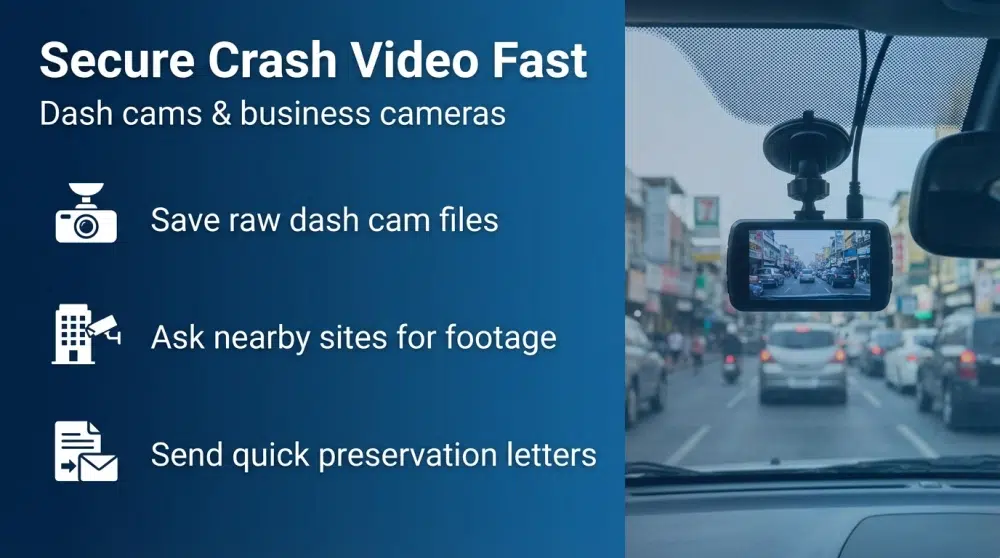
- Secure your own dash cam files. Immediately remove the memory card or copy the raw files to a separate device to prevent overwriting. Keep an original and a working copy.
- Canvas nearby locations. Politely ask businesses, homes, and property managers if their cameras may have captured the crash or escape route. Note camera positions and time offsets.
- Send preservation requests. Promptly send written preservation letters to likely custodians asking them to preserve footage and stating the date, time, and area of interest. Texas courts evaluate preservation efforts when considering spoliation issues [10].
- Request public records where available. For 911 audio, computer aided dispatch logs, and certain law enforcement records, you may submit a public information request under the Texas Public Information Act. Many records have statutory exceptions, but timely requests can help you secure accessible records [12].
How does Texas insurance handle hit and run claims including UM UIM, PIP, and MedPay?
Texas law requires auto insurers to offer uninsured and underinsured motorist coverage, often called UM and UIM. This coverage helps when the negligent driver has no insurance, not enough insurance, or cannot be identified such as a hit and run. A policyholder can reject UM or UIM in writing, but if not rejected, the coverage should appear on the declarations page [6]. Personal Injury Protection is also required to be offered, and it provides certain medical and lost income benefits regardless of fault unless rejected in writing [8]. Some policies also include Medical Payments coverage which can help with medical bills regardless of fault [8].
Texas courts have explained that the UM UIM insurer’s obligation to pay benefits depends on establishing the liability of the uninsured or unknown motorist and the insured’s legal damages. In a leading case, the Supreme Court of Texas held that the insurer’s duty to pay UIM benefits arises after the insured proves the third party’s liability and the amount of damages. This framework affects when an insurer can be said to have breached the policy and when attorney fee statutes may apply [9]. Understanding this timing helps you plan the progression of a Texas uninsured motorist claim [9].
Two practical takeaways for policyholders in Dallas:
- Report promptly and request a claim number. Many policies require prompt notice and a police report for unidentified motorist claims. Delays can trigger disputes over coverage [8].
- Document damages thoroughly. Because the UM UIM carrier stands in the shoes of the unknown driver, you must prove negligence and damages with the same depth you would in a claim against the at fault driver [9].
What if the at fault driver is never found in Dallas?
When the driver is not identified, you may pursue benefits under your UM coverage if it was not rejected in writing. Texas policies often require physical contact for a phantom vehicle claim or corroborating evidence when contact is disputed. Even without the driver’s identity, you can build liability with scene documentation, witness statements, and expert analysis of vehicle damage and trajectories. Personal Injury Protection or Medical Payments coverage can help address medical costs in the interim if those coverages are shown on your policy [8].
National data reflects the human cost of hit and run collisions, with fatalities associated with drivers who flee continuing to be a concern, reinforcing the policy reasons for UM coverage and strong civil remedies [13]. In practical terms, you should continue canvassing for cameras, recontacting witnesses, and checking for supplemental investigative leads while your claim proceeds.

What deadlines and statutes of limitations apply to Texas hit and run claims?
Texas law provides a two year limitations period for personal injury claims counted from the date of injury. This deadline applies to negligence claims arising from motor vehicle collisions, including hit and run events [5]. Wrongful death actions have specific timing rules that also generally track a two year limit from the date of death with specific exceptions not addressed here [5]. UM and UIM claims are governed by both contract and tort concepts, but the Brainard framework means you should plan the timeline to establish the unknown driver’s liability and your damages while observing any contractual claim deadlines and proof of loss requirements [9]. Missing these time limits can bar otherwise valid claims.
To avoid deadline issues, track three clocks in your Dallas hit and run case.
- Police report timing. Immediate reporting is required by statute for injury crashes and disables vehicle crashes [3].
- Policy deadlines. Policies often require prompt notice and medical proof within a defined period. Review your declarations and policy forms closely [8].
- Statutory limitations. File suit within two years for injury claims, and coordinate UM UIM litigation strategy consistent with Texas case law on when the insurer’s duties are triggered [5][9].
How does Texas spoliation law affect your evidence and case strategy?
Texas has a well developed spoliation framework. When a party fails to reasonably preserve relevant evidence after the duty to preserve has arisen, courts may impose remedies to level the playing field. The Supreme Court of Texas outlined that spoliation findings are made by the court, not the jury, and that sanctions should be no more severe than necessary to remedy the prejudice. A spoliation instruction to the jury is permitted only when intentional destruction significantly impairs the nonspoliating party’s ability to present its case or when lesser sanctions would not suffice [10]. This makes early preservation steps vital. Send preservation letters to likely custodians, secure your own devices and records, and work with your insurer to prevent loss of vehicle data, event data recorder content, and telematics.
Texas appellate decisions continue to apply the high court’s standard, reminding litigants that thoughtful, early preservation can avoid sanctions disputes and protect the merits of the case [11]. Treat video and electronic evidence as perishable and move quickly.
How are damages proven after a hit and run and what documents matter?
In civil cases, you bear the burden to prove both liability and damages by a preponderance of the evidence. For harms arising from a Dallas hit and run, consider organizing proof in these categories.
- Medical damages. Emergency bills, hospitalizations, surgeries, therapy, medications, and future care projections. Medical records should link diagnoses to the collision mechanism.
- Lost income and earning capacity. Employer letters, pay stubs, tax returns, and expert analysis for longer term losses when injuries are permanent or career limiting.
- Pain, suffering, and physical impairment. Journals, family and coworker observations, and provider notes that document activity limitations and life impacts.
- Property loss. Repair estimates, parts invoices, rental car and transportation receipts, and credible diminished value assessments.
You can also use demonstrative evidence such as collision diagrams, reconstruction visuals, and photos that help a jury or adjuster connect the dots. Because your UM UIM insurer contests liability and damages in the shoes of the unknown driver, treat the presentation with the same rigor as if you were suing the other driver directly, consistent with Texas law on uninsured motorist claims [9]. When in doubt, over document rather than under document.
Do witness statements and 911 recordings help and are they admissible?
Neutral witness statements can be powerful proof of negligence and can help corroborate your version of events when the at fault driver flees. Statements recorded close in time to the crash can be heard more favorably by insurers and may fit evidentiary exceptions when properly offered in litigation. Texas follows evidentiary rules that recognize exceptions to hearsay for present sense impressions and excited utterances when the requirements are satisfied. These rules are detailed in the Texas Rules of Evidence and guide what may be admitted at trial [14]. While admissibility is fact specific, immediate 911 calls and contemporaneous statements often carry significant weight.
Public information requests can help obtain available 911 audio and dispatch logs, though some records are exempt. The Texas Public Information Act outlines your rights and the government’s obligations, timelines, and exemptions [12]. Making a timely request can help preserve important corroboration.
What should you tell insurers after a Dallas hit and run and what should you avoid?
Communication with insurers is important but should be careful and concise.
- Notify promptly. Provide the date, time, location, a brief description, and the police report number once assigned. Confirm your UM UIM and PIP benefits on the declarations page [8].
- Stick to facts. Avoid speculation about speed, distraction, or motivations of the fleeing driver. Let the evidence and official report develop.
- Do not downplay injuries. Describe symptoms accurately and follow medical advice. Gaps in treatment can undermine causation claims.
- Be cautious with recorded statements. You may be required to cooperate with your own carrier, but you are not required to speak to any other insurer. Request copies of any recordings and transcriptions for your file.
- Track all claim deadlines. Keep a calendar of proof of loss, medical exams, and documentation deadlines in your policy [8].
If questions arise about coverage or process, Dallas car accident lawyers can help coordinate statements, clarify obligations, and present your documentation in the most effective sequence for settlement discussions or litigation.
How do criminal hit and run charges relate to your civil injury claim?
Leaving the scene of a crash with injury or death is a serious offense under Texas law, exposing drivers to felony charges with significant penalties [1]. Criminal investigations and prosecutions can move in parallel with civil claims. Key points for your civil case planning include:
- Independent standards of proof. Criminal cases require proof beyond a reasonable doubt. Civil cases use a preponderance standard. A criminal case outcome does not control the civil outcome, though it can influence it.
- Access to records. Some criminal records are protected during active investigations. You can still request public records where permitted, and later obtain certified records for use in civil proceedings [12].
- Restitution versus damages. Criminal restitution is distinct from civil damages and is not a substitute for pursuing bodily injury and other civil remedies.

How can GoSuits help with a Dallas hit and run injury claim?
Hit and run cases in Dallas can be complex because the at fault driver may be unknown and the evidence window is short. A free consultation with a personal injury attorney can help you understand coverage, secure key evidence quickly, and plan a pathway that fits Texas law on UM UIM, spoliation, and deadlines. At GoSuits, we serve clients throughout Texas with a technology driven approach built for speed and precision. Our exclusive proprietary software coordinates evidence capture, medical records, and insurance data in one place to reduce delays and improve clarity for negotiations and trial.
We pair innovation with people. Although we use technology to expedite each case, every client works directly with a designated attorney. We do not use case managers, and clients have unfettered access to their lawyer for strategy, updates, and preparation. Our team brings more than 30 years of combined experience, including extensive trial work that informs how we investigate, evaluate, and present Dallas hit and run claims. You can review a selection of past results here: prior cases, meet the team here: our attorneys, and learn more about the firm here: about us.
We handle a wide spectrum of personal injury matters, including car collisions, trucking crashes, motorcycle incidents, premises injuries, construction injuries, product defect claims, and wrongful death. See the full list here: practice areas. We practice across Texas and are available to help you take the next step toward obtaining the documentation, medical proof, and insurance responses your Dallas claim requires. If you prefer, call +1 844 467 8487 to speak with our team about your situation and options.
If you are comparing options for representation, car accident lawyers can coordinate liability proof, preserve scene and video evidence, and structure your UM UIM presentation consistent with Texas case law. When you want local support, Dallas car accident lawyers can add on the ground coordination for canvassing and court logistics while your case is being prepared for settlement discussions or trial.
References and resources
- Texas Transportation Code § 550.021 Duty to stop and render aid – Texas Legislature Online
- Texas Transportation Code § 550.022 Accident involving damage to vehicle – Texas Legislature Online
- Texas Transportation Code § 550.026 Immediate report of accident – Texas Legislature Online
- Crash Report Online Purchase System CRIS – Texas Department of Transportation
- Texas Civil Practice and Remedies Code § 16.003 Limitations for personal injury – Texas Legislature Online
- Texas Insurance Code § 1952.101 Uninsured or underinsured motorist coverage offer – Texas Legislature Online
- Texas Motor Vehicle Crash Facts 2022 – Texas Department of Transportation
- Auto insurance guide, UM UIM and PIP overview – Texas Department of Insurance
- Brainard v. Trinity Universal Insurance Co., 216 S.W.3d 809 Tex. 2006 – Supreme Court of Texas
- Brookshire Brothers, Ltd. v. Aldridge, 438 S.W.3d 9 Tex. 2014 – Supreme Court of Texas
- In re Farmers Texas County Mutual Insurance Co., No. 03 15 00527 CV – Texas Court of Appeals
- What information is public under the Texas Public Information Act – Office of the Attorney General of Texas
- Traffic fatalities 2021 annual overview – National Highway Traffic Safety Administration
- Texas Rules of Evidence resource page – Texas Courts
- Crime Victims’ Compensation Program overview – Office of the Attorney General of Texas