-
- What should you know if an e-bike or scooter battery exploded?
- What do current statistics show about e-bike and scooter battery fires?
- How do lithium-ion batteries fail and what is thermal runaway?
- Who can be liable in an exploding battery lawsuit for e-bikes and scooters?
- What legal theories apply to an e-bike or scooter battery explosion case?
- What evidence should you preserve after a lithium-ion battery fire?
- How do CPSC recalls and investigations affect your claim?
- What damages can you seek in an e-bike or scooter battery explosion lawsuit?
- What are the statutes of limitations and statutes of repose in TX, CA, and IL?
- How do misuse and comparative fault impact a battery explosion case?
- Should you file a class action or an individual lawsuit?
- What is the typical process and timeline for an exploding battery lawsuit?
- How do insurance policies interact with product liability claims for battery fires?
- What safety standards and certifications matter for e-bikes and their batteries?
- How can a product liability attorney help with an e-bike or scooter battery explosion?
- How does GoSuits help victims of exploding e-bike and scooter batteries?
- Official resources and references
What should you know if an e-bike or scooter battery exploded?
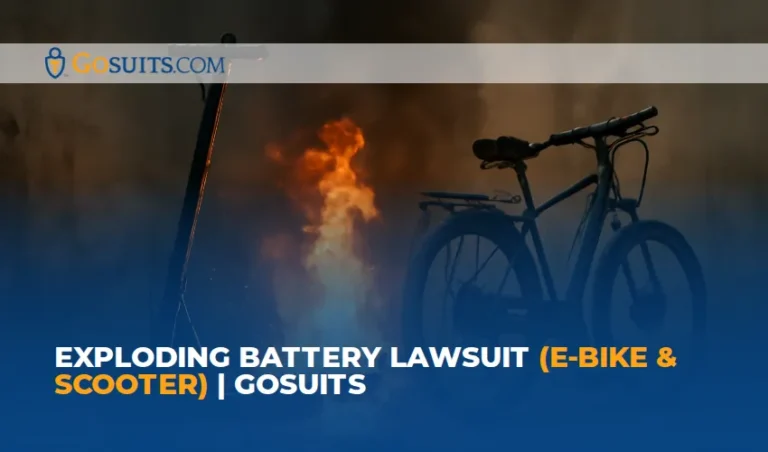
If you or a loved one were hurt by an exploding e-bike or scooter battery, you are dealing with unexpected injuries, smoke inhalation, lost work, and property loss. Lithium-ion batteries can fail catastrophically, leading to fast-moving fires and explosions. In civil cases, you may pursue an exploding battery lawsuit against the companies that designed, manufactured, imported, assembled, distributed, or sold the product. These cases often hinge on product defect and failure to warn theories under state law, along with federal safety guidance, recall records, and battery forensic analysis.
We understand this is stressful. Your immediate priorities are medical care, safe housing if there was a fire, and preserving evidence. We encourage you to get legal help early. Product manufacturers and insurers act quickly to limit exposure, and batteries or scorched devices can be lost or discarded if steps are not taken to preserve them for testing.
What do current statistics show about e-bike and scooter battery fires?
Public safety agencies have documented a marked increase in incidents tied to lithium-ion batteries powering micromobility products like e-bikes and e-scooters:
- National micromobility concerns. The U.S. Consumer Product Safety Commission (CPSC) publishes safety education for micromobility products and highlights risks from battery failures, including fires and explosions. See the CPSC’s micromobility safety center for official guidance (cpsc.gov).
- Local trend data in major cities. The New York City Fire Department reported a surge of lithium-ion battery fires tied to e-bikes and e-scooters, with multiple fatalities and hundreds of incidents in recent years (nyc.gov).
- Federal fire safety analysis. The U.S. Fire Administration highlights that damaged or improperly charged lithium-ion batteries can enter thermal runaway, creating toxic smoke and intense fires that spread rapidly (usfa.fema.gov).
While numbers vary by year and location, trends from the CPSC and major fire departments demonstrate that lithium-ion battery fires have caused fatalities, severe burns, and large property losses. These official resources are frequently cited by courts and investigators when evaluating risk, warnings, and safety measures.
How do lithium-ion batteries fail and what is thermal runaway?
Lithium-ion battery failures often involve a chain reaction called thermal runaway. In simple terms, a defect, damage, or abusive condition causes heat inside the cell to build until it vents flammable gases and ignites neighboring cells. This can produce rapid flame spread and explosions.
- Mechanism. Researchers describe thermal runaway as a self-heating reaction that accelerates, often triggered by internal short circuits, overcharging, manufacturing defects, or external damage (nist.gov).
- Contributing factors. Poor-quality cells, lack of protective battery management systems, noncompliant chargers, and inadequate warnings can raise risk. Charging near combustible materials and using mismatched or uncertified chargers also increases hazard potential, as highlighted by CPSC safety guidance (cpsc.gov).
Understanding thermal runaway is important for civil claims. If a battery or system was defectively designed, defectively manufactured, or shipped without adequate warnings and instructions, those failures may be linked directly to runaway, ignition, and resulting injuries or property losses.
Who can be liable in an exploding battery lawsuit for e-bikes and scooters?
Under state product liability law, multiple companies in the chain of commerce may be responsible, including the brand owner, assembler, cell supplier, pack manufacturer, importer, distributor, and retailer. Liability depends on jurisdiction and facts:
- Federal context for e-bikes. Low-speed electric bicycles are regulated as consumer products by the CPSC under 15 U.S.C. § 2085, which sets the federal classification framework and places e-bikes within CPSC jurisdiction for safety issues (law.cornell.edu).
- California. California uses strict product liability for companies that manufactured, distributed, or sold a defective product, as reflected in the state’s Civil Jury Instructions for product liability claims (Judicial Council of California, CACI series for product liability; see the CACI resources page at courts.ca.gov).
- Texas. Texas codifies products liability in Chapter 82 of the Civil Practice and Remedies Code. A seller that did not manufacture the product can be liable in specific circumstances, such as when it participated in design, altered the product, or if the manufacturer is insolvent or unreachable (Tex. Civ. Prac. & Rem. Code § 82.003; statutes.capitol.texas.gov).
- Illinois. Illinois allows dismissal of non-manufacturing sellers once the manufacturer is identified, with exceptions that can bring the seller back into the case if the manufacturer is not amenable to suit or cannot satisfy a judgment (735 ILCS 5/2-621; ilga.gov).
It is common to involve multiple defendants to secure evidence, allocate fault properly, and ensure a viable source of recovery if one party is insolvent or overseas. When a foreign manufacturer is involved, service of process may proceed under Federal Rule of Civil Procedure 4(f), including through the Hague Service Convention where applicable (law.cornell.edu).
What legal theories apply to an e-bike or scooter battery explosion case?
Battery explosion lawsuits typically involve one or more of the following civil theories:
- Strict liability for product defects. Plaintiffs may prove that the product was defective in design, manufacturing, or warnings, and that the defect was a substantial factor in causing harm. California’s jury instructions reflect this structure for strict liability against entities in the chain of distribution (courts.ca.gov).
- Negligence. Claims may allege negligent design, negligent manufacturing or quality control, negligent failure to warn, and negligent recall or post-sale duty to warn. The duty and breach are analyzed under state negligence law.
- Breach of warranty. Many states recognize implied warranties under the Uniform Commercial Code, including the implied warranty of merchantability for goods that are not fit for ordinary purposes (UCC § 2-314; law.cornell.edu).
- Failure to warn and instructions. Lithium-ion products often require clear instructions for safe charging, storage, use, and disposal. Inadequate warnings can support both strict liability and negligence claims.
- Wrongful death. Fatalities from battery explosions or fires allow certain family members or personal representatives to bring a wrongful death action under state statutes, such as California Code of Civil Procedure § 377.60 (leginfo.legislature.ca.gov) and Texas Civil Practice and Remedies Code Chapter 71 (statutes.capitol.texas.gov).
- Punitive damages where allowed. In Texas, exemplary damages have statutory limits and require clear and convincing evidence of malice, fraud, or gross negligence (Tex. Civ. Prac. & Rem. Code §§ 41.003, 41.008; statutes.capitol.texas.gov). In California, punitive damages may be available on proof of oppression, fraud, or malice (Cal. Civ. Code § 3294; leginfo.legislature.ca.gov).
Federal safety duties can also intersect with your state-law claims:
- Manufacturer reporting duties. Under Section 15(b) of the Consumer Product Safety Act, companies must report immediately to the CPSC if they obtain information that a product presents a substantial product hazard or creates an unreasonable risk of serious injury or death (15 U.S.C. § 2064; law.cornell.edu). Evidence of delayed reporting or inadequate corrective action may be relevant to punitive damages or negligence.
What evidence should you preserve after a lithium-ion battery fire?
After an e-bike or scooter battery explosion or fire, evidence can be lost quickly. Fire scenes get cleaned, landlords dispose of debris, and insurers repair property. Early preservation prevents spoliation and allows independent forensic testing.
- Preserve the battery and device. If safe to do so, keep the battery pack, charger, bicycle or scooter frame, power connectors, and any damaged cells. Photograph and bag loose fragments. Do not dispose of anything without legal guidance. If there is continuing fire risk, follow local fire department and CPSC safety guidance for handling damaged lithium-ion batteries (cpsc.gov).
- Document the scene. Take photos and videos of burn patterns, outlets, charging areas, smoke damage, and fire suppression efforts. Keep the incident report number from the fire department.
- Secure purchase and product records. Save receipts, order confirmations, warranty cards, bicycle or scooter model and serial numbers, battery and charger labels, packaging, and manuals. Download app data from your e-bike or scooter if available.
- Identify all parties and brands. Note the seller, platform, storefront, importer listed on the label, and any compliance marks. Keep links or screenshots of the product listing.
- Keep medical and employment records. Maintain records of emergency care, burn treatment, respiratory care, rehabilitation, and time off work.
- Notify your insurers in writing. Homeowners, renters, and health insurers have notice and subrogation provisions. Written notice helps maintain coverage.
A lawyer can send preservation letters to the seller, importer, and manufacturer, and can coordinate a joint inspection so that independent battery engineers can examine the evidence without risk of it being excluded later for lack of chain of custody.

How do CPSC recalls and investigations affect your claim?
Recalls and CPSC actions are often key in e-bike battery explosion lawsuits.
- Reporting duties. A company that learns its batteries or devices pose a substantial product hazard must report to the CPSC under 15 U.S.C. § 2064(b) (law.cornell.edu). Failure to report can lead to civil penalties and can be relevant evidence in civil litigation.
- Recall information. You can search open and past recalls by product type or brand on the CPSC’s recall portal (cpsc.gov/Recalls). Recall bulletins can help establish notice, identify affected serial numbers, and frame the defect theory.
- Standards references. CPSC guidance for micromobility products discusses safety standards for batteries and drive systems. While compliance is not automatically a shield from liability, noncompliance or lack of recognized safety features can be powerful evidence of defect (cpsc.gov).
If your e-bike or scooter was subject to a recall, bring that information to your attorney. Even if there was no recall, design or manufacturing evidence can still establish liability.
What damages can you seek in an e-bike or scooter battery explosion lawsuit?
Available damages depend on state law and your proof. Common categories include:
- Medical expenses. Emergency treatment, burn care, skin grafts, respiratory therapy, hospitalizations, medications, and rehabilitation.
- Lost income and diminished earning capacity. Wages lost during recovery and any long-term impact on your ability to work.
- Pain, suffering, and loss of enjoyment of life. Non-economic damages recognize physical pain and emotional distress from burns, scarring, and trauma.
- Property damage and out-of-pocket costs. Repair or replacement of damaged home contents, smoke remediation, temporary housing, and other fire-related expenses.
- Wrongful death damages. Funeral costs and losses suffered by statutory beneficiaries under state wrongful death laws, such as Texas Chapter 71 and California Code of Civil Procedure § 377.60 (statutes.capitol.texas.gov; leginfo.legislature.ca.gov).
- Punitive damages where permitted. Punitive damages, if allowed, require the higher proof standards set by state law, including Texas Chapter 41 and California Civil Code § 3294 (statutes.capitol.texas.gov; leginfo.legislature.ca.gov).
What are the statutes of limitations and statutes of repose in TX, CA, and IL?
Time limits are critical. If you file late, claims can be barred. Always act quickly and verify the deadline that applies to your facts.
- Texas. Most personal injury claims must be filed within two years (Tex. Civ. Prac. & Rem. Code § 16.003; statutes.capitol.texas.gov). Texas also has a 15-year statute of repose for product liability claims, with limited exceptions (Tex. Civ. Prac. & Rem. Code § 16.012; statutes.capitol.texas.gov).
- California. The general limitation period for personal injury is two years (Cal. Code Civ. Proc. § 335.1; leginfo.legislature.ca.gov). Other time limits can apply based on facts, defendants, or claim type.
- Illinois. Personal injury claims are generally two years (735 ILCS 5/13-202; ilga.gov). Illinois also has a product liability statute of repose of 12 years from first sale by the seller or 10 years from first sale to the first consumer, whichever is shorter (735 ILCS 5/13-213; ilga.gov).
Deadlines can be tolled or shortened in special situations. If a child was injured, if a defendant concealed defects, if the product was bought online from an out-of-state seller, or if government entities are involved, different rules may apply.
How do misuse and comparative fault impact a battery explosion case?
Defendants often argue user error, misuse, or alteration. States apply comparative fault principles that can reduce or bar recovery.
- Texas. A claimant cannot recover if more than 50 percent responsible for the harm, and damages are reduced by the claimant’s percentage of responsibility (Tex. Civ. Prac. & Rem. Code § 33.001 et seq.; statutes.capitol.texas.gov).
- Illinois. Illinois follows modified comparative negligence, reducing damages by the plaintiff’s fault and barring recovery at more than 50 percent fault (735 ILCS 5/2-1116; ilga.gov).
- California. California applies comparative fault principles in jury instructions, allocating responsibility among all parties; the Judicial Council’s CACI series addresses how juries consider plaintiff fault in negligence cases (see CACI resources at courts.ca.gov).
Even when a device was misused or charged improperly, liability can still attach if foreseeable misuse was not addressed by reasonable design, protective circuitry, or clear warnings. Evidence about chargers, adapters, battery management systems, and protective features is often decisive.
Should you file a class action or an individual lawsuit?
Both options can be effective, but they serve different goals:
- Individual claims. Best when injuries are severe or unique, such as extensive burns, inhalation injuries, or wrongful death. Damages are personalized and can include significant non-economic harm and future care.
- Class actions. Useful when many purchasers have the same product defect with relatively small individual damages, or for seeking uniform remedies like refunds. Class certification requires meeting Rule 23 criteria for numerosity, commonality, typicality, and adequacy (law.cornell.edu).
In exploding battery cases, individual lawsuits are common due to the highly personal nature of injury and property loss, though class cases may proceed on economic loss or recall-related issues.
What is the typical process and timeline for an exploding battery lawsuit?
Every case is different, but the general flow includes:
- Investigation. Immediate steps to secure the device and battery, photograph the scene, interview witnesses, and obtain fire department and insurance reports.
- Notice and claims. Written claims to sellers, importers, and manufacturers. Requests for preservation and for product identifiers, quality records, and distributor information.
- Forensic testing. Coordinated joint inspection of the battery, pack, and charger. Independent testing to identify design or manufacturing defects or warning deficiencies.
- Pre-suit negotiation. Settlement talks may proceed with insurers. If liability is denied or offers are inadequate, a lawsuit is filed.
- Litigation. Filing in state or federal court. Discovery includes depositions, interrogatories, and document production on design, testing, quality control, and prior incidents.
- Foreign defendants. If the manufacturer is abroad, service of process uses Rule 4(f) mechanisms and can affect timelines (law.cornell.edu).
- Resolution. Cases may settle after key discovery or proceed to trial. Appeals are possible.
Timelines vary with injury severity, number of defendants, and whether foreign service is required. Starting early helps meet limitation periods in Texas, California, and Illinois.

How do insurance policies interact with product liability claims for battery fires?
Insurance interacts with litigation in several ways:
- Homeowners and renters insurance. These policies may cover fire and smoke damage to property and temporary housing. Your insurer may later pursue subrogation against the manufacturer or seller.
- Health insurance. Medical bills may be paid initially by health insurance, with subrogation rights affecting final settlement distribution.
- Business and landlord policies. If a fire damaged a rental or multiunit property, commercial property and liability carriers become stakeholders. Their investigations can generate useful scene evidence.
Coordinating claims prevents coverage gaps and preserves your ability to recover full damages from the responsible product companies.
What safety standards and certifications matter for e-bikes and their batteries?
Standards can be relevant to whether a product was reasonably safe when sold and whether warnings were adequate. In the micromobility context:
- UL-type standards for e-bikes and batteries. Industry references often include system safety standards for e-bikes and separate standards for battery packs and chargers. The CPSC has published guidance urging manufacturers to follow recognized battery and micromobility safety practices and to address known hazards (cpsc.gov).
- Local rules. Some municipalities have adopted ordinances addressing lithium-ion battery certification for e-bikes and storage. New York City’s fire safety resources are an example of local initiatives that highlight certified equipment and safe charging practices (nyc.gov).
In civil cases, noncompliance with widely recognized standards can support defect claims, while compliance does not automatically defeat liability. Your legal team can evaluate whether UL-type certification was required by a jurisdiction or promised in marketing and whether the device, battery, or charger matched what was sold.
How can a product liability attorney help with an e-bike or scooter battery explosion?
Exploding battery cases are evidence intensive. Early legal help can make a practical difference in outcomes:
- Scene and evidence control. Coordinating safe storage of the battery and device, sending formal preservation notices, and organizing a joint forensic inspection so the product can be tested without dispute.
- Defendant identification and venue selection. Tracing importers, brand owners, and component suppliers for proper jurisdiction in Texas, California, or Illinois courts.
- Regulatory and recall research. Checking CPSC recall databases and analyzing Section 15(b) reporting issues that may inform liability and punitive exposure (law.cornell.edu; cpsc.gov).
- Damages development. Documenting medical care, respiratory injuries, scar and burn care, property damage, and lost earnings to present a full picture of harm.
- Negotiation and litigation. Engaging with insurers, filing suit if needed, and preparing for trial while keeping you informed.
Because deadlines are short and evidence is perishable, reaching out promptly protects your rights under Texas, California, and Illinois law.
How does GoSuits help victims of exploding e-bike and scooter batteries?
If you suffered injuries, smoke inhalation, or property losses from an e-bike battery explosion lawsuit or a scooter battery explosion lawsuit, our team is ready to help around the clock. We focus on serious personal injury and product liability matters across Texas, California, and Illinois, and we approach every case with careful attention rather than volume processing.
How do we make it easy to talk with us immediately?
- Available 24/7. You can reach us any time for an immediate free consultation. An attorney and staff are on call at all locations to begin protecting evidence and guiding next steps.
- Multilingual support. We offer multilingual customer service. Spanish and Farsi speakers are available 24/7, and we can coordinate interpreters in other languages upon request.
What are our fee policies and cost transparency?
- No win, No Attorney Fees. We handle injury cases on contingency. Learn how this works at our No win, No Attorney Fees page: gosuits.com/knowledge-base/no-fee-lawyers-unless-you-win/
- No hidden administrative fees. We clearly explain costs at the start and keep you updated throughout your case.
How do our tools and workflow help your claim?
- Purpose-built case software. We developed proprietary personal injury case software used only within our firm. It helps us move faster from investigation to demand, negotiation, filing, and discovery, and it keeps your documents, deadlines, and medical updates organized.
- Evidence-first approach. In battery fire cases, we quickly coordinate safe storage of the battery and device, issue preservation notices to sellers and manufacturers, and schedule joint inspections with independent forensic engineers and battery analysts. This early work positions your case for a strong liability showing and avoids spoliation disputes.
What is our experience and track record?
- 30 years of combined experience. Our attorneys and staff have handled complex product and injury cases for decades.
- Over 1,000 litigated matters. We have taken more than a thousand cases through settlement or verdict; see representative results on our prior cases page at gosuits.com/prior-cases.
- Complex case capability. For product liability, 18-wheeler collisions, and severe brain or spinal injuries, we retain qualified professional witnesses and in-state forensic teams to prove defect, causation, and damages.
- Multi-state litigation. We litigate severe injury and complex product cases in Texas, California, and Illinois.
- Awards and recognitions. Our firm has been recognized by TopVerdict for top settlements and verdicts across multiple U.S. counties. Additional honors include Top 100 Settlement in Texas, Sean Chalaki named to Top 40 under 40 by National Trial Lawyers, recognition by Best Lawyers in 2023, 2024, and 2025, and selection to Super Lawyers since 2021.
How are we involved in the community?
- Community engagement. We stay active with local schools, chambers of commerce, and non-profit foundations.
- Advocacy organizations. Team members serve with trial lawyer associations, including the Texas Trial Lawyers Association, and support consumer protection initiatives.
How do we add value to an exploding battery lawsuit?
- Micromobility focus areas. We understand lithium-ion thermal runaway, battery management systems, and charger compatibility. We address manufacturer liability for defective batteries and failure to warn claims using testing data, recall evidence, and purchase records.
- Local knowledge in TX, CA, and IL. We know how Texas Chapter 82, California strict liability instructions, and Illinois seller-dismissal practices affect strategy and defendant selection.
- Damages development. We pull together medical proof, respiratory and burn care documentation, lost wages, and property damage to build a complete demand for compensation for medical bills and lost wages and pain and suffering damages where allowed.
- Transparent communication. You receive regular updates, clear timelines, and prompt responses. We do not pass clients through a call center queue.
Where are we available to meet you?
We serve clients statewide across Texas, California, and Illinois. We can meet virtually within minutes or schedule an in-person meeting at the nearest staffed office in major metros such as Dallas–Fort Worth, Houston, Austin, San Antonio, and Fort Worth in TX; Los Angeles, Orange County, San Diego, San Francisco, Sacramento, and Oakland in CA; and Chicago, Cook County, Naperville, and Aurora in IL. An attorney and staff member are available at all locations 24/7 to help preserve evidence and start your claim immediately.
If you were injured by an exploding e-bike battery or scooter battery, reach out any time for a free consultation. We can help you understand next steps, protect evidence, and begin pursuing claims against all responsible companies.
Official resources and references
- CPSC Micromobility Safety Education Center
- CPSC Lithium-Ion Battery Safety for Businesses
- CPSC Recall Database
- 15 U.S.C. § 2064 (CPSA Section 15 Reporting)
- 15 U.S.C. § 2085 (Low-Speed Electric Bicycles)
- U.S. Fire Administration Lithium-Ion Battery Safety
- NIST Thermal Runaway Research Overview
- Texas Products Liability Statute (Chapter 82)
- Texas Statute of Limitations (Two Years)
- Texas Statute of Repose (Products)
- Texas Comparative Responsibility (Chapter 33)
- California Code of Civil Procedure § 335.1
- California Wrongful Death § 377.60
- California Civil Code § 3294 (Punitive Damages)
- Illinois SOL 735 ILCS 5/13-202
- Illinois Statute of Repose 735 ILCS 5/13-213
- Illinois Seller Dismissal 735 ILCS 5/2-621
- Illinois Comparative Fault 735 ILCS 5/2-1116
- UCC § 2-314 Implied Warranty of Merchantability
- Federal Rule of Civil Procedure 23
- Federal Rule of Civil Procedure 4(f)
- FDNY Lithium-Ion Battery Safety
- California Civil Jury Instructions (CACI) Resource
24/7 Free Consultation
|
30 Years Combined Experience
|
1846+ Satisfied Clients
|
500+ Successful Lawsuits
|
April 11, 2026 | CHP Watch: Multiple Injured in Highway 101 Rollover on California’s North Coast
|
April 11, 2026 | Santa Clarita pedestrian killed in hit-and-run at Magic Mountain Parkway and Tourney Road; authorities seek pickup truck driver
|
24/7 Free Consultation
|
30 Years Combined Experience
|
1846+ Satisfied Clients
|
500+ Successful Lawsuits
|
April 11, 2026 | CHP Watch: Multiple Injured in Highway 101 Rollover on California’s North Coast
|
April 11, 2026 | Santa Clarita pedestrian killed in hit-and-run at Magic Mountain Parkway and Tourney Road; authorities seek pickup truck driver
|
Exploding Battery Lawsuit (E-Bike & Scooter)
- Sean Chalaki
- December 5, 2025
- Knowledge Base

FAQ
Disclaimer
This article is provided solely for general informational and educational purposes. It is not intended as legal advice and should not be relied upon as such, particularly by individuals affected by the incident discussed. Reading this article does not create, nor is it intended to create, an attorney–client relationship.
An attorney–client relationship with our firm can only be established through the execution of a written contingency fee agreement signed by both the client and the law firm. If you are a victim of this incident, you should not interpret the information herein as legal advice. Instead, we strongly encourage you to contact an attorney of your choice to obtain a proper consultation tailored to your specific situation.
Some or all of the information found on this site maybe generated by AI. Images of the scene of the incident are not real images and are created by AI. We do not guarantee the accuracy of the research and infromation found here.
You agree to indemnify, defend, and hold Gosuits and the affliated companies harmless for damages or losses caused by you or another party due to any access to or use of the Services on this website or any information contained therein whether authorized or unauthorized.
We will not be liable for any information or access caused by unauthorized disclosure of your information by any third party. You agree to notify us in writing immediately if you suspect any unauthorized use of or access of your information from this website by a third party.
We rely on the information found on the net and do not always have first hand knowledge of the matters. If you find any information here inaccurate or offensive contact us and we will have it immediately removed.
By using this website you are agreeing to these terms and conditions along with our terms and conditions on our disclaimer page.
If you would like this article removed, please call 800-972-4355 and ask for Sean Chalaki, who will assist you with your request.

Sean Chalaki
About the Author
Sean Chalaki, is widely recognized as one of the best personal injury lawyers in Texas and California, known for his exceptional courtroom results, cutting-edge legal...
Recent Posts
-
CHP Watch: Multiple Injured in Highway 101 Rollover on California’s North Coast
April 11, 2026 -

Santa Clarita pedestrian killed in hit-and-run at Magic Mountain Parkway and Tourney Road; authorities seek pickup truck driver
April 11, 2026 -
Dana Point Crown Valley Parkway crash near Pacific Coast Highway claims Chef Rainer Schwarz
April 9, 2026

Tags
Service Areas
CONTACT US TODAY - 24/7
(844) 467-8487
Limited time to file your claim. Don't wait!
We’re here to help you get the compensation you deserve.

Start Your FREE Case Evaluation!
Request Your Police Report Now!
