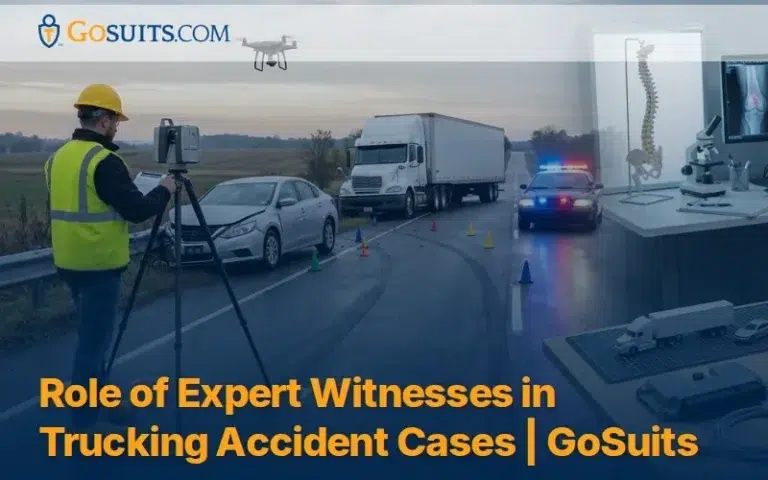
- What is the role of expert witnesses in trucking accident cases nationwide?
- Why do expert witnesses matter for causation and liability in commercial vehicle crashes?
- Which types of expert witnesses are commonly used in trucking litigation?
- What evidence do experts analyze, including ECM black box and ELD telematics data?
- How do chain of custody and spoliation letters protect critical trucking evidence?
- What goes into an expert report and what disclosure rules apply?
- How do courts decide whether expert testimony is admissible?
- How do federal rules shape expert testimony and discovery in trucking cases?
- How do California courts handle trucking accident expert testimony?
- How do Texas courts analyze trucking accident expert evidence?
- How do Illinois civil courts treat expert testimony in trucking cases?
- What happens at deposition and trial for trucking accident experts?
- How do medical, economic, and vocational experts prove damages?
- How do trucking companies and insurers use defense experts?
- What timeline, budget, and case strategy considerations should you expect?
- How can GoSuits support you in a trucking accident case?
- References and resources
What is the role of expert witnesses in trucking accident cases nationwide?
In trucking accident litigation across the United States, expert witnesses help judges and juries understand technical facts that go beyond ordinary experience. A semi tractor trailer is a complex system of driver decision making, vehicle dynamics, maintenance programs, motor carrier policies, and federal safety regulations. After a serious highway crash, both plaintiffs and defendants rely on experts to analyze the physical evidence, reconstruct how the collision occurred, interpret motor carrier compliance with federal rules, and quantify injuries and losses.
Under federal safety regulations, interstate truck drivers must follow specific hours of service limits, such as the 11 hour driving cap after 10 consecutive hours off duty. These limits are codified in federal regulations that also require electronic logging devices, vehicle inspections, and maintenance programs [1] [3]. When crashes happen, expert testimony can tie technical violations or human factors to causation and liability.
National data shows that large truck crashes cause thousands of injuries and fatalities each year. FMCSA crash facts summarize national trends in large truck and bus crashes and inspections. These data sets help contextually frame why a thorough investigation and qualified expert analysis matter to outcomes [4]. For anyone considering legal action after a commercial vehicle crash, coordinated work between your legal team and the right experts can be decisive.
This guide explains the major categories of trucking accident expert witness, how ELD and telematics data are used, why chain of custody and spoliation letters can make or break a case, and the key rules that courts apply when deciding whether an expert’s opinions can reach a jury.
Why do expert witnesses matter for causation and liability in commercial vehicle crashes?
Commercial motor carriers operate under a detailed body of federal rules intended to prevent collisions and reduce injury severity. When a crash occurs, the parties must prove or refute negligence and causation. Expert testimony helps by:
- Linking conduct to scientific principles. A truck accident reconstruction expert can apply physics and engineering to show pre impact speeds, braking, and visibility conditions that a layperson cannot reliably calculate.
- Interpreting regulatory duties. An FMCSA compliance expert reviews hours of service records, driver qualification files, and maintenance programs to assess whether the motor carrier met its obligations under 49 CFR Parts 382, 395, and 396 [1] [2].
- Explaining human decision making. A human factors expert analyzes perception reaction time, fatigue, and distraction, and may connect ELD duty status, circadian science, and roadway cues to the driver’s opportunity to avoid the crash.
- Quantifying harm. Medical expert witness opinions on diagnosis and causation, along with economic damages expert and vocational rehabilitation expert opinions on lost earning capacity and future care costs, convert complex medical and employment impacts into juror friendly terms.
Courts admit expert testimony when it rests on reliable methods properly applied to sufficient facts. Federal Evidence Rule 702 requires that the testimony will help the trier of fact, is based on adequate facts or data, and arises from reliable principles and methods that are reliably applied to the facts [5]. Foundational Supreme Court cases guide this inquiry, including Daubert and Kumho Tire [6] [7].
Which types of expert witnesses are commonly used in trucking litigation?

What does a truck accident reconstruction expert do?
A truck accident reconstruction expert analyzes physical evidence such as skid marks, vehicle crush, lamp filament analysis, event data, roadway geometry, and weather. Using conservation of momentum, time distance calculations, and scene measurements, the reconstructionist can estimate speeds, impact angles, and whether a collision was avoidable given perception reaction intervals. In multi vehicle crashes, reconstruction can sort out chain reactions, secondary impacts, and the role of cargo weight and center of gravity.
Reconstruction analysis often integrates ECM black box data, ELD duty status information, and dash cam video. Reconstructionists also test competing scenarios advanced by defense or plaintiff experts to demonstrate the sensitivity of conclusions to assumptions. Their end products include animations, scaled diagrams, and photo overlays that can be shown at deposition and trial.
How can an FMCSA compliance expert influence liability findings?
An FMCSA compliance expert evaluates whether the motor carrier met requirements covering driver hours of service, maintenance and inspections, and drug and alcohol testing [1] [2] [3]. Common issues include:
- Hours of service violations. Reviewing 11 hour, 14 hour, 30 minute break, and 60 or 70 hour limits, as well as short haul exceptions, split sleeper use, and adverse conditions adjustments [1].
- ELD and telematics data integrity. Checking the presence and completeness of ELD records, annotations, unassigned driving events, and edits under Part 395 Subpart B [3].
- Maintenance and inspection records. Reviewing DVIRs, periodic inspections, brake and tire service intervals, and mechanic certifications per Part 396 [2].
- Drug and alcohol policies. Determining whether pre employment, random, post crash, and return to duty testing conformed to Part 382, and whether testing timing affects impairment evidence [2].
When violations exist, the expert can address whether noncompliance increased risk, whether those violations were a cause in fact of the collision, and whether motor carrier policies indicate negligent hiring, training, supervision, or retention. Conversely, defense experts may argue that even with full compliance, a sudden emergency or third party negligence was the primary cause.
When is a human factors expert useful in trucking cases?
Human factors opinions are common when driver fatigue evidence or distraction is at issue. These experts assess how lighting, conspicuity, workload, and fatigue impair detection and response. They correlate ELD duty status, hours awake, timing in the circadian cycle, and task complexity to expected performance. When a driver traveled close to maximum duty time or had fragmented sleep before a night shift, a human factors expert can explain how reaction times lengthen and hazard detection degrades, framed around hours of service policy goals [1].
What about medical expert witness testimony for injuries?
Medical testimony covers injury mechanism, diagnosis, causation, prognosis, and need for future medical care. Treating physicians often testify to diagnosis and treatment. In complex injury cases, retained physicians may address causation and reasonable future care costs in consultation with life care planners. Testimony often responds to defense independent medical examination opinions that suggest preexisting conditions or alternative causes.
How do economic damages experts and vocational rehabilitation experts help?
An economic damages expert calculates lost wages, benefits, household services, and future earning capacity, accounting for worklife expectancy and discount rates. A vocational rehabilitation expert evaluates functional limitations, transferable skills, and labor market access to determine employability with and without accommodations. Together they outline damages in a way a jury can understand while satisfying disclosure and admissibility standards.
When is a mechanical or maintenance expert needed?
In cases involving brake failure, tire blowouts, steering components, or inadequate inspection programs, mechanical engineers and diesel technicians can analyze maintenance and inspection records under 49 CFR Part 396 to determine if defects should have been detected and corrected [2]. They may also address whether a component failure was a consequence of improper torqueing, contamination, or overdue replacement intervals.
What evidence do experts analyze, including ECM black box and ELD telematics data?
Timely preservation and analysis of trucking data are central to most cases. A typical evidence set includes:
- ECM black box data. Engine control modules often record speed, RPM, throttle, brake application, and fault codes. An ECM black box data expert can extract and interpret records, including last stop records and hard brake or sudden deceleration events. Access requires correct tooling, knowledge of the make and model, and documentation of each data access session for authentication under Evidence Rule 901 [10].
- ELD and telematics. Part 395 Subpart B governs ELD functions and required data elements. Experts review duty status changes, location pings, unassigned driving, edits, and mobile communications logs to cross check driver accounts and show pre crash duty cycles [3].
- Video evidence. Dash cams, forward facing cameras, and nearby business or traffic cameras can capture key moments. Synchronizing video with EDR, ELD, and map data often strengthens speed and timing conclusions.
- Maintenance and inspection records. Brake measurements, tire tread depth, DVIR reports, and defect repair orders are examined under 49 CFR Part 396 [2].
- Scene and vehicle inspections. Laser scans, drone photography, and downloads from passenger vehicle EDRs build a comprehensive dataset for reconstruction.
According to federal safety data, enforcement programs collect extensive roadside inspection and crash information, which can corroborate trends such as frequent hours of service and brake related violations. FMCSA crash facts summarize multi year trends and contextualize risk on interstate highways [4].
How do chain of custody and spoliation letters protect critical trucking evidence?
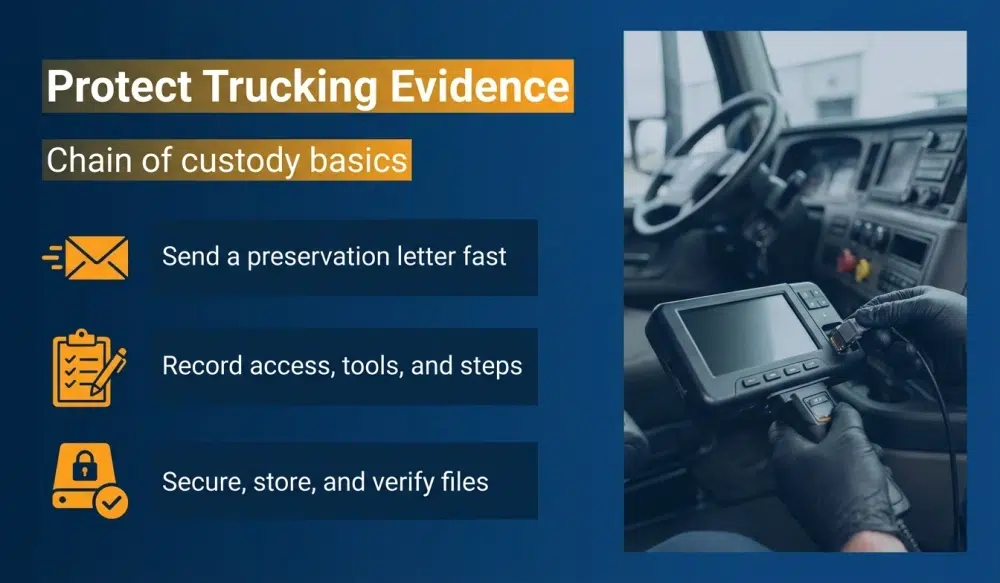
Chain of custody is the documented history of evidence from collection to courtroom. For ECM and ELD data, chain of custody includes who accessed the modules, the tools used, hash values for digital files when available, and secure storage protocols. Proper authentication under Federal Rule of Evidence 901 requires showing that the item is what the proponent claims it is [10]. Breaks in chain of custody can lead to challenges or exclusion.
A spoliation letter, sent promptly after counsel is hired, instructs the motor carrier to retain critical materials such as the tractor and trailer in post crash condition, ECM and ELD data, driver cell phone contents, dispatch communications, and maintenance files. If relevant electronically stored information is lost, Federal Rule of Civil Procedure 37(e) allows courts to impose measures ranging from additional discovery to adverse inference instructions in severe cases [9]. Plaintiffs and defendants both benefit from clarity and speed here. Early preservation is one of the most important practical steps in any trucking case.

What goes into an expert report and what disclosure rules apply?
In federal court, retained experts must provide a written report under Federal Rule of Civil Procedure 26(a)(2)(B). The report must contain a complete statement of all opinions, the basis and reasons for them, the facts or data considered, exhibits used, qualifications, publications, prior testimony, and a statement of compensation [8]. Non retained treating physicians may provide summary disclosures in many courts. State rules vary, but most require identification of opinion witnesses and the substance of their opinions.
Practical components of a strong trucking expert report include:
- Clear questions presented. Identify assignment issues such as causation, speed analysis, hours of service compliance, or medical causation.
- Methodology. Outline accepted principles, equations, and industry standards. Reference specific regulations or guidance where relevant.
- Data sources. List ELD logs, ECM downloads, inspection photos, scene measurements, medical records, and deposition testimony reviewed.
- Findings and opinions. Tie each conclusion to facts and methods, and state limitations.
- Demonstratives. Provide diagrams, time distance charts, and annotated photos for use at deposition and trial testimony.
In California state court, expert disclosure and exchange procedures are governed by Code of Civil Procedure section 2034.210, which sets timelines and content for exchanging expert information before trial [13]. Texas and Illinois have their own disclosure frameworks in civil practice rules and court orders, which typically require identification of the subject matter, general substance of opinions, and bases for those opinions.
How do courts decide whether expert testimony is admissible?
Federal courts apply Federal Rule of Evidence 702, which focuses on whether the testimony will help the trier of fact, is based on sufficient facts or data, relies on reliable principles and methods, and reflects a reliable application to the facts of the case [5]. The Supreme Court’s Daubert decision requires judges to serve as gatekeepers and consider factors such as testability, peer review, error rate, standards, and general acceptance in the field [6]. Kumho Tire extended this gatekeeping to all expert testimony, not just scientific testimony [7].
Admissibility often turns on whether the expert collected adequate data, used an accepted method, and connected facts to opinions. In trucking cases, that might mean showing that time distance calculations faithfully reflect measured scene evidence and synchronized ELD events, or that a medical opinion connects mechanism of injury to observed clinical and imaging findings without speculation.
State courts may adopt similar or different tests. California follows a reliability approach that emphasizes trial courts’ gatekeeping role and the fit between methodology and conclusions. Texas applies a set of factors identified by the Texas Supreme Court in Robinson. Illinois follows a general acceptance framework in many civil contexts. The bottom line is that a careful foundational record increases the likelihood that the jury hears the testimony.
How do federal rules shape expert testimony and discovery in trucking cases?
What are the key federal rules for expert evidence?
- Rule 702. Sets the admissibility standard for expert testimony in federal courts [5].
- Daubert and Kumho Tire. Supreme Court cases defining the judge’s gatekeeping role and reliability analysis [6] [7].
- Rule 901. Governs authentication, crucial for ECM and ELD records [10].
- Rule 26. Requires expert disclosures and reports for retained experts [8].
- Rule 37(e). Addresses sanctions for loss of electronically stored information, a frequent issue with telematics and mobile data [9].
How do FMCSA regulations inform expert analysis?
Experts routinely assess compliance with:
- Hours of service. 11 hour driving limit, 14 hour duty window, break requirements, and 60 or 70 hour limits [1].
- ELD requirements. Device functions, required data fields, annotations, edits, and unassigned driving event management under Part 395 Subpart B [3].
- Maintenance and inspections. Systematic inspection, repair, and maintenance under Part 396, including documentation and periodic inspections [2].
These federal standards set the baseline for safe operation. A trucking accident expert witness may compare driver logs, ELD outputs, and shop records to the motor carrier’s internal policies and the federal code to evaluate whether departures contributed to the crash.
How do California courts handle trucking accident expert testimony?
What legal standard governs expert opinions in California trucking cases?
California Evidence Code section 801 permits expert opinion when the subject is sufficiently beyond common experience and the opinion is based on matter reasonably relied upon by experts in the field [11]. The California Supreme Court in Sargon clarified that trial courts must act as gatekeepers to exclude speculative testimony and to verify that the material relied on actually supports the conclusions offered [12].
How are experts disclosed in California civil litigation?
California uses an expert exchange procedure. Under Code of Civil Procedure section 2034.210, parties must identify expert witnesses, state the general substance of expected testimony, and provide demanded materials by statutory deadlines [13]. In trucking cases, counsel typically designate reconstruction, FMCSA compliance, medical, and damages experts during the exchange, followed by depositions.
What California specific issues arise in trucking crashes?
- Visibility and conspicuity on urban freeways. Human factors experts address lighting and traffic density.
- Mountain grades and brake fade. Maintenance experts may analyze service intervals and defect history for heavy vehicles.
- Comparative fault. Reconstruction experts often address lane change and following distance dynamics where passenger vehicles interact with big rigs.
How do Texas courts analyze trucking accident expert evidence?
What is the Texas reliability framework for expert testimony?
Texas Rule of Evidence 702 tracks the usefulness and reliability of expert testimony, and Texas courts apply a multifactor reliability analysis. The Texas Supreme Court in Robinson articulated factors similar to Daubert, focusing on testability, peer review, error rates, standards, and general acceptance [14] [15].
What discovery practices shape expert work in Texas trucking cases?
Texas civil practice rules govern disclosures and discovery for opinion witnesses. Courts commonly order timelines for designation, production of materials considered, and scheduling of depositions. In serious highway collisions involving 18 wheelers, parties frequently stipulate to protocols for ECM and ELD downloads, inspection access, and non destructive testing early in the case.
How is comparative responsibility litigated in Texas truck cases?
Reconstruction, human factors, and compliance opinions often intersect with proportionate responsibility. Defense experts may argue that a non party driver or the plaintiff was primarily responsible due to sudden lane changes or unsafe merges, while plaintiffs present event data and time distance analysis to show that the truck had ample time and distance to react.
How do Illinois civil courts treat expert testimony in trucking cases?
What admissibility standard applies in Illinois?
Illinois courts apply a general acceptance framework to many types of expert testimony in civil cases. In practice, judges evaluate whether proffered opinions are based on principles and methods generally accepted in the relevant field and whether those methods are reliably applied. Trucking litigants frequently address acceptance of reconstruction techniques, human factors models, and the reliability of ECM and ELD data sources as foundational matters.
What common Illinois discovery practices affect expert work?
Illinois civil courts typically require the identification of opinion witnesses, disclosure of the subject matter and conclusions, and production of materials considered. In motor carrier cases, parties usually negotiate protocols for vehicle inspections, ECM downloads, and chain of custody records early in discovery, in addition to scheduling depositions with adequate time to review technical productions.
What happens at deposition and trial for trucking accident experts?
How do depositions test an expert’s methodology and assumptions?
Depositions probe the expert’s qualifications, assignment scope, data considered, calculations, and alternative explanations. In trucking cases, expect questions on:
- Data sufficiency. Whether scene measurements were taken, whether ECM or ELD data were authenticated under Rule 901, and why any missing data does or does not change the opinions [10].
- Method fit. Whether equations and models apply to articulated vehicles, jackknife dynamics, or underride collisions.
- Assumptions. How sensitive conclusions are to lighting levels, coefficient of friction, or ELD time stamps.
- Alternative causation. Consideration of sudden emergency, third party actions, or mechanical failure independent of maintenance negligence.
What demonstratives are persuasive in trucking trials?
Jurors respond well to clear visuals. Scaled scene diagrams, synced video with ELD time overlays, and speed charts help explain complex events. Experts should be ready to walk jurors through the chain of calculations from raw data to conclusions, showing work in a step by step way. Courts expect that demonstratives fairly reflect the underlying data and that any animations identify assumptions.
How do motions to exclude affect trial strategy?
Parties often file Daubert or similar motions well before trial to challenge reliability or fit. In federal court, the motion usually argues that the expert lacked sufficient data, used an unreliable method, or failed to apply a method reliably to case facts under Rule 702 [5]. California litigants may file motions in limine under Sargon principles [12], and Texas parties may invoke Robinson. Anticipating and addressing these issues in the report and deposition can protect the testimony from exclusion.
How do medical, economic, and vocational experts prove damages?
What is the medical expert’s role in connecting injuries to the crash?
Medical experts address the mechanism of injury, diagnosis, treatment history, maximum medical improvement, and prognosis. They analyze how crash forces and occupant kinematics could have produced musculoskeletal injuries, traumatic brain injuries, or other conditions. In cases with preexisting conditions, they explain aggravation versus new injury and expected future needs, referencing clinical guidelines and imaging findings where appropriate.
How are lost wages and earning capacity calculated?
Economic damages experts compile employment records, tax returns, and benefits information to estimate past losses and future earning capacity. They incorporate vocational opinions on job restrictions and employability, calculating present value of future loss using accepted discounting methods. In cases with long recovery periods, household services replacement and fringe benefits can be significant components.
How is future medical care quantified?
Life care planners and treating providers map future care needs such as therapies, surgeries, medications, and durable medical equipment. They assign unit costs and frequency over expected lifespans and explain cost drivers. These calculations often become central in settlement negotiations and trial presentations.
How do trucking companies and insurers use defense experts?
How do defense experts challenge plaintiff theories in trucking cases?
Defense teams frequently retain reconstruction, human factors, and medical experts to offer alternative explanations and to argue that claimed violations were not causative. Examples include:
- Reconstruction. Offering different coefficients of friction or perception reaction times to support a shorter avoidance window.
- Human factors. Arguing that nighttime glare, occlusion, or unexpected maneuvers by another vehicle limited avoidance.
- Compliance. Showing that the motor carrier complied with hours of service, ELD, and maintenance rules or that any deviation was immaterial to the crash [1] [3] [2].
- Medical and damages. Attributing symptoms to degenerative conditions or arguing that claimed work restrictions are not supported by functional capacity testing.
What strategies help jurors evaluate competing expert opinions?
Jurors often compare which side presents clearer data, explains methods transparently, and ties opinions tightly to facts. Consistent time synchronized analyses using ELD and video, thorough maintenance record reviews, and fair consideration of alternative causes tend to carry weight. Clarity and candor are typically as important as technical depth.
What timeline, budget, and case strategy considerations should you expect?
How early should experts be retained in a trucking case?
Early engagement is important. Reconstruction and ECM black box data experts should often be consulted immediately so that inspection and download protocols can be negotiated and implemented. Prompt spoliation letters can help preserve vehicles and data. Medical and damages experts often begin work after the initial treatment phase clarifies diagnoses and long term needs.

How much does expert work typically cost and how is it managed?
Costs vary widely depending on the number of experts, volume of digital evidence, and need for site inspections and testing. Budgets should contemplate initial reviews, downloads, written reports, deposition preparation, and trial readiness. Clear scopes of work and phased tasking keep spending aligned with case strategy.
How do internal linking keywords fit naturally when learning about your options?
When you research your options nationwide after a crash with a large commercial truck, you might compare truck accident lawyers, commercial truck accident attorneys, and 18-wheeler accident lawyers to understand who handles ELD and telematics issues. Some readers also look at semi-truck accident attorneys and truck collision lawyers for help coordinating reconstruction and FMCSA compliance testimony. If a passenger car was involved, you might read about car accident lawyers and auto collision lawyers to understand differences between passenger vehicle and big rig cases. Others review commercial vehicle accident lawyers when multiple companies are involved, or browse truck accident law firm and truck crash injury claims content to learn about damages experts.
How do you choose a litigation approach without going it alone?
Trucking litigation is complex. You do not have to navigate ELD, ECM, or deposition rules by yourself. Coordinating with a litigation team that works daily with reconstruction, FMCSA compliance, medical, and damages professionals can help protect your rights and position your case for settlement or trial.
How can GoSuits support you in a trucking accident case?
If you or a loved one were hurt in a crash with a semi anywhere in the United States, a free, confidential consultation can help you understand the process, timelines, and the role of experts from day one. GoSuits represents clients nationwide in serious injury cases, including highway collisions with tractor trailers and other heavy vehicles. We blend seasoned courtroom advocacy with a technology driven approach that accelerates investigations while keeping you informed.
- Technology forward case building. Our exclusive proprietary software streamlines intake, evidence tracking, ECM and ELD data intake, and calendaring so discovery moves faster without sacrificing accuracy.
- Attorney access. Although we leverage automation to speed routine tasks, every client works directly with a designated attorney. We do not delegate case ownership to case managers. You have unfettered access to your lawyer for strategy, updates, and preparation.
- Results and track record. Review representative recoveries in our prior cases. Past outcomes depend on facts and law unique to each matter.
- Trial ready. Our team prepares each file as if it will be tried, which can strengthen negotiation leverage and presentation quality if a jury decides the case.
- Practice areas and scope. We handle a range of personal injury matters including truck accident, car accident, motorcycle accident, construction accident, brain injury, product liability, and wrongful death. Learn more about our practice areas, meet our attorneys, and read about our firm at about us.
- Experience. With 30 years of combined experience, we bring courtroom skill, modern investigation methods, and disciplined case management to each file.
Whether you are searching for truck accident legal help after an interstate pileup, reviewing options among interstate truck accident lawyers for a complex multi defendant case, or comparing serious truck accident lawyers for a catastrophic injury, we are ready to listen and help you plan next steps.
References and resources
- 49 CFR 395.3 Hours of Service of Drivers – eCFR
- 49 CFR Part 396 Inspection, Repair, and Maintenance – eCFR
- 49 CFR Part 395 Subpart B Electronic Logging Devices – eCFR
- Large Truck and Bus Crash Facts – FMCSA
- Federal Rule of Evidence 702 – LII Cornell Law
- Daubert v. Merrell Dow Pharmaceuticals, Inc. – LII Cornell Law
- Kumho Tire Co. v. Carmichael – LII Cornell Law
- Federal Rule of Civil Procedure 26(a)(2) – LII Cornell Law
- Federal Rule of Civil Procedure 37(e) – LII Cornell Law
- Federal Rule of Evidence 901 – LII Cornell Law
- California Evidence Code section 801 – California Legislative Information
- Sargon Enterprises, Inc. v. University of Southern California – California Courts
- California Code of Civil Procedure section 2034.210 – California Legislative Information
- Texas Rules of Evidence – Texas Judicial Branch
- E.I. du Pont de Nemours and Co. v. Robinson – Texas Supreme Court Opinion