- What is an Irvine injury evidence checklist and why does it matter?
- How do California rules define relevant, admissible evidence?
- What photos should you take at the scene in Irvine and how should you organize them?
- What notes and timelines help your claim?
- Which medical records and bills should you gather in California?
- How do you get an Irvine police report and what does it include?
- How do you capture witness statements that hold up?
- How do you preserve phone, dashcam, and digital evidence?
- What should you document for vehicle and property damage?
- How should you present evidence to an insurance company?
- What deadlines apply to an Irvine personal injury claim?
- What evidence will the defense look for and how can you prepare?
- How can you get your evidence ready for negotiation, mediation, and trial?
- Why do many Irvine residents ask GoSuits for help and how do we work?
- References and Resources
What is an Irvine injury evidence checklist and why does it matter?
If you were hurt in Irvine, CA, the right evidence can clarify how the incident happened, connect the at fault conduct to your injuries, and support fair compensation for medical care, lost income, and other losses. An Irvine injury evidence checklist is a practical roadmap that helps you collect photos, notes, medical and police records, witness names, and digital files in a way that meets California evidentiary rules and insurance claim expectations. It is also a stress reducer. When you know what to gather and how to protect it, you can focus on your health while your claim is built step by step.
Local data highlights the stakes. The California Office of Traffic Safety reports crash and injury figures by city, including Irvine, which helps show where and when collisions occur and informs prevention and enforcement priorities [14]. Nationally, NHTSA reports more than forty thousand traffic deaths in 2022, underscoring how critical careful documentation is after any crash or serious injury event [15].
Your checklist should do three things well:
- Capture the scene: Photos and video from multiple angles, lighting conditions, and distances, plus quick notes about weather, traffic control, and surface conditions.
- Create a treatment record: Medical visits, diagnostics, prescriptions, referrals, and work restrictions, with dates and providers.
- Protect authenticity: Keep original files, create simple logs, and avoid edits that could raise questions about reliability when evidence is reviewed under California rules.
While you are not required to hire a lawyer, building a strong California personal injury claim is detailed work. A careful approach can prevent mistakes that weaken your case later, especially when an insurer or a defense team scrutinizes each item you submit.
How do California rules define relevant, admissible evidence?
California evidence law focuses on whether a piece of proof makes a disputed fact more or less likely. Evidence is relevant if it has any tendency in reason to prove or disprove a material fact [2]. A photo, for example, can be admitted when someone with knowledge can say it fairly and accurately depicts what it claims to show, which is called authentication [3].
Common record types in injury cases include medical records and bills that can fit within California’s business records exception if foundational requirements are met [4]. Some government records can be admissible under the public records exception, again subject to foundation and other rules [5]. Statements made in the heat of the moment may qualify as spontaneous statements, an exception that sometimes applies to witness statements at a crash scene [6].
Courts and insurers also pay attention to preservation. If a party destroys or fails to keep relevant evidence, a California jury may be instructed that it can infer the evidence would have been unfavorable to that party [10]. In federal court, lost electronically stored information can lead to sanctions in certain circumstances [11]. The takeaway for you is simple. Gather early, store carefully, and keep original versions.
What photos should you take at the scene in Irvine and how should you organize them?
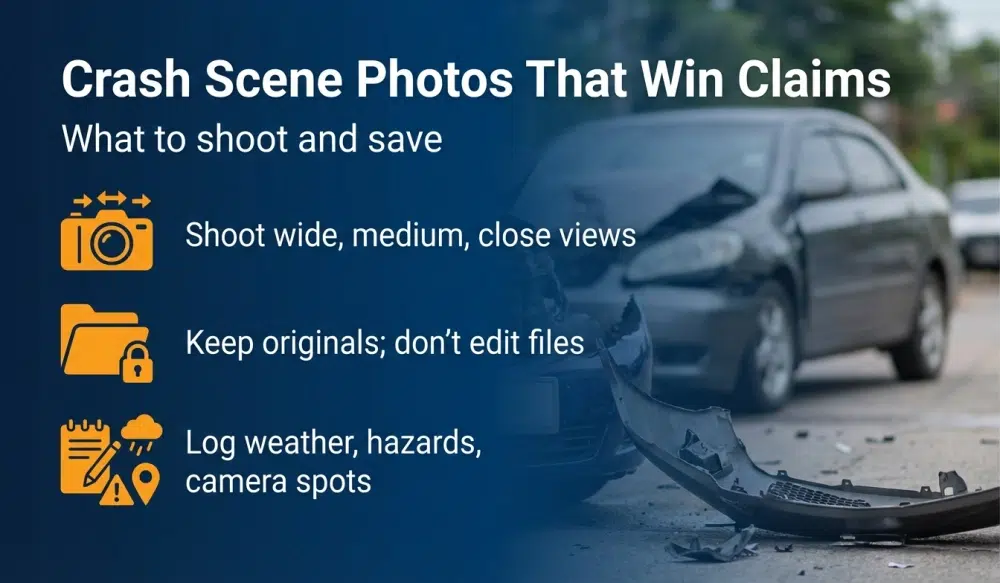
Clear, time stamped photos often become the spine of a claim. They show positions, damage, lighting, and context that memories cannot fully capture. When safe to do so and after calling 911 if needed, aim to take at least three sets of images:
- Wide shots: Intersections, traffic signals, lane markings, debris fields, skid marks, and nearby businesses or cameras.
- Medium shots: Vehicle sides, points of impact, license plates, and relative positions.
- Close ups: Damage detail, airbag deployment, broken parts, fluid leaks, and injuries like bruising or lacerations.
For non traffic incidents like a fall, focus on the hazard, lighting, warning signs, footwear, and nearby maintenance logs or cameras. If a spill or defect is temporary, photos and quick notes about timing and conditions are especially important.
To keep your photos admissible and useful, follow these steps rooted in California authentication and relevance principles [2] [3]:
- Do not edit originals: Keep the original files untouched and create a separate folder for any copies you crop for review.
- Preserve metadata: Retain the original date and time data. You can keep a short log listing file names, locations, and who took each photo.
- Note scene details: Quickly write down weather, lighting, traffic control, and anything unusual like road work or lane closures.
- Capture surveillance sources: Photograph any cameras and business names that might have relevant footage. Footage often overwrites quickly, so note the time and ask staff whom to contact to request a copy.
When you later describe a photo, the person who took it or saw the scene can authenticate it by saying it accurately portrays what it purports to show, which satisfies California’s authentication requirement [3].
What notes and timelines help your claim?
Notes connect the dots between the incident and ongoing symptoms. They also help fight the common insurer argument that gaps in care show limited injury. Consider this simple structure:
- Day of incident: Date, time, location, what you were doing, what you saw or heard, and immediate symptoms.
- First 72 hours: Pain levels, mobility issues, sleep disruption, headaches, dizziness, or other changes. Note work or school limitations.
- Treatment log: Every appointment, provider, diagnosis, imaging, therapy, medication, and referrals. Keep dates and clinic addresses.
- Activity changes: Tasks you cannot do, help you need at home, hobbies you paused, and mileage for medical travel.
Statements made by you or witnesses during or immediately after the event may sometimes be admissible as spontaneous statements in California if they were made under the stress of excitement caused by the event [6]. Keep your notes factual and clear. Avoid speculation or assigning fault in your personal notes. Stick to what you observed and felt, and record names and contact information for anyone who saw the incident.

Which medical records and bills should you gather in California?
Medical documentation supports the two central issues in a personal injury case: the nature and extent of your injuries and the cost of treatment. Start a folder that includes:
- Emergency care: Ambulance run sheet, ER records, imaging, discharge instructions.
- Primary care and specialists: Office notes, referrals, work status notes, and care plans.
- Therapies: Physical therapy evaluations and progress notes.
- Diagnostics: MRI, CT, X rays, and radiology reports.
- Pharmacy: Medication lists and receipts.
- Bills and EOBs: Provider invoices and health plan explanations of benefits.
Under federal privacy rules, you have a right to obtain copies of your medical records from providers with limited exceptions, and providers must respond within specific time frames and with reasonable cost based charges [12]. In California litigation, medical records and bills may be admissible under the business records exception if the foundational requirements are met, typically through a custodian declaration or testimony [4].
Keep originals and share copies as needed. If your care is ongoing, update your folder weekly. Accurate and complete medical documentation can strengthen settlement negotiations and helps if your case proceeds to arbitration or trial.
How do you get an Irvine police report and what does it include?
If a crash causes injury or death, California law requires the driver of a vehicle to report the collision to law enforcement within 24 hours [7]. Separately, many crashes must also be reported to the DMV using the SR 1 form within 10 days if anyone was injured or if property damage meets the monetary threshold [9].
Traffic collision reports are confidential but available to involved parties, their representatives, insurers, and certain others for claims and litigation purposes [8]. A typical report may include diagrams, involved parties, witness names, officer observations, and sometimes statements. While the report itself may contain hearsay, it often guides investigation, helps locate witnesses, and can qualify for admissibility in part under recognized exceptions or for impeachment and refreshment of recollection, depending on context and foundation [5].
In practice, request the report as soon as a report number is available. Note the responding agency and report number at the scene. Keep a copy of your DMV SR 1 submission and proof of delivery for your records [9].
How do you capture witness statements that hold up?
Neutral witnesses can be decisive. Try to collect at the scene:
- Names and contacts: Full name, phone, email, and mailing address.
- What they saw: Ask for a brief written or recorded statement describing what they observed.
- Timing and location: Where they were positioned and when they arrived or left.
California law recognizes that some statements made during or right after a startling event may be admissible as spontaneous statements if the declarant was under the stress of excitement caused by the event [6]. Even when a witness will later testify directly, early statements help preserve details and refresh recollection.
Practical tips:
- Ask permission: If recording on your phone, ask if the witness is comfortable giving a short statement.
- Stick to facts: Encourage them to describe what they saw, heard, or smelled, not opinions about fault.
- Follow up promptly: Send a thank you text or email confirming contact details and availability for questions.
How do you preserve phone, dashcam, and digital evidence?
Digital files can be powerful but fragile. Phone photos, dashcam clips, vehicle infotainment logs, app data, and fitness tracker data may all be relevant. Preservation begins immediately. Create read only copies where possible and store duplicates in two separate secure locations.
Courts can impose sanctions for lost electronically stored information when a party should have preserved it and the loss prejudices another party. In federal cases, Rule 37 addresses these issues, including when courts may give an adverse inference instruction or impose other remedies [11]. The principle is clear for your checklist. Do not delete or overwrite relevant digital files. Keep originals, document collection steps, and avoid filters or edits to source files.
Law enforcement and forensic guidance from federal sources explain that authenticity and chain of custody matter for digital evidence introduced in court. Keeping original media, logging when and how copies were made, and documenting who handled files all support reliability when challenged under California authentication rules [3] [15].
- Dashcams: Save the full card image instead of only short clips. Note device make, model, and settings.
- Vehicle data: If your car or truck stores event data, ask your counsel about preservation and whether a specialist is needed.
- Smartphone files: Export original files with metadata intact. Back up to a secure drive, then to a second location.
- Business cameras: Politely ask nearby businesses to preserve footage and send a prompt written preservation request.
What should you document for vehicle and property damage?
Thorough damage documentation helps prove crash severity and supports valuation. For vehicles, gather:
- Repair estimates: At least two detailed estimates that identify parts, labor, and any structural issues.
- Shop photos: Before and during repairs, including frame measurements if applicable.
- Total loss paperwork: If your vehicle is a total loss, California regulations set standards for valuation and comparable vehicles [13].
- Personal items: List and photograph damaged items inside the vehicle.
For other property, such as a bicycle, helmet, phone, or clothing, take clear photos and keep the items in their post incident condition until your claim is resolved. Do not discard or repair important items without photographs and a written notice to the other side if litigation is likely. Maintaining the items themselves can be important to avoid spoliation arguments and to allow inspection [10].
How should you present evidence to an insurance company?
Insurance adjusters look for consistent, contemporaneous documentation that aligns with California law and claim guidelines. A persuasive submission typically includes:
- Liability packet: Scene photos, a diagram, witness list, and the police report number with a brief cover explaining how the facts establish fault.
- Injury packet: ER and clinic records, imaging reports, therapy notes, work status restrictions, and a summary of symptoms over time with dates tied to records.
- Damages packet: Bills, insurance EOBs, wage loss proof, and property repair estimates.
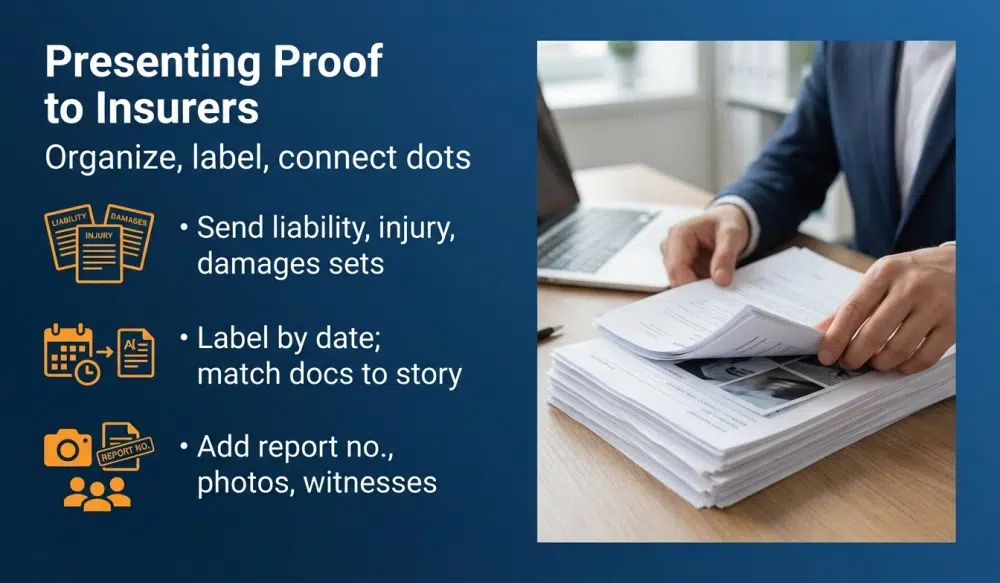
Organize with labels and dates so claim reviewers can match each item to your narrative. When insurers examine vehicle total loss or repair disputes, they must follow California claims settlement regulations, which include specific rules for determining comparable vehicles and certain disclosures [13].
If you were hurt in a vehicle collision, it is natural to consider reaching out to car accident lawyers for guidance on assembling and presenting a complete claim. Working with Irvine car accident lawyers can also help with preservation letters, witness outreach, and coordination with medical providers while you focus on recovery.
What deadlines apply to an Irvine personal injury claim?
Deadlines can be unforgiving. In most California personal injury cases, a two year statute of limitations applies, measured from the date of injury [1]. Claims against public entities can have shorter notice requirements that may be as short as six months, and different deadlines can apply to minors or latent injuries. Because deadlines vary, mark your calendar early and confirm your date with counsel.
Separate from filing deadlines, California and federal rules impose prompt reporting requirements after crashes. For example, certain crashes must be reported to law enforcement within 24 hours and to the DMV within 10 days using the SR 1 form in specific circumstances [7] [9]. Keeping copies of your filings and proof of submission is part of a strong evidence record.
What evidence will the defense look for and how can you prepare?
Defense teams and insurers commonly look for items to challenge liability or damages. Expect scrutiny of:
- Scene inconsistencies: Conflicting versions of how the incident unfolded or vehicle positions that differ from photos.
- Medical gaps: Delays in seeking care or missed appointments used to suggest limited injury.
- Prior conditions: Medical history to argue for alternative causes of symptoms.
- Social media: Posts or images taken out of context.
- Repair patterns: Prior damage or aftermarket modifications that complicate valuation or causation.
You can prepare by keeping consistent, dated documentation, seeking prompt care when needed, and preserving all relevant evidence. If a dispute arises about a missing file or damaged device, California instructions allow juries to consider whether evidence was willfully suppressed and draw appropriate inferences [10]. In federal court, ESI spoliation rules may apply [11].
How can you get your evidence ready for negotiation, mediation, and trial?
Settlement negotiations and trial preparation both benefit from the same disciplined approach:
- Foundation first: Identify a witness who can say a photo or video fairly and accurately depicts the scene, which meets California’s authentication rule [3].
- Explain relevance: Tie each exhibit to a key disputed fact under California’s relevance standard [2].
- Use exceptions wisely: For records, consider business records and public records exceptions where appropriate, with custodian declarations when available [4] [5].
- Present a timeline: A simple chronology that integrates photos, medical visits, and work impacts helps mediators and jurors understand your story.
Consider mock presentations with a trusted advisor to confirm that the story is clear and supported by documents. If you plan to use animations or demonstratives, keep source files and make sure they fairly illustrate the underlying evidence rather than suggest something new. Early planning makes it easier to resolve disputes and reduces the risk of last minute challenges.
What Irvine specific steps should you take in the first 48 hours?
In the first two days after an incident in Irvine, focus on documentation and preservation:
- Seek medical care: Prompt evaluation protects your health and creates contemporaneous records that insurers and courts consider reliable.
- Secure the scene: If safe, collect photos and videos. If not, return as soon as possible to document conditions, lighting, and camera locations.
- Identify agencies: Note whether Irvine Police Department, California Highway Patrol, or another agency responded for later report requests. Keep the report number.
- File required reports: If applicable, complete the DMV SR 1 within 10 days and note any law enforcement reporting requirements [7] [9].
- Preserve digital data: Save dashcam cards, phone files, and app data. Do not reset devices.
You can also begin a simple contact list for medical providers, adjusters, and any witnesses, and set calendar reminders for follow up appointments and reporting deadlines.
What is a practical Irvine scene documentation checklist you can use today?
Use this quick checklist after any collision or injury in Irvine:
- Safety: Call 911 for emergencies and move to a safe location when possible.
- Photos and video: Wide, medium, and close views, then injury photos as needed.
- Contacts: Names, phone numbers, and emails for all drivers, property owners, and witnesses.
- Insurance and plates: Insurer names, policy numbers, license plates, and vehicle VINs.
- Conditions: Weather, lighting, signals, lane markings, and any signs or warnings.
- Cameras and businesses: Document locations of any potential surveillance sources.
- Report info: Responding agency, officer name, and report number when available.
- Medical: ER or urgent care visit if indicated, with discharge instructions kept.
- DMV SR 1: File if required within 10 days and keep a copy [9].
How does Irvine and Orange County context affect your checklist?
Local crash patterns, commute routes, and enforcement priorities can influence what evidence matters most. California OTS publishes city level metrics, including Irvine, which can be relevant for understanding context or locating potential third party footage on common corridors [14]. For example, major arterials with frequent traffic may have more businesses with security cameras and more third party dashcams on rideshare and delivery vehicles.
For vehicle valuations and total loss disputes, California’s settlement regulations create a common framework that carriers must follow, which you can cite when negotiating property damage claims [13].
How can an evidence first approach drive better negotiation results?
When your documentation is organized and legally grounded, adjusters and defense counsel have fewer arguments to discount your claim. A structured submission that clearly ties each document to a disputed fact, cites governing rules where appropriate, and anticipates likely objections shortens the path to resolution.
- Map evidence to issues: Show how each file supports liability, causation, or damages.
- Use timelines: Integrate scene events, symptoms, diagnostics, and work impacts.
- Flag legal anchors: Reference relevance, authentication, and applicable records exceptions in your cover letter [2] [3] [4].
If discussions stall, a mediation brief with exhibits can mirror a trial presentation and help a neutral evaluator understand your position quickly.
Why do many Irvine residents ask GoSuits for help and how do we work?
We built this Irvine injury evidence checklist to help you protect your rights after a serious incident. If your injuries stem from a vehicle crash, falls on unsafe property, or another preventable event, a free consultation with a personal injury attorney can clarify the roadmap, help prevent evidence loss, and coordinate medical and insurance communications while you focus on healing. GoSuits represents clients across California, including Irvine and Orange County, and in select jurisdictions where our team is licensed.
Our technology driven approach uses exclusive proprietary software that organizes photos, records, and timelines faster, with real time sharing for clients and counsel. That efficiency supports better preparation and quicker decision points. Even with advanced tools, every client has a designated attorney and unfettered access to their lawyer. We do not route clients through case managers. When questions arise about police reports, medical billing codes, or dashcam files, your attorney answers them directly.
Our team has more than 30 years of combined experience across negotiation, mediation, and trial. We bring courtroom experience to every claim, which means we prepare from day one with the level of detail a jury would expect. That approach has led to successful outcomes across a range of cases. You can see our track record in prior cases, learn about our attorneys, read about about us, and review our practice areas.
If you prefer, we can start by reviewing your photos, notes, and medical papers to identify next steps. Whether you plan to handle early claim tasks yourself or want full representation, organization and preservation are the foundation. If you are comparing options among car accident lawyers, ask how they preserve digital evidence, how they authenticate photos, and how they prepare medical records foundations for admissibility. A clear process can make a significant difference in both the pace and strength of your case.
References and Resources
- Cal. Code Civ. Proc. § 335.1 two year limitation for injury or death – California Legislature
- Cal. Evid. Code § 210 definition of relevant evidence – California Legislature
- Cal. Evid. Code § 1400 requirement of authentication – California Legislature
- Cal. Evid. Code § 1271 business records exception – California Legislature
- Cal. Evid. Code § 1280 public employee records exception – California Legislature
- Cal. Evid. Code § 1240 spontaneous statement – California Legislature
- Cal. Veh. Code § 20008 injury or death collision reporting to law enforcement – California Legislature
- Cal. Veh. Code § 20012 confidentiality and access to collision reports – California Legislature
- Report of Traffic Accident SR 1 and reporting rules – California DMV
- CACI No. 204 Willful Suppression of Evidence – Judicial Council of California
- Fed. R. Civ. P. 37 electronically stored information sanctions – U.S. Courts
- Individuals’ Right under HIPAA to Access Health Information – HHS
- Auto total loss valuation and fair claims settlement standards – California Department of Insurance
- City crash rankings and traffic safety data – California Office of Traffic Safety
- Traffic Safety Facts 2022 Overview – NHTSA