- What is a personal injury demand letter?
- Why does a settlement demand letter matter and is it admissible in court?
- What are the core components of a strong demand package?
- Which documents and evidence should be included in a demand letter to an insurance company?
- How are pain and suffering described or calculated in a personal injury claim demand letter?
- How do you address liability analysis and comparative fault in a settlement demand?
- What is the demand letter timeline and how long do insurers have to respond in California, Texas, Illinois, and under federal claims?
- What is a policy limits demand and when is it appropriate?
- How can demand letters differ across case types nationwide?
- What strategies help when negotiating with an insurance adjuster after a demand letter?
- What are common insurer arguments and how do plaintiffs and defendants frame responses?
- What is bad faith insurance and how does it relate to pre litigation demands?
- How do statutes of limitations affect the timing of a pre litigation demand?
- What pitfalls should you avoid when drafting a personal injury claim demand letter?
- Is there a sample demand letter outline you can adapt?
- What are the most common FAQs about demand letters in personal injury cases?
- How can GoSuits help with your personal injury demand letter and settlement negotiations?
- Where can you find the sources and references used in this guide?
What is a personal injury demand letter?
A personal injury demand letter is a formal written request for compensation sent to the at-fault party or that party’s insurer. It lays out liability, injuries, medical treatment, damages, and a settlement number to resolve the claim before a lawsuit. In many states and for many insurers, the demand letter is the centerpiece of pre litigation negotiations and often travels with a supporting demand package containing records, bills, photos, and other evidence. A demand letter is not required by every jurisdiction, but it is a widely recognized tool for resolving disputes early and documenting key facts. Legal dictionaries describe a demand letter as a written communication asserting rights and requesting payment or action, often as a precursor to litigation [1].
Because most injury claims are handled by insurers, a demand letter to an insurance company typically identifies the insured, policy number, claim number, and a clear explanation of why the insured is responsible. It also details medical records and bills, wage loss, out of pocket costs, and pain and suffering. If you experienced a car accident, truck accident, motorcycle accident, slip and fall accident, construction accident, product liability incident, or a brain injury event, the demand letter can be tailored to your facts and jurisdiction.
Context matters. For example, a policyholder’s auto insurer may respond differently in a high exposure semi or 18-wheeler collision than in a minor car accident fender bender. A thoughtful, fact driven demand helps the adjuster evaluate liability and damages quickly, which can speed resolution in a personal injury case.
Why does a settlement demand letter matter and is it admissible in court?
Demand letters serve multiple roles. They preserve facts, organize evidence, and communicate a settlement position. They can also demonstrate reasonableness. If later litigation occurs, parties sometimes argue about the content of negotiations. Under the Federal Rules of Evidence, statements made during compromise negotiations about the claim are generally not admissible to prove liability or the amount of a disputed claim [2]. This policy encourages candid settlement discussions.
However, portions of a demand letter referencing objective facts or attached records may still be discoverable. The negotiation number itself usually remains protected from use to prove liability or amount under rules similar to FRE 408, but exceptions can apply for other purposes such as proving bias or negating claims of undue delay [2]. State evidence rules often mirror these principles. Speak with counsel about the strategic and evidentiary choices before sending a settlement demand letter.
What are the core components of a strong demand package?
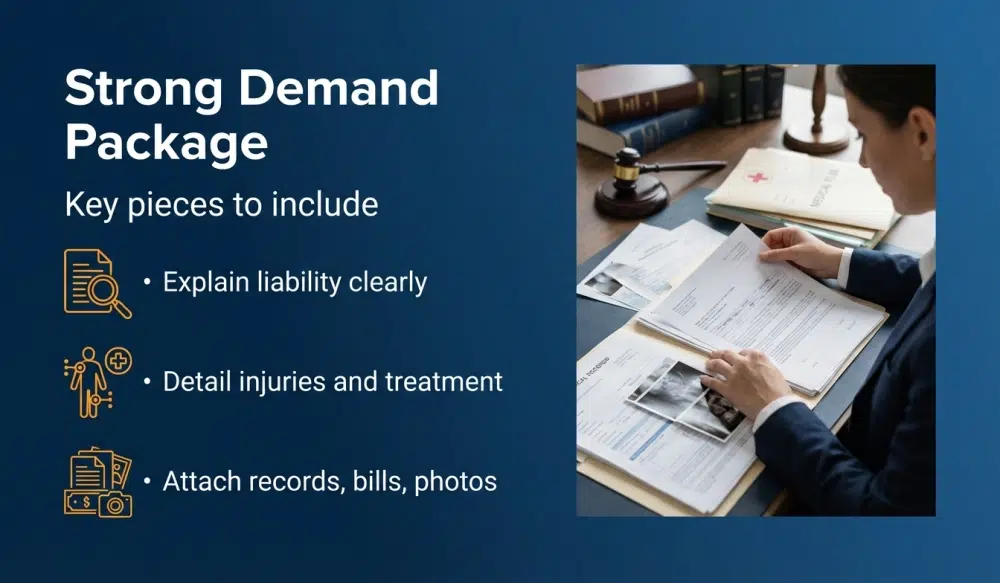
Your demand package will be tailored to your case. For nationwide personal injury claims, common components include:
- Parties and policy Who you are, who the insured is, claim number, policy number, and basic claim background.
- Accident overview Time, date, location, and a concise narrative. For a tractor-trailer or big rig collision, include road, speed, and any FMCSA or state commercial vehicle issues. In a pedestrian accident, clarify crossing conditions and signals.
- Liability theory The rules violated and why the insured is at fault. Cite traffic laws, premises liability duties, or product safety obligations where appropriate.
- Injuries and treatment Diagnosis, treating providers, and the timeline of care. Summarize hospital visits, imaging, therapy, and any permanent impairment.
- Medical records and bills Itemize and attach records and billing statements. Patients have a right to access their medical records, generally within 30 days, under federal privacy regulations [3].
- Wage loss and economic damages Employer verification, tax documents, and any independent contractor proof.
- Pain and suffering The human impact, limitations, and long term consequences, especially after a brain injury or concussion.
- Photographs and physical evidence Vehicle photos, scene images, product condition, and defect evidence in a product liability case.
- Insurance and liens Health insurance, Medicare, or Medicaid liens. Medicare may have rights to recover conditional payments, which must be addressed for proper claim resolution [4].
- Settlement demand number A clear figure, supported by your analysis and documentation, and a reasonable deadline for response that comports with local law.
Which documents and evidence should be included in a demand letter to an insurance company?
Strong documentation bolsters credibility and can help move an adjuster to a fair evaluation. Consider including:
- Police collision reports Important in a crash involving a truck, motorcycle, or car.
- Witness statements Brief, signed statements or contact information.
- Medical records and bills Hospital, imaging, specialist, therapy, pharmacy. Use HIPAA-compliant requests and track dates to meet the federal access timeline [3].
- Employer wage verification Paystubs, 1099s, or payroll letters to substantiate lost income.
- Photos and video Vehicle damage, scene conditions, surveillance, or body cam footage when available.
- Repair or replacement estimates Particularly relevant for commercial property damage claims.
- Medical opinions Short letters from treating providers regarding causation, necessity of treatment, and prognosis.
- Lien documents Medicare conditional payment summaries, Medicaid notices, private health plan subrogation letters [4].
How are pain and suffering described or calculated in a personal injury claim demand letter?
There is no universal formula for non economic damages, and state law varies. Many demand letters describe pain and suffering with specific, concrete effects on daily life: sleep disruption, mobility limits, anxiety, missed family activities, and loss of enjoyment. For serious injuries or wrongful death claims, families may also detail loss of companionship and household services where permitted by law.
Quantifying these losses often includes:
- Symptom timeline A day by day or week by week account during the acute phase, then monthly summaries.
- Function limits What you could do before versus after, especially in a worksite or construction context.
- Objective corroboration Therapy notes, physical restrictions, assistive devices, or job duty modifications.
- Comparable verdicts and settlements Counsel may research analogous cases to inform negotiation, typically using public court resources or legal research tools.
National data can help frame the seriousness of accidents. In recent estimates, thousands of people die annually in traffic crashes, and millions are injured, reflecting the high burden of motor vehicle incidents across the country [12]. The economic cost of injuries to individuals and communities is substantial, including medical spending and productivity losses [13].

How do you address liability analysis and comparative fault in a settlement demand?
Liability analysis anchors your demand. Address both direct negligence and any comparative fault issues. Consider:
- Duties and breaches Traffic rules, maintenance obligations for premises, safety standards for products, or commercial motor carrier rules for a tractor-trailer.
- Causation Medical evidence connecting the event to the injuries.
- Comparative negligence Many states reduce recovery in proportion to the plaintiff’s percentage of fault. Confront disputed facts directly to show why your allocation is fair.
- Defenses Pre existing conditions, gap in treatment, independent causes. Use records and witness statements to rebut.
A thoughtful liability section can neutralize common defenses and help an adjuster fairly weigh the risks. Where appropriate, attach diagrams, scene photos, or inspection reports. For a slip and fall accident, focus on notice, hazard duration, and inspection routines. For a motorcycle accident, develop visibility, lane position, and speed data. For a large truck accident involving an 18-wheeler or big rig, consider hours of service, braking distance, and trailer load securement. In product liability claims, outline defect type and safer alternative designs when applicable.
What is the demand letter timeline and how long do insurers have to respond in California, Texas, Illinois, and under federal claims?
Timelines depend on state law and claim type. In general, a demand letter requests a response within a reasonable window and incorporates any statutory or regulatory deadlines that apply.
What are California claim handling timelines?
California’s Fair Claims Settlement Practices Regulations generally require insurers, upon receiving a proof of claim, to accept or deny the claim in whole or in part within 40 calendar days, or provide written notice explaining the need for more time and continue to update every 30 days [9]. Your demand letter’s response date should be compatible with this framework.
What are Texas claim handling timelines?
Texas law contains prompt payment deadlines for many property and casualty claims. Once an insurer receives notice, it must acknowledge the claim and begin investigation within specific periods. After receiving all requested items necessary to evaluate the claim, the insurer typically has 15 business days to accept or reject, with some extensions available. Chapter 542 of the Texas Insurance Code details these timelines and potential interest penalties for late payment [10]. Your demand should account for the statutory calendar when requesting a reply.
What about Illinois claim handling and penalties?
Illinois law provides a statutory remedy for unreasonable and vexatious delay in settling certain claims. Section 155 of the Illinois Insurance Code authorizes attorney fees and penalties when an insurer’s delay or denial is vexatious and unreasonable, evaluated on the facts of the case [11]. When crafting a demand letter in Illinois, emphasize complete documentation and a reasonable timeline, then assess any delay against this framework.
Do federal claims have special timing rules?
When the United States is a potential defendant, such as under the Federal Tort Claims Act, you must first file an administrative claim before suing. The statute provides a two year window to present the claim and a six month period to file suit if the agency denies the claim [8]. A pre suit demand to the federal agency uses different forms and procedures than a demand to a private insurer. Track agency receipt dates carefully.
What is a policy limits demand and when is it appropriate?
A policy limits demand requests payment of the insured’s full available policy limit. It is typically considered when liability is strong and damages clearly exceed the policy. A well framed limits demand usually includes:
- Clear liability proof Police reports, admissions, video, or forensic analysis.
- Damages exceeding policy Serious injuries, long term care needs, or wrongful death.
- Complete documentation So the insurer can fairly evaluate within any applicable deadline.
- Reasonable opportunity to pay A fair time frame that aligns with state claims handling rules.
Limits demands carry legal implications. In some jurisdictions, failing to settle within limits when liability is reasonably clear can lead to extra contractual exposure for the insurer, often discussed as bad faith. The exact standards are state specific. Build your demand around the facts and governing law in your jurisdiction and consider how any liens will be satisfied, including Medicare conditional payments [4].
How can demand letters differ across case types nationwide?
Demand letters are not one size fits all. Tailor tone, content, and exhibits based on the type of case:
- Car accident Focus on collision configuration, property damage consistency with claimed injuries, and medical timeline.
- Truck accident Truck and tractor-trailer crashes often involve higher forces. Include carrier information, driver logs or hours of service data if available, and a thorough scene analysis.
- Motorcycle accident Address visibility, lane positioning, roadway design, and the dynamics of two wheel stability.
- Slip and fall accident Emphasize notice and inspection protocols, hazard duration, lighting, and footwear.
- Construction accident Site safety plans, subcontractor roles, OSHA references, and equipment maintenance can be relevant.
- Brain injury Describe cognitive symptoms, neuroimaging when present, neuropsych testing, and day to day functional impact.
- Product liability Identify defect category, warning adequacy, and alternative design considerations.
- Commercial property damage Provide expert assessments, repair estimates, business interruption data, and mitigation steps.
- Wrongful death Address the decedent’s economic and non economic contributions, funeral costs, and applicable state wrongful death statutes.
No matter the type, the personal injury demand letter should read as a grounded, evidence based presentation of fault and loss, with a settlement number connected to the proof.
What strategies help when negotiating with an insurance adjuster after a demand letter?
Negotiation is a process, not an event. Consider the following approach:
- Anchor with documentation Lead with medical records and bills, scene evidence, and a clear causation narrative.
- Speak to policy language Liability coverage, exclusions, and limits shape the negotiation range.
- Be responsive and organized Provide requested items thoughtfully and track production dates.
- Address comparative fault directly Offer a realistic assessment and explain why your apportionment is appropriate.
- Use objective metrics Treatment duration, imaging results, impairment ratings, and wage documentation add weight.
- Stay professional Adjusters carry heavy caseloads. Respectful, concise communications tend to get traction.
- Consider mediation If negotiations stall, structured settlement discussions can help. Federal and state courts encourage meaningful settlement efforts and provide ADR resources [2].
What are common insurer arguments and how do plaintiffs and defendants frame responses?
Understanding typical insurer positions helps you prepare a demand package that answers them in advance.
- Gaps in treatment Insurer may claim delayed care suggests minor injury or alternative cause. Response connects practical reasons for delay and ties symptoms to the event through provider notes.
- Low property damage Insurer may argue minimal impact equals minimal injury. Response emphasizes that injury severity can be independent of visible damage and highlights medical findings.
- Pre existing conditions Insurer may attribute symptoms to prior issues. Response uses before and after records to show aggravation or worsening.
- Comparative negligence Insurer may overstate claimant fault. Response provides traffic laws, scene diagrams, and witness statements supporting a fair apportionment.
- Excessive medical charges Insurer may challenge reasonableness of bills. Response provides market rate context and medical necessity opinions.
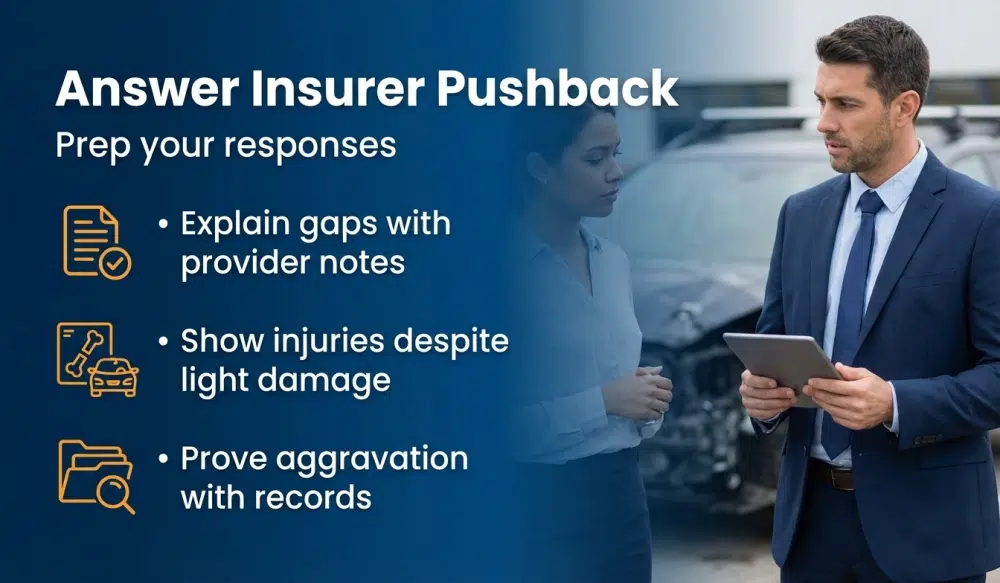
Defendants often focus on uncertainty and causation. Plaintiffs emphasize clear liability and documented harm. Both sides benefit from accurate facts and a respectful tone.
What is bad faith insurance and how does it relate to pre litigation demands?
Insurers owe duties to their insureds. While the exact doctrine varies, many states provide remedies when an insurer unreasonably delays or fails to settle within policy limits when liability is reasonably clear. California’s regulations require timely and fair claim decisions [9]. Texas sets prompt payment obligations and interest penalties for late payment in many claims [10]. Illinois allows fees and penalties for vexatious and unreasonable conduct in certain cases under Section 155 [11]. Properly documenting your demand creates a record of reasonableness on timing and content.
Remember that bad faith remedies are primarily designed to protect the insured, not the third party claimant, though in some circumstances third parties benefit indirectly. Because rules differ by state, align your demand letter with local statutes and regulations, and keep a clear log of communications and deadlines.
How do statutes of limitations affect the timing of a pre litigation demand?
Statutes of limitations set deadlines to file a civil lawsuit. Your pre litigation demand schedule should leave enough time to file suit if needed. Selected examples:
- California Most personal injury claims must be filed within two years of injury. Wrongful death generally shares the two year period, with exceptions. See Code of Civil Procedure section 335.1 [5].
- Texas Most personal injury claims carry a two year limitations period under Civil Practice and Remedies Code section 16.003 [6].
- Illinois Most personal injury claims have a two year limitations period under 735 ILCS 5/13-202, with specific exceptions [7].
- Federal Tort Claims Act Administrative claim must be presented within two years, and suit filed within six months of agency denial [8].
If a deadline is near, your demand letter should reflect urgency and your plan to preserve rights in court. Do not let ongoing negotiations pass a filing deadline.
What pitfalls should you avoid when drafting a personal injury claim demand letter?
- Overstating facts Stick to verifiable facts. Attach proof and avoid speculation.
- Ignoring liens Address Medicare and other lienholders early to avoid surprises later [4].
- Unrealistic numbers A demand should be ambitious but tethered to evidence and jurisdictional norms.
- Missing deadlines Track statutes of limitations and state claim handling timeframes [5][6][7][9][10].
- Incomplete packages Missing records or bills slow evaluation. Confirm you have the complete set from each provider.
- Unclear causation Connect each claimed injury to the event with provider notes and diagnostics.
- Failing to tailor A policy limits demand requires stronger documentation than a low exposure claim.
Is there a sample demand letter outline you can adapt?
Below is a general outline you can discuss with your legal team. Modify language to fit your facts, jurisdiction, and audience.
What is a practical sample structure for a settlement demand letter?
- Header Date, insurer name, adjuster, claim number, insured, policy number, your contact information.
- Introduction Identify the incident, parties, and purpose of the letter.
- Facts and liability Concise narrative with citations to attached reports or statements.
- Injuries and treatment Chronological medical summary with key diagnoses and outcomes.
- Medical records and bills Total amount and exhibit list.
- Wage loss and other economic damages Employer verification and totals.
- Pain, suffering, and life impact Specific functional losses and limitations.
- Insurance and liens Health insurance liens, Medicare conditional payments, and plan contacts [4].
- Settlement demand Dollar amount, reasonable response date considering local regulations [9][10].
- Reservation of rights Preserve all rights, including the right to file suit within the statute of limitations [5][6][7][8].
- Attachments Numbered exhibits list.
How can GoSuits help with your personal injury demand letter and settlement negotiations?
When you are hurt in a personal injury incident, the demand letter is often the first serious step toward settlement with an insurer. A free consultation with our team can help you understand timelines, evidence needs, and negotiation strategy for your situation. GoSuits represents clients nationwide, with a focus on clear communication and thorough documentation across injury claims from a car accident, motorcycle accident, truck accident, slip and fall accident, construction accident, product liability injury, brain injury, commercial property damage losses, and wrongful death matters.
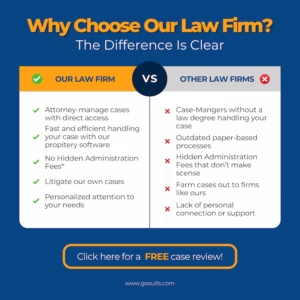
- Technology driven approach We built exclusive proprietary software to gather records faster, organize evidence, track deadlines, and generate polished demand packages that help move cases efficiently.
- Designated attorneys Although we use technology to expedite your case, every client works directly with a designated attorney. We do not use case managers, and clients have unfettered access to their lawyer.
- Trial ready mindset Our lawyers have tried cases in court. That trial experience helps us evaluate risk, push negotiations forward, and prepare for litigation if needed.
- Proven history We have secured meaningful results for clients across a wide range of cases. Review some of our prior cases for examples of past outcomes.
- Breadth of practice Explore our practice areas, including personal injury, vehicle collisions, premises liability, product liability, and more. Learn about our attorneys and firm story on the about us page.
- Experience The firm brings 30 years of combined experience to negotiations, demand letters, and litigation. We handle the paperwork, evidence collection, and insurer communications so you can focus on healing.
If you are navigating a settlement demand letter to an insurance company or preparing a policy limits demand, we are ready to help you map the path forward and protect your rights while negotiations unfold.
Where can you find the sources and references used in this guide?
- Demand Letter – Cornell Law School Legal Information Institute
- Federal Rule of Evidence 408 Compromise Offers and Negotiations – Cornell Law School LII
- Individuals’ Right under HIPAA to Access their Health Information – U.S. Department of Health and Human Services
- Medicare Secondary Payer Program and Conditional Payments – Centers for Medicare & Medicaid Services
- Cal. Code Civ. Proc. § 335.1 – California Legislative Information
- Tex. Civ. Prac. & Rem. Code § 16.003 – Texas Statutes
- 735 ILCS 5/13-202 – Illinois General Assembly
- 28 U.S.C. § 2401 – Time for commencing action against United States – Cornell Law School LII
- California Fair Claims Settlement Practices Regulations, 10 CCR § 2695.7 – California Department of Insurance
- Tex. Ins. Code Chapter 542 Prompt Payment of Claims – Texas Statutes
- 215 ILCS 5/155 – Illinois Insurance Code Section 155 – Illinois General Assembly
- Early Estimate of Motor Vehicle Traffic Fatalities, 2023 – National Highway Traffic Safety Administration
- The Cost of Injuries in the United States – Centers for Disease Control and Prevention
- Settlements Taxability Publication 4345 – Internal Revenue Service