- What immediate evidence should you collect at a Dallas truck crash scene?
- How do you preserve truck electronic data like ELD, ECM, GPS, dashcams, and surveillance video?
- Which trucking company records matter and how long are they kept?
- How do you get the police accident report in Dallas and use it in your claim?
- Which medical records and bills should you keep and how do you request them?
- Why do witness statements, photos, and video matter so much in truck crash cases?
- What is a Texas spoliation letter and when should you send one?
- How do FMCSA regulation violations impact liability in a Texas truck crash?
- What is the Texas statute of limitations for truck crashes and are there exceptions?
- How do commercial vehicle insurance rules affect your claim and negotiations?
- Who helps reconstruct a truck crash and what can they analyze?
- What should defendants and insurers do to preserve evidence fairly?
- Can you use a simple Dallas truck crash evidence checklist?
- Why consider GoSuits if you are hurt in a Dallas truck crash?
- References and resources
What immediate evidence should you collect at a Dallas truck crash scene?
Safety comes first. Call 911, move to a safe location if possible, and accept medical evaluation. Once safe, start documenting. Early details get lost quickly. Your phone can be a powerful tool for preserving facts that may later determine liability and damages.
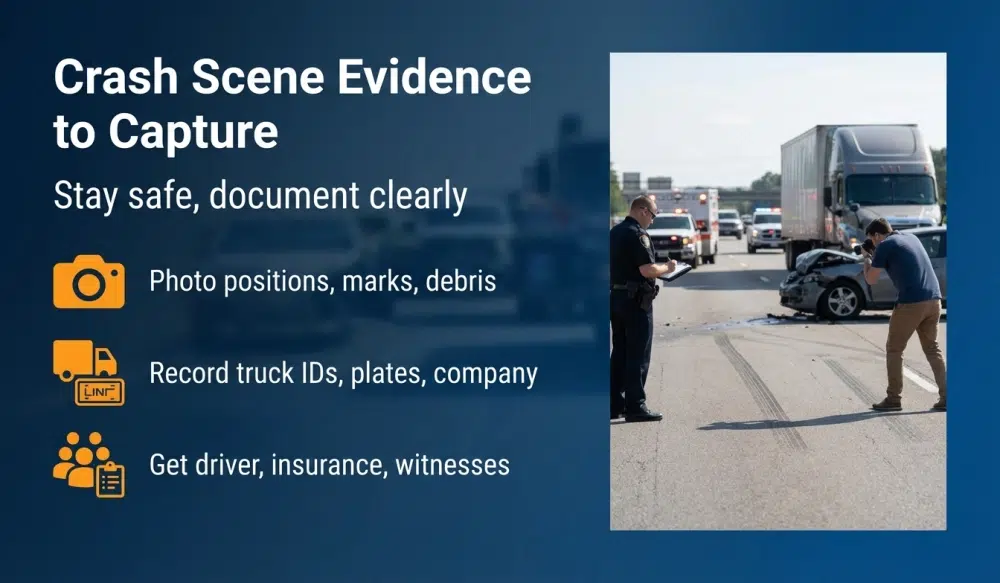
What photos and videos should you take right away?
- Vehicle positions before any cars or the truck are moved. Capture multiple angles, long shots to show lane markings and intersections, and close ups of impact points.
- Road evidence such as skid marks, yaw marks, debris fields, broken glass, spilled cargo, gouge marks, and any fluid trails. These can help with speed and timing analysis.
- Traffic controls including traffic lights, stop signs, yield signs, temporary construction signs, and detour signs. Include timestamps where possible.
- Weather and lighting conditions including glare, rain, fog, and street lighting. This context often matters for visibility and stopping distances.
- Injuries and property damage to you, your passengers, and all vehicles involved. Photograph medical devices like braces or crutches you need to use after the crash.
- Truck identifiers like the USDOT number on the door, license plates of the tractor and trailer, company name and address, trailer number, and hazardous material placards.
What information should you exchange and record?
- Driver license and insurance information for all drivers.
- Truck driver employer name, address, and phone number plus the motor carrier’s USDOT and MC numbers visible on the cab.
- Witness names and contacts including phone numbers and email. Ask them to briefly describe what they saw and if they captured video.
- Law enforcement agency and the officer’s name and badge number who responds, the incident number, and where to request the crash report.
Are there legal reasons to avoid posting on social media?
Yes. Defense teams often request social media content in discovery. Avoid posting photos or comments about the crash, your injuries, or your recovery. Preserve your privacy and protect your claim’s integrity.
How do you preserve truck electronic data like ELD, ECM, GPS, dashcams, and surveillance video?
Commercial trucks generate and store time sensitive data. Some systems overwrite data in days or weeks unless preservation steps are taken. Acting quickly can make the difference between a clear liability picture and an evidence gap.
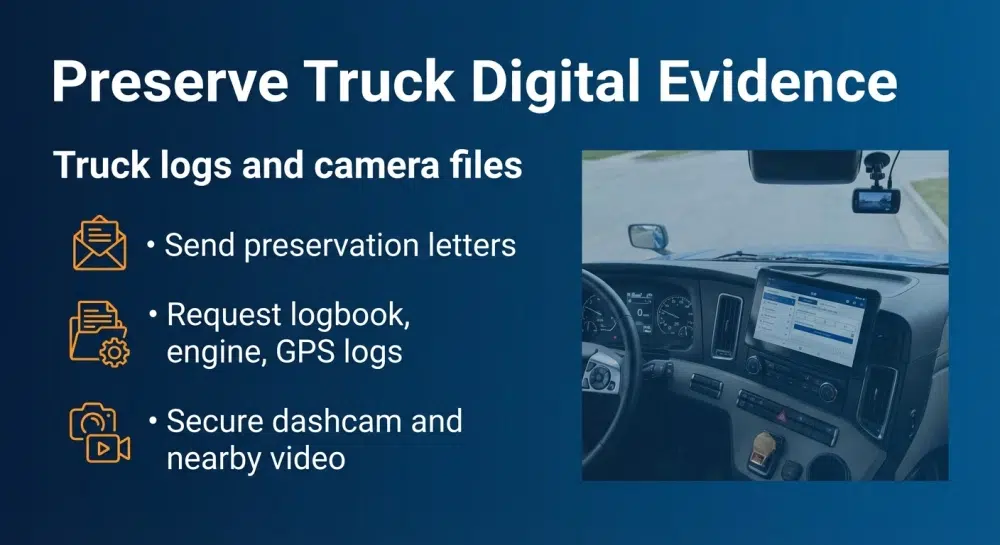
What records are on the ELD and how long must the carrier keep them?
Electronic logging devices record duty status changes, driving time, location, and related supporting documents. Federal regulations require motor carriers to retain hours of service and ELD data for 6 months [1]. The ELD rule is administered by the Federal Motor Carrier Safety Administration, which provides compliance guidance [2].
What about maintenance, inspection, and repair records?
Maintenance records can corroborate brake condition, tire tread, and recent repairs. Federal rules require carriers to keep maintenance and inspection documentation for each vehicle, including inspection schedules and repairs [3]. These records can reveal whether mechanical issues contributed to the crash.
How important is cargo and load securement data?
If cargo shifted or fell, securement compliance becomes critical. The Federal Motor Carrier Safety Regulations outline detailed securement requirements for different cargo types [4]. Bills of lading, load plans, and shipper communications can shed light on how the load was placed and secured.
Can crash related company records disappear quickly?
Yes. Carriers must maintain an accident register and related reports for 3 years [5], but other records such as certain driver inspection reports and ELD supporting documents can be kept for shorter periods. Some on vehicle modules and cameras can overwrite data in short cycles unless a preservation hold is in place [2].
Do trucks have black box or ECM data and how is it preserved?
Many heavy trucks have engine control modules and telematics that log speed, throttle, brake events, fault codes, and sometimes event snapshots. There is no universal federal mandate for heavy truck event data recorders, but ELD and other systems often capture relevant data. Light vehicle EDR requirements are governed by federal rules [14]. Prompt written preservation requests are crucial so the carrier and its vendors secure ECM downloads, telematics logs, and camera files before they are overwritten.
What about dashcam and external surveillance footage?
Dashcams are increasingly common in cabs and on trailers. Nearby businesses and public facilities may also have exterior cameras. Ask nearby locations to retain relevant timeframes as many systems overwrite within days. A targeted preservation letter to the carrier and to identified businesses helps lock down this evidence.
Which trucking company records matter and how long are they kept?
Below are high value categories and typical retention requirements under federal rules. These are not exhaustive but they highlight what plaintiffs and defendants often seek in Dallas, TX truck crash litigation.

Driver qualification and history
- Driver qualification file. Includes application, motor vehicle records, road test certificates, and prior employer checks. These materials help evaluate training, experience, and safety history.
- Drug and alcohol testing records. Retention periods vary depending on the type of record. Certain testing records must be retained from one to five years under federal rules [6].
Hours of service compliance
- ELD records and supporting documents. Carriers must keep these for at least 6 months, and they must have a system to detect and deter falsification [1]. Look for anomalies that correlate with the crash timeline.
Vehicle condition and inspections
- Inspection, repair, and maintenance files. Carriers must maintain records showing nature and due date of inspections and repairs. Retention rules apply while the vehicle is in service and for a period after it leaves the fleet [3].
- Daily vehicle inspection records. The regulations include requirements for driver inspection reports and carrier retention obligations for a period specified in the rules [3].
Cargo and load information
- Bills of lading, load diagrams, and securement documentation. These establish weight distribution, tie down methods, and any special securement steps under the applicable cargo securement standards [4].
Accident records
- Accident register and related documents. Carriers must maintain a register listing each accident and keep copies of all reports for a set period [5]. These files can identify prior incidents and corrective actions.
How do you get the police accident report in Dallas and use it in your claim?
In Texas, peace officers complete a CR 3 crash report when a reportable crash occurs. Access to crash reports is governed by state law [10]. You can typically request the Dallas crash report through the Texas Department of Transportation’s Crash Records Information System or the Dallas Police Department’s processes [11].
What is in the crash report and why does it matter?
- Event narrative and diagram. These provide an overview of positions, impacts, and officer observations.
- Contributing factors. Officer assessed factors such as speeding, following too closely, or improper lane use.
- Citations issued. While not definitive of civil liability, citations can be persuasive in settlement discussions.
- Witness names. Additional contacts to corroborate events and fill gaps.
Is the crash report always admissible in court?
Crash reports can be used in various ways during litigation. Parties should comply with Texas rules regarding hearsay and exceptions, and they should be prepared to authenticate diagrams and narratives. Even when portions are not admissible, the report can guide discovery and expert analysis.
Which medical records and bills should you keep and how do you request them?
Medical documentation ties the crash to your injuries and shows the cost and scope of care. Keep an organized record from day one.
What should you maintain?
- Emergency care records including ambulance run sheets, ER records, imaging, and physician notes.
- Follow up care including orthopedic, neurological, pain management, physical therapy, and rehabilitation notes.
- Pharmacy receipts and itemized bills matched to prescriptions.
- Work notes documenting restrictions, time off, and return to duty status.
How do you get your records and bills?
You have a right under federal privacy rules to access your medical records, typically within 30 days, and you can request electronic copies. Providers may charge limited reasonable fees for copies [13]. Request both records and itemized billing with CPT codes to support economic damages.
Why do witness statements, photos, and video matter so much in truck crash cases?
Independent witnesses and objective footage can resolve disputes about speed, signal status, and lane changes. Combined with scene photos and vehicle damage patterns, they provide a timeline that helps both sides evaluate responsibility.

What should witnesses include in a statement?
- Their vantage point including location, lighting, and weather.
- Sequence of events in plain terms, from first observation to final rest positions.
- Sensory details such as horn use, tire squeal, or cargo noise.
- Any video they captured from phones or dashcams, with exact time settings.
What is a Texas spoliation letter and when should you send one?
A spoliation letter is a formal preservation notice sent to a trucking company, its insurer, and sometimes third parties. In Texas, the duty to preserve evidence arises when a party knows or reasonably should know that there is a substantial chance a claim will be filed. Texas courts address spoliation through the trial court’s inherent authority, focusing on whether evidence was lost and whether prejudice resulted [7]. Courts may impose remedies ranging from additional discovery time and continuances to sanctions and, in limited cases, jury instructions [8].
What should a preservation letter request?
- ELD and hours of service data plus supporting documents for at least 6 months before and after the crash [1].
- ECM, telematics, and dashcam files including raw data and any vendor reports, with chain of custody documentation.
- Maintenance and inspection records for the tractor and trailer covering the year before the crash and any post crash repairs [3].
- Cargo and securement documents such as bills of lading, load diagrams, and securement checks [4].
- Accident register entries and incident reports related to the event [5].
- Driver qualification file and training records, plus drug and alcohol testing records governed by federal retention rules [6].
When should you send it?
As soon as practicable. ELD and video systems can overwrite quickly. Early notice helps avoid disputes and protects all parties from claims of spoliation. This is a key step where truck accident lawyers provide structure and urgency based on the facts and applicable law.
How do FMCSA regulation violations impact liability in a Texas truck crash?
Violations of federal safety rules do not automatically decide civil liability, but they are often persuasive evidence of negligence when tied to the crash. Here are frequent focus areas.
Do hours of service violations matter?
Yes. Drivers who exceed permitted hours may experience fatigue that impairs reaction time and judgment. Hours of service rules are codified at the federal level [1]. ELD records and supporting documents can corroborate or contradict manual logs and testimony [2].
What about maintenance problems?
Brake, tire, and lighting failures are recurrent contributors to heavy vehicle crashes. Federal maintenance and inspection requirements establish baselines for safe operation [3]. Post crash inspections and repair invoices can link mechanical conditions to causation.
Does cargo securement play a role?
Improperly secured cargo can shift center of gravity, lengthen stopping distances, and cause rollovers. Federal cargo securement standards define methods and minimums by cargo type [4].
Are drug and alcohol testing records relevant after a crash?
Carriers must maintain certain testing records under federal rules [6]. Post accident testing, where required, can be significant in evaluating impairment and compliance.
What is the Texas statute of limitations for truck crashes and are there exceptions?
In Texas, most personal injury claims must be filed within two years of the date of the crash [9]. Wrongful death claims also generally follow a two year period, calculated under specific rules. Some exceptions may toll the deadline, such as for minors or when the defendant is absent from the state.
What if a governmental entity may be responsible?
If a governmental unit is implicated, additional notice rules may apply under the Texas Tort Claims Act. Local charters may impose shorter notice timelines. Because the rules are strict, it is critical to evaluate potential government involvement early.
Early guidance from Dallas truck accident lawyers can help you avoid deadline traps while gathering the records that matter most.
How do commercial vehicle insurance rules affect your claim and negotiations?
Federal law imposes minimum financial responsibility levels for interstate motor carriers depending on cargo and hazardous materials classifications. Confirming the applicable policies and endorsements helps set expectations in settlement planning.
What insurance documentation should you request?
- Liability policy declarations stating limits, named insureds, and exclusions.
- MCS 90 endorsement if applicable for interstate carriers operating commercial motor vehicles.
- Umbrella or excess policies that may provide additional coverage layers.
Can federal crash statistics support your damages theory?
Context matters. Large trucks are involved in a significant number of severe injury and fatal crashes nationally. FMCSA publishes annual Large Truck and Bus Crash Facts that compile trends, vehicle factors, and driver factors [12]. These references can inform expert analysis and jury education, especially on stopping distances and injury mechanisms.
Who helps reconstruct a truck crash and what can they analyze?
Complex collisions benefit from multidisciplinary analysis. Qualified reconstruction professionals and transportation safety analysts can evaluate how driver behavior, vehicle condition, and environment interacted.
What can qualified analysts evaluate?
- Speed and timing using scene measurements, crush profiles, and video frame analysis.
- Event data and telematics correlating ELD, ECM, GPS, and dashcam records to establish a second by second timeline [1] [14].
- Cargo securement dynamics including load shift effects based on securement methods and regulatory standards [4].
- Human factors such as perception response time and fatigue indicators aligned with hours of service records [1].
Consulting truck accident lawyers early helps coordinate preservation, inspect vehicles, and involve the right technical disciplines in a timely sequence.
What should defendants and insurers do to preserve evidence fairly?
Defendants and their insurers have preservation duties once litigation is reasonably anticipated. Texas courts emphasize addressing spoliation within the case, remedying prejudice primarily with measures that level the playing field rather than punishing conduct unrelated to the merits [7]. Courts consider the culpability and prejudice when fashioning remedies [8].
What practical steps should defense take immediately?
- Litigation hold to suspend routine deletion of ELD, ECM, telematics, dashcam, email, and messaging related to the trip.
- Centralize data collection with IT and fleet safety so that copies are created with documented chain of custody.
- Vehicle preservation to allow joint inspection before repairs or salvage disposal.
- Preserve driver communications including dispatch messages and supporting documents tied to duty status periods [1] [2].
Can you use a simple Dallas truck crash evidence checklist?
Yes. Use this checklist in Dallas, TX and adapt it to your crash. It is focused on civil claims and designed to help you and your legal team capture time sensitive proof.
At the scene and within 48 hours
- Call 911 and accept medical evaluation.
- Photograph the scene including vehicle positions, skid marks, debris, signals, lighting, and weather.
- Capture truck identifiers including USDOT number, plate numbers for the tractor and trailer, company name, and trailer number.
- Gather witness contacts and ask for brief written or recorded statements.
- Do not post on social media about the crash or injuries.

Within the first week
- Request the Dallas police crash report and keep the incident number handy [11] [10].
- Send preservation letters to the motor carrier, insurer, and known third parties regarding ELD, ECM, GPS, and camera footage [1] [2] [5].
- List all providers and request medical records and itemized bills under your right of access [13].
- Track lost income with employer wage verification and time off records.
Over the first month
- Document property damage with repair estimates and total loss valuations.
- Confirm carrier records requested, including hours of service, maintenance, and cargo securement documents [1] [3] [4].
- Identify additional video sources by canvassing nearby businesses for exterior cameras that captured the crash.
- Evaluate FMCSA rule compliance that could be tied to causation or injury severity [1] [3] [4].
Throughout the claim
- Keep a pain and recovery journal to document symptoms and limitations in daily activities.
- Organize all bills and receipts including out of pocket expenses.
- Preserve communications with insurers and repair shops. Save emails and text messages.
- Calendar the two year Texas filing deadline and any special notice requirements [9].
If you are unsure where to begin, working with truck accident lawyers can help you send the right notices and gather the right proof in the right order.
Many families prefer to work with Dallas truck accident lawyers who understand both the local courts and the federal rules that frame commercial vehicle cases.
Why consider GoSuits if you are hurt in a Dallas truck crash?
Truck collisions in Dallas, TX sit at the intersection of Texas law and federal motor carrier safety rules. A free consultation with a personal injury team can help you understand timelines, evidence preservation, and the steps that align with your goals. Our practice is focused on people hurt in civil crashes, including heavy commercial vehicle collisions and complex multi party cases across Texas.
- Where we practice. We represent clients throughout Texas, including Dallas County and neighboring North Texas counties.
- Technology driven approach. GoSuits uses exclusive proprietary software to accelerate evidence capture, track medical records, and coordinate litigation tasks for faster, better results.
- Leadership in innovation. We integrate data from ELDs, medical providers, and insurers to keep your case on track, while our attorneys remain your direct point of contact.
- Attorney access. Although we deploy technology to expedite every phase, we do not use case managers. Every client has unfettered access to their designated attorney from day one.
- Past results. See a sample of outcomes in verdicts and settlements on our page for prior cases. Results depend on facts and law in each matter.
- Team and experience. Learn more about the attorneys who will stand with you at trial and in negotiation at our attorneys. Explore our values and methods at about us.
- Practice areas. We handle truck collisions and other serious injury matters. See the full list at practice areas.
- Trial readiness. Trial experience can add leverage in settlement and clarity in the courtroom. Our team brings 30 years of combined experience to prepare cases for trial when needed.
References and resources
- Hours of Service of Drivers and ELD Records Retention 49 CFR Part 395 – eCFR
- Electronic Logging Devices Overview – FMCSA
- Inspection, Repair, and Maintenance 49 CFR Part 396 – eCFR
- Cargo Securement Standards 49 CFR Part 393 Subpart I – eCFR
- Accident Register and Reports 49 CFR 390.15 – eCFR
- Retention of Records for Drug and Alcohol Testing 49 CFR 382.401 – eCFR
- Brookshire Brothers, Ltd. v. Aldridge 438 S.W.3d 9 Tex. 2014 – CourtListener
- Petroleum Solutions, Inc. v. Head 454 S.W.3d 482 Tex. 2014 – CourtListener
- Texas Civil Practice and Remedies Code Section 16.003 Limitations – Texas Legislature
- Texas Transportation Code Section 550.065 Release of Accident Report – Texas Legislature
- Crash Records and CR 3 Reports – Texas Department of Transportation
- Large Truck and Bus Crash Facts – FMCSA
- Individuals’ Right Under HIPAA to Access Health Information – HHS
- Event Data Recorders 49 CFR Part 563 – eCFR