- What evidence should you collect at a Dallas motorcycle crash scene?
- How do you document injuries and medical care after a Dallas motorcycle crash?
- What is chain of custody and why does it matter in Texas motorcycle cases?
- How do you preserve helmet cam, phone data, and vehicle black boxes in Texas?
- How do Texas police crash reports work and how do you get the Dallas report?
- What legal deadlines apply to Texas motorcycle claims, and what timelines should riders follow?
- How do Texas evidence rules affect photos, video, and witness statements?
- What are spoliation risks in Texas and how can riders avoid them?
- How will insurers scrutinize your evidence, and what should you keep?
- What should you do in the first 30 days after a Dallas motorcycle accident?
- What damages can evidence help you prove in a Texas motorcycle case?
- What Dallas riders ask most often about preserving motorcycle crash evidence?
- Why choose GoSuits for Dallas motorcycle crash cases?
- References and resources
What evidence should you collect at a Dallas motorcycle crash scene?
If it is safe and you are medically able, start a quick, methodical pass through the scene. The goal is to freeze details that can disappear within minutes, hours, or days. If you are seriously hurt, do not risk your safety. Ask a bystander to help capture what you cannot.

- Photograph vehicle positions, skid or yaw marks, fluid trails, and debris fields before tow trucks move anything. Take wide shots to show lanes, traffic signals, and landmarks, then medium and close-up angles for clarity. Photos are often authenticated later through a witness with knowledge and metadata under Texas evidentiary rules [3].
- Document roadway features such as construction zones, potholes, gravel, faded lane markings, and blocked sightlines. Capture traffic control devices and their operating condition. If a timing sequence or signal malfunction may be involved, note the intersection name for later records requests.
- Record weather and lighting conditions. Include sun position, visibility, roadway wetness, and reflections. Small details like glare lines can be decisive when allocating fault.
- Collect driver and vehicle information for every party, including license and insurance cards, license plates, VINs if visible, and DOT numbers for commercial vehicles. If a commercial truck is involved, note company name on the door and trailer number for future discovery.
- Identify witnesses and get names, mobile numbers, and emails. Ask bystanders if they captured dash cam, helmet cam, or cell phone video. Preserve a contemporaneous note on what they saw, being careful not to argue or speculate at the scene.
- Note cameras and data sources nearby, including storefront CCTV domes, intersection cameras, transit buses, rideshare vehicles, and delivery vans. Many systems overwrite within days. Prompt preservation efforts reduce spoliation risk [1].
- Inspect your gear. Photograph your helmet, jacket, gloves, boots, and any visible impact points or abrasions. These images can help reconstruct impact direction, speed, and rider kinematics.
Talking with motorcycle accident lawyers early can help you delegate preservation letters, secure time sensitive video, and protect against accidental deletion that can trigger spoliation disputes [1].
How do you document injuries and medical care after a Dallas motorcycle crash?
Medical documentation ties your injuries to the collision. The record you build in the first days and weeks will be scrutinized by insurers and, if necessary, a jury.
- Seek emergency evaluation promptly even if you feel “okay.” Adrenaline can mask symptoms. Emergency clinicians’ records and imaging provide contemporaneous proof of trauma that is highly probative under Texas rules for business records and authentication [3].
- Follow through on referrals to orthopedics, neurology, or physical therapy. Gaps in care become defense talking points that can reduce recoverable damages under proportionate responsibility principles [6].
- Request and preserve medical records and bills. You have a federal right of access to your health information, usually within a set timeframe, and in the requested format if readily producible [11].
- Use Texas medical expense affidavits. Where appropriate, Texas Civil Practice and Remedies Code section 18.001 allows affidavits to support the reasonableness and necessity of medical charges, which can streamline proof on damages [7].
- Maintain a symptom and activity log describing pain levels, sleep disruption, missed work, and limitations in daily tasks. Keep it factual, dated, and consistent with medical notes.
- Save all out of pocket documentation, including pharmacy receipts and mileage logs for treatment visits. These are recoverable economic losses if proven with competent evidence [3].
- Track potential liens. Texas hospital and certain provider liens may attach to your recovery and must be addressed before settlement finalization [14].
What is chain of custody and why does it matter in Texas motorcycle cases?
Chain of custody is the documented history of who handled an item of evidence, when, where, and how. In Texas, establishing authenticity generally requires testimony or other proof that an item is what the proponent claims it is [3]. Good chain practices increase the likelihood your evidence will be admitted and given weight.
- Label and date digital media. Immediately copy photos and video to two separate devices or secure cloud locations. Keep original files intact, preserve metadata, and document the copy method.
- Secure physical items like a damaged helmet or jacket in clean containers, avoid cleaning or alterations, and record storage conditions. Photograph the item with identifying markers.
- Minimize handlers. The shorter and clearer the chain, the stronger the foundation for authenticity. Identify each custodian by name and contact information.
- Use preservation letters to opposing parties and third parties to demand they keep relevant evidence. Courts evaluate whether a party had a duty to preserve and whether loss prejudiced the other side when considering spoliation remedies [1].
How do you preserve helmet cam, phone data, and vehicle black boxes in Texas?
Digital evidence is powerful and fragile. Early steps protect admissibility and availability.
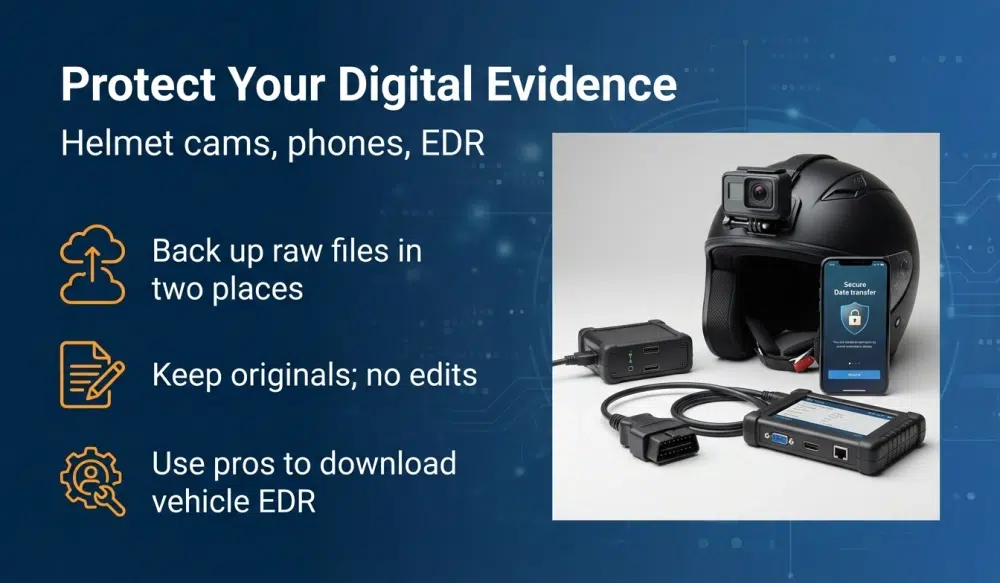
How should you handle helmet cam and smartphone video?
- Immediately back up raw files to at least two locations. Do not edit or apply filters to originals. Keep a read only copy and document the file path, device, and time of transfer for chain purposes [3].
- Preserve app data such as GPS tracks, ride logging, or fitness metrics that show speed and route. Screen record any in app maps along with timestamps and device settings that show time zone and clock accuracy.
Can you access vehicle event data recorders after a Dallas crash?
Many passenger vehicles have event data recorders that store pre crash speed, braking, and throttle. Access is regulated at both the federal and state levels. Federal rules govern EDR performance and data elements [10], and the Texas Transportation Code restricts who may access vehicle EDR data and under what conditions [9].
- Send a timely preservation notice to the vehicle owner and any custodian, requesting that the vehicle not be repaired, sold, or destroyed before data can be imaged.
- Coordinate professional downloads using accepted hardware and software. Improper handling can overwrite data or produce inadmissible results. Courts in Texas scrutinize proportionality and burden in e discovery disputes over electronic data [2].
- Identify third party sources. Commercial trucks, rideshare vehicles, and delivery fleets may have telematics, GPS, and camera systems subject to preservation. Early notice reduces spoliation risk [1].

How do Texas police crash reports work and how do you get the Dallas report?
Texas law requires crash reporting under certain circumstances, and official crash reports often anchor a civil claim timeline. The Texas Transportation Code sets out reporting duties and the statewide crash reporting process [8].
- Obtain the CR 3 police report through the Texas Department of Transportation’s crash report portal with the date, location, and involved parties. The agency provides instructions for the public to purchase crash reports [13].
- Request 911 audio and CAD logs if helpful. In Texas, many public records are available by request under the Public Information Act, subject to exemptions and redactions [12].
- Verify officer identifiers and unit numbers on the report. This helps when seeking supplemental narratives, measurements, or scene diagrams.
- Note listed contributing factors. While not conclusive, officers’ observations may point you to additional evidence, such as a nearby security camera or a missing witness.
What legal deadlines apply to Texas motorcycle claims, and what timelines should riders follow?
Texas civil claims have strict time limits and strategic timing considerations.
- File within the statute of limitations. Most personal injury claims in Texas must be filed no later than two years from the date of injury [5].
- Understand proportionate responsibility. Texas bars recovery if a claimant’s percentage of responsibility is greater than 50 percent, and reduces damages by the percentage of fault otherwise assigned [6].
- Send preservation letters early to at fault drivers, employers, premises owners, and third parties with relevant footage or logs. Courts consider whether a party’s duty to preserve had arisen when evidence was lost in deciding spoliation remedies [1].
- Calendar medical billing deadlines and lien notices. Texas hospital liens and other provider claims can affect settlement timing and distribution [14].
Dallas motorcycle accident lawyers can coordinate these timelines, protect against inadvertent spoliation, and position evidence for admissibility under Texas rules [3].
How do Texas evidence rules affect photos, video, and witness statements?
Texas Rules of Evidence set the framework for admissibility. Planning with these rules in mind strengthens your proof.
- Authentication. Photos and video must be shown to be what you claim, often through a witness who saw the scene or through metadata and chain documentation [3].
- Hearsay and exceptions. Business records, medical records, and regularly kept logs may be admissible under exceptions if supported by the proper custodial testimony or affidavits [3]. Texas section 18.001 affidavits can streamline proof of the reasonableness and necessity of medical expenses [7].
- Relevance and prejudice. Even relevant evidence can be excluded if unfairly prejudicial, confusing, or misleading. Organize your evidence to show how each item ties into liability or damages.
- Discovery scope and proportionality. Texas courts address proportionality for electronic data requests, including burdens and privacy concerns, when deciding disputes about device imaging or broad data extraction [2].
What are spoliation risks in Texas and how can riders avoid them?
Spoliation is the destruction or failure to preserve relevant evidence. The Texas Supreme Court in Brookshire Brothers v. Aldridge set the framework for when courts may impose remedies for spoliation and how those remedies should be determined [1].
- Know the duty to preserve. The duty arises when a party knows or should know that there is a substantial chance a claim will be filed and that evidence in its possession or control will be material [1].
- Avoid self editing. Do not delete photos or messages related to the crash. Keep originals and document any technical steps taken with your files.
- Send targeted letters. Tailor preservation requests to likely evidence sources like intersection cameras, nearby businesses, rideshare companies, or fleet operators. Courts assess proportionality in managing electronic discovery [2].
- Use counsel led collection. Having counsel coordinate forensic imaging and third party subpoenas reduces the chance of later exclusion or sanctions under Texas discovery rules [4].
How will insurers scrutinize your evidence, and what should you keep?
Insurers evaluate liability and damages by testing credibility, consistency, and completeness.
- Liability proof. Maintain scene photos, vehicle damage images, witness contacts, and any digital location or speed data. Tie each item to a fact in dispute, like right of way or visibility.
- Damages proof. Keep all medical records, bills, wage documentation, employer leave statements, and receipts. Texas allows streamlined proof of medical expenses in some circumstances through affidavits [7].
- Communications log. Save all insurer correspondence, claim numbers, adjuster names, and call notes. Avoid recorded statements until you have legal guidance.
- Social media discipline. Assume posts will be requested. Texas courts weigh proportionality and privacy in electronic discovery disputes, but public content is often reachable [2].
What should you do in the first 30 days after a Dallas motorcycle accident?
The first month is critical for preserving evidence and setting medical care on the right track.
What should riders do in week 1?
- Get medical evaluation and follow initial treatment recommendations. Request your discharge papers and any imaging on a CD or portal download [11].
- Back up all photos and videos, label them by date and source device, and create a simple index that identifies what each file shows [3].
- Note cameras and businesses along the crash route for preservation letters. Ask that potential footage not be overwritten [1].

What should riders do in weeks 2 to 4?
- Request the Dallas police crash report as soon as it becomes available through TxDOT’s portal [13]. Confirm correct spelling of names and VINs.
- Send preservation letters to drivers, employers, property owners, and data custodians. Track delivery and responses [1].
- Document work impact. Obtain employer letters showing missed time, job duties, and wage information. Keep copies of disability slips.
- Organize medical records and bills and discuss whether section 18.001 affidavits will help streamline future proof of medical expenses [7].
If questions arise about imaging a vehicle EDR, consult counsel about the intersection of federal EDR standards and Texas access restrictions [10] [9].
What damages can evidence help you prove in a Texas motorcycle case?
Evidence connects the dots from fault to loss.
- Property damage. Repair estimates, total loss valuations, and high resolution photos of your motorcycle and gear help establish the property component of your claim.
- Medical expenses. Itemized statements and payment records document the amount charged and paid, while affidavits may streamline admissibility in certain circumstances [7].
- Lost income. Pay stubs, W 2s, 1099s, and employer attestations support wage loss. For self employed riders, business financials and client communications are helpful.
- Pain and limitations. Consistent medical notes, therapy records, and a contemporaneous activity journal provide detail. Photos and video showing mobility aids or activity modifications can corroborate impact on daily life.
- Comparative fault rebuttal. Scene measurements, timing studies, and visibility analyses can counter claims that you were primarily at fault. Texas law bars recovery if you are found more than 50 percent at fault, so liability proof is essential [6].
What Dallas riders ask most often about preserving motorcycle crash evidence?
Is a police report required for a Dallas motorcycle crash?
Texas law requires crash reporting to law enforcement in specified circumstances, such as injury, death, or apparent damage meeting statutory thresholds. Officers submit crash reports to the state, which you can request through TxDOT’s portal [8] [13].
Can I get 911 audio of my crash?
Many 911 recordings and dispatch logs can be requested under the Texas Public Information Act, though some information may be redacted or withheld under statutory exemptions [12].
Will a helmet camera video be admissible?
Helmet cam footage can be admitted if properly authenticated and relevant. Keep the original file, maintain metadata, document chain of custody, and be prepared to testify that the video fairly and accurately depicts the scene [3].
What if a business tells me their CCTV overwrites every 7 days?
Send a written preservation request immediately. Courts look at whether a party or nonparty had notice that litigation was reasonably likely when evidence was lost. Spoliation remedies are controlled by the judge and depend on duty, culpability, and prejudice [1].
How do I access data from the other driver’s vehicle?
Send a preservation letter and consider legal process to compel access. Access is subject to federal EDR standards and Texas access restrictions, and courts manage burdens and privacy concerns in e discovery disputes [10] [9] [2].
Should I give a recorded statement to the at fault insurer?
Not before you understand your rights. Statements can be used to challenge credibility. Focus on documentation and consider speaking with counsel before giving recorded interviews.
Why does my medical file matter so much?
Medical records are the backbone of damages. They prove diagnosis, causation, treatment, and prognosis. Consistency between your symptoms, imaging, therapy, and work restrictions will be weighed heavily by insurers and juries under Texas evidentiary rules [3].

What statistics help explain risk to a claims adjuster?
Federal transportation safety data documents that motorcyclists face a disproportionate share of serious and fatal injuries relative to their exposure, and thousands of motorcyclists lose their lives each year nationwide [10]. Keeping thorough evidence helps personalize your specific crash within that broader safety picture.
Why choose GoSuits for Dallas motorcycle crash cases?
We focus on helping injured riders and families in Dallas, TX build strong, evidence based civil claims. A free consultation can help you understand how a thorough evidence plan protects your rights, preserves vital digital and physical proof, and supports the medical and wage documentation your claim will require.
- Technology driven case building. GoSuits uses exclusive proprietary software to accelerate evidence collection, organize chain of custody, and surface what matters for liability and damages, while keeping you informed in real time.
- Designated attorneys, not case managers. Every client has unfettered access to their attorney. While technology speeds tasks, your lawyer leads strategy, negotiations, and courtroom presentation.
- Proven results. We have secured meaningful outcomes for clients across injury cases. See our prior cases for examples of past results.
- Trial ready mindset. Our team has extensive trial experience, which strengthens negotiation leverage and readiness if a fair settlement does not materialize.
- 30 years of combined experience. Our attorneys have decades of combined work in personal injury litigation, from crash scene investigation through verdict.
- Comprehensive practice coverage. We handle motorcycle, car, and truck collisions, premises liability, wrongful death, product liability, brain injury, and more. Explore our practice areas, read about our attorneys, and learn about us.
- Local presence. We practice throughout Texas, including Dallas County courts and federal courts serving North Texas.
If you were hurt in a Dallas motorcycle crash, we are here to help you map out a practical evidence checklist, coordinate preservation with third parties, and prepare your case for the forum where it will be decided.
Many riders start by asking for help from motorcycle accident lawyers. If you prefer a local team that uses technology to speed the process while keeping your attorney at the center of your case, we would be honored to talk.
References and resources
- Brookshire Brothers, Ltd. v. Aldridge, 438 S.W.3d 9, Texas Supreme Court opinion PDF – Texas Courts
- In re Weekley Homes, L.P., 295 S.W.3d 309, Texas Supreme Court opinion – Texas Courts
- Texas Rules of Evidence and related rule sets – Texas Courts
- Texas Rules of Civil Procedure, discovery and sanctions – Texas Courts
- Tex. Civ. Prac. & Rem. Code § 16.003, Limitations – Texas Statutes
- Tex. Civ. Prac. & Rem. Code Chapter 33, Proportionate Responsibility – Texas Statutes
- Tex. Civ. Prac. & Rem. Code § 18.001, Affidavits concerning cost and necessity of services – Texas Statutes
- Texas Transportation Code Chapter 550, Accidents and Accident Reports – Texas Statutes
- Texas Transportation Code § 547.615, Event Data Recorders, disclosure and access – Texas Statutes
- 49 CFR Part 563, Event Data Recorders – eCFR
- Your Right of Access to Your Health Information – U.S. Department of Health and Human Services
- How to Request Public Information in Texas – Office of the Attorney General
- Purchase and Access Texas Crash Reports – Texas Department of Transportation
- Tex. Civ. Prac. & Rem. Code Chapter 55, Hospital and Emergency Medical Services Liens – Texas Statutes