
- What should you do in the first 24 to 48 hours after an injury in Dallas?
- How do you get medical care quickly and protect your health and claim?
- How do you document the scene, injuries, and expenses in week one?
- What should you say, and not say, to insurance adjusters in week one?
- How do Texas deadlines and notice rules affect your case timeline?
- What evidence should you preserve, and what is spoliation in Texas?
- How do Dallas car, motorcycle, and truck crashes differ in the first week?
- What if you were hurt on dangerous property in Dallas, Texas?
- What should injured construction workers in Dallas do in the first week?
- How do product defects and SUV rollover incidents fit into Texas civil law?
- What losses can you claim in Texas, and how are damages calculated?
- When should you contact a Dallas personal injury lawyer in week one?
- What defenses will insurers raise, and how can you respond early?
- How do federal evidence preservation rules compare with Texas rules?
- Is there a first week checklist you can follow in Dallas?
- Why consider GoSuits for Dallas injury cases?
- References and Resources
What should you do in the first 24 to 48 hours after an injury in Dallas?
If you were hurt in Dallas, Texas, the first two days can shape your entire civil claim. This injury help guide explains immediate steps that protect your health, safety, and legal rights.
- Call 911 or seek urgent care. Your health comes first. Prompt diagnosis also creates the medical records that insurers and courts rely on to evaluate injuries.
- Report the incident. For traffic incidents, request a police response and later obtain the crash report through the Texas CRIS system [11]. For injuries on property, notify the owner or manager and ask for an incident report.
- Collect time sensitive evidence. Photograph vehicles, surfaces, signage, lighting, product packaging, and visible injuries. Save dashcam or surveillance clips if safely available. See preservation guidance below about avoiding spoliation [1].
- Identify witnesses. Get names, phones, and email addresses of anyone who saw the event or the aftermath.
- Avoid fault admissions. Provide factual information but do not speculate about causes or injuries during the shock of the event. Texas comparative negligence rules can reduce or bar recovery if fault is assigned to you [4].
- Contact legal help quickly. Civil cases involve strict deadlines, evidence preservation, and specialized procedures. Early guidance helps you avoid mistakes in week one.
How do you get medical care quickly and protect your health and claim?
Seeing the right providers early both supports your recovery and builds the foundation of your claim.
- Use emergency or urgent care for serious symptoms. Headaches, dizziness, numbness, shortness of breath, chest or abdominal pain, or worsening symptoms are red flags. Early care can identify hidden injuries like concussions and internal trauma.
- Follow medical instructions and attend follow ups. Gaps in care are often used by insurers to dispute causation and severity.
- Request your records promptly. Federal privacy rules give you a right to receive copies of your records, generally within 30 days, which helps you verify accuracy and prepare a claim file [9].
- Track out of pocket costs. Save receipts for co pays, prescriptions, devices, mileage, and home modifications. These support economic damages.
Relevant data underscore the need for timely care and documentation. Nationally, traffic fatalities were 42,514 in 2022, a high baseline for risk awareness and prevention [12]. Falls are a leading cause of injuries, particularly for older adults, with millions of emergency visits each year [13]. Documenting the mechanism of injury and following your treatment plan ties your symptoms to the event in a way insurers recognize.
How do you document the scene, injuries, and expenses in week one?
Strong claims start with organized, verifiable proof. In the first week, focus on completeness and clarity.
- Create a master file. Include the police or incident report, photos, videos, witness list, medical records and bills, correspondence, and insurance information. Add a timeline of symptoms and missed work.
- Photograph healing progress. Take dated photos of bruising, lacerations, swelling, casts, and devices over time to show progression.
- Log wage loss. Ask your employer for a letter confirming your position, hourly rate or salary, typical hours, dates missed, and whether light duty is available. Preserve pay stubs and tax forms.
- Obtain crash reports. In Texas, you can purchase the official crash report through the state system, which insurers and courts routinely rely on [11].
- Secure product or footwear. If a defective product or a slip on a slick surface is suspected, keep the product and shoes unaltered in a sealed container, labeled with date and location.
What should you say, and not say, to insurance adjusters in week one?
Insurance communications in week one can affect liability and damages evaluations.

- Report promptly. Notify your insurer and, where appropriate, the at fault insurer. Be factual about date, time, location, vehicles, and known injuries.
- Be cautious with recorded statements. Texas regulators provide consumer guidance on auto insurance claims, including what to expect and how to navigate the process [10]. Consider waiting to give recorded statements until you understand the scope of injuries and have guidance.
- Do not sign broad releases early. Routine medical releases can be limited to accident related records and reasonable time windows.
- Keep copies. Save emails and letters. Confirm phone calls with a brief written summary.
How do Texas deadlines and notice rules affect your case timeline?
Texas civil law imposes strict timeframes that can determine whether a claim proceeds.
- General personal injury statute of limitations. In Texas, most personal injury lawsuits must be filed within two years of the injury date [2].
- Claims against government units. Texas law requires timely notice of claims against governmental units, generally within six months, and some cities or counties have shorter local deadlines. Missing these can bar recovery [3].
- Comparative negligence threshold. Texas uses a modified comparative negligence rule. If you are more than 50 percent responsible, you cannot recover, and any award is reduced by your percentage of responsibility [4].
- Exemplary damages limitations. Texas caps exemplary damages under a formula tied to economic and noneconomic losses [5].
Because notice and filing rules are unforgiving, early evaluation in week one can influence whether claims are preserved, especially where a government entity may be involved.

What evidence should you preserve, and what is spoliation in Texas?
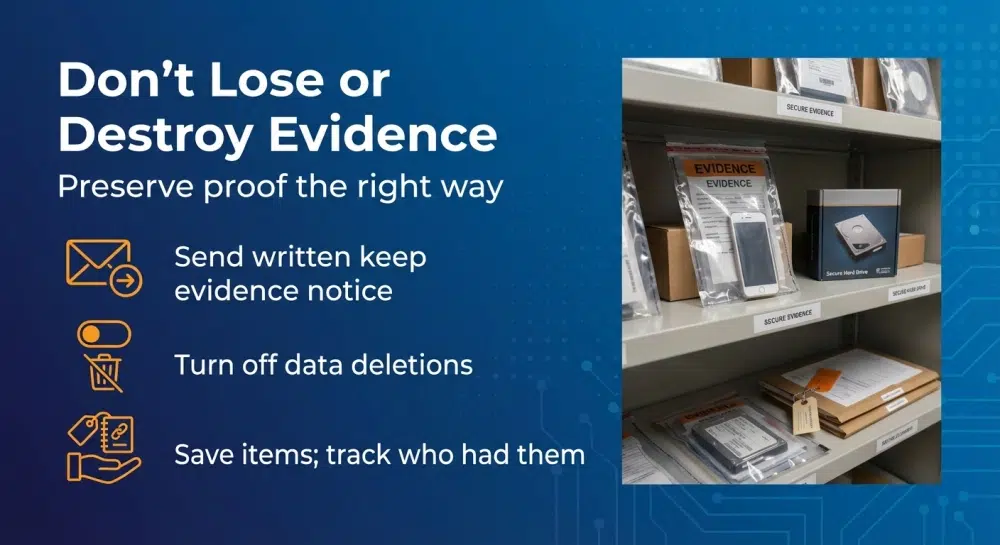
Evidence preservation is a core first week task. Texas courts treat the loss or destruction of relevant evidence as spoliation, which can trigger sanctions and jury instructions.
- Texas spoliation framework. The Texas Supreme Court in Brookshire Brothers v. Aldridge clarified that spoliation is determined by the judge, not the jury, and that a spoliation instruction is reserved for severe prejudice or intentional concealment. Sanctions should be proportionate to the misconduct and prejudice [1].
- Practical steps to avoid spoliation. Send preservation notices, suspend routine deletion of emails, texts, and videos, and secure physical items like vehicles, products, and footwear in their existing condition. Document chain of custody.
- Electronic evidence. At the federal level, sanctions for lost electronically stored information turn on reasonable steps and prejudice under Rule 37(e) [8]. Even in Texas state court, these standards provide a helpful roadmap for sound preservation habits.
- Rule based discovery. Early familiarity with the Texas Rules of Civil Procedure helps you prepare for required disclosures, requests, and depositions [6] [7].
How do Dallas car, motorcycle, and truck crashes differ in the first week?
Traffic collisions share common steps, yet each crash type has unique first week priorities.
What are the first week priorities after a Dallas car crash?
- Vehicle inspections. Preserve the vehicle prior to repairs so your team or the defense can inspect crash damage and data modules.
- Medical trajectory. Whiplash, concussions, and soft tissue injuries often evolve over days. Keep a daily symptom journal.
- Local representation. Car accident lawyers can coordinate vehicle inspections, crash reports, and local medical evidence to build liability and damages from day one.
How is the first week different for a motorcycle collisions?
- Roadway evidence. Photograph skid marks, gouges, and debris fields quickly, before traffic and weather degrade the scene.
- Protective gear. Preserve the helmet and riding gear. These items can show impact angles and energy.
- Local counsel. Dallas motorcycle accident lawyers understand bias issues riders face and document visibility, lane positioning, and driver behavior early.
What is unique about Dallas truck crashes in the first week?
- Carrier preservation letters. Send immediate notices to preserve driver logs, electronic logging device data, dashcams, maintenance records, and load documents.
- Scene control. Heavy vehicle crashes often involve multiple agencies. Identify all responders and request their photos and diagrams.
- Experienced guidance. Dallas truck accident lawyers navigate federal motor carrier rules and time sensitive data that can disappear quickly.
The stakes are high. National crash data show tens of thousands of lives lost each year, highlighting the importance of accurate first week documentation and early advocacy [12].

What if you were hurt on dangerous property in Dallas, Texas?
Premises liability in Texas turns on the duty owed to the injured person and conditions on the property.
- Scene documentation. Photograph the floor, lighting, warning signs, mats, spills, and footwear immediately. Request any incident report and, when possible, ask that video be preserved in writing.
- Notice and duty. Liability generally depends on the property owner’s actual or constructive knowledge of an unreasonably dangerous condition and failure to make it safe or warn adequately.
- Local support. Slip and fall injury attorneys and premises liability lawyers focus on notice, inspection policies, and preservation of surveillance video during the first week, guided by Texas spoliation standards [1].
What should injured construction workers in Dallas do in the first week?
Construction injuries involve overlapping safety rules, contracts, and potential third-party liability.
- Report and record. Report the injury to your employer or site safety officer immediately. Photograph the equipment, fall protection, signage, and weather conditions.
- Identify parties. Note the general contractor, subcontractors, equipment lessors, and site owner. Save badges, site maps, and any pre-task plans.
- Preserve equipment. Secure tools and safety gear are involved. Do not alter guarding or settings.
- Right help. Construction accident lawyers in Dallas coordinate safety document preservation and investigate roles among multiple companies from the start.
Workplace injuries and illnesses remain common. Employers reported millions of nonfatal cases in recent national data, underscoring the need for early safety documentation and medical care [14].
How do product defects and SUV rollover incidents fit into Texas civil law?
Defective products and vehicle dynamics, including SUV stability concerns, require careful first week handling.
- Do not discard the product. Preserve the product, packaging, manuals, and receipts. Photograph labels and serial numbers. Do not attempt repairs.
- Vehicle rollover evidence. In SUV rollover events, secure the vehicle and tires, record road conditions, and identify any loading or cargo that may affect center of gravity.
- Injury patterns. Head and spinal injuries can be severe. Continue care and request all imaging records for later review.
- Knowledgeable counsel. Product liability lawyers and brain injury lawyers can coordinate inspections and expert evaluations while the evidence is fresh.
Consumer product incidents lead to millions of emergency department visits each year, according to national surveillance systems that inform safety trends [15].
What losses can you claim in Texas, and how are damages calculated?
Texas civil law recognizes multiple categories of compensable losses, subject to proof and statutory limits.
- Economic damages. Medical bills, rehabilitation, lost wages, loss of earning capacity, home or vehicle modifications, and other measurable financial losses documented through records and testimony.
- Noneconomic damages. Physical pain, mental anguish, physical impairment, disfigurement, and loss of companionship, where applicable. Thorough medical documentation and consistent reporting support these claims.
- Exemplary damages. In limited cases involving fraud, malice, or gross negligence, exemplary damages may be available, subject to Texas statutory caps [5].
Your recovery may be reduced if you share responsibility. Texas law reduces damages by your percentage of responsibility and bars recovery at more than 50 percent responsibility, which is why early liability investigation is vital [4].
When should you contact a Dallas personal injury lawyer after your accident?
Early help can prevent common pitfalls that weaken claims. In the first week, consider contacting Dallas personal injury lawyers who handle civil claims involving traffic collisions, premises liability, construction incidents, product defects, and wrongful death.
- Evidence preservation. Counsel can send preservation notices, secure vehicles, products, and videos, and build a chain of custody that courts take seriously under Texas spoliation case law [1].
- Managed communications. Insurers seek statements and releases quickly. Coordinated communications help avoid overbroad disclosures and misstatements that impact liability.
- Deadline control. Government notice rules and short fuse deadlines can be calendared and met early in the process [3].
If your situation involves a fatality, a wrongful death lawyers can explain who may bring claims, what damages are available, and how to balance investigations with the needs of grieving families.
What defenses will insurers raise, and how can you respond early?
Expect adjusters and defense counsel to focus on several themes. Addressing these in week one can improve outcomes.
- Comparative fault. Respond with scene photos, independent witnesses, and objective data like skid marks and event recorder downloads to clarify conduct and timing [4].
- Causation challenges. Maintain continuous medical care and consistent symptom reporting. Obtain treating physician records early under your right of access [9].
- Preexisting conditions. Document your baseline before the incident where possible, and focus on objective diagnostic findings, functional limits, and work restrictions post-incident.
- Video gaps. In premises cases, ask for full day surveillance around the time period to address cherry picked clips. Texas law scrutinizes whether relevant footage was preserved or lost [1].
How do federal evidence preservation rules compare with Texas rules?
Understanding both systems helps you protect claims that may cross state and federal lines.
- Texas spoliation. Judges decide spoliation and remedies, and severe sanctions like a jury instruction are reserved for intentional concealment or extreme prejudice that lesser measures cannot cure [1].
- Federal ESI standards. Under Federal Rule of Civil Procedure 37(e), courts assess whether a party took reasonable steps to preserve electronically stored information, whether it can be restored, and whether prejudice or intent to deprive is shown before imposing sanctions [8].
- Practical takeaway. In week one, suspend deletion policies, collect key devices and accounts, and coordinate with counsel on targeted preservation to satisfy both Texas and federal expectations [6] [7].
Is there a first week checklist you can follow in Dallas?
Use this checklist to stay organized after an injury in Dallas, Texas. Adapt it to car, motorcycle, truck, premises, construction, product, residential property damage, and commercial property damage events.
- Day 1 to 2: Seek medical care, call 911 if needed, report the incident, photograph the scene and injuries, identify witnesses, and contact your insurer.
- Day 3 to 4: Start a master file, request medical records under federal access rules [9], purchase the Texas crash report if applicable [11], and notify property owners or employers in writing with a brief factual summary.
- Day 5 to 7: Send preservation letters, suspend deletion of emails, texts, and videos, secure vehicles and products, and coordinate with Dallas personal injury lawyers and, where applicable, auto accident attorneys for strategy on statements and inspections.
- Week one ongoing: Continue medical care, keep a daily symptom and activity log, track expenses and wage loss, and avoid posting details on social media.

Why consider GoSuits for Dallas injury cases?
If you were hurt in Dallas, GoSuits aligns with the needs of civil injury clients in the critical first week. Our practice serves Texans across personal injury, vehicle collisions, premises incidents, construction injuries, product liability, property damage disputes, and wrongful death claims. We offer complimentary initial consultations so you can understand options, timelines, and next steps without pressure.
- Where we practice. GoSuits represents clients throughout Texas, including Dallas and North Texas courts.
- Technology driven approach. We use exclusive proprietary software to accelerate evidence collection, organize medical and billing records, and model case value drivers faster.
- Leadership in innovation. Our tools streamline preservation notices, crash data workflows, and suit filing, saving time and reducing errors.
- Attorney access. Although we use technology to expedite your case, every client has a designated attorney and unfettered access to that attorney. We do not use case managers to wall clients off from their lawyer.
- Past results. Visit our results page to see representative outcomes across practice areas. Past results do not predict future outcomes, but they show how thorough preparation and trial focus can move cases forward. See prior cases.
- Trial experience. Willingness and readiness to try cases informs settlement posture and case strategy from week one, especially when preservation or comparative fault is disputed.
- Experience. Our team brings 30 years of combined experience to investigation, damages development, and trial preparation.
- Learn more. Meet our attorneys, explore practice areas, and read about us.
References and Resources
- Brookshire Brothers, Ltd. v. Aldridge, 438 S.W.3d 9, Texas Supreme Court – CourtListener
- Texas Civil Practice and Remedies Code § 16.003 Limitations – Texas Legislature Online
- Texas Tort Claims Act Notice § 101.101 – Texas Legislature Online
- Texas Proportionate Responsibility § 33.001 – Texas Legislature Online
- Texas Exemplary Damages Cap § 41.008 – Texas Legislature Online
- Texas Rules of Civil Procedure, Evidence, and Appellate Rules – Texas Courts
- Texas Court Rules Research Guide – Texas State Law Library
- Federal Rule of Civil Procedure 37(e), ESI Sanctions – LII Cornell Law
- Right of Access to Health Records – U.S. Department of Health and Human Services
- Auto insurance claims consumer tips – Texas Department of Insurance
- Texas Crash Report Purchase System – TxDOT CRIS
- 2022 Traffic Crash Deaths – National Highway Traffic Safety Administration
- Older Adult Falls Facts – Centers for Disease Control and Prevention
- Employer Reported Workplace Injuries and Illnesses, 2022 – U.S. Bureau of Labor Statistics
- National Electronic Injury Surveillance System Overview – U.S. Consumer Product Safety Commission