- What should you photograph first at a Dallas Amazon delivery crash scene?
- How can you document vehicles, plates, and identifying marks?
- What damage photos help establish impact and fault?
- Where should you look for skid marks, debris, and road evidence?
- How do you capture road, traffic, and weather conditions safely?
- Should you photograph cargo, packages, and loading conditions?
- What injury photos are appropriate, and how can you respect privacy?
- How can you document the Amazon driver and employer information without confrontation?
- What witness and bystander information should you capture?
- How do timestamps, geotags, and angles improve evidence weight?
- Which Texas and federal rules make photos valuable in civil cases?
- What should you avoid photographing or posting after a crash?
- How do you preserve electronic evidence from delivery apps, vehicles, and roadway cameras?
- What on scene photo checklist works in Dallas, TX?
- How are photos used by insurers and in litigation, including spoliation issues?
- When and how can a lawyer help you with evidence after an Amazon delivery collision?
- Why consider GoSuits if you were hurt in a Dallas Amazon delivery crash?
- References and Resources
What should you photograph first at a Dallas Amazon delivery crash scene?
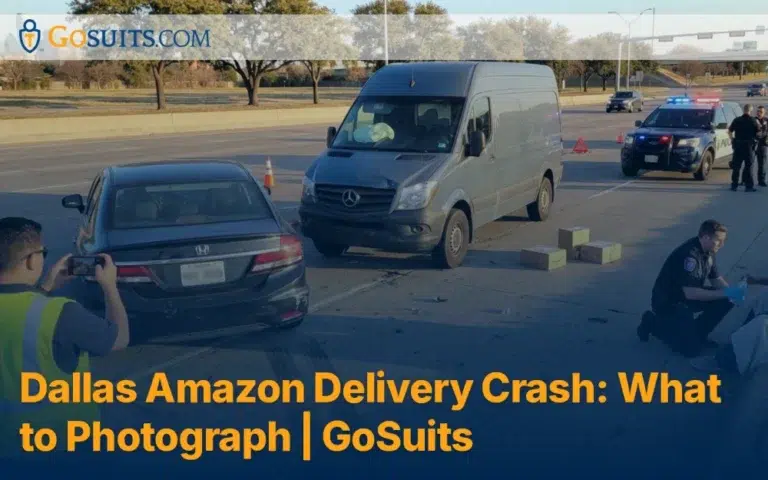
Your safety always comes first. If possible and safe to do so, turn on hazard lights, place emergency triangles if available, and move vehicles out of travel lanes following the law and condition requirements. According to Texas law, drivers involved in crashes causing property damage must safely relocate their vehicles from lanes if they’re drivable and no one is seriously hurt.[1] . After securing the scene and calling 911 for assistance, start documenting everything with clear photos and short videos.
- Start wide: Take several wide shots that capture all vehicles, their positions, and the surrounding roadway. These help reconstruct how the collision happened and preserve the overall layout for investigators and insurers [2].
- Detailed instructions on how to gather specific information: Make sure you get a good look at all aspects of the scene, including every single vehicle involved, any points where they meet (like an intersection or collision site), their license plates, and any items being delivered or cargo visible to the naked eye. Take clear photos of any branding associated with Amazon delivery vehicles as well as any unit numbers that are safely visible in the area.
- Record time and place: Make sure your phone location services are enabled so photos include geotags and timestamps. Authentication rules for evidence focus on whether a photo fairly and accurately depicts what it claims to show, so metadata helps [3].
If you are unable to take photos due to injury, ask a passenger or a trusted bystander to assist. Photos taken immediately often capture details that vanish within minutes, like skid marks, debris fields, and traffic signals cycling. Nationally, large trucks were involved in 5,700 fatal crashes in 2021, and an estimated 117,300 injury crashes, underscoring why prompt scene documentation matters [13].
How can you document vehicles, plates, and identifying marks?
Vehicles and plates connect the parties and insurers and help identify the right corporate entities. With commercial delivery fleets, unit numbers and company markings can matter.
- Picture the vehicle from all angles: Capture photos of the front, back, and both sides of every car or truck, including any pre-existing dents or scratches, to prevent misunderstandings in the future.
- Capturing license plates and VIN numbers is crucial when taking photos of vehicles. Make sure to capture the license plate directly facing it from a close distance. If you can see the Vehicle Identification Number (VIN) plate through the windshield, take a clear photo without touching the vehicle.
- Delivery vehicles often feature brand logos, route numbers, or barcodes for identification purposes. If you can safely capture these details from a public vantage point with photographs, it will help confirm which particular company operates that specific delivery route.
- Inspection and permit stickers: Take closeups of inspection stickers if readable. For commercial carriers, regulatory markings can connect the vehicle to a regulated entity and possible records of maintenance and hours of service under federal rules [4][5].
What damage photos help establish impact and fault?
Damage photographs can provide valuable information about the angles, speeds, and points of impact during an accident. Insurers and courts often analyze factors like crush patterns, paint transfers, and bumper heights in order to validate or dispute accountability stories.
- Critical photographic locations: Capture images of the precise areas where vehicles collided. Make sure to take photos from various angles and distances.
- In this secondary contact scenario, pay close attention to elements such as mirror strikes, side scrapes, or trailer swings in order to establish a potential series of events and the resulting consequences.
- To ensure safety in case of any accident, always remember to photograph the deployed airbags, broken windows, and moved interior elements to clearly illustrate the forces involved.
- Car underside leaks can reveal valuable insights about a vehicle’s positioning following an accident, as well as whether or not it was moving at the time of the incident. This is due to the fact that the direction and nature of fluid stains can indicate how the car came to rest. If you spot any suspicious fluids underneath your car, consider investigating further to see what may have caused them.
When disputes arise, these photos can be authenticated by a witness as fair and accurate depictions, satisfying basic evidentiary requirements for relevance and authentication [3][6].
Where should you look for skid marks, debris, and road evidence?
Physical markings along the road provide vital information to help reconstruct speed, braking, and direction of travel in accident investigations.
- Skid and yaw marks: Photograph beginning and ending points with a shoe or object in frame for scale. Walk the full length and capture any curves and lane transitions. Technical guides for scene work emphasize documentation of tire marks, scuffs, and gouges to preserve later measurements [2].
- Debris fields play a crucial role in accident investigations by showing the spread of glass and vehicle parts, which may reveal the impact point. Begin by taking wide shots to capture the overall scene before zooming in for close-ups that show the specific location of debris relative to lane markings. This allows you to get a better understanding of how and where the accident occurred.
- Grooves and liquid streaks: Capture images by shooting at a right angle to the reference point, then also at an angle of 45 degrees for depth perception. Document road markings to establish the place.

How do you capture road, traffic, and weather conditions safely?
The contextually relevant photographs can provide insights into factors such as lighting, signage, and road conditions that might have contributed to an accident or incident.
- Traffic control devices: Record signals, stop signs, yield signs, school zone signs, and work zone warnings. Include photos that show their relation to the crash site.
- Lane and shoulder conditions: Photograph construction barrels, potholes, gravel, pooled water, and uneven joints.
- Weather and visibility: Capture wet pavement, glare, fog, and sun angle. These factors can support or rebut claims about stopping distance and visibility [6].
- Night scenes: Include photos from the driver eye height to show what was realistically visible at the time.
If your vehicle blocks traffic, Texas law generally expects you to move the vehicle if it can be done safely and the crash involves only property damage, which can also reduce secondary crashes [1]. TxDOT highlights persistent roadway risk and ongoing crash trends, noting the state has not had a deathless day on its roads since 2000 [14].
Should you photograph cargo, packages, and loading conditions?
In delivery collisions, cargo can contribute to instability, longer stopping distances, or shifting loads. Federal rules govern cargo securement for commercial carriers, and evidence of loose packages, displaced straps, or open doors can be relevant [5].
- Securement points: Photograph tie downs, straps, and racks. If a van door opened in the crash, photograph the position of door latches and any loose cargo visible from public vantage points.
- Fallen cargo: If packages fell onto the roadway, capture where they landed and any labels in plain view. Do not touch or move items unless necessary for safety.
- Hazard warning devices: Commercial drivers must place warning devices when stopped on certain roadways within specific time frames. Document triangles or lack thereof, as federal rules address emergency signal placement [7].
What injury photos are appropriate, and how can you respect privacy?
Injury documentation helps link the collision to the harm you suffered, which insurers and courts may contest. Photograph visible bruising, swelling, lacerations, and abrasions. Include a coin or ruler for scale. Take photos again over the following days as bruises evolve.
- Timing matters: Date stamped images taken shortly after the crash are more persuasive than delayed photos.
- Privacy: Only photograph your injuries or the injuries of consenting family members. Do not share graphic images publicly. Medical images taken during care can later support causation when properly authenticated [3].
- Context: Include one photo that shows the injury in relation to your body and another closeup for detail.
How can you document the Amazon driver and employer information without confrontation?
Stay calm and avoid arguments. Exchange information as Texas law requires, including name, address, registration, and insurance information [1]. Photograph insurance cards and driver licenses only if the other driver consents. If there is delivery related documentation visible in plain view, such as a route manifest on a seat, do not handle it, but note its presence. If police respond, ask how to obtain the official crash report from the Texas system maintained by the state transportation agency [8].
What witness and bystander information should you capture?
Neutral witnesses can be decisive in civil cases. If anyone stops to help, politely ask for their name, phone, and a brief statement. Photograph their business card if offered. Ask if they captured dash camera or phone video, and request that they preserve it. Obtaining witness contact information promptly makes later follow up more likely.

How do timestamps, geotags, and angles improve evidence weight?
Evidence rules require that photos be relevant and authentic. You can authenticate a photo if you or a witness can testify that the image fairly and accurately portrays the scene. Timestamps and location data help lay that foundation [3][6].
- Enable location services: Most phones embed latitude, longitude, and time. Keep the original files to preserve metadata.
- Shoot from multiple angles: Take at least three angles for each subject. This reduces claims that an image hides critical context.
- Include fixed landmarks: Put street signs, mile markers, or unique buildings in frame to anchor the location.
- Preserve originals: Back up the original files. If you edit for brightness, keep the unedited copies for admissibility and to avoid claims of alteration.
Courts may also consider the chain of custody for digital files and whether any alterations occurred. Keeping the original files, documenting when and how they were transferred, and avoiding destructive edits support authenticity under applicable rules [3][6].
Which Texas and federal rules make photos valuable in civil cases?
Several rules and statutes guide how your photos are used in civil cases arising from Dallas Amazon delivery crashes.
- Relevance and authentication: Evidence must be relevant and supported by a foundation showing it is what you claim it is. Photos typically meet these standards if a witness can attest they fairly depict the scene [6][3].
- Texas crash duties: Texas law sets duties to stop, exchange information, and, if safe, remove vehicles from the roadway after property damage crashes. Photos can corroborate compliance and scene conditions [1].
- Electronic discovery: Civil discovery rules allow parties to request electronically stored information, including photos and videos, from opponents and third parties. Requests can reach delivery app data, dash camera files, and telematics where appropriate [9][10].
- Spoliation and preservation: Courts can consider sanctions when relevant evidence is lost after a duty to preserve arises. In Texas, leading authority identifies how courts evaluate prejudice and remedies for lost evidence [11], and federal rules address loss of electronic data [12].
- Carrier regulations: Federal rules require carriers to maintain hours of service records and govern cargo securement. Scene photos that suggest overloading, unsecured cargo, or emergency stopping without signals can lead to targeted record requests [5][4][7].
As discovery progresses, parties may use your photos to frame requests for production, interrogatories, and depositions. Targeted requests for electronic logs, telematics, and maintenance records often rely on what your images reveal about time, place, and vehicle condition [9][10].
What should you avoid photographing or posting after a crash?
Avoid actions that put you or others at risk, or that can be misconstrued later.
- Do not block traffic to take photos: Stay off live lanes where possible. Safety takes priority over documentation.
- Avoid photographing private documents: Do not open or handle company papers or packages. Photograph only what is visible without touching.
- Do not post publicly: Social posts can be discoverable and may be used to challenge your account. Save your images privately and share them only with your legal team and insurer [10].
- Do not edit originals: Keep unaltered versions to avoid claims of manipulation. If you must enhance for clarity, always preserve the original files separately.
How do you preserve electronic evidence from delivery apps, vehicles, and roadway cameras?
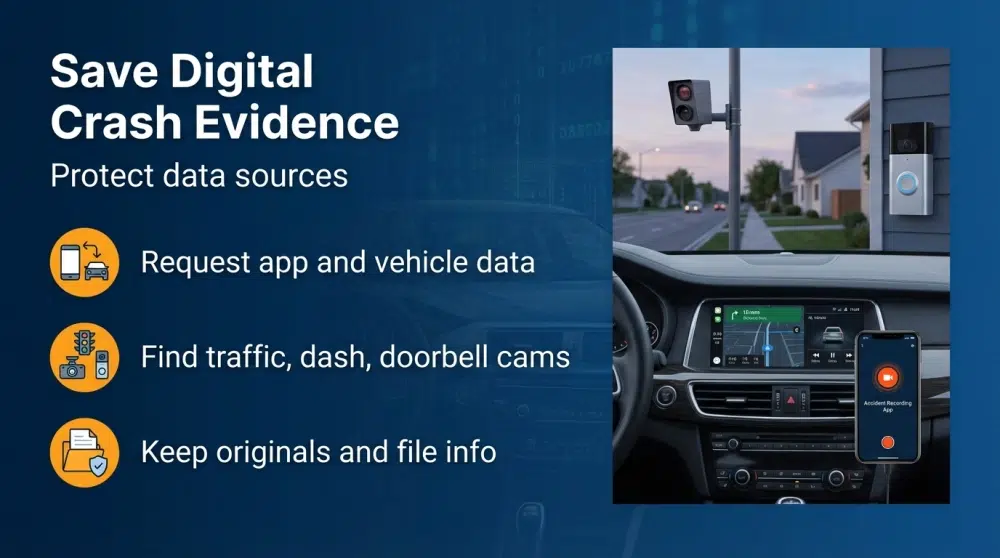
Delivery collisions often involve digital trails that complement your photos. Consider these categories and steps to preserve them:
- Delivery app data: Route start and end, time stamps, and scan events may exist on company systems. Your legal team can send preservation notices and pursue discovery requests tailored to these systems under civil discovery rules [10].
- Telematics and event data recorders: Many vehicles store speed, brake, and seat belt data. Your photos help identify the vehicles and the time frame to request downloads.
- Dash and doorbell cameras: Nearby vehicles and residences may have cameras that captured the collision or its aftermath. Your photos of the area help your team locate potential cameras quickly.
- Public traffic cameras: Some intersections and toll facilities retain footage for short periods. Swift preservation requests are critical, as retention windows can be brief.
- Carrier compliance data: Hours of service and cargo securement are governed by federal regulations, and non compliance can be probative in civil negligence claims [4][5].
What on scene photo checklist works in Dallas, TX?
Use this practical checklist tailored to delivery collisions. Shoot only when safe, after calling 911:
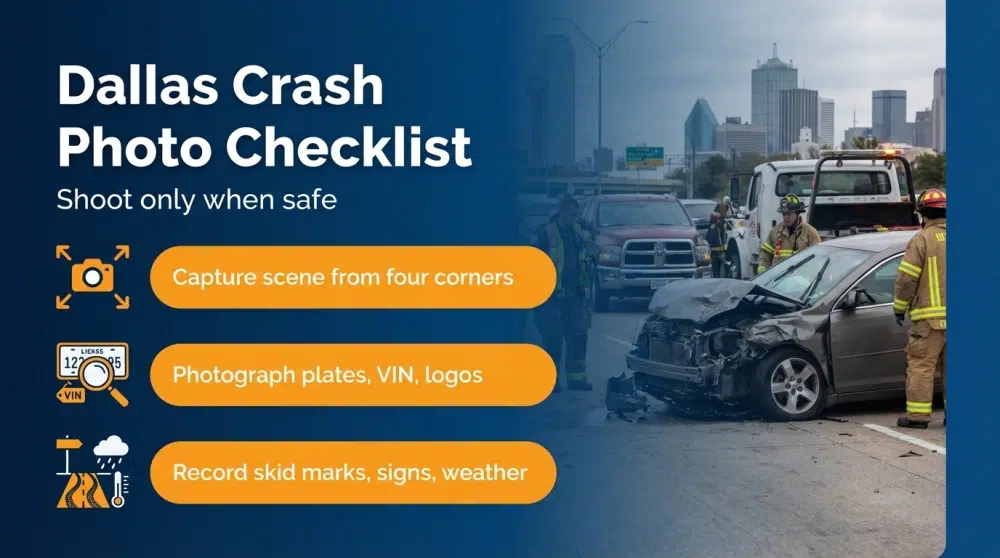
- Scene overview: Four corners of the scene, from different distances.
- Vehicle identities: Plates, VIN through windshield if visible, company logos, unit numbers.
- Damage points: Primary and secondary impacts, interior airbags, wheel and suspension angles.
- Roadway evidence: Skid and yaw marks, gouges, fluid trails, debris fields, lane markings, construction signage.
- Signals and signs: Traffic lights, stop signs, yield signs, school zone signs, work zone markers.
- Weather and lighting: Wet pavement, glare, shadows, fog, streetlight function.
- Cargo and securement: Van doors, straps, racks, fallen packages visible in public view.
- People and contacts: Drivers, passengers, witness contact information with consent. No confrontations.
- Photographs of your Injuries: Capturing both visible injuries, after obtaining necessary consent and providing contextual information, these images will be taken at different points in time to document the healing process accurately.
- Emergency measures: Position of warning triangles, hazard flashers, and vehicle final rest position [7].
After experiencing a car accident while working as an Amazon Flex driver in Dallas, taking photographs of the damage and other relevant elements can significantly strengthen your case during insurance negotiations or any potential legal proceedings.
How are photos used by insurers and in litigation, including spoliation issues?
In civil claims, photographs play a crucial role in determining the outcome of cases. They function as highly effective tools that help establish liability, prove causation for injuries sustained, and enable smoother negotiations during settlements. The images you present serve as reference points when additional evidence is gathered, and they can either support or contest statements made throughout the process. Photographs ultimately provide essential support to determine the truth of a case.
- Insurance evaluation: Insurers review scene photos to assess impact severity, consistency with statements, and potential defenses. Texas crash reports and your images together provide a clearer narrative [8].
- Discovery strategy: Attorneys use your images to craft targeted requests for documents, ESI, and admissions from the delivery contractor and any involved carrier under the civil rules [10].
- Spoliation concerns: If a party loses or destroys relevant evidence after a duty to preserve arises, courts may consider sanctions depending on culpability and prejudice. Texas authority explains how judges evaluate such situations, and federal rules address loss of electronic information [11][12].
Texas roadway crash trends remain significant. TxDOT reports ongoing elevated crash counts statewide, reinforcing the need for prompt and careful documentation when collisions happen [14]. If you are navigating a delivery van crash documentation effort on your own, remember that civil cases involve deadlines and rules that can affect how your photos and other evidence will be received by a court.
When and how can a lawyer help you with evidence after an Amazon delivery collision?
Civil lawsuits typically involve several crucial steps that must be followed carefully in order to build a strong case. Obtaining early legal assistance is highly advisable as it ensures you do not lose any vital pieces of evidence along the way, such as telematics data or videos from third-party sources, which could easily get overwritten later on. Your attorney can collaborate with skilled crash investigators who use nationally recognized methods to document the scene and measure things like skid marks, positions of vehicles after impact, and patterns of damage. This process helps provide a more accurate picture of what transpired in the incident [2] .
Before discussing an accident with your insurance company, it’s vital to gather some essential documentation first. Take pictures at the scene, record the official accident report ID, and craft a narrative of events leading up to and after the crash. Having these materials readily available will make your conversation with your insurer more effective, detailed, and productive. This way, you’ll be better prepared to discuss the situation accurately and efficiently.
Truck accidents often involve complex factors such as commercial carrier rules, driver qualification files, hours of service limits, and cargo securement standards. When an accident involves a large delivery vehicle, having the right documentation is crucial for your legal team to prioritize which records to request under discovery rules. This information is vital to effectively represent your case, ensuring that all relevant details are considered [4] [5] [10] .
When people find themselves in need of assistance with truck accident cases, they typically seek out experienced and knowledgeable attorneys who specialize in this area of law. These lawyers possess not only an extensive understanding of the legal complexities that come with such situations, but are also well-versed in developing customized strategies to efficiently handle events related to large vehicles like trucks. Their primary goal is to skillfully manage both the legal aspects and the details of these often intricate cases while also meticulously examining every single aspect, thereby increasing the chances of a successful outcome.
Dealing with accidents involving passenger vehicles or ride-sharing services can be overwhelming for many families. With so much at stake when it comes to insurance claims and electronic data access, turning to a car accident lawyer might be the best course of action. These legal professionals are experts in handling vehicle collision cases, utilizing their knowledge and experience to navigate the complexities of insurance claims and data retrieval. Car accident lawyers understand how essential photographic evidence can be for winning a case. They know how to gather, organize, and present photos effectively. If you’re involved in an accident with a ride-sharing service and unsure about obtaining necessary information from your insurance provider or the platform where the incident occurred, a car accident lawyer can assist in this process, ensuring your interests are protected and all relevant evidence is collected promptly. Additionally, they can help clients navigate the various legal nuances of their specific case, such as understanding statutes of limitations, determining liability, and calculating damages. By working closely with their clients, these lawyers can improve their cases’ chances for success in court or during settlement negotiations. In conclusion, consulting with a car accident lawyer is highly recommended for families facing accidents involving passenger vehicles or ride-sharing services. Their expertise and experience can make all the difference when it comes to collecting, organizing, and presenting photographic evidence effectively while guiding you through the legal process associated with vehicle collisions.
When a truck accident occurs in Dallas, it’s crucial to find a reliable legal professional who specializes in handling such cases from your local area. This individual will ensure that important requests for evidence preservation are handled meticulously and efficiently, considering factors like local traffic patterns and CCTV surveillance systems.
In the event of a car accident on Dallas city streets or highways, several families turn to local auto accident lawyers for guidance and assistance. These attorneys meticulously examine pictures related to the collision in conjunction with the official police report, and they make an effort to incorporate any nearby security camera footage if it’s available during their investigation. The objective of this comprehensive review is to accurately establish the facts and determine whether legal action might be required down the line.
When dealing with personal injury claims, timing is essential. In many instances, particularly in Texas where most injury lawsuits must be filed within two years from the date of the incident (unless exceptions apply). If you act swiftly and obtain legal representation, your rights will be protected, and you’ll be better positioned to maintain the quality of your photographs and evidence [15].

Why consider GoSuits if you were hurt in a Dallas Amazon delivery crash?
At our dedicated and passionate firm, we specialize in helping individuals who have been injured in vehicle accidents, especially those involving delivery or commercial vehicles, throughout Dallas and across Texas. We provide free initial consultations to guide you through the process, explore crucial evidence and discuss how it can be used to build a strong case timeline. Additionally, we’ll offer guidance on information to gather after an accident. During your consultation with us, we will advise you on what photos to take following a delivery accident, explain the process of requesting an official accident report, and teach you methods for identifying other sources of proof that could strengthen your claim.
- At our organization, we firmly believe that integrating technology is crucial for enhancing our efficiency and productivity. Our skilled professionals have developed tailored software solutions to streamline our processes, leading to smoother and more efficient operations. By embracing the latest technologies, we can expedite data input, create more comprehensive evidence maps, and build timelines with unmatched accuracy. This enables us to manage information effectively and present more concise and compelling arguments during discussions with insurance companies or in court when a case goes to trial.
- Our law firm greatly values direct client-attorney interaction without any hassles or difficulties. By employing the latest technology and tools, we simplify legal processes, making them more efficient. We also place great importance on a hands-on approach by ensuring that each client works closely with their assigned attorney who is always accessible when required. Unlike some other firms, we do not utilize case managers as intermediaries between our clients and lawyers. This direct method permits effective communication, precise attention to detail, and highly personalized services tailored specifically for each of our esteemed clients.
- At our core, we are relentlessly committed to continuous innovation. We’re always refining our processes, keeping them current, aligned with legal standards, and adopting new industry practices. This pursuit of excellence drives us to continually rethink, adapt, and evolve to meet shifting market needs and digital evidence management demands. By staying abreast of the latest technological advancements, we strive to lead our sector for the benefit of both our clients and the broader community.
- A strong track record emphasizes the importance of comprehensive documentation and prompt action when handling legal matters. Do not forget to explore our examples of how we have successfully resolved client cases involving intricate transport situations through our prior cases.
- We are truly proud of our legal team at our law firm, who are dedicated and highly skilled. With years of experience behind them, they have become familiar with the inner workings of courtrooms. This knowledge allows us to approach every case with unwavering dedication and meticulous attention to detail that is only rivaled by the most seasoned trial attorneys. From day one, we treat each case as if it will be argued in front of a jury, which influences how we handle and analyze photographic and video evidence sets.
- We have over 60 years of combined experience handling a diverse range of personal injury cases, including accidents involving delivery vans, commercial trucks, multi-vehicle collisions, pedestrian and bicycle incidents, premises liability, construction site mishaps, product liability, and wrongful death. Make sure to visit our website at practice areas, meet us in person by stopping by our attorneys, and learn more about what we do on about us.
- Our law firm offers comprehensive legal support catering to clients across Texas. We particularly prioritize serving those based in Dallas and neighboring counties. We have a strong focus on representing our clients with utmost efficacy in state and federal court systems, ensuring their interests are well-protected and vigorously defended at all times.
We understand the gravity and urgency of the recent Amazon delivery truck accident, and we assure you that we are fully committed to addressing this matter as quickly and effectively as possible. We kindly request that when you come in for your consultation, please share with us any relevant images or videos of the incident if you have them available. Sharing these materials will significantly assist our efforts to create a customized preservation plan and ensure we take all necessary precautions to prevent any potential legal issues from arising.
References and Resources
- Texas Transportation Code Chapter 550 Duties After Accident – Texas Statutes
- Crime Scene Investigation A Guide for Law Enforcement – National Institute of Justice
- Texas Rules of Evidence including Rule 901 Authentication – Texas Courts
- Summary of Hours of Service Regulations – FMCSA
- 49 CFR Part 393 Subpart I Cargo Securement – LII
- Federal Rule of Evidence 401 Relevance – LII
- 49 CFR 392.22 Emergency Signals for Stopped Commercial Vehicles – LII
- Crash Reports and Records for Texas – TxDOT
- Texas Rules of Civil Procedure including Rule 196.4 Electronic Discovery – Texas Courts
- Federal Rule of Civil Procedure 34 Producing Documents Electronically Stored Information – LII
- Brookshire Brothers Ltd v Aldridge 438 S W 3d 9 Tex 2014 – CourtListener
- Federal Rule of Civil Procedure 37 Failure to Make Disclosures Sanctions ESI – LII
- Large Truck and Bus Crash Facts – FMCSA
- Crash Statistics and Reports – TxDOT
- Texas Civil Practice and Remedies Code Section 16.003 Limitations – Texas Statutes