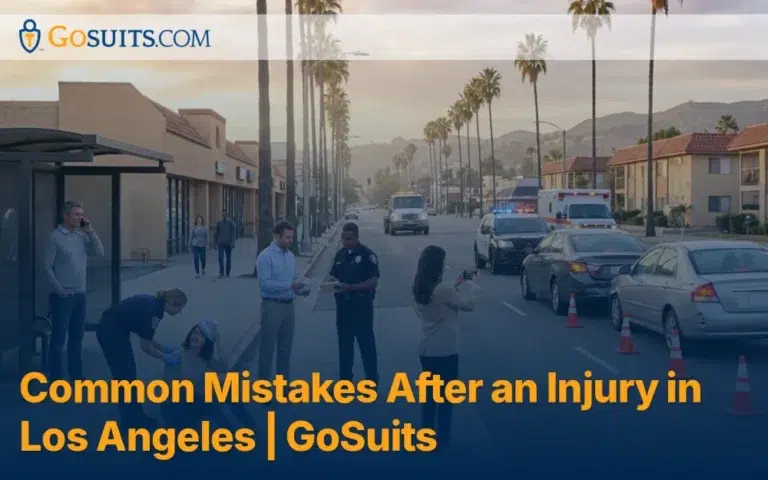
- What are the most common mistakes after an injury in Los Angeles?
- Why is waiting to seek medical attention risky?
- Should you talk to insurance adjusters or give a recorded statement?
- What should you avoid posting on social media after an accident?
- Why does admitting fault hurt your case in California?
- How do police reports and DMV reporting affect a claim in Los Angeles?
- How should you document injuries and preserve evidence?
- What if there is a gap in medical treatment?
- What deadlines and statutes of limitations apply in California injury cases?
- What if a government agency or employee is involved in the crash?
- How do California comparative negligence and Prop 51 change recovery?
- Should you sign releases or cash checks from insurers right away?
- Why should you contact a lawyer early in the process?
- What local resources can help you in Los Angeles after an injury?
- How does GoSuits support injured people in Los Angeles?
- References and Resources
What are the most common mistakes after an injury in Los Angeles?
After an unexpected injury in Los Angeles, your first actions can influence both your health and your civil claim. We see the same pitfalls again and again. Avoiding these common mistakes can protect your rights under California law and put you in a stronger position if a claim becomes necessary.
- Waiting to seek medical care Delayed evaluation can put your health at risk and create gaps in care that insurers may use to question causation and damages. Prompt treatment also builds contemporaneous records that support your claim [14].
- Giving recorded statements to insurers Adjusters often request recorded statements within days of a crash. You are not legally required to give a recorded statement to the other driver’s insurer, and early statements can be quoted out of context later [5].
- Posting on social media about the incident Public posts are discoverable in litigation and can be used to challenge your credibility or damages. Discovery in California is broad, and social media content can be requested if relevant [11] [12].
- Admitting fault or apologizing in ways that sound like an admission Statements a party makes can be used against them as party admissions under evidence rules, which can complicate liability arguments [6] [13].
- Failing to report or document the incident California law requires reporting certain traffic collisions to law enforcement and to the DMV within specific timelines when injuries or certain property damage thresholds are involved [3] [4].
- Not preserving photos, video, or physical evidence Evidence can be lost or degraded quickly. Timely preservation supports liability and damages and reduces disputes about what happened.
- Missing deadlines In California most personal injury claims must be filed within two years, with a much shorter six month claim deadline for most claims against public entities [1] [2].
- Signing blanket releases or early settlement checks General releases can waive unknown claims under California law unless carefully reviewed, and early checks may include rights waivers you did not intend [16].
The civil justice process in California is designed to resolve disputes fairly, but it also demands thorough documentation, timely action, and careful communication. In a city as large and complex as Los Angeles, small errors at the outset can have outsized consequences.
Why is waiting to seek medical attention risky?
Some injuries are not obvious in the first hours or days after an incident. Concussions, soft tissue injuries, and internal injuries can develop or worsen over time. The Centers for Disease Control and Prevention notes that symptoms from a mild traumatic brain injury may be delayed and that immediate evaluation is important to rule out more serious harm [14].
Delays also invite disputes about causation. Insurers often argue that a gap between the event and your first documented care means either the injury was minor or was caused by something else. If you wait, your medical records may not connect your symptoms to the incident with the clarity needed for a strong personal injury claim.
- Get checked promptly Even if you feel okay, a prompt exam creates a baseline and can catch hidden injuries [14].
- Follow your treatment plan Consistent follow up supports recovery and documents the course of your injury, which helps quantify damages.
- Keep all records Visit summaries, diagnostic imaging, and prescriptions are objective evidence that helps support a Los Angeles personal injury claim if settlement talks stall.
One more practical reason to act quickly is the legal timeline. Although California generally allows two years to file an injury lawsuit, early evaluation strengthens documentation during that period [1].
Should you talk to insurance adjusters or give a recorded statement?
Adjusters for the at fault party often contact you quickly. California’s Department of Insurance publishes consumer guidance for auto claims that explains your rights and outlines the claims process, including the importance of carefully reviewing what you say and sign during early communications [5].

You can expect friendly questions about what happened and how you feel. The problem is that your words can be used to dispute liability or damages later. A casual phrase like I am fine can appear in a transcript to imply you were uninjured. You should cooperate with your own insurer as your policy requires, but for the opposing carrier you can decline a recorded statement, or limit it until after you have obtained guidance about your options [5].
- Be accurate and brief Stick to facts you know and avoid speculation about fault or injuries.
- Do not guess If you do not know an answer, say so. Guessing can create inconsistencies.
- Request written communication when possible It leaves a clear record of what was asked and answered.
When negotiations begin, remember that damages in California personal injury cases are measured by the amount that will compensate for the harm caused by the wrongful act or omission of another [9]. Early statements that minimize your pain, limit your activities, or concede a share of fault can materially lower the settlement value of your case.

Why does admitting fault hurt your case in California?
Determining fault is complex and depends on facts, police findings, and sometimes expert analysis. Early statements like it was my fault can later be used as admissions by party opponents under evidence rules [6] [13]. California is a pure comparative negligence state, which means your damages are reduced by your percentage of fault [7]. Small wording choices can lead to larger fault allocations than the facts support.
- Stick to facts at the scene Exchange information, call law enforcement when appropriate, and avoid debating blame.
- Let the investigation play out Liability can turn on camera footage, witness statements, roadway design, and vehicle dynamics that are not obvious at first.
A careful approach protects your credibility while allowing an accurate fault analysis to emerge.
How do police reports and DMV reporting affect a claim in Los Angeles?
California law requires reporting of collisions that cause injury or death to law enforcement within 24 hours. This is satisfied by a report from the law enforcement officer who investigated the collision, or by the driver if no officer responds [3]. Separately, the DMV requires an SR 1 report within 10 days when a crash involves injury, death, or property damage of at least one thousand dollars [4].
- Call 911 for injury collisions A police report documents the scene, identifies parties and witnesses, and may record initial fault indicators.
- File the DMV SR 1 timely Failing to file can result in license consequences and can complicate insurance dealings [4].
- Obtain the report The report is important for claim evaluation and negotiations.
While a police report is not the final word on fault, insurers rely on it early. Corrections or supplements can sometimes be requested when factual errors are found.
How should you document injuries and preserve evidence?
Evidence tells the story of what happened. In California civil cases, the scope of discovery is broad, which means both sides can request and inspect evidence that is relevant to any party’s claims or defenses [11]. This makes early preservation essential.
- Photograph the scene and vehicles Capture positions, damage, skid marks, debris fields, traffic controls, and any visibility issues. For premises incidents, document the hazard, lighting, and warning signs if any.
- Collect witness details Names, phone numbers, and brief statements help later when memories fade.
- Save damaged items Keep torn clothing, broken gear, and other physical objects in sealed bags with dates.
- Track symptoms and limitations A simple daily log of pain levels, missed work, and task limitations helps demonstrate non economic damages under California law [9].
- Request camera footage quickly Traffic, retail, and residential cameras often overwrite data in days. Prompt requests can prevent loss.
Good documentation makes liability clearer, shortens disputes, and can accelerate fair resolution.
What if there is a gap in medical treatment?
Life in Los Angeles is busy, and missing an appointment is easy. Insurers, however, frequently cite gaps as evidence that you healed or that your injuries were modest. If you must miss a visit, reschedule as soon as possible and keep a record of why. Consistent care not only supports your health, it strengthens causation and damages.
- Explain unavoidable gaps Document child care conflicts, transportation issues, or provider availability. Add that documentation to your file.
- Follow referrals If your primary provider refers you to specialists or imaging, go as soon as you can and keep paperwork organized.
- Monitor delayed symptoms Some conditions, including concussive injuries, can worsen after a delay. If new symptoms appear, return to a provider promptly [14].
What deadlines and statutes of limitations apply in California injury cases?
California sets specific timelines for injury claims. Missing these deadlines can end your claim regardless of fault.
- General personal injury deadline Two years from the date of injury in most cases, including wrongful death claims arising from negligence [1].
- Claims against government entities Most require a written claim within six months of the incident, before you may file a lawsuit in court [2].
- Minors and certain tolling situations California tolls certain claims during minority and in other narrow circumstances, which can extend the filing deadline [10].
Even if you believe you have time, the quality of evidence and witnesses can degrade quickly. Early action helps preserve your rights within California’s civil procedure framework.
What if a government agency or employee is involved in the crash?
If the at fault party is a city, county, state agency, or certain public employees, California’s Government Claims Act generally requires that you present a written claim to the public entity before filing in court. For personal injury claims the claim is typically due within six months of the incident date [2].
- Identify the right entity Public agencies can be distinct from the City or County. Getting the correct addressee is crucial.
- Meet content requirements The claim must include specific information and is best sent by a method that proves receipt.
- Calendar the follow up After a claim is rejected or deemed rejected by inaction, a separate lawsuit deadline applies. Track each step carefully [2].
Missing the claim step can be fatal to a public entity case, even if your underlying claim has merit.
How do California comparative negligence and Prop 51 change recovery?
California applies pure comparative negligence, meaning your recovery is reduced by your percentage of fault. If you are 20 percent at fault, your damages are reduced by that percentage [7]. California also limits joint liability for non economic damages. Under Civil Code section 1431.2, each defendant is severally liable for non economic damages only in proportion to that defendant’s fault, while economic damages remain subject to joint responsibility under other principles [8].
- Do not concede fault early Percentages can shift with new evidence. Keep your options open.
- Document your economic losses Medical bills and lost wages are economic damages, and thorough proof supports full recovery from responsible parties [9].
- Track non economic harms Pain, inconvenience, and loss of enjoyment are non economic damages, but each defendant pays only their share for these in California [8].
Should you sign releases or cash checks from insurers right away?
Insurers sometimes offer early payments with release language attached. In California, a general release can waive unknown claims unless it expressly preserves them. Civil Code section 1542 is often quoted or waived in settlement documents to address unknown claims. Do not sign until you understand what rights you are giving up [16].
- Read everything Look for the word release and any waiver of California Civil Code section 1542 language before signing [16].
- Confirm all losses Make sure the amount covers medical care, wage loss, property damage, and future care needs where applicable.
- Save copies Keep a file with all communications and draft offers.
Once you sign a valid release and cash a settlement check, reversing course is difficult.
Why should you contact a lawyer early in the process?
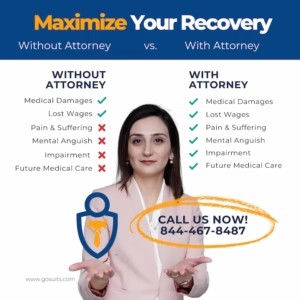
Early guidance helps you avoid avoidable mistakes. It can also speed up evidence preservation, clarify deadlines, and take pressure off you so you can focus on recovery. An attorney can coordinate records, craft careful communications with insurers, and evaluate liability under California statutes and case law, including comparative negligence and damages rules [7] [9].
If you want to talk with Los Angeles car accident lawyers about options and timelines, do so before you engage in recorded statements or sign any releases.
In a city as large as Los Angeles, it is often helpful to speak with Los Angeles car accident lawyers who understand local roadways, common collision patterns, and the practices of carriers that frequently operate in Southern California.
What local resources can help you in Los Angeles after an injury?
These practical steps and resources can help you navigate the first days after an incident in Los Angeles, while preserving your rights.
- Call law enforcement for injury collisions A report satisfies legal reporting and creates neutral documentation for claims [3].
- File the DMV SR 1 if required Submit within 10 days when an injury occurs or property damage meets the threshold [4].
- Use the California Department of Insurance resources Understand claims practices and your rights as a consumer [5].
- Keep a centralized file Store your medical records, receipts, repair invoices, and correspondence. Detailed proof supports your Los Angeles personal injury claim.
For serious collisions, national safety data from the National Highway Traffic Safety Administration highlights the scale of roadway injuries and fatalities each year, which underscores why careful documentation and timely action matter for claim evaluation [15].
How does GoSuits support injured people in Los Angeles?
If you are navigating a personal injury in Los Angeles, we offer a free consultation to help you understand timelines, documentation, and options for pursuing a civil claim. GoSuits represents clients throughout California, with a focus on Los Angeles, and handles cases across motor vehicle collisions, premises incidents, product defects, catastrophic injuries, and wrongful death. Learn more about about us, meet our attorneys, and review a selection of prior cases that reflect our work.
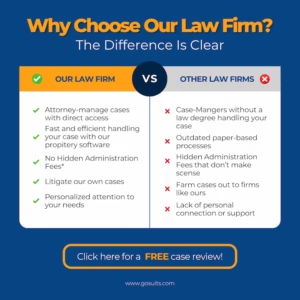
We use a technology driven approach to move cases forward efficiently. Our exclusive proprietary software integrates evidence intake, medical record tracking, and litigation timelines, which helps us deliver faster and more organized case progression while maintaining high quality filings and negotiations. Although we leverage technology to expedite the process, every client has a designated attorney. We do not route cases through case managers, and clients have direct access to the lawyer handling their matter.
Our team brings more than 30 years of combined experience, including substantial trial work that informs strategic decisions from day one. Trial readiness often increases settlement leverage because carriers evaluate risk with an eye toward how facts will play at trial. You can explore our practice areas to see the breadth of matters we handle, from vehicle collisions to premises liability and complex injury litigation.
- Technology leadership Exclusive proprietary platform that streamlines evidence, deadlines, and communication.
- Designated attorneys Direct access to your lawyer, not a call center or case manager.
- Trial experience Courtroom skills that support better positioning in negotiations.
- Past results A record of meaningful outcomes for clients across California, highlighted in our prior cases.
Whether your claim calls for early resolution or litigation, our approach is built to move efficiently and carefully, with attention to both your recovery and your long term interests.
References and Resources
- California Code of Civil Procedure section 335.1 two year limit for injury or death – California Legislative Information
- California Government Code section 911.2 claim presentation within six months – California Legislative Information
- California Vehicle Code section 20008 reporting injury or death collisions – California Legislative Information
- California Collision Reporting SR 1 requirements – California DMV
- Automobile Insurance Claims Consumer Guide – California Department of Insurance
- California Evidence Code section 1220 admissions of party – California Legislative Information
- Li v. Yellow Cab Co. of California, 13 Cal.3d 804 – CourtListener
- California Civil Code section 1431.2 several liability for non economic damages Prop 51 – California Legislative Information
- California Civil Code section 3333 measure of damages – California Legislative Information
- California Code of Civil Procedure section 352 tolling for minors and others – California Legislative Information
- California Code of Civil Procedure section 2017.010 scope of discovery – California Legislative Information
- Federal Rule of Civil Procedure 26 scope of discovery – Legal Information Institute
- Federal Rule of Evidence 801 definitions and exclusions including admissions by party opponent – Legal Information Institute
- Traumatic Brain Injury Signs and Symptoms including delayed presentation – Centers for Disease Control and Prevention
- Traffic Safety Facts and national fatality estimates – National Highway Traffic Safety Administration
- California Civil Code section 1542 effect of general releases – California Legislative Information





What should you avoid posting on social media after an accident?
Anything you post can be saved and used against you. Both California and federal rules allow broad discovery of nonprivileged information relevant to a claim, which can include social media content [11] [12]. Even posts that seem unrelated can be used to argue that you were less injured than claimed or that your activities contradict your testimony.
The safest approach is to stay off social platforms while your claim is pending. If that is not practical, post sparingly and never about the incident.