- What counts as evidence for a personal injury lawsuit?
- What should you collect at the scene after a car accident or slip and fall accident?
- How do you document accident injuries and medical treatment the right way?
- How do police reports and witness statements support a personal injury claim?
- How do you preserve digital evidence like photos, videos, dash cam, EDR, and surveillance footage?
- What is a spoliation letter and when should it be sent?
- What is chain of custody and why does it matter for your case?
- How do you prove medical bills, wage loss, and other financial harms?
- Do you need accident reconstruction or expert testimony to win?
- Which federal and state rules affect evidence collection in California, Texas, and Illinois?
- What evidence mistakes should you avoid after an injury?
- FAQ: Your top evidence questions answered
- About GoSuits
- References and resources
What counts as evidence for a personal injury lawsuit?
Evidence for a personal injury lawsuit is any information that helps a judge, jury, or insurance carrier decide what happened, who is responsible, and what harm resulted. In civil cases, you generally carry the burden to prove your claims by a preponderance of the evidence. The types of proof can include both physical and digital materials, as well as testimony and records that connect the incident to your injuries and losses.
According to federal discovery rules, parties may seek nonprivileged information that is relevant and proportional, including documents, electronically stored information, photos, videos, and data compilations [2]. Courts also apply rules for authenticating evidence before it can be admitted at trial, which means you must be prepared to show that an item is what you claim it is [3].
Common categories of personal injury claim evidence include:
- Accident photos and videos including vehicle damage, scene measurements and skid marks, weather, lighting, and roadway or premises conditions.
- Police report and witness statements to document observations, fault indicators, citations, admissions, and roadway diagrams.
- Medical records and bills such as EMS and 911 records, emergency department notes, treating physician notes, radiology, pharmacy records, and medical lien documentation.
- Digital datasets like dash cam footage, surveillance footage, black box EDR data from vehicles, cell phone photos, text messages, and social media evidence.
- Employment and financial records including employer wage-loss records, timesheets, tax forms, and property damage estimates.
- Pain and symptom journal contemporaneous notes that track limitations, therapies, and the impact on daily life.
The scale of injury in the United States is significant. NHTSA’s early estimates report approximately 40,990 traffic fatalities in 2023, a decrease compared to 2022 but still tragically high [7]. The CDC notes that injuries remain a leading cause of death for people ages 1 through 44, and they carry large medical and productivity costs nationwide [8]. Collecting strong evidence is how you translate what happened to you into a clear, compensable picture.
What should you collect at the scene after a car accident or slip and fall accident?
If you are able and it is safe, gathering scene evidence immediately can meaningfully strengthen your personal injury claim evidence. In a car accident, pedestrian collision, motorcycle accident, or truck accident involving a semi, 18-wheeler, tractor-trailer, or big rig, useful items include:
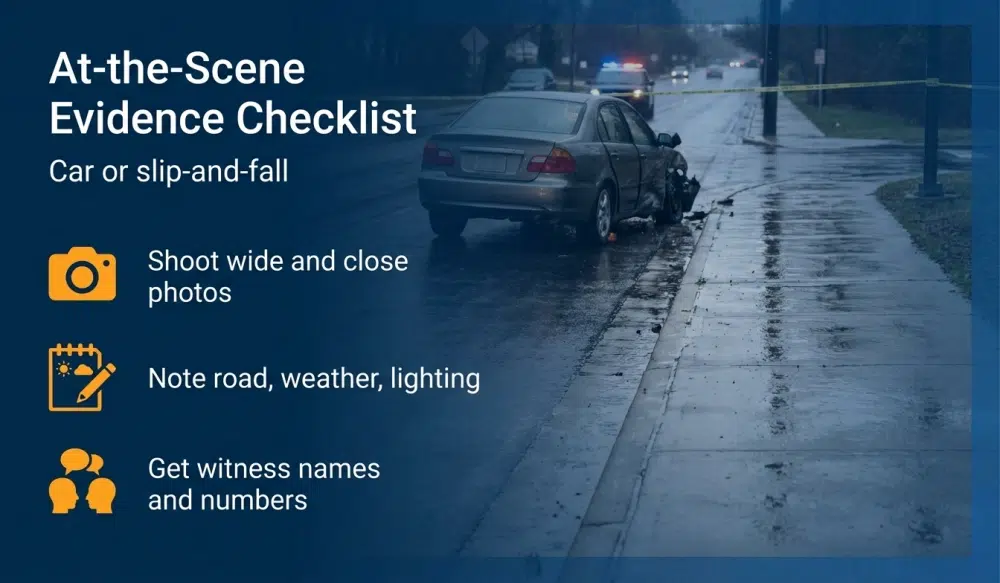
- Wide and close photos of all vehicles, license plates, VINs, debris fields, glass, airbags, seatbelts, and any deployed or damaged safety systems.
- Roadway details intersection control devices, lane markings, potholes, construction zones, scene measurements and skid marks, gouges, and curb strikes.
- Environmental conditions lighting, glare, sun position, weather, wet surfaces, or oil spills.
- Damage points crush zones, underride or override patterns in truck collisions, helmet damage in a motorcycle accident, or vehicle intrusions linked to a brain injury or concussion.
- Witness contact information names, numbers, and short audio or written statements if they are willing.
- Property and premises evidence in a slip and fall accident: spilled liquids, mats, warning signs, inadequate lighting, broken stairs, video cameras, floor logs, and inspection records if visible.
Additional quick steps:
- Call 911 so EMS and law enforcement can document injuries and conditions in official reports.
- Request the officer’s card and report number so you can obtain the crash report later.
- Note nearby cameras gas stations, storefronts, rideshare dash cams, and public transit cameras can capture critical footage.
- Preserve your vehicle; do not repair or dispose of it until consulting legal counsel, especially if black box EDR data might be needed.
In a construction accident, collect photos of the worksite, equipment, scaffold condition, safety gear, and any jobsite logs or postings you are allowed to view. For product liability incidents involving a defective product, preserve the product and all packaging. For severe outcomes, including wrongful death, protect all documents, devices, and vehicles involved from alteration.
How do you document accident injuries and medical treatment the right way?
Medical documentation is the backbone of damages. Thorough medical records and bills show diagnosis, causation, and the cost of care. You can gather and preserve this information systematically:
- Emergency care obtain EMS and 911 records, emergency department provider notes, imaging, and discharge instructions.
- Follow-up care collect treating physician notes, referrals, therapy notes, and pharmacy records for medications and medical devices.
- Organize bills keep original statements and Explanation of Benefits for all providers. Track any medical lien documentation from hospitals or insurers.
- Pain and symptom journal write daily entries about pain levels, mobility, sleep, activities missed, appointments, and how injuries affect work and home life.
- Keep appointment history missed or rescheduled visits should be recorded, along with the reasons, to avoid disputes about treatment gaps.
You have rights under federal law to access your medical records, often within a specific timeframe and at reasonable cost. The HIPAA Privacy Rule grants patients the right to inspect and obtain copies of their protected health information from covered entities [5]. When records are needed for litigation, attorneys can also use subpoenas or court orders to obtain records from providers subject to the Privacy Rule’s conditions for judicial and administrative proceedings [6].
How do police reports and witness statements support a personal injury claim?
Police reports can capture objective scene information, provide preliminary fault analysis, and identify witnesses. They often include drawings, measurements, citations, roadway conditions, and statements that may otherwise be lost over time. While a report may not be admissible for the truth of everything it contains, it is valuable for claims evaluation and discovery strategy.
States set rules for crash reporting and availability. For example:
- California requires drivers to promptly report collisions involving injury or death to law enforcement, which results in an official report [11].
- Texas requires officers who investigate crashes resulting in injury, death, or property damage to forward a written report to the Department of Transportation [12].
- Illinois imposes immediate reporting duties and follows specific statutory rules for accident reporting and records [13].
Witness statements can corroborate your account. Ask witnesses for contact information at the scene. Written or recorded statements help lock in details while memories are fresh. Later, formal depositions can be taken during discovery under procedural rules, and the testimony can be used to challenge inconsistent trial accounts.
How do you preserve digital evidence like photos, videos, dash cam, EDR, and surveillance footage?
Digital evidence is now central to accident claims. It includes photos, smartphone videos, metadata, dash cam footage, commercial surveillance footage, and vehicle black box EDR data. Courts often require litigants to act reasonably to preserve relevant electronically stored information, and sanctions can result if ESI is lost after a duty to preserve arises [1].

What is black box EDR data and why is it important?
Most modern passenger vehicles contain an event data recorder that may store precrash speed, braking, throttle position, seatbelt use, and airbag deployment parameters depending on the model. NHTSA publishes information about EDRs and supports tools for downloading data [9]. In a truck accident, separate regulatory data can exist in electronic logging devices, engine control modules, GPS, and fleet telematics. Preserving these datasets early can help reconstruct timing and driver actions.
What are the special rules for commercial trucks and ELD data?
Federal rules require motor carriers to retain driver records of duty status and certain supporting documents for specified periods, often at least six months for ELD data retention in typical scenarios [10]. If you are dealing with a semi, 18-wheeler, tractor-trailer, or big rig, time is critical because some carriers overwrite or purge data in the ordinary course of business unless they are notified to preserve it.
How do you obtain dash cam and surveillance footage?
- Identify sources quickly personal dash cams, rideshare vehicles, buses, storefront cameras, parking garages, or residential doorbell systems.
- Request preservation in writing send a spoliation letter as soon as possible to the owner or business controlling the footage.
- Follow up with subpoenas if voluntary cooperation fails, formal legal process can be used during litigation to request production of the footage, subject to relevance and proportionality standards [2].
How should you handle social media evidence?
Posts, photos, check-ins, and messages can become key evidence. Preserve your own content and avoid deleting posts after an incident, because you may later have a duty to preserve. To use social media content in court, you will need to authenticate it just like any other evidence under Federal Rule of Evidence 901 or equivalent state rules [3]. Courts and judges in ESI-heavy cases expect planned preservation and cooperation when reasonably possible [14].
What is a spoliation letter and when should it be sent?
A spoliation letter, sometimes called a preservation letter or litigation hold notice, formally tells the opposing party or a third party to preserve specific categories of evidence. The duty to preserve generally arises when litigation is reasonably anticipated. Early letters can prevent routine deletion of emails, EDR data, dash cam files, and surveillance video that might otherwise be overwritten within days or weeks.
Federal courts may impose measures or sanctions if electronically stored information is lost because a party failed to take reasonable steps to preserve it after a duty arose, particularly if the information cannot be restored or replaced [1]. Foundational case law elaborates on the duty to preserve, custodial scope, and sanctions analysis in the ESI context [4]. A clear, specific letter helps show diligence and puts custodians on notice of the need to suspend ordinary deletion practices.
Effective preservation communications should identify, to the extent known:
- Categories of evidence surveillance footage, dash cam files, black box EDR data, employment files, emails, maintenance logs, or floor inspection logs.
- Date ranges the incident day, the days before and after, and relevant historical maintenance or safety records.
- Systems and custodians fleet telematics vendors, store managers, property owners, IT departments, drivers, or third-party logistics providers.

What is chain of custody and why does it matter for your case?
Chain of custody is the documented path an item of evidence travels from collection to court. It shows who had possession, when, and how it was stored. Gaps invite challenges that an item was altered or contaminated. Courts require a threshold showing that evidence is authentic before it can be admitted, and chain of custody records support that showing [3].
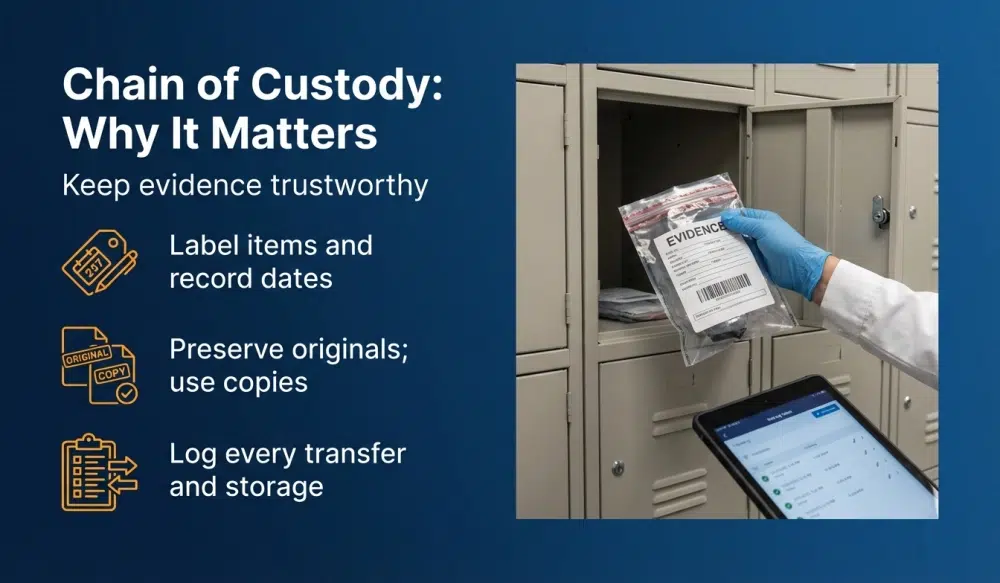
Practical steps to maintain chain of custody for both plaintiffs and defendants:
- Label and date photos, videos, and physical items the same day they are collected.
- Preserve originals keep original SD cards, phones, or devices if possible, and work from forensic copies.
- Use logs maintain an evidence log that records transfers, storage locations, and access.
- Secure storage store items in sealed, tamper-evident containers or controlled digital vaults.
This discipline is especially important for surveillance footage, EDR data, dash cam cards, and products in a product liability case. For vehicles involved in a severe car accident or motorcycle accident, consider storing the vehicle in a secure lot to protect future inspection and download of onboard data.
How do you prove medical bills, wage loss, and other financial harms?
Your damages presentation should be as complete as possible. Build your file with the following:
- Medical records and bills collect itemized statements, CPT and ICD coding pages, and balance ledgers from each provider.
- Pharmacy printouts request a full medication history tied to the injury period.
- Employer wage-loss records obtain payroll summaries, timesheets, W-2s or 1099s, job descriptions, and letters confirming time missed and restrictions.
- Self-employed documentation if applicable, gather invoices, bank statements, profit-and-loss reports, and tax returns to show reduced earnings.
- Property damage estimates secure independent repair estimates and pre-loss valuations for vehicles or other property.
- Out-of-pocket expense log mileage to appointments, medical devices, home health support, and childcare substitutions.
If a provider will not voluntarily release medical records, you may use a HIPAA authorization or subpoena. The Privacy Rule explains permitted disclosures for judicial or administrative proceedings when certain safeguards are met, such as notice to the individual or a qualified protective order [6]. Patients also have a direct right of access to their own medical information [5]. Organized, verified documentation shortens disputes and helps resolve claims more quickly.
Do you need accident reconstruction or expert testimony to win?
Not every case requires advanced modeling, but technical analysis can be decisive where liability is disputed or injuries are severe. Accident reconstruction may combine scene measurements and skid marks with vehicle crush analysis and EDR datasets to estimate speeds, braking, and collision dynamics. In a truck accident, reconstruction can incorporate hours-of-service data, ELD records, GPS breadcrumbs, and maintenance logs governed by federal rules [10].
Under the rules of evidence, any technical or scientific opinion must be grounded in sufficient facts and reliable methodology. Even if your case is a straightforward car accident or slip and fall accident, targeted opinions from treating physicians or other qualified witnesses may help explain causation and prognosis, particularly in a brain injury case. For commercial property damage components of an incident, independent appraisals and engineering reports can document cost to repair and scope of loss. The decision to use specialized testimony depends on complexity, contested issues, and the value of the claim.
Which federal and state rules affect evidence collection in California, Texas, and Illinois?
- Discovery scope Rules permit discovery of nonprivileged matter that is relevant and proportional to the needs of the case [2].
- ESI preservation and sanctions Courts can address loss of electronically stored information when a party failed to take reasonable steps to preserve it after a duty arose [1].
- Authentication Evidence must be shown to be what the proponent claims it is, which can be done by witness testimony, distinctive characteristics, or digital hash values for files [3].
- ESI case management Federal Judicial Center guidance encourages early attention to ESI, targeted preservation, and cooperation to reduce cost and disputes [14].
What California laws are relevant?
- Crash reporting California Vehicle Code section 20008 requires reporting injury or fatal collisions to law enforcement, resulting in a police report that can be requested later [11].
- Medical records Federal HIPAA rights apply to California patients seeking access to their records [5].
What Texas laws are relevant?
- Officer reports Officers must submit crash reports to the Department of Transportation in qualifying crashes, providing a centralized record [12].
- Commercial trucking data Federal hours-of-service and ELD retention rules apply to interstate motor carriers operating in Texas [10].
What Illinois laws are relevant?
- Immediate reporting Illinois statutes address immediate accident reporting obligations and related records, which can be vital in a disputed liability case [13].
- Discovery procedures State discovery tools parallel federal practice, allowing subpoenas and requests for production consistent with proportionality principles reflected in federal rules [2].
What evidence mistakes should you avoid after an injury?
- Waiting too long to act surveillance and dash cam systems frequently overwrite data within days. Send a spoliation letter immediately.
- Repairing or discarding vehicles dispose of nothing until critical inspections and EDR downloads are completed.
- Deleting social media posts do not delete or alter potentially relevant content once litigation is reasonably anticipated, as courts can penalize spoliation [1].
- Failing to authenticate track who created a photo or video, when, and how it was stored to meet authentication requirements [3].
- Ignoring trucking records send targeted preservation demands for ELD data, driver qualification files, maintenance logs, and dispatch communications in a truck accident [10].
- Missing medical detail incomplete charts or unpaid bills create gaps that insurers exploit. Request full and itemized records.
- Not documenting pain and limitations a simple daily journal often makes the difference in explaining non-economic harm.
- Going it alone civil litigation and ESI issues can be complex. Consider timely legal help before evidence disappears or mistakes impact your claim.

How GoSuits Personal Injury Lawyers Can Help You
If you are navigating a personal injury claim, thoughtful evidence collection can make a real difference. A free consultation with a personal injury attorney can help you prioritize preservation steps, target critical sources like surveillance footage and EDR data, and coordinate medical records and bills without delay.
GoSuits represents clients nationwide in the United States with a focus on civil injury matters, including car accident, truck accident, motorcycle accident, slip and fall accident, construction accident, brain injury, product liability, commercial property damage, and wrongful death cases. We combine 30 years of combined experience with a technology-driven approach designed to move cases faster and more transparently. Our exclusive proprietary software centralizes medical records tracking, automates preservation notices, and accelerates document review so you spend less time waiting for updates and more time focusing on recovery.
Every client has unfettered access to their attorney. We do not route clients through case managers. While technology expedites timelines, trial preparation and courtroom advocacy remain at the core of our practice. Our trial experience benefits clients in negotiations and at trial when needed. You can review selected past results at prior cases, meet the lawyers you will work with at our attorneys, and learn more about who we are at about us. For the full list of our services, visit practice areas.
References and resources
- Federal Rule of Civil Procedure 37, Failure to Make Disclosures or to Cooperate in Discovery – Legal Information Institute
- Federal Rule of Civil Procedure 34, Producing Documents, Electronically Stored Information – Legal Information Institute
- Federal Rule of Evidence 901, Authenticating or Identifying Evidence – Legal Information Institute
- Zubulake v. UBS Warburg LLC, 220 F.R.D. 212 (S.D.N.Y. 2003) – CourtListener
- Individuals’ Right under HIPAA to Access their Health Information – U.S. Department of Health and Human Services
- Disclosures for Judicial and Administrative Proceedings – U.S. Department of Health and Human Services
- Early Estimate of Motor Vehicle Traffic Fatalities in 2023 – National Highway Traffic Safety Administration
- Injury and Violence Overview and Data Tools – Centers for Disease Control and Prevention
- Event Data Recorder Research – National Highway Traffic Safety Administration
- 49 CFR 395.8 Driver’s Record of Duty Status and ELD Record Retention – eCFR
- California Vehicle Code § 20008, Duty to Report Accidents – California Legislative Information
- Texas Transportation Code Chapter 550, Accidents and Accident Reports – Texas Statutes
- 625 ILCS 5/11-406, Immediate Notice of Accident – Illinois Compiled Statutes
- Managing Discovery of Electronic Information, Third Edition – Federal Judicial Center