
- How do you find the best personal injury lawyer in California?
- Which California laws affect your personal injury case and timeline?
- What is the statute of limitations for California personal injury and government claims?
- How should you compare case results, trial background, and courtroom readiness?
- What fees and costs should you expect from a California personal injury lawyer?
- What questions should you ask during a free consultation personal injury meeting?
- How do you evaluate communication, capacity, and client access?
- How do investigation and insurance negotiations work in California injury claims?
- How do damages and comparative fault work under California law?
- How can you research reviews and public records without relying only on ratings?
- What red flags should you avoid when choosing a lawyer?
- What is different in a wrongful death case in California?
- When does hiring a trial lawyer in California matter most?
- What is a step by step checklist to choose a lawyer in California?
- Why consider GoSuits for personal injury cases in California?
- References and Resources
How do you find the best personal injury lawyer in California?
You want someone who matches your case needs, communicates clearly, understands local courts, and is ready to take a case through trial when necessary. The best personal injury lawyer in California for you is not just about ratings; it is about fit, preparedness, and results backed by transparent information you can verify.
Start with these qualities:
- Local familiarity: Knowledge of Los Angeles County court practices and filing procedures can streamline case progress and avoid missed deadlines.
- Proven negotiation and trial capacity: Most civil cases resolve before trial, yet the possibility of trial drives fair settlements. Government data shows only a small share of civil cases reach trial, which makes pretrial advocacy pivotal [8].
- Clear fee explanation: California has specific rules for contingency fee agreements, including disclosures and content requirements in certain matters [5].
- Accessible communication: You should know how often you will receive updates, who will handle your file, and how quickly calls are returned.
- Transparent case strategy: A practical plan for investigation, medical documentation, and damages proof tailored to your facts.
Which California laws affect your personal injury case and timeline?
Several California rules shape your rights, deadlines, and potential recovery:
- Personal injury statute of limitations: In most cases you have two years from the date of injury to file a lawsuit [1].
- Property damage claims: Claims for damage to property, such as a vehicle, typically have a three-year deadline [2].
- Claims against government entities: You usually must file a government claim within six months before suing a public entity like a city or county, and failure to do so can bar the claim [3].
- Comparative fault: California uses pure comparative negligence, meaning your recovery can be reduced by your share of fault but is not barred entirely [6] [7].
- Apportionment of non-economic damages: For pain, suffering, and similar losses, each defendant is responsible only for their percentage of fault [4].
A California personal injury lawyer must account for these rules early, especially when evidence needs preservation and when public entities may be involved [3].
What is the statute of limitations for California personal injury and government claims?
If you are searching for how to choose a personal injury lawyer, a key factor is whether the lawyer flags and manages deadlines from day one. California law generally gives you two years for bodily injury and three years for property damage, and shorter administrative windows when a public entity is involved [1] [2] [3].
- Two years for injury to a person in most negligence cases [1].
- Three years for injury to personal property, like a vehicle [2].
- Six months to present a claim to a government entity before filing suit, with specific content and delivery rules, followed by short periods to act if denied [3].
Missing a deadline can end a claim regardless of merit. Ask any lawyer you consult to identify your deadlines in writing and outline steps needed to preserve them.
How should you compare case results, trial background, and courtroom readiness?
While settlements are common, a lawyer’s history of preparing and trying cases can influence insurers and defendants. Data from the justice system shows relatively few civil claims go to trial, so early, thorough preparation is critical [8].
To evaluate trial readiness in the greater Los Angeles County, ask:
- What cases have you tried in the last five years? Trial pressure can raise settlement value, especially when liability or causation is contested.
- What is the plan if the defense disputes medical causation? The answer should address medical records, treating providers, and expert testimony planning where appropriate.
- How will you handle a low early offer? Look for a concrete negotiation strategy supported by evidence, not generalities.
- Do you prepare client witnesses and damages themes early? Early preparation protects credibility and avoids last minute scrambles.

What fees and costs should you expect from a California personal injury lawyer?
Many California injury firms use contingency fees, where the attorney’s fee is a percentage of the recovery. State law requires specific provisions for contingency agreements in certain matters and regulates what must be disclosed in the fee contract [5].
Key points to confirm in writing:
- Contingency percentage: Clarify the percentage at different stages such as pre-suit settlement, post-filing, or after trial.
- Case costs: Understand what costs are advanced, how they are approved, and whether they are deducted before or after the fee is calculated.
- No recovery, no fee: If the case does not resolve in your favor, ask who pays incurred costs.
- Client control: Confirm that no settlement occurs without your consent.
A contingency fee lawyer should give you a readable, detailed fee agreement and enough time to ask questions. If anything is unclear, request plain language explanations and a cost estimate for likely expenses like depositions or medical records.
What questions should you ask during a free consultation personal injury meeting?
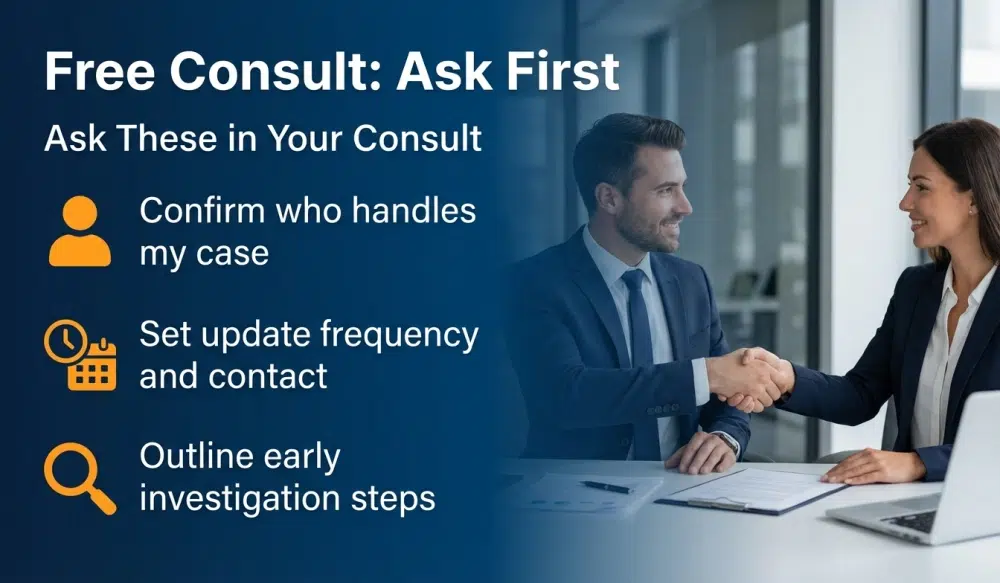
Prepare a focused list so you can compare answers across firms:
- What is your experience with cases like mine, including specific injuries and crash types?
- What are my deadlines under the statute of limitations California personal injury rules and do any government claims apply? Ask for the dates in writing [1] [3].
- How will you investigate liability and preserve evidence right away?
- How often will I receive status updates and who will call me?
- What is your strategy if the insurer disputes fault or medical causation?
- What are the likely costs and how are they handled in the contingency agreement?
- What are three risks in my case and how will we address them?
Bring photos, incident reports, medical records, and insurance information. The better the documentation at intake, the faster a lawyer can map out next steps.
How do you evaluate communication, capacity, and client access?
High quality representation includes clear communication, realistic timelines, and access to your attorney. Ask:
- Will I have direct contact information for my attorney?
- How quickly do you respond to calls and emails?
- How many active injury cases do you manage per attorney?
- Do you use secure portals for document sharing and status updates?
Good communication supports better decisions, especially when you are weighing settlement options versus filing suit.
How do investigation and insurance negotiations work in California injury claims?

Sound case development builds leverage. Expect your lawyer to:
- Secure and analyze official reports: Police collision reports, incident logs, and witness statements guide liability theories.
- Preserve time sensitive evidence: Footage from businesses or residences near a crash scene can be crucial. Prompt preservation letters can help lock down evidence.
- Order medical records and bills: Comprehensive records connect the mechanisms of injury to treatment and prognosis, which are central to damages.
- Use verified crash data tools: Public resources like California’s SWITRS data and academic mapping tools help contextualize crash patterns in Los Angeles County [10].
- Negotiate systematically: Demand packages should attach records, itemize losses, and cite governing law for liability and damages.
These steps apply broadly across claims handled by a California personal injury lawyer, including collisions, premises incidents, and product cases.
How do damages and comparative fault work under California law?
California permits recovery for both economic and non-economic damages in civil personal injury cases. Several rules matter in practice:
- Pure comparative negligence: Your damages are reduced by your assigned percentage of fault, but you can still recover the remainder [6] [7].
- Apportionment of non-economic damages: A defendant pays only their percentage share of non-economic losses like pain and suffering [4].
- Settlement dynamics: Because only a small fraction of civil claims reach trial, early proof of damages and liability often drives resolution [8].
In addition to private losses, remember that unintentional injury is a leading cause of death nationwide for ages 1 to 44, underscoring the stakes in serious cases [9]. Motor vehicle fatalities still number in the tens of thousands annually in the United States, according to federal safety data [11].

How can you research reviews and public records without relying only on ratings?
Ratings can be a starting point, but public sources provide more reliable context:
- California laws and court rules: Read the statutes that will govern your case [1] [2] [3] [4].
- Authoritative legal summaries: Cornell Law School’s Wex offers reliable legal definitions and overviews [6].
- Court opinions: Major California cases like Li v. Yellow Cab explain foundational rules like comparative negligence [7].
- Local court portals: The Los Angeles County Superior Court website provides information about procedures and access to case information in many instances [12].
- Academic tools: UC Berkeley’s TIMS provides public crash mapping using California SWITRS data to contextualize collision patterns [10].
Use these resources alongside reviews to get a fuller picture of a firm’s capabilities and approach.
What red flags should you avoid when choosing a lawyer?
- Vague fee agreements with no clear percentages, cost policies, or client consent terms.
- Pressure to sign without time to read the agreement or ask questions.
- No discussion of weaknesses, risks, or the defense’s likely arguments.
- Poor communication, no direct attorney contact, or switching your primary contact without notice.
- Guarantees of results, which are not compatible with ethical rules or the realities of litigation.
What is different in a wrongful death case California?
Wrongful death and survival claims involve unique rules on who can sue, what damages are recoverable, and how fault is allocated. California’s comparative negligence system still applies, and non-economic damages are apportioned by fault among defendants [4] [6] [7]. Because deadlines and standing can be complex, families should consult counsel promptly to protect their rights.
When does hiring a trial lawyer in California matter most?
Cases with contested liability, disputed medical causation, high damages, or multiple defendants often benefit from counsel who is prepared to try the case if needed. Even if your case settles, that trial readiness frequently improves negotiation leverage [8]. For collisions, premises incidents, or product claims of significant value, ask for specific examples of courtroom work in the last few years.
What is a step by step checklist to choose a lawyer in California?
- List your priorities: Timeline certainty, communication, trial readiness, or specific injury experience.
- Verify California law issues: Confirm the statute of limitations and any government claim requirements in writing [1] [3].
- Collect documents: Police report number, photos, medical summaries, wage documentation.
- Schedule two to three consultations: Compare strategies and communication styles.
What should you ask each firm to provide?
- Written fee and cost policy that explains percentages and cost treatment [5].
- Case plan for the first 60 to 90 days including investigation steps and expected updates.
- Approach to comparative fault and apportionment issues under California rules [4] [6].
How can you weigh the decision objectively?
- Responsiveness: Did the firm follow up promptly and answer your specific questions.
- Clarity: Did you receive plain language explanations of risks and next steps.
- Local fit: Does the plan make sense for a case filed in Los Angeles County.

Why consider GoSuits for personal injury cases in California?
If you are evaluating a top-rated injury law firm, here is how our approach may help.
- California-focused practice: We handle civil personal injury cases throughout California, including Lakewood and greater Los Angeles County.
- Technology-driven workflow: Our exclusive proprietary software streamlines investigation, records collection, and case tracking, which helps move cases forward efficiently without sacrificing quality.
- Designated attorneys, no case managers: Every client works directly with a dedicated attorney and has unfettered access for questions and updates.
- Trial-ready approach: We prepare cases from day one for negotiation and, when necessary, trial. This benefits settlement strategy and courtroom performance.
- Past results and transparency: See a sample of our past matters at prior cases, learn about the team at our attorneys, and explore our firm background at about us.
- Breadth of practice areas: We handle cases across motor vehicle collisions, premises incidents, product claims, catastrophic injuries, and wrongful death. Explore more at practice areas.
- 30 years of combined experience: Our team brings decades of combined litigation experience to investigation, negotiation, and trial.
References and Resources
- Cal. Code Civ. Proc. § 335.1 two year limitation for personal injury – California Legislative Information
- Cal. Code Civ. Proc. § 338 three year limitation for property damage – California Legislative Information
- Cal. Gov. Code § 911.2 six month government claim deadline – California Legislative Information
- Cal. Civ. Code § 1431.2 apportionment of non economic damages – California Legislative Information
- Cal. Bus. & Prof. Code § 6147 contingency fee contracts requirements – California Legislative Information
- Comparative negligence overview – Cornell Law School Legal Information Institute
- Li v. Yellow Cab Co. of California, 13 Cal.3d 804 1975 – CourtListener
- Civil Bench and Jury Trials in State Courts, 2005 – Bureau of Justice Statistics
- Leading causes of death, United States data – CDC WISQARS
- Transportation Injury Mapping System SWITRS tools – UC Berkeley SafeTREC
- Early Estimate of Motor Vehicle Traffic Fatalities in 2023 – NHTSA
- Los Angeles County Superior Court resources and information – LACourt