- What makes a Chicago UPS delivery truck accident unique and why does evidence matter?
- What evidence should you gather at the scene in Chicago?
- How do you preserve EDR black box and telematics data from a UPS delivery truck?
- What is a spoliation letter to UPS and when should you send it in Illinois?
- Which official records matter most, including the Chicago police report and medical records?
- How do witness statements, dashcam footage, and nearby videos strengthen your case?
- Which commercial vehicle rules apply to a UPS delivery truck crash in Chicago?
- What happens in Illinois if UPS or a third party loses or destroys key evidence?
- How does the insurance claim process work after a UPS delivery truck accident?
- What Illinois deadlines and local timing pitfalls should you know?
- How should you document damages for settlement or trial?
- What is the complete Chicago UPS delivery truck accident evidence checklist?
- What common mistakes do people make with evidence and how can you avoid them?
- Why choose GoSuits if you were hurt in a Chicago UPS delivery truck crash?
- References and resources
What makes a Chicago UPS delivery truck accident unique and why does evidence matter?
If you were hit by a UPS delivery truck in Chicago, the facts need to be captured fast. Commercial vehicles carry company telematics, onboard cameras, and engine control module data that can clarify speed, braking, and driver behavior before and after impact. In Illinois, courts can recognize duties to preserve evidence and can impose sanctions if critical proof is destroyed or withheld during a lawsuit [1] [2]. That makes early evidence preservation a central step for both injured people and companies involved.
UPS vehicles are part of a high volume logistics network across Cook County and the broader Chicago region. Delivery schedules, route assignments, and freight handling provide context about driver hours, dispatch practices, and vehicle maintenance. Much of this information is time sensitive. Electronic logs and camera footage can be overwritten on routine cycles, sometimes in days or weeks. The faster you act, the more you can lock down before it disappears [7] [8] [9].
Evidence decides liability and damages. It also affects credibility with insurers and in court. Courts in Illinois have addressed spoliation and preservation duties for decades, clarifying when a party or even a third party may have to preserve potential evidence, and what happens if they do not [1] [3] [4].
What evidence should you gather at the scene in Chicago?
Your safety comes first. After that, if you can do so safely, collect the basics while they are still present:
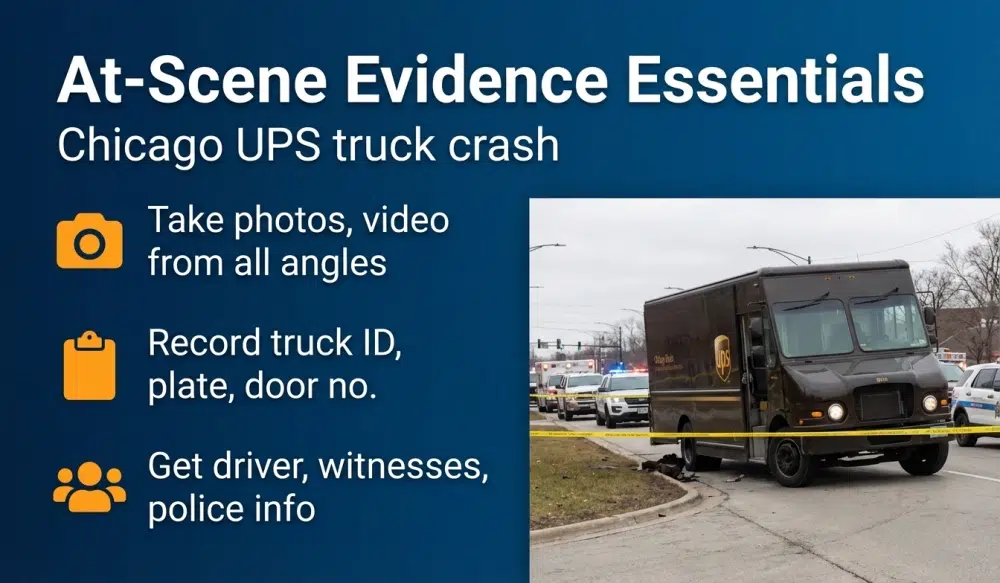
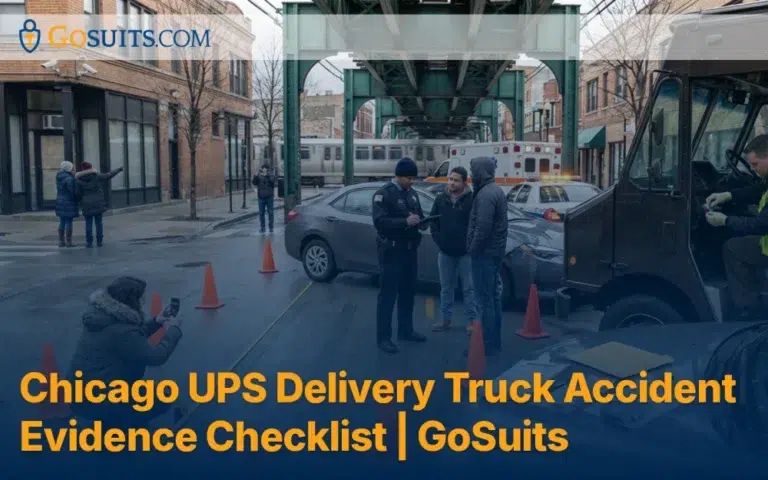
- Photos and videos of vehicle positions, road conditions, skid marks, traffic signals, and property damage from multiple angles.
- Vehicle identifiers including the UPS truck number, DOT number on the door, license plate, and any trailer info.
- Driver information including name, employer, and insurance details. Ask to see the commercial driver license.
- Witness contacts names, mobile numbers, emails, and where they were standing or driving when they saw the crash.
- Emergency responder details which police district responded and any report numbers given on scene. In Illinois, written crash reports are governed by statute and are important for later claims [11].
- Immediate notes about delivery activity, package loading, or route observations if visible. Record weather, lighting, and traffic flow.
Even if you cannot gather these items at the moment, you or your legal team can follow up quickly with a formal preservation request and targeted subpoenas if litigation becomes necessary [1] [2].
How do you preserve EDR black box and telematics data from a UPS delivery truck?
Many vehicles have event data recorders that capture speed, braking, throttle, seatbelt use, and more around significant events. Federal rules specify EDR parameters for many light vehicles [10]. Commercial fleets often maintain separate telematics, electronic logging devices for hours of service, and engine control module data. While exact systems vary, several federal rules guide what carriers must keep and for how long:
- Hours of service records including ELD data and supporting documents generally must be kept at least six months [7].
- Driver qualification files must be maintained by the motor carrier with specified retention periods [8].
- Vehicle inspection and maintenance records must be kept for defined periods while the vehicle is in service and after it leaves service [9].
Because these retention horizons can be short, immediate written notice to UPS or any involved contractor is vital. The notice should identify the vehicle, date, time, and event, and specifically request preservation of EDR data, engine control module data, dashcam and inward facing camera footage, dispatch logs, GPS breadcrumbs, and any third party telematics. Early requests help establish foreseeability and can support a duty to preserve under Illinois law [1] [3].
What is a spoliation letter to UPS and when should you send it in Illinois?
A spoliation or preservation letter is a written demand asking the recipient to keep specific evidence that may be relevant to a civil claim. In Illinois, duties to preserve can arise from an agreement, a statute, a special circumstance, or other relationships once litigation is reasonably foreseeable. Illinois courts have set out these principles and the consequences for failing to preserve evidence [1] [2].
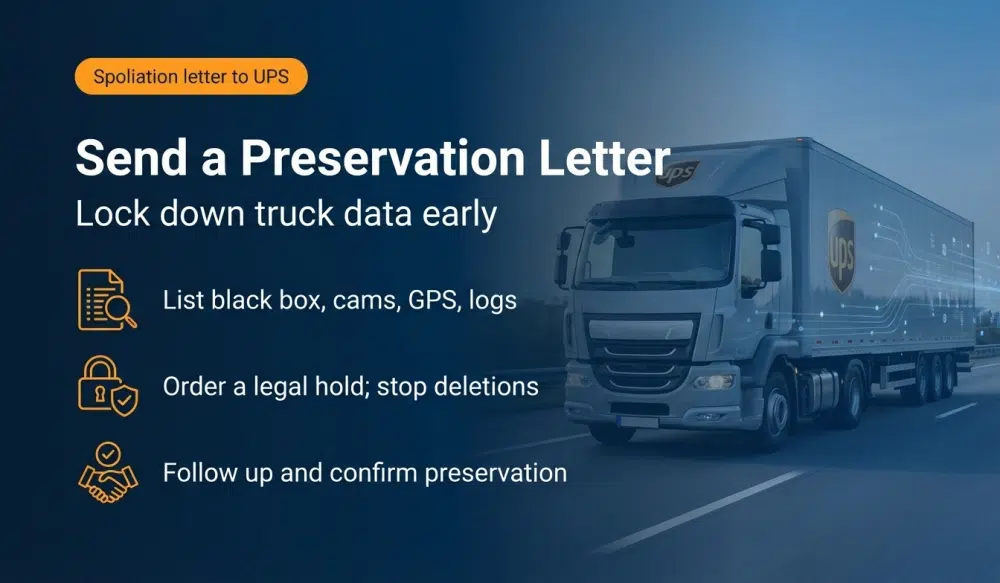
Send a detailed preservation letter immediately. Include:
- All electronic data types EDR, engine control module, dashcam and driver facing cameras, telematics, GPS, ELD hours of service, dispatch communications, and handheld device messages.
- Hard copy and digital records delivery manifests, route assignments, driver qualification file contents, and vehicle inspection and repair histories [8] [9].
- Third party data vendor hosted video or telematics platforms and any contracted maintenance records.
When appropriate, request that UPS stop any auto deletion cycles and place legal holds. Follow up regularly to confirm data is secured. If you later need court involvement, judges can consider these steps when evaluating any spoliation questions [2] [3].
Which official records matter most, including the Chicago police report and medical records?
Official records can carry significant weight with insurers and in court. In a Chicago UPS delivery truck crash, these are central:
- Police crash report Illinois law provides for driver written reports and police investigation of reportable crashes. Request the report number from the responding officers and obtain the full report and any diagrams when available [11].
- Medical records and bills Diagnose injuries early and continue treatment as advised. Federal rules give you rights to access your medical records; request complete files, imaging, test results, and itemized bills [13].
- Employment and wage documentation Pay stubs, W two or tax forms, sick leave records, disability forms, and employer letters about missed time help prove wage loss.
- Vehicle property damage records Repair estimates, parts lists, and photos document damage and can reflect impact forces.
Keep all records organized. Accurate documentation expedites claims and supports later litigation if necessary.

How do witness statements, dashcam footage, and nearby videos strengthen your case?
Independent evidence often makes or breaks liability disputes. Helpful sources include:
- Witness statements Collect names and contacts at the scene. Follow up for written or recorded statements while memories are fresh.
- Dashcam and surveillance video Many vehicles and businesses in Chicago have cameras covering intersections, alleys, and loading zones. Footage may be overwritten quickly, so send notices fast and canvas nearby buildings.
- UPS vehicle cameras Fleet cameras can capture forward roadways and occasionally driver behavior within the cab. Request preservation in your first letter.
Courts in Illinois have addressed how lost or withheld evidence can be handled through sanctions or instructions to the jury during litigation, which raises the stakes for preserving this material upfront [2] [3] [6].
Which commercial vehicle rules apply to a UPS delivery truck crash in Chicago?
Commercial carriers operate under federal safety rules that shape what records exist and how they should be retained. Key categories:
- Hours of service and ELD data Electronic records of duty status and supporting documents must be retained for defined periods [7].
- Driver qualification file contents Certain hiring, licensing, and safety history records are maintained by carriers with specific retention periods [8].
- Vehicle maintenance records Inspection, repair, and maintenance documents must be kept for regulated periods [9].
- Event data recorders EDR rules for many light vehicles appear in federal regulations and can guide what is captured in a crash [10].
These rules provide a roadmap to the evidence you can request. They also help you evaluate a motor carrier’s safety practices and compliance. If a crash involves a package car or a larger freight vehicle in Cook County, these same categories usually apply.
What happens in Illinois if UPS or a third party loses or destroys key evidence?
Illinois recognizes negligent spoliation as a form of negligence when a duty to preserve exists and a breach causes harm to a party’s ability to prove a case. The Illinois Supreme Court explained the foreseeability and relationship analysis used to decide whether a duty arose, and how courts should address such claims [1]. Illinois decisions also make clear that courts can impose discovery sanctions for destruction of evidence, up to and including dismissal of claims or defenses, depending on the circumstances [2]. Later cases have refined how these principles apply across different industries and third parties [3] [4] [5].
If you suspect spoliation, act quickly. Document your preservation requests and follow up. If needed, seek court orders to secure data or to address loss of evidence through sanctions or adverse inference instructions during trial. Federal appellate decisions applying Illinois law illustrate how courts analyze these issues in depth [6].
How does the insurance claim process work after a UPS delivery truck accident?
Most claims begin with notice to the carrier’s liability insurer and to your own insurer if any coverage may apply. Early steps typically include:
- Notice of claim Provide basic facts, policy numbers if available, and contact information for follow up.
- Preservation request Send your spoliation letter at the same time so evidence is locked down early [1].
- Records exchange Share medical bills, proof of wage loss, and property damage estimates as they become available. Request key carrier records relevant to liability and damages [7] [8] [9].
- Evaluation and settlement talks Insurers may evaluate based on liability facts, comparable outcomes, medical documentation, and future care projections.
- Litigation if needed If settlement does not resolve the case, a lawsuit in Cook County or another proper venue lets you use subpoenas and discovery to compel production of evidence. Discovery duties and sanctions rules apply to all parties [2].
You do not need to go through this alone. Truck crash cases are evidence heavy and time sensitive. Working with experienced counsel helps you navigate preservation, discovery, and negotiation in a way that protects your rights.
What Illinois deadlines and local timing pitfalls should you know?
Deadlines can affect your claim even when liability is clear:
- Illinois statute of limitations for personal injury Generally two years for most negligence claims, subject to exceptions [12].
- Evidence retention windows Hours of service data and camera footage can be overwritten or deleted on short cycles. Put carriers on notice immediately [7] [9].
- Police crash reports and supplemental materials Request promptly. If a reconstruction is expected, coordinate early access to vehicles for inspection.
- Medical documentation Obtain complete records and itemized bills throughout treatment so valuation does not lag [13].
In Cook County, complex cases can involve multiple parties. Coordinating preservation across UPS, contractors, tow yards, and repair facilities is often crucial in the first weeks after a crash.
How should you document damages for settlement or trial?
Liability proof is only part of the picture. To present a complete claim, build a clear record of your losses:
- Medical care Diagnosis, treatment plans, therapy, prescriptions, imaging, and any future care recommendations. Request full records and itemized bills from every provider [13].
- Lost income and earning capacity Employer letters, timesheets, pay stubs, tax forms, and vocational opinions when needed.
- Property damage Professional estimates, parts receipts, and before and after photos.
- Daily impact A contemporaneous journal of pain levels, sleep issues, missed family events, and limitations in daily activities.
A structured file helps both sides evaluate settlement and keeps trial preparation focused. It also supports related claims such as loss of normal life and other compensable categories recognized in Illinois civil cases.
What is the complete Chicago UPS delivery truck accident evidence checklist?
Use this step by step checklist to protect critical proof from day one. Adapt it to your situation.
What should you do in the first 24 to 72 hours?
- Get medical care Prioritize health and create an accurate medical record of injuries [13].
- Photograph everything Vehicles, roadway, debris field, skid marks, traffic control, and visible injuries.
- Identify the UPS vehicle Record unit number, license plate, VIN if available, and the DOT number on the door.
- Collect witness contacts Names, phones, emails, and where they observed the crash from.
- Request the police report number Note the responding agency and report number for later follow up [11].
- Preservation letter to UPS Send written notice requesting preservation of EDR, engine data, dashcam, inward facing camera, ELD, GPS, dispatch, and maintenance records [7] [9] [10].
What should you do in the first two weeks?
- Canvas for video Ask nearby businesses and homes for exterior camera footage before it is overwritten.
- Secure your own dashcam data Back up files with original metadata.
- Track all medical visits Obtain records and itemized bills as treatment progresses [13].
- Notify insurers Provide basic claim info and request written confirmation of evidence preservation.
- Plan vehicle inspection Coordinate independent inspection and imaging before repairs or salvage disposal.
What should you do in the first one to three months?
- Request carrier records Seek driver logs, ELD data, route and dispatch materials, and maintenance files under applicable retention rules [7] [9].
- Obtain complete police materials Diagrams, supplemental narratives, and any reconstruction references [11].
- Document wage loss Gather employer letters, payroll extracts, and tax forms.
- Evaluate settlement posture Once liability facts and medical documentation are developed, consider negotiation timelines relative to Illinois deadlines [12].
Which facts are easy to overlook but often decisive?
- Pre and post trip inspections Whether the driver noted defects and how they were handled [9].
- Dispatch communications Real time messages about route delays, reassignments, or time pressure.
- Camera retention cycles Auto deletion periods and whether legal holds stopped them in time.
- Third party custodians Tow yards, repair shops, and storage facilities that may have vehicles or parts.
What common mistakes do people make with evidence and how can you avoid them?
- Waiting to send a preservation letter Delays risk permanent loss of video and electronic logs [7] [9].
- Assuming the police report will have everything Official reports are vital, but they rarely include fleet telematics, camera footage, or internal dispatch records [11].
- Letting the vehicle be repaired or salvaged too soon Early inspection captures impact evidence that cannot be recreated later.
- Overlooking Illinois spoliation law Courts can sanction missing evidence and may recognize claims when duties to preserve are breached [1] [2] [3].
- Missing the statute of limitations Filing late can bar claims regardless of fault [12].
Why choose GoSuits if you were hurt in a Chicago UPS delivery truck crash?
UPS delivery truck cases are document heavy and time sensitive. Our team handles civil injury cases across Illinois, including Cook County and the Chicago area. We offer a free consultation to talk through your situation, map out an evidence plan, and start preservation steps the right way.
We use technology to move faster and smarter. GoSuits deploys exclusive proprietary software that organizes evidence, tracks legal holds, flags retention deadlines, and helps build timelines from ELD and camera data. This improves speed and clarity without sacrificing personal attention.
Every client works directly with a designated attorney from start to finish. We do not route your case through case managers. You have open access to your attorney for updates and strategy discussions. When negotiations do not reflect the facts and the harm, we bring trial experience that helps set clear expectations for insurers and defendants.
Our civil practice includes truck, auto, motorcycle, construction, premises, product liability, and serious injury litigation. We have 30 years of combined experience, a record of results for clients, and a focus on complex evidence preservation disputes. Explore our prior cases, meet our attorneys, learn more about us, and review our practice areas.
If you are evaluating your options, truck accident lawyers can help coordinate police materials, medical records, telematics, and EDR imaging while you focus on healing. In complex commercial vehicle matters, Chicago truck accident lawyers can also pursue court orders to secure data, address spoliation questions, and position your case for fair resolution.
We are committed to careful preparation, early evidence preservation, and clear communication. Talk with us about your case, your goals, and how technology supported case building can help.
How do Chicago wide facts and numbers affect UPS delivery claims?
Traffic safety data helps show patterns and risk factors. Illinois publishes annual crash facts that track statewide trends in fatal and serious injury crashes [14]. Large truck and bus fact books from federal safety agencies provide additional context about national crash severity, common causation factors, and injury distribution, which can inform claims and safety analysis [15].
References and resources
- Dardeen v. Kuehling Opinion Illinois Supreme Court
- Shimanovsky v. General Motors Corp. Illinois Supreme Court
- Martin v. Keeley and Sons, Inc. Illinois Supreme Court
- Caburnay v. Norwegian American Hospital Illinois Appellate Court
- Brobbey v. Enterprise Leasing Company of Chicago Illinois Appellate Court
- Schaefer v. Universal Scaffolding and Equipment Seventh Circuit
- 49 CFR 395.8 Records of duty status Electronic logging devices eCFR
- 49 CFR 391.51 General requirements for driver qualification files eCFR
- 49 CFR 396.3 Inspection repair and maintenance eCFR
- 49 CFR Part 563 Event Data Recorders eCFR
- 625 ILCS 5 11 409 Accident reports required by drivers Illinois Vehicle Code ILGA
- 735 ILCS 5 13 202 Personal injury actions Statute of limitations ILGA
- Individuals Right under HIPAA to Access Their Health Information HHS
- Illinois Crash Facts and Statistics IDOT
- Large Truck and Bus Crash Facts FMCSA