- What evidence should you secure in the first 72 hours after a Chicago truck crash?
- How do you get the police report and official crash records in Chicago and Illinois?
- What is an Illinois spoliation letter, and when should you send it?
- Which truck data should be preserved, and why does it matter?
- How do FMCSA log and record retention rules affect your evidence request?
- Which maintenance and inspection records can prove fault?
- What is in the driver qualification file, and how can it help your case?
- How do cargo securement rules impact liability?
- Which witnesses, photos, and videos make the strongest impact?
- Which medical and work records should you gather for damages?
- How does accident reconstruction use physical and digital evidence?
- What are the key Illinois deadlines to protect your claim?
- How is truck crash evidence authenticated and admitted in civil court?
- What should trucking companies and drivers do to preserve evidence?
- How can a lawyer coordinate preservation and build the record?
- Why choose GoSuits for a Chicago truck crash case?
- What is the Chicago truck crash evidence checklist for victims?
- What national safety trends should Chicago victims know?
- What practical tips can make your evidence stronger?
- Where can you verify the rules and data we cited?
What evidence should you secure in the first 72 hours after a Chicago truck crash?
If you are safe and have received medical care, the first 72 hours are critical for preserving evidence. Time sensitive records can be overwritten or lost quickly. National data shows that crashes involving large trucks lead to thousands of deaths, and far more injuries, each year, making a prompt evidence plan essential [11] [12].
- Photograph and video the scene: include vehicle resting positions, skid or yaw marks, debris fields, lane markings, traffic signals, posted limits, nearby cameras, and any obscured signs or construction zones.
- Document road, weather, and lighting: capture timestamps, visibility, precipitation, and any standing water or ice.
- Identify and contact witnesses: record full names, mobile numbers, emails, and brief summaries of what they saw; follow up quickly to confirm availability.
- Preserve the involved vehicles: maintain their post crash condition when possible, including deformed components, tires, and cargo securement devices.
- Seek immediate medical evaluation: follow through with care plans. Early evaluation creates a consistent record of injuries and causation.
You can request a lawyer to send preservation notices within days to protect digital truck data, third party camera footage, and maintenance files that could otherwise cycle out of corporate or municipal systems [6] [7] [9].
How do you get the police report and official crash records in Chicago and Illinois?
Police and state databases contain foundational information that helps align facts and witnesses. In Illinois, crash reports are maintained by state and local agencies. You can obtain Illinois crash reports through the Illinois State Police portal after they are processed [13]. For Chicago specific incident data, the City of Chicago publishes a traffic crash dataset that includes location, type, and selected attributes, which can help you locate nearby cameras or witnesses and spot recurring hazards [14].
- Request the Illinois Traffic Crash Report: include all supplements and diagrams; verify names, plates, VINs, and officer narratives for accuracy.
- Ask for associated records: request dispatch audio, 911 calls, body worn camera footage, and traffic camera clips while they are still retained by the agency.
- Confirm the reporting officer and unit: this helps with subpoenas and future testimony if needed.
A police report serves as a starting point; it is not the last word on fault. Additional evidence from the truck and company records can materially change the liability picture.
What is an Illinois spoliation letter, and when should you send it?
Illinois recognizes claims for negligent spoliation through traditional negligence principles when a duty to preserve arises. The Illinois Supreme Court explained that a duty can arise by agreement, contract, statute, or voluntary undertaking, and parties who reasonably should foresee litigation may have to preserve relevant evidence [1]. Courts can also impose sanctions or adverse inferences when evidence is destroyed, even absent a separate tort claim, making early preservation notices vital [2].
A spoliation letter gives notice to the motor carrier, driver, and any third parties, such as maintenance vendors, tow yards, and telematics providers, that litigation is reasonably anticipated and that they must preserve specified items. Send it as soon as possible, ideally within days after medical stabilization. A well drafted letter should list categories like electronic logging device data, dash camera video, engine control module downloads, driver qualification file contents, hours of service logs, bills of lading, dispatch and messaging records, and post crash drug and alcohol testing documentation [6] [7] [8] [9] [10] [15].
Which truck data should be preserved, and why does it matter?
Modern commercial vehicles and fleets generate multiple streams of data. Preservation prevents automatic overwrites and gives both sides a fair chance to evaluate what happened.
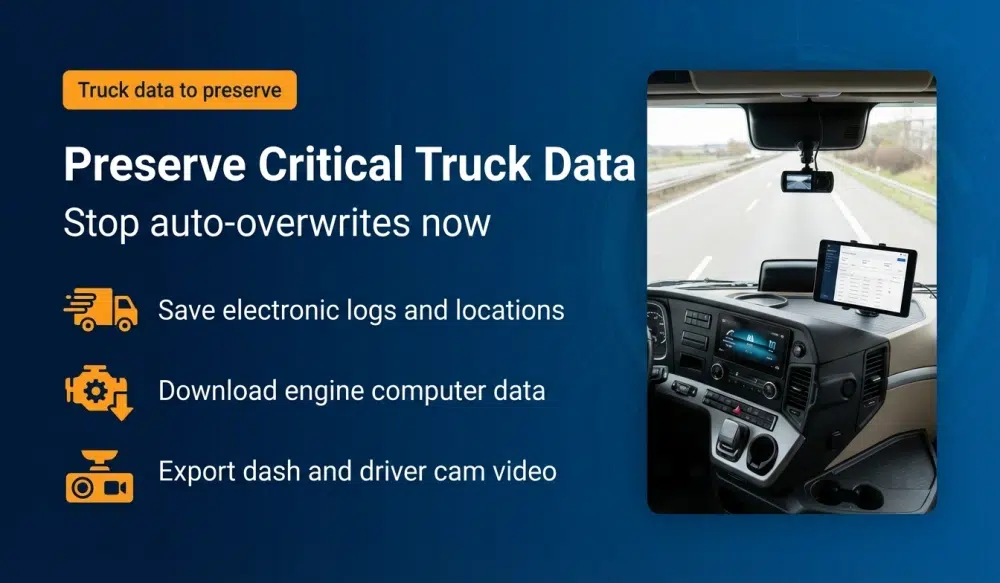
- Electronic Logging Device data: confirms driving time, on duty periods, and locations with automatic capture. ELD records help test compliance with hours of service rules and can be compared to bills of lading, fuel and toll records, and GPS pings [6] [7].
- Engine Control Module data: often stores limited event windows, such as speed, throttle, brake applications, and fault codes. It can corroborate or refute claims about speed and braking response.
- Forward and driver facing cameras: may record before and after the trigger threshold. Companies often have vendor managed portals with retention limits measured in days or weeks.
- Dispatch, telematics, and GPS: include route assignments, out of route stops, traffic alerts, electronic messaging, and geofences that can confirm timing and duty status.
- Cargo documentation: bills of lading, weight tickets, load plans, and photographs of securement show whether the load met federal securement standards [10].
Because some devices overwrite data during normal operations, a rapid preservation notice to the carrier and relevant vendors is crucial [6].
How do FMCSA log and record retention rules affect your evidence request?
Federal motor carrier safety rules specify retention periods for important records. Understanding these timeframes helps you request what exists before it lawfully cycles out.
- Record of duty status and supporting documents: motor carriers generally must retain records for six months, including ELD data and related supporting documents such as fuel, toll, and dispatch records [7].
- Driver qualification file contents: applications, motor vehicle records, medical certifications, road tests or equivalents, and annual reviews must be maintained with specific retention periods, generally as long as a driver is employed and for years after [8].
- Inspection, repair, and maintenance files: must be retained for each vehicle, with minimum time requirements and continuity through the vehicle’s service with the carrier [9].
- Cargo securement compliance records: training, policies, and inspection reports may be implicated when securement is at issue under the federal securement standards [10].
- Drug and alcohol testing program records: retained under FMCSA rules, including post crash testing records where applicable [15].
Because retention minimums can be short, especially for logs and supporting documents, prompt written requests to preserve are a practical necessity [7].

Which maintenance and inspection records can prove fault?
Brakes, tires, steering, lights, and coupling systems are common focus areas in serious crashes. Maintenance documentation can turn conjecture into provable fact.
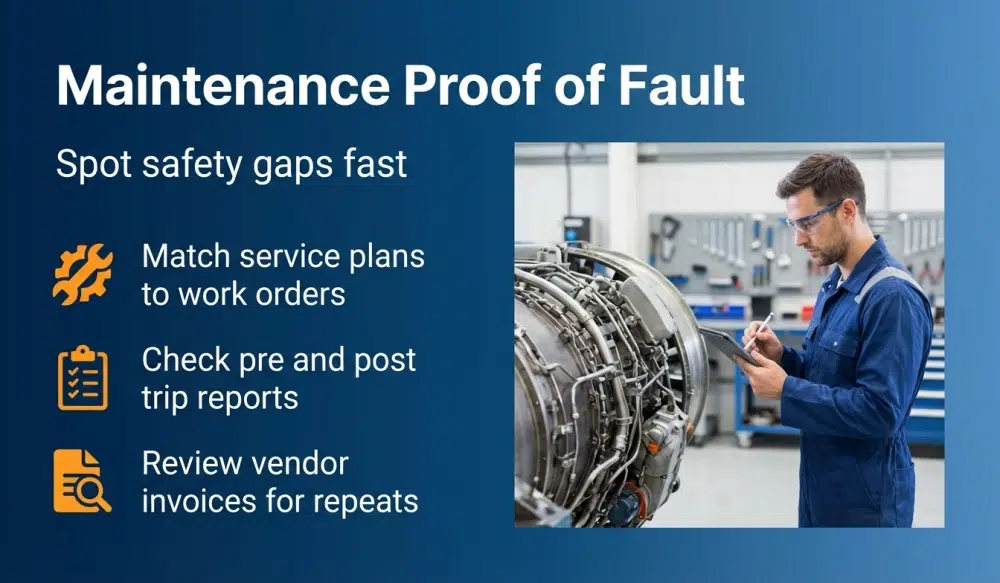
- Preventive maintenance schedules: and work orders show whether the fleet met its own protocols and whether those matched federal requirements [9].
- Driver vehicle inspection reports: pre trip and post trip records reveal known defects, whether they were addressed, and how quickly the vehicle returned to service.
- Annual inspections: and qualifications of the inspector help establish diligence, or lack of it, in safety critical systems.
- Repair vendor invoices: and parts receipts can identify recurring problems, such as out of adjustment brakes or uneven tire wear, that align with physical evidence.
When brakes or securement issues contributed to a crash, maintenance noncompliance is often a central theory of liability under the FMCSA rules [9].
What is in the driver qualification file, and how can it help your case?
The driver qualification file DQF is a mandatory collection of records that can reveal hiring, training, medical, and error history [8].
- Driver application and prior employment verifications: confirm driving experience and safety performance.
- Motor vehicle records: show citations, crashes, and license status that may have required remedial action.
- Medical certification: demonstrates physical qualification to drive a commercial vehicle.
- Road test or equivalent: confirms practical skill assessment and any restrictions.
- Annual reviews and training records: evidence ongoing monitoring and corrective measures after incidents.
Where the DQF reflects gaps or substandard screening, negligent hiring or retention theories may be supported by objective documents [8].
How do cargo securement rules impact liability?
Federal securement standards specify how cargo must be immobilized based on weight, type, and vehicle. Improper securement can lead to load shifts, rollovers, or spills that cause multi vehicle events. Evidence that the system did not meet federal requirements can be compelling proof of negligence [10].
- Load plans and diagrams: should match the load actually carried.
- Securement device ratings: and condition should meet minimum working load limits.
- Pre trip and en route inspections: should include checks at the start and at intervals consistent with federal rules and company policy.
Which witnesses, photos, and videos make the strongest impact?
Neutral witnesses, clear imagery, and video, synced with location and time stamps, are often decisive. In Chicago, traffic cameras, private businesses, rideshare dash cams, and transit vehicles may capture the event. The City of Chicago crash dataset can help you map the location and identify nearby intersections and potential camera sources [14].
- Independent eyewitnesses: with vantage points that cover approach and impact.
- Dash and surveillance video: captured before, during, and after the crash from multiple angles.
- Scene photographs: including lane markings, curb damage, gouges, and vehicle crush profiles.
Authenticating the sources, preserving originals, and maintaining a clean chain of custody makes these materials more persuasive later in litigation.
Which medical and work records should you gather for damages?
Injury cases depend on proof of diagnosis, treatment, and functional loss. Consistent, contemporaneous records help establish causation and the nature and extent of damages.
- Emergency care and hospital records: including imaging, labs, operative reports, and discharge instructions.
- Treating provider notes: documenting symptoms, limitations, and recovery trajectory.
- Therapy and rehabilitation notes: for physical, occupational, speech, or cognitive therapy.
- Pharmacy records: to corroborate pain management and compliance.
- Employment records: such as pay stubs and attendance to quantify lost wages and job impact.
Your care team’s records, paired with objective crash evidence and biomechanics, support a clear damages story for negotiation or trial.

How does accident reconstruction use physical and digital evidence?
Reconstruction blends roadway evidence, vehicle damage, and electronic data to evaluate speeds, angles, timing, and driver behavior. Truck ECM logs, ELD location stamps, and camera clips can be synchronized with scene measurements to test each side’s theory of the crash. National safety data systems collect information on crashes with large trucks, underscoring the public importance of accurate reconstruction [11] [12].
- Speed and time distance analysis: from ECM and video frames.
- Brake and reaction assessment: using physical marks and control module data.
- Visibility evaluation: by modeling lighting, weather, and sight lines.
What are the key Illinois deadlines to protect your claim?
Most Illinois personal injury actions must be filed within two years of the injury event. There are shorter deadlines for actions against local public entities, such as municipal fleets or public works trucks, which can arise in the Chicago area. Do not wait to identify the correct defendant and their status under the statute [3] [4].
- Two years: for personal injury in most cases from the date of the crash [3].
- One year: for civil actions against a local public entity in many circumstances under the Tort Immunity Act [4].
Missing a deadline can end a claim regardless of merit. Early legal help can align preservation, investigation, and filing timelines with these requirements.
How is truck crash evidence authenticated and admitted in civil court?
Most trucking records are business records created and kept in the ordinary course of a carrier’s operations. Logs, DQF contents, and maintenance files are typically admissible when a foundation is laid through a qualified witness. Digital files should be preserved in original format where possible, with metadata and hash values logged when they are copied. Third party vendor records, such as camera footage and telematics, should be requested promptly with a preservation letter so the original vendor can verify authenticity later.
Authentication can be strengthened by maintaining a careful chain of custody from the moment of collection through trial. Where a carrier fails to preserve key evidence after notice, courts may allow adverse inferences or other remedies under Illinois spoliation and discovery principles [1] [2].
What should trucking companies and drivers do to preserve evidence?
Defendants have preservation duties once litigation is reasonably anticipated. A consistent, documented response limits sanctions risk and helps the defense team evaluate exposure.
- Issue a litigation hold: notify the driver, dispatch, safety, maintenance, and IT teams with a specific list of categories to preserve.
- Secure the vehicle and components: hold for inspection and document condition before any repair or salvage activity.
- Download ELD and ECM data: use a defensible process and store read only copies with clear index and metadata [6] [7].
- Collect and seal camera footage: export from vendor portals and truck devices with time sync information.
- Preserve the DQF and maintenance records: for the involved driver and vehicle beyond the minimum retention periods [8] [9].
- Document post crash drug and alcohol testing: maintain steps and results where the rules apply [15].
How can a lawyer coordinate preservation and build the record?
Trucking litigation requires coordinating multiple streams of data across different custodians. A lawyer can prioritize the items most likely to disappear soon, sequence inspections, and align the proof with applicable federal and Illinois rules. This is one reason many people prefer to work with truck accident lawyers who routinely send preservation notices, file targeted discovery, and retain qualified reconstruction and human factors professionals.
When you work with Chicago truck accident lawyers, they can combine local knowledge of Cook County venues with national trucking safety rules. They will track carrier retention schedules, move quickly for temporary restraining orders when needed, and keep you informed while focusing on medical recovery and documentation [7] [8] [9].
Why choose GoSuits for a Chicago truck crash case?
GoSuits represents people in personal injury and wrongful death cases across Illinois and neighboring jurisdictions, including Cook County and the greater Chicago area. A free consultation can help you understand how a preservation plan, early investigations, and focused discovery can support your claim while you concentrate on healing.
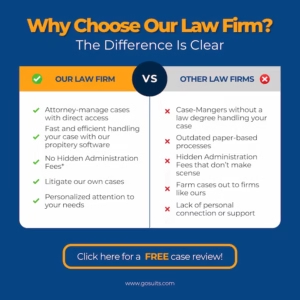
- Technology driven approach: we use exclusive proprietary software designed to collect, index, and analyze trucking evidence faster and with better organization across ELD data, ECM downloads, camera footage, and maintenance files.
- Leadership in innovation: our platform integrates timelines, geospatial mapping, and regulation cross references to help your team make timely, informed decisions.
- Attorney access: every client has a designated attorney. We do not use case managers as substitutes, and clients have direct access to their lawyer throughout the case.
- Trial seasoned team: our lawyers have courtroom experience that helps shape investigation and motion practice from day one, which can improve settlement posture and prepare the case for trial when necessary.
- Proven history: review our prior cases to see examples of results across complex injury matters.
- Thirty years combined experience: our attorneys bring decades of combined civil litigation work to trucking, motor vehicle, premises, construction, and product cases.
- Full service personal injury practice: explore our practice areas, learn about our attorneys, and read more about us.
We are ready to coordinate preservation letters, inspections, and expert consultations while you focus on recovery and family needs.
What is the Chicago truck crash evidence checklist for victims?
Use this checklist to organize your next steps: share it with your lawyer so they can prioritize preservation and follow up with carriers, vendors, and agencies.
- Scene evidence: photos, videos, witness contacts, weather, lighting, and roadway conditions.
- Police records: Illinois crash report, body worn camera, 911 audio, and dispatch logs [13].
- Vehicle preservation: physical condition of truck and car, tires, brakes, and cargo securement devices.
- Digital truck data: ELD exports, ECM downloads, camera footage, GPS and telematics, dispatch and messaging [6] [7].
- Company documents: driver qualification file, safety policies, training materials, and post crash testing records [8] [15].
- Maintenance files: inspection, repair, and maintenance logs, and vendor invoices [9].
- Cargo records: bills of lading, weight tickets, load plans, and securement device ratings [10].
- Medical documentation: ER records, treating provider notes, imaging, therapy, and pharmacy records.
- Employment proof: pay history, time off records, and job descriptions for wage loss and work impact.
- Public data: City of Chicago crash dataset extracts for location mapping and hazard analysis [14].
- Preservation letters: to carrier, driver, tow yard, camera owners, and telematics vendors, citing Illinois spoliation principles [1] [2].
- Deadline tracking: two year personal injury deadline and special deadlines for local entities [3] [4].
What national safety trends should Chicago victims know?
Large truck crash trends remain a serious public safety concern. National systems, such as the Fatality Analysis Reporting System and FMCSA’s Large Truck and Bus Crash Facts, report thousands of fatalities and many times more injuries in crashes involving large trucks each year [11] [12]. These data underscore the importance of collecting high quality evidence quickly so that you and your legal team can present a clear, documented account of what happened and why.
What practical tips can make your evidence stronger?
- Act quickly: digital data can be overwritten within days, and some records have retention minimums measured in months, not years [7].
- Use precise requests: cite the categories and rules that support preservation, including logs, DQF, maintenance, and securement [8] [9] [10].
- Coordinate inspections: preserve vehicles and cargo for joint inspection so both sides can observe and document condition.
- Sync timelines: align ELD and ECM time stamps with camera video and phone data to remove guesswork.
- Keep originals: preserve native file formats with metadata, and maintain a clear chain of custody.
When you need guidance on sequencing these steps and working with reconstruction professionals, you can reach out for legal help with truck crashes so your rights are protected while the evidence is still fresh.
Where can you verify the rules and data we cited?
- Boyd v. Travelers Insurance Co. 166 Ill. 2d 188 1995 Illinois Supreme Court – CourtListener
- Shimanovsky v. General Motors Corp. 181 Ill. 2d 112 1998 – Google Scholar
- 735 ILCS 5 13-202 Limitation for actions for damages for injury to the person – Illinois General Assembly
- 745 ILCS 10 8-101 Local Governmental and Governmental Employees Tort Immunity Act – Illinois General Assembly
- 735 ILCS 5 2-1116 Comparative negligence in actions on account of death or injury – Illinois General Assembly
- Electronic Logging Devices overview – FMCSA
- 49 CFR 395.8 Driver’s record of duty status and retention – LII Cornell Law
- 49 CFR 391.51 General requirements for driver qualification file – LII Cornell Law
- 49 CFR 396.3 Inspection, repair, and maintenance – LII Cornell Law
- 49 CFR 393.100 General cargo securement requirements – LII Cornell Law
- Large Truck and Bus Crash Facts portal – FMCSA
- Fatality Analysis Reporting System FARS overview – NHTSA
- Illinois State Police Crash Reports – Illinois State Police
- Traffic Crashes dataset – City of Chicago Data Portal
- 49 CFR 382.303 Post accident testing – LII Cornell Law