- What makes a rear end crash case in Chicago different?
- How is fault determined in Illinois rear end collisions?
- What evidence proves fault after a rear end crash in Chicago?
- How do insurance claims and lawsuits work in Cook County?
- Who can be liable beyond the rear driver in a Chicago rear end crash?
- What defenses do insurers raise and how do courts treat them?
- What steps should you take after a rear end crash in Chicagoland?
- Why should you consider GoSuits for your Chicago rear end crash claim?
- References and Resources
What makes a rear end crash case in Chicago different?
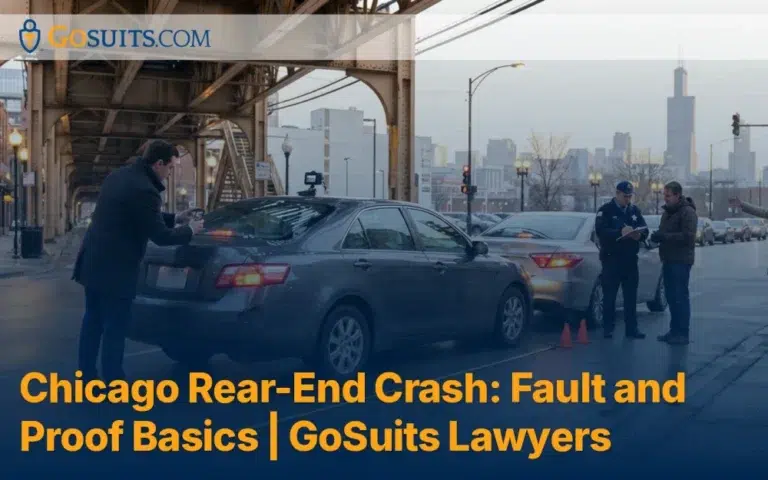
Rear end crashes in Chicago, IL often happen in dense traffic on the Kennedy, Eisenhower, Dan Ryan, and Lake Shore Drive, at busy intersections, and during lake effect weather. These conditions can complicate fault, causation, and damages because multiple vehicles, traffic signal timing, and sudden stops are common. Illinois law governs how fault is assigned and how your claim proceeds, but local practices in Cook County and the City of Chicago also matter for police reporting, crash records, and court procedures.
Illinois traffic laws require drivers to follow at a safe distance and maintain reasonable speed for conditions. Violations can be evidence of negligence in a civil case, but they do not automatically decide fault. Instead, everyone’s conduct is examined, including whether a lead driver braked suddenly, had brake lights working, or made an improper lane change. Illinois uses modified comparative negligence, which means your compensation can be reduced by your share of fault and is barred if you are more than 50 percent at fault [3].
Because the stakes include medical bills, lost income, vehicle repairs, and pain and suffering, most people want guidance from a legal professional. You do not have to navigate statutes, evidence rules, and insurance tactics alone. In conversations about strategy, we focus on building proof from day one and anticipating defenses, which is especially important in chain reaction collisions common on Chicago expressways.
How is fault determined in Illinois rear end collisions?
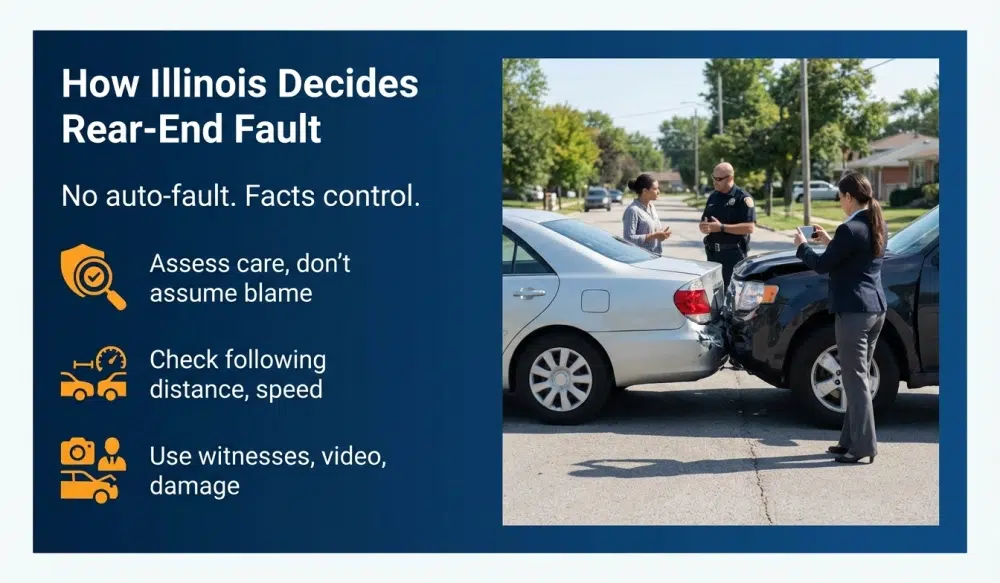
No. There is no automatic fault rule in Illinois for rear end crashes. Instead, investigators and courts look at whether a driver failed to use reasonable care. Following too closely and failing to reduce speed to avoid a collision are common theories against a rear vehicle [1] [2]. But facts can shift responsibility, such as if a lead driver reversed into a car, made a sudden unsafe lane change, stopped without functioning brake lights, or cut across lanes during congestion. Evidence from witnesses, cameras, event data recorders, and physical damage patterns helps clarify what happened.
What Illinois traffic laws apply to following distance and speed?
Two key Illinois statutes often come into play in rear end cases. The following distance law requires drivers to follow at a distance that is reasonable and prudent, considering the speed of traffic and roadway conditions [1]. The speed statute requires drivers to travel at a speed that is reasonable and proper for existing conditions, and to reduce speed when hazards exist, including heavy traffic and weather [2]. A violation of a safety statute can be used as evidence of negligence if it proximately caused the crash, but proof of violation alone does not end the case for civil liability.
How does Illinois comparative negligence work in rear end cases?
Illinois follows modified comparative negligence. If a plaintiff is 50 percent or less at fault, damages are reduced by that percentage. If a plaintiff is more than 50 percent at fault, recovery is barred [3]. This is critical in situations where a lead driver’s actions may have contributed to the crash, such as stopping abruptly to make an illegal turn or merging unsafely. For example, if a jury finds total damages of 100,000 dollars and assigns the plaintiff 20 percent of the fault, the net award becomes 80,000 dollars. If the plaintiff is 51 percent at fault, there is no recovery.
What evidence proves fault after a rear end crash in Chicago?
If anyone is hurt, call 911 first. For crashes involving injury, death, or property damage meeting state thresholds, Illinois requires a report to law enforcement and, in many cases, a written report to the Illinois Department of Transportation within set time limits [6]. In Chicago, a responding officer will usually generate a Traffic Crash Report with a unique RD or event number. This report identifies involved drivers, vehicles, insurance, roadway location, diagrams, and statements that can help in evaluating fault. You can later request a copy through official channels [15].
Beyond the police report, gather contact information for witnesses, take photos or video of positions of vehicles, debris fields, skid marks, and the status of traffic signals. Document weather, lighting, and construction zones. In heavy traffic, nearby drivers often capture relevant clips on dash cams. Preserve any available footage immediately and consider sending preservation letters to businesses, transit authorities, or agencies that may have cameras facing the roadway.

How do event data recorders, cameras, and phone records help?
Modern vehicles often contain event data recorders that can capture pre impact speed, brake usage, throttle, and seat belt status. Access and use of this data must comply with applicable federal and state laws. The federal regulation governing event data recorders specifies standardized data elements and retrieval protocols [14]. In a contested rear end crash, these datapoints can corroborate or refute claims about sudden stops, hard braking, or lack of evasive action.
Traffic and security cameras may also be available at intersections, along the L tracks, and outside businesses. In Illinois, public records requests are governed by the Freedom of Information Act. Some agencies produce records through that process, while private entities typically require a subpoena or court order. Timing matters because many systems overwrite footage quickly [6].
Phone records can show whether a driver was using a device. Illinois law restricts handheld device use and texting while driving [8]. In a civil case, call logs or data usage records can be obtained through discovery and may support claims of inattentive driving.
How do medical records link whiplash and other injuries to the crash?
Rear end impacts often cause neck and back injuries due to rapid acceleration and deceleration. Medical documentation should connect your symptoms to the collision through history, timing, exam findings, and diagnostic imaging when appropriate. Consistency across emergency department notes, primary care visits, and physical therapy records strengthens causation. Gaps in care are common after a crash because symptoms may flare later. Explain those gaps to your providers so medical notes accurately reflect the course of your recovery. Illinois law does not cap non economic damages in ordinary motor vehicle injury cases, so detailed medical records help establish the full scope of pain, suffering, and loss of normal life.
How do insurance claims and lawsuits work in Cook County?
Notify your insurer promptly. When the at fault insurer calls, you can provide basic facts, but recorded statements are often used to minimize liability. If liability is disputed, we typically coordinate communications to avoid misunderstandings. The insurer may ask for broad medical authorizations or quick settlements before you know the full extent of injuries. Illinois law on comparative negligence and evidentiary rules shape what information matters, so being deliberate in how you present facts can improve outcomes [3] [10].
If needed, car accident lawyers can handle communications, preserve evidence, and prepare a claim package with records, bills, wage loss proof, photos, and expert opinions. This helps position your case for settlement or litigation if the insurer contests fault or damages. Chicago car accident lawyers can also coordinate investigation steps unique to the city, such as requesting camera footage from local transit or municipal sources before it is overwritten.
What is the statute of limitations for Chicago car accidents and what special deadlines apply?
Most Illinois personal injury claims must be filed within 2 years of the crash date [4]. Property damage claims generally have 5 years [5]. Shorter deadlines apply when a defendant is a local public entity or employee, including municipalities. Those actions usually must be filed within 1 year [12]. Claims involving the Chicago Transit Authority are governed by the CTA Act, which sets a 1 year limitations period for civil actions against the Authority [13]. Because limitations periods are strict, early evaluation preserves your rights. If you are within months of any deadline, urgent action is needed to identify all responsible parties and file in time.
What damages can you claim and how are they calculated in Illinois?
In a civil rear end case, compensable damages can include:
- Medical expenses past and future, including emergency care, primary care, specialists, therapy, imaging, and medications.
- Lost income and diminished earning capacity if injuries affect your work.
- Pain and suffering, loss of normal life, and emotional distress.
- Property damage, towing, storage, and rental costs.
Illinois uses comparative negligence to adjust awards if a plaintiff shares fault [3]. Evidence drives valuation, including the consistency of your medical documentation, the impact on your daily activities, and objective proof such as imaging or physician opinions. For property claims, detailed repair estimates, photos, and market research can support reimbursement and, where appropriate, diminished value claims.
Who can be liable beyond the rear driver in a Chicago rear end crash?

Can an employer be liable for a rear end crash in a company vehicle?
Yes. Under respondeat superior, an employer can be responsible for an employee’s negligence committed within the scope of employment, such as a delivery driver who rear ends another car during a scheduled route. Additional theories like negligent entrustment or negligent hiring may apply when evidence shows unsafe driving history or inadequate training. Commercial policies may provide higher coverage limits than personal policies, which can be significant in cases with serious injuries.
Can the City or CTA be defendants and what deadlines apply?
Sometimes a rear end crash involves a municipal vehicle, bus, or conditions influenced by public entities. If a City of Chicago vehicle or employee is involved, the claim is subject to the Local Governmental and Governmental Employees Tort Immunity Act timelines and defenses, including the 1 year limitations period [12]. Claims against the Chicago Transit Authority must be brought under the CTA Act, which has a 1 year statute of limitations [13]. Public entity cases also involve notice, service, and immunity issues that should be assessed early.
What about chain reaction pileups on the Kennedy or Dan Ryan?
Chain reaction crashes often feature multiple impacts and complex causation. Investigations examine whether the first impact created an unavoidable hazard, whether subsequent drivers maintained safe following distance, and whether any vehicle made an unsafe maneuver that contributed to a second or third collision. Illinois comparative negligence allows fault to be apportioned among multiple drivers [3]. Evidence such as sequence of damage, paint transfer, event data recorder timing, and eyewitness accounts can help establish which impacts caused which injuries.
What defenses do insurers raise and how do courts treat them?
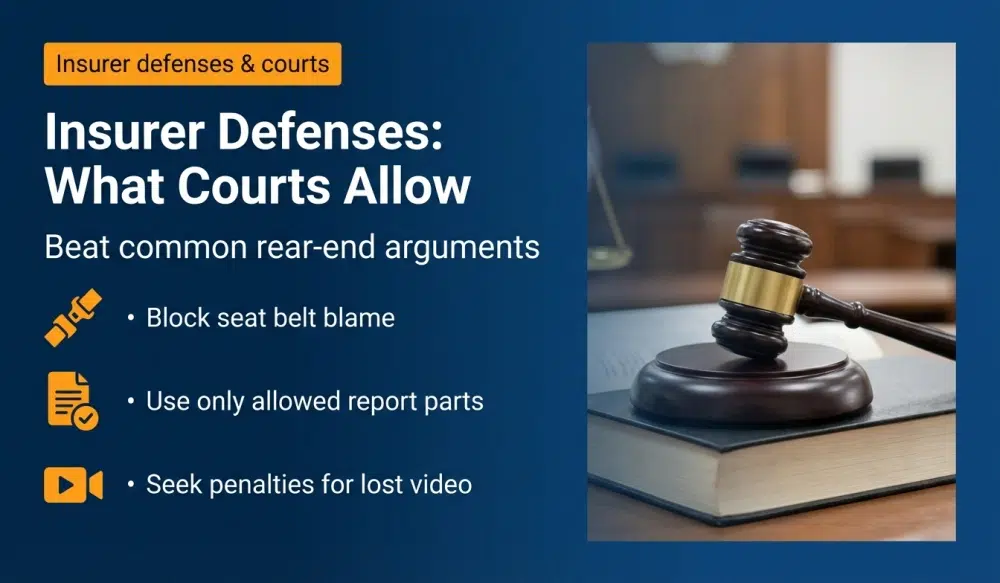
Generally, Illinois law bars admission of evidence that a person did not use a seat belt to prove negligence, to reduce damages, or to mitigate injury claims in a civil action [9]. There are limited exceptions not typically relevant to ordinary rear end claims. If an insurer insists on using seat belt evidence to reduce your recovery, this statute is a strong response and can be raised through motions in limine before trial.
Are police reports admissible in Illinois civil trials?
Police reports may be admissible if they meet the requirements of the business records or public records exceptions to hearsay, and if embedded hearsay is addressed with separate exceptions or redactions. The Illinois Rules of Evidence govern these issues, including Rules 803 and 902 for self authentication [10]. In practice, some portions of a report come into evidence while other parts, such as third party statements, may be excluded. Photographs and officer observations based on personal knowledge are often the most straightforward parts to admit.
How is spoliation of evidence handled if video is deleted?
Illinois recognizes claims for negligent spoliation under general negligence principles. A party that undertakes to preserve evidence and then loses or destroys it may face liability if that loss causes damage to a plaintiff’s underlying case [11]. Courts can also impose sanctions when a litigant fails to preserve relevant evidence after a duty attaches. In rear end cases, timely preservation letters to businesses, transit authorities, or other entities with cameras can be crucial to avoid loss of valuable footage.
What steps should you take after a rear end crash in Chicagoland?
Call 911 when there are injuries, suspected impairment, or significant damage. Illinois requires reports for crashes involving injury or death and sets thresholds for property damage that trigger reporting obligations. Drivers typically must make a written report to the Illinois Department of Transportation within 10 days if the crash meets specific criteria [6]. In Chicago, you can obtain a copy of the Traffic Crash Report online or through the Chicago Police Department’s designated system using the report number, date, and location details [15]. The report can be critical evidence for insurance and litigation.
How do you document property damage and diminished value?
Start with high resolution photos of all sides of your vehicle, close ups of each point of impact, and images showing the frame, crumple zones, and suspension when accessible. Obtain at least one detailed estimate that identifies parts and labor by line item. If repairs involve structural components, alignment, or advanced driver assist systems calibration, keep invoices and calibration reports. For newer vehicles with significant damage, a diminished value opinion may be warranted. Illinois law allows property damage claims and the statute of limitations is generally 5 years [5].
When does it make sense to file suit in the Circuit Court of Cook County?
If liability or damages remain in dispute despite your claim package and good faith negotiation, filing suit can be the next step. The Circuit Court of Cook County is the venue for most Chicago car crash lawsuits. Filing initiates formal discovery, where you can compel documents, answers under oath, inspections, and depositions to develop proof. Court rules and scheduling orders set deadlines for disclosures, expert testimony, and motion practice [16]. Many cases still resolve before trial, but preparing thoroughly as if the case will be tried often improves settlement positions.
Why should you consider GoSuits for your Chicago rear end crash claim?
Rear end collisions raise questions about fault, proof, and fair value. A free consultation can help you understand how Illinois negligence rules apply to your facts, which insurers are responsible, and what evidence will matter most. We practice throughout Chicago, Cook County, and the broader Chicagoland area, and we regularly work with local investigators, medical providers, and experts to build clear, persuasive cases.
We are a technology driven injury firm. GoSuits uses exclusive proprietary software to move cases faster and with greater clarity for clients. Our platform integrates medical records, billing, crash data, and timelines so we can spot gaps, preserve evidence sooner, and respond quickly when insurers challenge fault. Even with advanced tools, you are never routed to a call center. Every client has direct, unfettered access to a designated attorney from start to finish.
Our team brings 30 years of combined experience and a strong trial record. Jury readiness can change the way insurers evaluate your case, and we prepare each file with that in mind. We have obtained meaningful outcomes for clients in motor vehicle cases and other injury matters. You can review a selection of our past work here: prior cases. Learn more about who will represent you: our attorneys, and our approach: about us.
GoSuits handles a wide range of civil injury matters, including car, truck, motorcycle, premises, product, construction, and serious injury cases. For a fuller view of what we handle, visit our practice areas. If you were in a rear end crash and have questions about fault or proof, reach out for a free consultation to discuss your options and a plan for next steps.
References and Resources
- 625 ILCS 5/11 710 Following too closely Illinois Vehicle Code Illinois General Assembly
- 625 ILCS 5/11 601 Speed restrictions Illinois Vehicle Code Illinois General Assembly
- 735 ILCS 5/2 1116 Comparative negligence Illinois Code of Civil Procedure Illinois General Assembly
- 735 ILCS 5/13 202 Personal injury statute of limitations Illinois General Assembly
- 735 ILCS 5/13 205 Property damage statute of limitations Illinois General Assembly
- 625 ILCS 5/11 406 Motor vehicle crash reports Illinois Vehicle Code Illinois General Assembly
- Illinois Roadway Crash Data Illinois Department of Transportation
- 625 ILCS 5/12 610.2 Electronic communication devices while driving Illinois Vehicle Code Illinois General Assembly
- 625 ILCS 5/12 603.1 Seat safety belts Illinois Vehicle Code Illinois General Assembly
- Illinois Rules of Evidence Supreme Court of Illinois
- Boyd v. Travelers Insurance Co. 166 Ill. 2d 188 Illinois Supreme Court CourtListener
- 745 ILCS 10/8 101 Local Governmental and Governmental Employees Tort Immunity Act Illinois General Assembly
- 70 ILCS 3605/41 Chicago Transit Authority Act Section 41 Illinois General Assembly
- 49 CFR Part 563 Event Data Recorders Electronic Code of Federal Regulations
- Traffic Crash Reports Chicago Police Department
- Circuit Court of Cook County Official Website